






Deregulated Energy
Deregulated energy gives consumers the right to choose their own electricity and natural gas supplier — breaking the monopoly hold of local utilities and introducing real competition. In deregulated states, your local utility still delivers energy and handles outages, but who you buy that energy from is entirely your choice. At Utility Search Marketplace, we help you compare suppliers, find the best available rate, and switch — all in minutes.
- 13 states + Washington, D.C. have residential electricity choice — you pick your supplier.
- Your local utility still delivers the power and handles outages; only your supplier changes.
- Texas, Ohio, Pennsylvania, and Illinois are the most competitive markets.
- Switching is free, takes minutes, and never interrupts your service.
- Not deregulated? Your internet is always a choice — compare providers at your address.
Which states let you choose your electricity provider?
As of 2026, 13 states plus Washington, D.C. have residential electricity choice, meaning you can shop competing suppliers for your energy rate while your local utility still delivers the power. Texas has the most competitive market, followed by Ohio, Pennsylvania, and Illinois. Here are the deregulated-energy states and the utility that delivers power in each.
| State | Electricity choice | Local utility (delivers power) |
|---|---|---|
| Texas | Full retail choice | Oncor, CenterPoint, AEP |
| Ohio | Retail choice | AEP, FirstEnergy, Duke, AES |
| Pennsylvania | Retail choice | PECO, PPL, Duquesne, FirstEnergy |
| Illinois | Retail choice | ComEd, Ameren |
| New York | Retail choice | Con Edison, National Grid, NYSEG |
| New Jersey | Retail choice | PSE&G, JCP&L, Atlantic City Electric |
| Maryland | Retail choice | BGE, Pepco, Delmarva |
| Massachusetts | Retail choice | Eversource, National Grid |
| Connecticut | Retail choice | Eversource, United Illuminating |
| Maine | Retail choice | Central Maine Power, Versant |
| New Hampshire | Retail choice | Eversource, Unitil, Liberty |
| Rhode Island | Retail choice | Rhode Island Energy |
| Delaware | Retail choice | Delmarva Power |
| Washington, D.C. | Retail choice | Pepco |
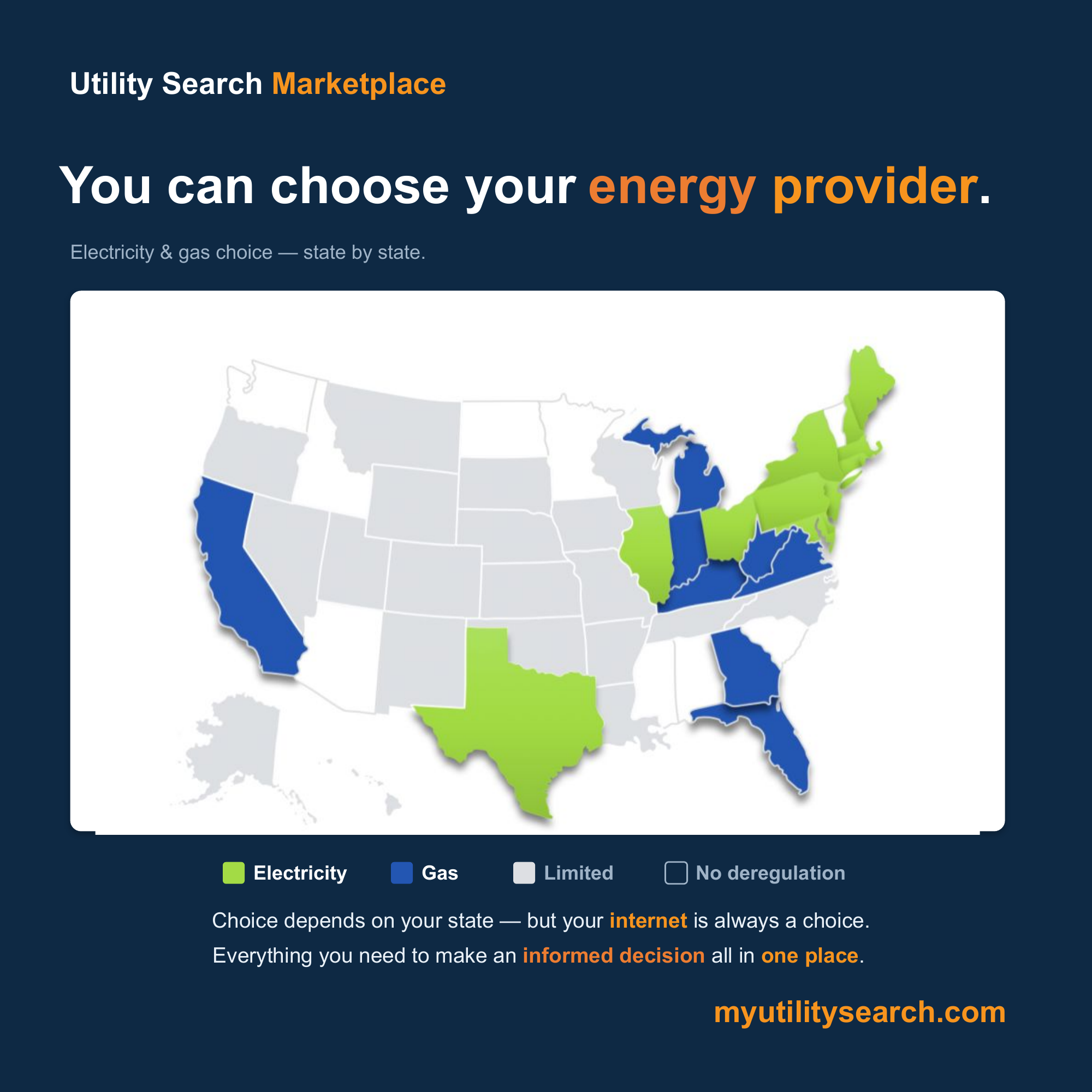
Choose Your State
Select your state below to see the specific energy suppliers, internet providers, and home services available at your address:
- 🤠 Texas — Most competitive energy market in the US. 100+ REPs on the ERCOT grid.
- 🏙️ Ohio — Fully deregulated for electricity and natural gas. AEP Ohio, FirstEnergy, Duke Energy territories.
- 🔔 Pennsylvania — Full deregulation under PECO, PPL, West Penn Power, Met-Ed, and Penelec.
- 🏙️ Illinois — ComEd (Chicago) and Ameren Illinois — electricity and gas fully shoppable.
- 🗽 New York — Con Edison, National Grid, NYSEG, and RG&E territories. High rates = high savings.
- 🌊 New Jersey — Highest rates in the continental US. PSE&G, JCP&L, and Atlantic City Electric territories.
- 🌿 Connecticut — Eversource and United Illuminating. Among the highest rates in the US.
- 🦀 Maryland — BGE, Pepco, Delmarva Power, and Potomac Edison. DC suburb market with strong ISP competition.
- 🦞 Massachusetts — Eversource and National Grid. High New England rates with solid Boston ISP competition.
- 🚗 Michigan — Natural gas deregulation through Consumers Energy and DTE. Shop your gas supplier.
- 🍑 Georgia — Natural gas deregulation through Atlanta Gas Light. AT&T Fiber strong in Atlanta.
- 🏔️ New Hampshire — Eversource and Unitil territories. High New England rates with rural Starlink options.
What is deregulated energy?
In a regulated energy market, your local utility is the only company allowed to sell you electricity or gas. In a deregulated market, multiple licensed suppliers compete for your business — and you get to choose. Think of it like switching car insurance or choosing a wireless carrier: the infrastructure (wires, pipes) stays the same, but who charges you for the energy flowing through them is open to competition. For national market data, see the U.S. Energy Information Administration.
The United States has 15 states with meaningful electricity or natural gas deregulation. In most of these states, both electricity and gas are shoppable. Together, these markets represent some of the best opportunities for household savings in the country.
How Switching Works
- Find your utility and current rate — Check your bill to identify your delivery utility and what you’re currently paying per kWh or therm.
- Compare suppliers at your address — Use Utility Search Marketplace to see licensed supplier offers at your zip code.
- Choose a fixed-rate plan — Lock in a rate below your utility’s default for 6–24 months.
- Enroll in minutes — Online enrollment takes under 10 minutes. You’ll need your utility account number.
- No service interruption — Your utility continues delivering energy. Only the supply charge on your bill changes.
Beyond Energy: Bundle and Save More
At Utility Search Marketplace, we help you compare more than just electricity. In every deregulated energy market, you can also shop:
- 🌐 Internet providers — Compare fiber, cable, and 5G home internet options at your address
- 🔐 Home security — Vivint, ADT, Ring, SimpliSafe, and more
- 🏠 Home warranty — Choice Home Warranty, American Home Shield, and others
- 🛡️ Home insurance — Compare rates from multiple carriers
The average household that actively shops and optimizes all four services saves $500–$1,000+ per year compared to accepting default rates across the board.
Deregulation: a state policy that lets you buy energy from competing suppliers instead of a single utility. Price to Compare: your utility’s default supply rate — the number a competitive plan should beat. EFL (Electricity Facts Label): the standardized disclosure (Texas) showing a plan’s per-kWh price, term, and fees.
The other 37 states are regulated — but your internet is still a choice
In regulated states, one utility sets the electricity rate and there is no supplier to shop. But no matter where you live, you can still compare high-speed internet providers and home security at your address — so you never overpay on the essentials.
Frequently asked questions
What does deregulated energy mean?
Deregulated energy means you can choose your own electricity or natural gas supplier instead of being locked into your local utility’s rate. Your utility still delivers the energy and fixes outages; you just pick who you buy it from.
Which states have deregulated electricity?
Thirteen states plus Washington, D.C. — Texas, Ohio, Pennsylvania, Illinois, New York, New Jersey, Maryland, Massachusetts, Connecticut, Maine, New Hampshire, Rhode Island, and Delaware — have residential electricity choice.
Does switching electricity suppliers interrupt my service?
No. Switching only changes who supplies your energy. The same utility keeps delivering power over the same lines, so there is no interruption and no new equipment.
How do I find the cheapest electricity rate?
Compare the per-kWh price and fees on each plan against your utility’s Price to Compare, and watch for teaser rates that jump after a few months. Enter your ZIP above to compare available plans.
Is my state deregulated?
Check the list above. If your state isn’t listed, electricity is regulated where you live — but you can still compare internet and home security providers at your address.