




Deregulated Energy in Pennsylvania: Compare Electricity, Internet & Home Services
By Chris Burg, founder of MyUtilitySearch
Last updated September 28, 2026 · Price to Compare figures are the Pennsylvania PUC’s June 1, 2026 rates, read from the Commission’s own releases.
PA Power Switch is the Pennsylvania Public Utility Commission’s official electricity shopping site. It lists every licensed supplier serving your utility territory next to your utility’s Price to Compare — the rate you pay if you never shop. As of June 1, 2026 that benchmark ranges from 11.759¢ per kWh at PECO to 14.14¢ at Duquesne Light, a 20% spread decided by nothing but your address.
Comparing deregulated energy Pennsylvania suppliers is how smart residents save hundreds every year. Pennsylvania is one of the most consumer-friendly deregulated energy states in the country. Since deregulation in 1997, Pennsylvania residents across PECO, PPL, West Penn Power, Met-Ed, Penn Power, and Penelec territories have had the right to choose their own Electric Generation Supplier (EGS) and natural gas supplier. Despite nearly three decades of market availability, millions of Pennsylvania households are still on their utility’s default Price to Compare. This guide covers how Pennsylvania deregulated energy works, which suppliers to consider in 2026, and how to bundle internet and home security savings at the same time.
Pennsylvania Energy Deregulation: How It Works
Pennsylvania deregulated its electricity market under the Electricity Generation Customer Choice and Competition Act of 1997. Your electric distribution company (EDC) — PECO, PPL, West Penn Power, Met-Ed, Penn Power, or Penelec — still owns the wires, handles delivery, and manages outages. What you can shop is the generation or supply portion of your bill, provided by a licensed Electric Generation Supplier (EGS) regulated by the Pennsylvania Public Utility Commission (PUC). The PUC maintains PAPowerSwitch.com where you can compare licensed EGS offers by zip code against your utility’s current Price to Compare.
PECO Territory: Philadelphia and Eastern Pennsylvania
PECO serves Philadelphia, Delaware County, Montgomery County, Chester County, and Bucks County. It is the largest electric utility in Pennsylvania by population served and has one of the strongest competitive EGS markets in the state. Residents in the PECO territory have access to a wide range of supplier offers, and Verizon Fios coverage in the Philadelphia suburbs makes this territory one of the best dual-shopping markets in the northeast.
PPL Territory: Central and Eastern Pennsylvania
PPL serves Allentown, Bethlehem, Harrisburg, Scranton, Wilkes-Barre, State College, and surrounding communities in central and eastern Pennsylvania. PPL territory has solid EGS competition from national suppliers including Constellation, Direct Energy, and Spark Energy. The PPL Price to Compare is published quarterly and should always be your baseline for evaluating supplier offers.
West Penn Power Territory: Pittsburgh Suburbs and Western Pennsylvania
West Penn Power (a FirstEnergy subsidiary) serves the Pittsburgh suburbs and western Pennsylvania counties. EGS competition in this territory tends to be slightly lower than in PECO or PPL, but national suppliers like Constellation and Direct Energy are consistently available. Frontier Fiber’s expansion in western Pennsylvania makes this an interesting market for simultaneous internet and energy shopping.
PA Power Switch: what the PUC’s shopping site actually shows
PA Power Switch (papowerswitch.com) is the official electric shopping website of the Pennsylvania Public Utility Commission. You enter a ZIP code, it lists every licensed supplier enrolling customers in your utility’s territory, and it shows each offer’s price per kWh, whether the rate is fixed or variable, the contract length, and any cancellation fee. PA Power Switch is free, it is run by the state, and it is the only place where the offers are presented without a sales agenda.
What PA Power Switch does not tell you is which utility territory you are in, why that matters more than any supplier, or how to tell a good offer from a trap. That is what this page adds to PA Power Switch.
Definition: the Price to Compare
Your Price to Compare (PTC) is the per-kWh rate your electric distribution company charges for generation and transmission if you never choose a supplier. It is printed on your bill and it is the number every PA Power Switch offer should be measured against. A supplier rate below your PTC saves money; a rate above it costs money. Distribution charges stay with your utility no matter who supplies your power. Most Pennsylvania utilities reset the PTC on June 1 and December 1; PECO and Duquesne Light also adjust quarterly.
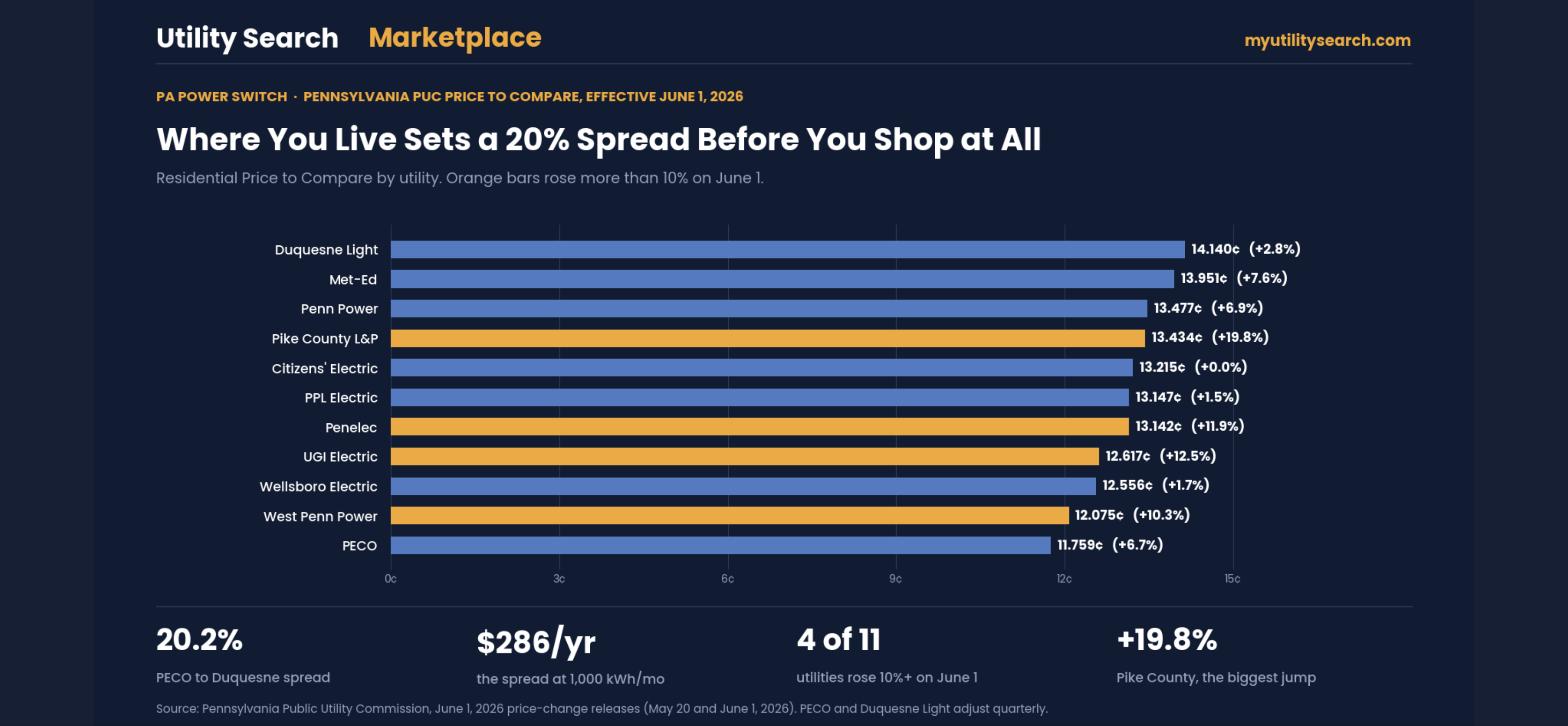
Pennsylvania Price to Compare by utility, effective June 1, 2026
Pennsylvania has eleven electric distribution companies and each one sets its own Price to Compare. The PUC publishes the full list twice a year. Here is the June 1, 2026 set that PA Power Switch offers are measured against, with the change from the previous period.
| Utility | Price to Compare | Change on June 1 | Supply cost at 1,000 kWh/mo |
|---|---|---|---|
| Duquesne Light | 14.140¢ | +2.8% | $141.40 |
| Met-Ed | 13.951¢ | +7.6% | $139.51 |
| Penn Power | 13.477¢ | +6.9% | $134.77 |
| Pike County Light & Power | 13.434¢ | +19.8% | $134.34 |
| Citizens’ Electric | 13.215¢ | 0.0% | $132.15 |
| PPL Electric | 13.147¢ | +1.5% | $131.47 |
| Penelec | 13.142¢ | +11.9% | $131.42 |
| UGI Electric | 12.617¢ | +12.5% | $126.17 |
| Wellsboro Electric | 12.556¢ | +1.7% | $125.56 |
| West Penn Power | 12.075¢ | +10.3% | $120.75 |
| PECO | 11.759¢ | +6.7% | $117.59 |
What the June 2026 numbers reveal about shopping in Pennsylvania
Three things stand out once all eleven utilities sit in one table. None of them is visible from your own bill or from a single PA Power Switch search.
1. Your address sets the benchmark before you shop at all
The gap between the cheapest and most expensive Price to Compare in Pennsylvania is 20.2% — 11.759¢ at PECO against 14.14¢ at Duquesne Light. At 1,000 kWh a month that is $23.81 every month, or about $286 a year, decided entirely by which utility’s wires reach your house. A Pittsburgh household on Duquesne starts the year $286 behind a Philadelphia household on PECO, before either one opens PA Power Switch.
2. June 1 hit the FirstEnergy and rural territories hardest
Four utilities raised the Price to Compare by more than 10% on June 1: Pike County (+19.8%), UGI Electric (+12.5%), Penelec (+11.9%) and West Penn Power (+10.3%). Met-Ed and Penn Power rose 6.9–7.6%. PPL, Duquesne, Citizens’ and Wellsboro barely moved. If your utility is in the first group, the default rate you were paying in May is not the rate you are paying now, and the PA Power Switch math has changed with it.
3. Pennsylvania households pay above the national average; businesses pay below it
According to the U.S. Energy Information Administration’s 2024 state data, Pennsylvania residential customers paid 17.77¢ per kWh all-in against a 16.48¢ national average — 7.8% above. Commercial customers paid 11.03¢ against 12.75¢ nationally, 13.5% below. A Pennsylvania business pays about 38% less per kWh than a Pennsylvania home. That gap is why the commercial section below exists.
How to read a PA Power Switch offer in sixty seconds
Five fields decide whether an offer on PA Power Switch is worth taking. Check them in this order:
- Rate type. Fixed or variable. A variable rate can change monthly after any introductory period. Unless you actively want to track the market, stop at fixed.
- Price per kWh against your Price to Compare from the table above. Below it, keep reading. At or above it, move on.
- Term length. A 6-month fixed rate means shopping again in six months. A 12- or 24-month term locks the saving through the next PTC reset.
- Cancellation fee. Pennsylvania suppliers may charge one on fixed terms. It is acceptable on a long term, not on a short one.
- Introductory price. If PA Power Switch flags an offer as introductory, the number you are comparing is temporary.
One more thing the PUC itself has begun saying out loud: on September 10, 2026 the Commission voted unanimously to open a Ratemaking Working Group (Docket M-2026-3064953) to examine return on equity, settlement transparency and the distribution surcharge, citing rising costs and customer payment defaults. That is the regulator acknowledging that the non-shoppable part of your bill is the problem too.
Top Electricity Suppliers in Pennsylvania for 2026
Constellation Energy
Constellation is available across all major Pennsylvania utility territories and is consistently one of the most competitive EGS providers in the state. Fixed-rate plans in 6, 12, and 24-month terms are available, along with renewable energy options and combined electric and gas supply for households on deregulated gas service. Constellation’s transparent pricing and strong customer service record make it a reliable choice for Pennsylvania energy shoppers.
Direct Energy
Direct Energy competes actively in PECO and PPL territories and frequently offers some of the most competitive fixed rates in the Pennsylvania market. Their 12-month fixed plans are popular. Verify that the advertised rate is for the full contract term, not an introductory rate that steps up after a few months.
Spark Energy
Spark Energy is a solid no-frills option in the PPL territory with competitive fixed rates and a straightforward pricing structure. They are particularly useful for Pennsylvania residents who want a simple fixed rate without complicated bill credits or base charges that can obscure the true effective cost per kWh.
Pennsylvania Natural Gas Deregulation
Pennsylvania natural gas supply is also deregulated through PECO, Peoples Natural Gas, National Fuel Gas, and UGI. Most Pennsylvania homes rely on natural gas for heat, making Pennsylvania natural gas deregulation one of the most valuable shopping opportunities in the state. Fixed-rate gas supply plans are available from suppliers including Constellation, XOOM Energy, and IGS Energy. Locking in a fixed gas rate before the winter heating season protects against wholesale price spikes common during cold Pennsylvania winters.
Internet Providers in Pennsylvania: Compare by Region
Philadelphia and Eastern Pennsylvania Internet
The Philadelphia suburbs have some of the best internet infrastructure in the country. Verizon Fios provides extensive fiber coverage across Montgomery, Delaware, Chester, and Bucks Counties with symmetrical gigabit speeds and no data caps. Xfinity (headquartered in Philadelphia) provides dominant cable coverage statewide. For many PECO territory residents, the Verizon Fios vs Xfinity comparison is one of the best internet competitions in the country — both offer strong service at competitive prices.
Pittsburgh and Western Pennsylvania Internet
The Pittsburgh metro has Xfinity cable coverage as the dominant option, with Frontier Fiber expanding in the area as a competitive fiber alternative. AT&T has some presence in Pittsburgh, and T-Mobile Home Internet provides a no-contract 5G alternative across the region. Starlink is the best option for rural western and central Pennsylvania where cable and fiber are unavailable.
Home Security in Pennsylvania
Vivint and ADT both operate throughout Pennsylvania. For Pennsylvania homeowners managing both electricity and gas costs, the Vivint smart thermostat provides a meaningful energy management layer — automatically optimizing heating and cooling to reduce consumption. Paired with a competitive EGS electricity plan and a fixed-rate gas supplier, the combined effect on your total annual energy spend is significant, particularly in a state with cold winters and variable energy prices.
Pennsylvania Bundle Savings Estimate
- ⚡ Electricity (EGS switch): Beat your utility’s Price to Compare — save $10–$25/month ($120–$300/year)
- 🔥 Natural gas (competitive supplier): Lock in a fixed supply rate before winter — save $15–$30/month in heating season
- 🌐 Internet: Verizon Fios vs Xfinity vs Frontier in your area — save $20–$40/month ($240–$480/year)
- 🔐 Home security: Compare Vivint vs ADT — save $10–$25/month
Total potential annual savings for a Pennsylvania household: $400–$900+
PA Power Switch for businesses
PA Power Switch serves business customers as well as households: the shopping tool offers a commercial path, and the PUC publishes consumer protections for small business accounts. Small commercial customers on a utility’s default service are hit by the same June 1 and December 1 resets as residential customers, and in 2026 the increases landed on both.
Pennsylvania businesses already pay well below the national average. Commercial power in the state runs 11.03¢ per kWh against a 12.75¢ U.S. commercial average, while Pennsylvania households pay 17.77¢. A Pennsylvania business pays about 38% less per kWh than a Pennsylvania home — and the national gap is only 23%.
Where PA Power Switch stops being useful is at scale. Once a business has meaningful load, suppliers stop quoting from a rate card and price off your interval data: twelve months of usage from your meter, your load factor, and the forward curve on the day you sign. Two identical storefronts on the same street can get different numbers. A published chart cannot show you that price, which is why larger accounts are quoted rather than shopped.
If you are comparing multi-site or multi-state supply, our commercial electricity rates by state breakdown shows where Pennsylvania sits against the other retail-choice markets.
Frequently Asked Questions: Pennsylvania Deregulated Energy
How do I find my utility’s current Price to Compare in Pennsylvania?
Visit PAPowerSwitch.com — the official Pennsylvania PUC comparison tool — and enter your zip code. The site shows your utility’s current Price to Compare alongside licensed EGS offers for your territory. You can compare rates side by side and enroll directly through the platform or through individual supplier websites.
Can Pennsylvania apartment residents switch electricity suppliers?
Yes, if the electric account is in your name. Pennsylvania renters who are billed directly for electricity have full access to the EGS market. If electricity is included in your rent, the building owner controls the account.
What is the best time to shop for electricity in Pennsylvania?
Spring (March through May) is typically the best time to lock in a fixed-rate EGS plan in Pennsylvania. Wholesale electricity prices tend to be lower during mild spring weather, before summer cooling demand pushes rates higher. Shopping in spring maximizes your chance of locking in a below-average rate for the year ahead.
Is PA Power Switch run by the state?
Yes. PA Power Switch is published by the Pennsylvania Public Utility Commission at papowerswitch.com. Suppliers must be licensed by the PUC to appear, and they are responsible for the accuracy of their own listings. It is a state-run list of offers, not an endorsement of any one of them.
Which Pennsylvania utility has the highest Price to Compare?
As of June 1, 2026, Duquesne Light in Pittsburgh has the highest residential Price to Compare at 14.14¢ per kWh, and PECO in Philadelphia has the lowest at 11.759¢. That 20% spread is worth about $286 a year at 1,000 kWh a month, before anyone shops.
When does the Price to Compare change in Pennsylvania?
Most Pennsylvania utilities reset the Price to Compare on June 1 and December 1, and the PUC publishes the new figures a few days before each change. PECO and Duquesne Light adjust quarterly. A fixed-rate PA Power Switch contract that runs past the next reset is how shoppers avoid the jump.
Sources
- Pennsylvania Public Utility Commission — Consumer Reminder: Summer Electric Price Changes Begin Today, June 1, 2026 (final Price to Compare by utility).
- Pennsylvania Public Utility Commission — PUC Alerts Consumers to June 1 Electric Price Changes, May 20, 2026 (prior-period rates and percentage changes).
- Pennsylvania Public Utility Commission — PUC Launches Review of Utility Ratemaking, September 10, 2026.
- Pennsylvania Public Utility Commission — PA Power Switch, the official electric shopping site.
- U.S. Energy Information Administration — Electric Sales, Revenue, and Average Price, Table 4, 2024 data (Pennsylvania and U.S. average retail price by sector).
Price to Compare figures are the PUC’s published June 1, 2026 rates and are shown with that period. PECO and Duquesne Light adjust quarterly and every utility resets on December 1; confirm the figure on your own bill before you enroll. Supplier offers on PA Power Switch change daily.
Also compare internet, home security and home warranty at your address
Internet, home security and home warranty plans for your address.
Are you a commercial customer?
Business and multi-site electricity accounts are quoted individually by load, term and utility zone rather than from a posted rate. Talk to a commercial energy specialist at 855-712-5521, or for business internet, phones and IT at your location, our business desk at BOX by TechGuidance pulls every serviceable connection for your address.