




Home Security
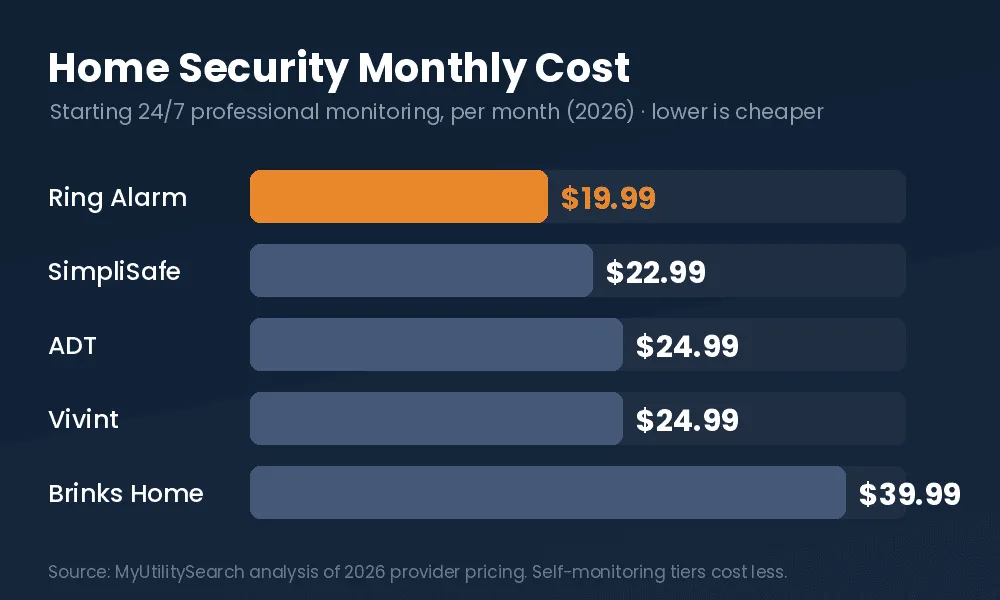
Home security systems in 2026 range from $5–$10/month DIY kits you install yourself (Ring, SimpliSafe, Wyze) to fully installed, professionally monitored smart-home systems (ADT, Vivint) that run $25–$60/month. The best home security system for you comes down to three questions: do you want 24/7 professional monitoring or self-monitoring, will you accept a contract, and how much do you want to install yourself? Compare the top providers below by monthly price, contract, and who each is best for.
Key takeaways
- Cheapest monitoring: Ring ($4.99 self / $19.99 pro) and SimpliSafe ($9.99–$22.99) lead on price — and neither requires a contract.
- Best smart home: Vivint has the most advanced connected-home tech, but locks you into a 42–60 month contract and $1,000+ in equipment.
- Most trusted brand: ADT — 145+ years and nationwide professional monitoring, now with an optional no-contract DIY line (ADT Self Setup).
- No contract / DIY: SimpliSafe, Ring, and Frontpoint install in minutes and cancel anytime.
- $0/month is possible: Ring, SimpliSafe, and Wyze all work self-monitored — sirens and phone alerts with no monthly fee.
Compare the best home security systems (2026)
Here is how the top six home security systems compare on monthly monitoring, upfront equipment, contract, and installation. Figures are 2026 starting prices; monitoring scales up as you add cameras and smart devices.
| Provider | Monitoring /mo | Upfront | Contract | Install | Best for |
|---|---|---|---|---|---|
| ADT | $24.99–$60.99 (DIY Blu from $9.99) | From $269 | 36 mo (pro) | Pro or DIY | Most trusted, pro-monitored brand |
| Vivint | $24.99–$49.99 | $599–$2,000+ | 42–60 mo | Pro only | Best smart-home ecosystem |
| SimpliSafe | $9.99–$32.99 | Kits from ~$250 | None | DIY | Best overall DIY, no contract |
| Ring Alarm | $4.99–$19.99 | Kits from ~$100 | None | DIY | Budget + Alexa smart homes |
| Frontpoint | $4.99–$49.99 (tiered) | Equipment separate | None | DIY | DIY with premium support |
| Brinks Home | $39.99–$54.99 | Sold separately | 36 mo | Pro or DIY | Established brand, 30-day risk-free |
How to choose a home security system
Beyond price, weigh these factors when picking home security systems — they decide how well the system actually protects you and how locked-in you are:
- Monitoring type. Professional monitoring means a 24/7 center dispatches police, fire, or medical for you; self-monitoring sends alerts to your phone and you decide what to do.
- Contract & cancellation. DIY brands are month-to-month; ADT pro-install runs 36 months and Vivint 42–60 months, with early-termination fees that can top $700.
- Cellular backup. A system that stays online over cellular keeps working if an intruder cuts your internet or power — standard on SimpliSafe and Brinks, optional on cheaper tiers.
- Installation. DIY (SimpliSafe, Ring, Frontpoint) avoids install fees; professional install (ADT, Vivint) typically adds $99–$199 but removes the setup work.
- Smart-home fit. Vivint leads on proprietary automation; Ring and SimpliSafe integrate best with Alexa and everyday smart devices.
- Total 3-year cost. Add equipment + monthly monitoring across the contract — a “cheap” monthly can hide a pricey system, and a pricey brand can be reasonable over time.
The top home security providers, reviewed
Each provider below links to our full, independent review with plans, real costs, and pros and cons.
ADT — best trusted brand (with an optional DIY path)
ADT is the most recognized name in home security, with 145+ years and the largest professional-monitoring network in the U.S. Professional-install plans run $24.99–$60.99/month on a 36-month agreement, while the newer ADT Self Setup DIY line starts at $9.99/month with no contract. Best for homeowners who want a proven, professionally monitored brand. Read the full ADT Home Security review →
Vivint — best smart home
Vivint builds the most polished connected-home system: a Smart Hub panel, AI “Smart Deter” cameras, smart locks and thermostats, all professionally installed and calibrated. Monitoring is $24.99–$49.99/month, but equipment runs $599–$2,000+ and contracts stretch 42–60 months. Best for homeowners investing in full automation long-term. Read the full Vivint review → · Vivint vs. ADT compared →
SimpliSafe — best overall DIY
SimpliSafe pairs robust hardware (glass-break, smoke, CO, cellular backup) with no contracts and easy DIY setup. Self-monitoring with camera recording is $9.99/month; 24/7 professional monitoring is $22.99 (Standard) or $32.99 (Core, with video verification). Best for DIY buyers who want serious protection without a contract. See Ring Alarm vs. SimpliSafe →
Ring Alarm — best budget & Alexa
Ring is the cheapest way in: tool-free setup, deep Amazon/Alexa integration, and a huge camera and doorbell ecosystem. Self-monitoring is about $4.99/month; full professional monitoring with cellular backup is $19.99/month, no contract. Best for budget buyers already in the Alexa ecosystem. Ring vs. SimpliSafe →
Frontpoint — best DIY support
Frontpoint offers quick DIY install with full professional monitoring and highly rated customer service. Plans are tiered from a $4.99 in-app safety button up to $49.99 Ultimate, month-to-month with no cancellation fees. Best for DIY buyers who value premium support over the rock-bottom price. Read the full Frontpoint review →
Brinks Home — established brand, risk-free trial
Brinks Home runs on the Alarm.com platform with a touchscreen hub, cameras, smart locks, and cellular backup, all professionally monitored. Monitoring is $39.99–$54.99/month on a 36-month contract, backed by a 30-day money-back guarantee — a middle ground between ADT and Vivint. Read the full Brinks review →
See which providers actually serve your address
DIY vs. professional monitoring — and going fee-free
Professional monitoring (ADT, Vivint, Brinks, plus paid tiers on the DIY brands) means a monitoring center dispatches help even when you can’t. Self-monitoring routes alerts to your phone with an audible siren and $0 monthly — enough to deter most opportunistic break-ins. If you travel often or live in a higher-crime area, a $10–$20/month pro plan is worth it. See our roundup of the best home security systems with no monthly fee. Also watch out for high-pressure, door-to-door alarm sales — the Federal Trade Commission warns these often lock buyers into overpriced long-term contracts.
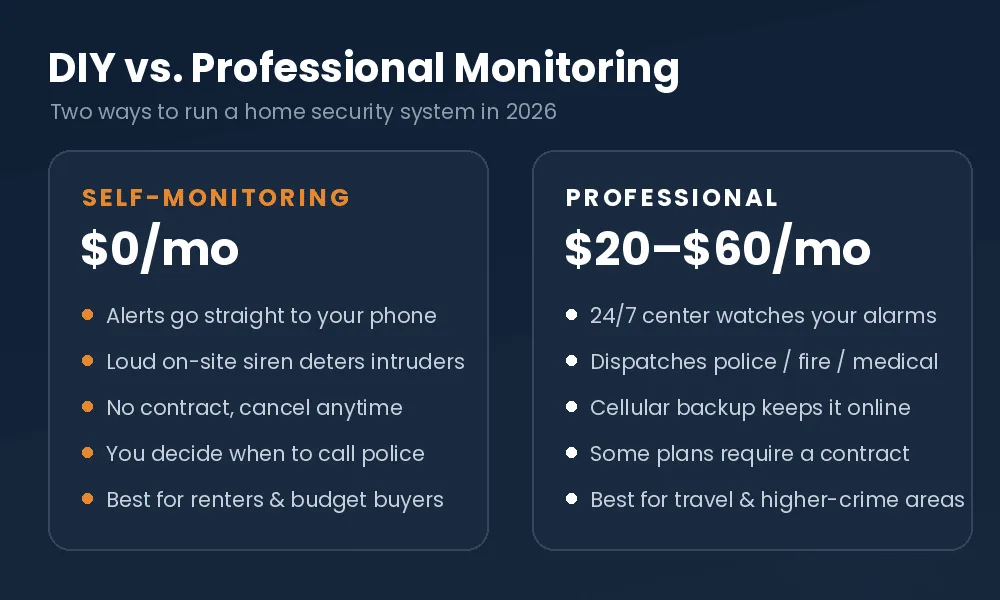
Professional monitoring: a 24/7 center watches your alarms and dispatches police/fire/medical. Self-monitoring: alerts go to your phone; you respond. Cellular backup: keeps the system online if internet or power is cut. Early-termination fee (ETF): what you owe for canceling a financed/contract plan early.
Do you still need a landline? (No.)
Modern home security systems monitor over cellular and Wi-Fi, not copper phone lines — and the old copper landline network is being retired nationwide, so cellular backup is now the standard for staying connected. If you’re still on a copper line, here’s what the AT&T POTS line shutdown means for your alarm.
Frequently asked questions
Do home security systems still require long contracts?
No. DIY systems (SimpliSafe, Ring, Frontpoint) are contract-free and month-to-month. Vivint still requires 42–60 months when you finance equipment, and ADT’s professional-install plans typically run 36 months.
Can I run a home security system with no monthly fee?
Yes. Self-monitored systems like Ring, SimpliSafe, and Wyze send alerts straight to your phone with audible sirens and $0/month. You can add professional monitoring later if you want 24/7 dispatch.
How much does professional monitoring cost per month?
It ranges widely in 2026: Ring from $19.99, SimpliSafe $22.99–$32.99, ADT $24.99–$60.99, Vivint $24.99–$49.99, and Brinks $39.99–$54.99.
Is self-monitoring enough?
For most households, yes — visible equipment and loud sirens deter the opportunistic break-ins that make up most burglaries. If you travel a lot or want guaranteed dispatch, pay for professional monitoring.
What happens to my system if I move?
DIY wireless systems (Ring, SimpliSafe, Frontpoint) come with you easily, which is ideal for renters. ADT offers a Mover’s Guarantee, and Vivint can transfer service, though that depends on your contract.
Ring or SimpliSafe — which is better?
Ring wins on price and Alexa integration; SimpliSafe wins on hardware quality and monitoring (video verification and cellular backup on more plans). Budget buyers lean Ring; reliability-first buyers lean SimpliSafe.
What home security actually costs in 2026
Two numbers decide the real cost of a home security system, and only one of them appears in the advertising. The first is equipment. The second is the monthly fee, which keeps arriving long after the kit is paid off, and which varies far more between brands than the hardware does.
We priced the camera side of this across six brands from each company’s own plan page. Three years of whole-home cloud storage ranged from $0 on a local-storage eufy system to $648 on Arlo Secure Plus, with Ring, Wyze and Google all landing within a dollar of each other around $300. The full breakdown is in our guide to the best home security cameras, and the pattern holds for full systems too: competition has flattened the subscription far more than it has flattened the hardware.
Professional monitoring sits on top of that. It is the part you are really buying when you choose a monitored provider over a DIY kit, because it is the only thing that sends a human when the alarm goes off at 3am. Our home security cost breakdown walks through what each tier includes.
The practical rule: add up 36 months of monitoring before you compare two systems. A cheaper panel with a dearer plan is usually the more expensive choice by year two.
When you actually need this, according to the data
Security gets sold on fear, and fear has poor timing. The federal numbers are worth knowing before you buy.
Property crime is falling. The FBI’s First Look: 2025 Crime Data, released in May 2026 and covering 96% of the US population, reported property crime down an estimated 12.4% from 2024 to 2025. And burglary is not a winter crime: the Bureau of Justice Statistics’ canonical seasonality study found household burglary peaks in July, roughly 22% above the annual average, and bottoms out in February.
The exception is parcels. Roughly 37 million packages are stolen from doorsteps each year, the average one worth about $222, and deliveries roughly triple between October and December. That is a genuine seasonal risk, and it is the one a camera or a locked receptacle actually addresses — we cover the claim process and the prevention data in what to do when a package is stolen.
So buy for the right threat. If the worry is a break-in, the risk peaks in midsummer and the trend is downward. If the worry is parcels disappearing, December is exactly the right time to act.
What happens when you check a real address
Home security is less portable than it looks. Professional monitoring is licensed and sold through dealers, so which companies will actually install and monitor at your address genuinely varies street by street — a provider that dominates the reviews may not sell where you live.
Three other things resolve only at the address. Your upload speed decides whether several cameras can stream at once without ruining the wifi. Whether you own or rent decides what can be drilled into a wall or mounted outside. And in a deregulated market, the electricity running all of it is something you may be able to shop separately.
That is the check this page runs: enter the ZIP and you see the providers that can serve you, rather than a national ranking that may not apply.
See which providers actually serve your address
Sources
Crime figures come from the FBI’s First Look: 2025 Crime Data (released May 13, 2026) and the US Department of Justice, Bureau of Justice Statistics, Crime and Seasonality, the canonical federal study of when property crime happens — note its data is drawn from 1973–77 and describes the long-run structural pattern rather than a current forecast.
Package theft volume and value are from Security.org’s 2025 Package Theft Annual Report (survey of 3,307 US adults, October 2025) and the US Postal Service Office of Inspector General’s report RISC-WP-25-002, May 2025. Subscription pricing was read from each brand’s own plan page in September 2026. For guidance on alarm-company sales practices, the FTC’s consumer pages are the authority.
Last updated September 25, 2026.