Blog
Stolen Package? What to Do in the First 48 Hours — and the Data on What Actually Stops the Next One

13 min read
A stolen package is now one of the most common property crimes in the United States, and one of the least reported. Roughly 37 million packages are taken from doorsteps each year, the average one is worth about $222, and fewer than one victim in four ever tells the police. If a parcel has just vanished from your porch, the next 48 hours decide whether you get your money back.
The short answer
Wait a few hours before assuming the worst — carriers frequently scan a parcel as delivered before it physically arrives. Check every door, the bushes, the garage, and with neighbours. Then file with the retailer, not the carrier: in almost every case the seller is the party that owes you a replacement or refund, because the contract is with them.
After that, file a police report even though most people do not. It costs ten minutes, it is often required before a retailer will pay out on a high-value item, and it is the only reason a stolen package ever appears in crime data at all.
What matters most: the deterrents that measurably work are boring ones — a visible camera, a locked receptacle, or simply not letting the parcel sit outside. What does not work, and can land you in prison, is building a trap.
Stolen package? What to do in the first 48 hours
Work through these in order the moment you suspect a stolen package. The first three are free and resolve a surprising share of cases without any theft having occurred.
- Wait a few hours before acting. Carriers routinely scan a parcel as delivered while it is still on the van, and it turns up later the same day or the next morning. A package marked delivered that is missing at 4pm is often on the porch by 8pm.
- Search properly. Side and back doors, behind planters and bins, inside an unlocked garage or screen porch, and with the building manager if you are in a block. Drivers hide parcels from the street on purpose, which also hides them from you.
- Ask the neighbours. Misdelivery to a similar house number is far more common than theft, and it is the single likeliest explanation for a package that was genuinely scanned at your address.
- Check the delivery photo and GPS. Most carriers now attach a proof-of-delivery photo. Look at the doormat, the door colour, the porch furniture. If it is not your door, you have misdelivery and a much easier claim.
- Contact the retailer, not the carrier. This is the step people get wrong. Your contract is with whoever sold you the item. The carrier was hired by them, not by you, and generally will not pay you directly.
- File a police report. Under a quarter of victims do. Do it anyway — retailers often require a report number before refunding anything expensive, and it is the only way the theft enters the statistics that drive local enforcement.
- Tell your card issuer if the retailer refuses. A chargeback for goods not received is a legitimate last resort once the seller has declined to make it right.
One thing not to do: do not build a trap. Glitter bombs are one thing; the “exploding box” and paint-bomb ideas circulating online are another, and a device that injures someone can expose you to criminal liability and a civil suit even though they were stealing from you. The law does not let you set a trap for a thief.
How to report a stolen package to Amazon, UPS, FedEx or USPS
The process differs by who sold the item and who carried it, and the terms change often enough that you should read them at the source rather than trust a summary. What follows is where to go and what to have ready.
Reporting a stolen package to Amazon
Start in Your Orders and use the problem-with-order flow for the specific item. Amazon distinguishes between items it sells and ships itself and items from third-party sellers in its marketplace; the route and the remedy are not identical, and marketplace purchases fall under Amazon’s A-to-z Guarantee. Because Amazon’s published terms and time limits change, check the current wording on Amazon’s missing package help page and the A-to-z Guarantee page before you file, and do it promptly — every claims process has a deadline.
Reporting a stolen package to UPS and FedEx
Both accept claims, but in practice the shipper — the retailer — is usually the party entitled to file, because they hold the contract of carriage and any declared value. Report the loss to the retailer first and ask them to open the carrier claim. Keep your tracking number and the delivery scan time.
Reporting a stolen package to USPS
The Postal Service has its own Missing Mail search, and separately the US Postal Inspection Service takes reports of mail theft, which is a federal offence. If a parcel was stolen from a mailbox rather than a porch, that federal angle is worth using.
Whoever you deal with, have four things ready: the order number, the tracking number, the exact delivery scan timestamp, and the proof-of-delivery photo. A claim with those four attached is resolved faster than one without, whatever the carrier.
How common is a stolen package, really?
Common enough that the federal government has studied it. In May 2025 the USPS Office of Inspector General published Package Theft in the United States (report RISC-WP-25-002), which put annual losses somewhere between $5.2 billion and $16 billion and noted that roughly a quarter of Americans have had a parcel taken at some point in their lives.
The honest caveat, which the Inspector General makes itself: the estimates diverge wildly depending on who is counting. Security.org put the figure at 58 million packages stolen in 2024; SafeWise said 120 million for 2023. That is a twofold gap between two credible trackers, and it exists because almost nobody reports a stolen package to anyone who keeps records. Treat any single number you see as an estimate with wide error bars, this page included.
| Measure | Figure | Source |
|---|---|---|
| Packages stolen per year | ≈37 million | Security.org, 2025 annual report |
| Total value taken | $8.2 billion | Security.org, 2025 |
| Average value per stolen package | ≈$222 | Security.org, 2025 |
| Americans affected at some point | 1 in 4 (≈64 million) | Security.org / USPS OIG |
| Hit in the last three months | 9 million adults | Security.org, Oct 2025 survey |
| Lost holiday gifts to theft | 31 million Americans | Security.org, 2025 |
| Victims who report it to police | Fewer than 1 in 4 | Security.org, 2025 |
| Estimated annual losses, range | $5.2bn – $16bn | USPS OIG, RISC-WP-25-002 |
The holiday spike is real — but not for burglary
There is a persistent belief that Christmas brings a wave of break-ins. The federal data does not support it. The Bureau of Justice Statistics’ canonical study of Crime and Seasonality found household burglary peaks in July, about 22% above the annual average, and bottoms out in February at roughly 15% below it. Household larceny followed the same shape: lowest in February, highest in August. BJS concluded the driver was opportunity — open windows, doors, possessions left outside — not winter hardship.
That study is old, drawn from National Crime Survey data for 1973 to 1977, and it should be read as the long-run structural pattern rather than a forecast for this December. But the structural pattern has not reversed, and the broader trend is downward: the FBI’s First Look: 2025 Crime Data, released in May 2026 and covering 96% of the US population, reported property crime down an estimated 12.4% from 2024 to 2025.
So why does a stolen package feel like a December problem? Because the exposure is. Security.org’s respondents expected around 25 deliveries between October and December against roughly 8 in a normal three-month stretch — more than triple the number of unattended boxes sitting on doorsteps. The thief population does not surge at the holidays. The opportunity does.
That distinction matters for what you buy. If you are shopping for a system because you fear a winter break-in, the evidence says the risk peaks in July. If you are shopping because parcels keep disappearing, December is exactly the right time to act.
Compare internet, energy & home security at your address
What actually stops a stolen package from happening again
The USPS Inspector General grouped the realistic countermeasures into four families, and the useful thing about its framing is that it ranks them by whether they remove the opportunity rather than merely record it.
Remove the parcel from the doorstep — the only true fix
This is the only approach that prevents the theft outright rather than documenting it. Ship to a locker, a pickup point, your workplace, or schedule delivery for when someone is home. The Postal Service had more than 500 Smart Locker locations in place by summer 2024, and the major carriers all run access-point networks. It is free, and it is the single most effective thing on this list.
Lock the parcel up where it lands
A porch lockbox or a secure receptacle turns an opportunistic grab into a job requiring tools. It costs less than a camera subscription and needs no wifi.
Watch the doorstep
Cameras are the most popular answer by a distance — 34% of people use a doorbell camera and 28% an outdoor motion camera. Be clear-eyed about what they do: a camera rarely stops the first theft, it produces evidence and, if visible, some deterrence. What the survey data does show is a real quality-of-life effect — people with security devices reported 40% less anxiety about theft. If you go this route, check what the recording costs before you buy; our breakdown of camera subscription costs found three years of cloud storage ranges from $0 to $648 depending on brand.
Reduce the signal
Discreet packaging, avoiding deliveries you will not be home for, and asking for placement out of sight from the street all lower the odds without costing anything.
Worth noting what is missing from that list: retaliation. Traps, booby-trapped boxes and rigged parcels are not a countermeasure, they are a separate crime, and the “porch pirate trap” videos circulating online are entertainment rather than advice.
Is stealing a package a felony?
Increasingly, yes. Ten states have passed enhanced porch-piracy laws, and Florida’s 2024 statute sets the lowest bar in the country — a third-degree felony at a threshold of just $40.
Texas has had one of the tougher regimes since September 2019 under Texas Penal Code § 31.20, which grades mail and package theft by how many addresses the offender hit rather than by the value taken:
| Addresses targeted | Offence | Penalty |
|---|---|---|
| Fewer than 10 | Class A misdemeanour | Up to 1 year in jail, fine up to $4,000 |
| 10 to 29 | State jail felony | 180 days to 2 years, fine up to $10,000 |
| 30 or more | Third-degree felony | 2 to 10 years, fine up to $10,000 |
Elsewhere: Michigan made it a misdemeanour in December 2019 with felony exposure for repeat offences, Oklahoma followed in November 2020 with a felony trigger at three or more offences inside 60 days, and South Carolina attaches a mandatory five-year minimum even for a first offence. Federal mail theft carries up to five years but in practice is charged alongside other felonies rather than on its own.
The practical implication for a victim is simple. Stolen package laws are graded on patterns, which prosecutors can only see if thefts are reported. The three-quarters of victims who stay silent are the reason most porch thieves are never charged with anything.
What happens when you check a real address
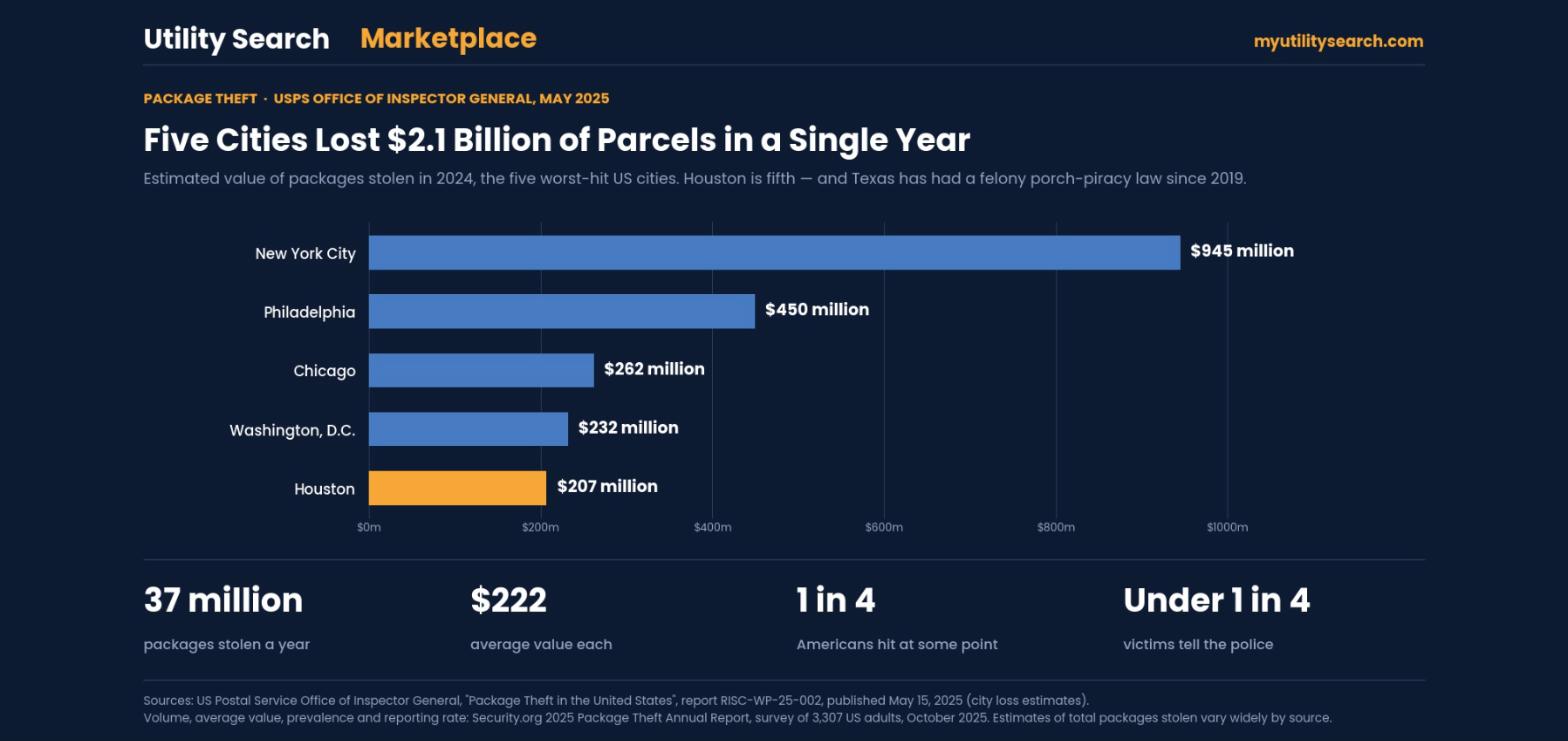
A stolen package is an intensely local risk. The Inspector General’s own figures make that plain: five cities accounted for more than $2 billion of stolen parcels in 2024 alone, with New York at $945 million and Houston fifth at $207 million. Two streets in the same city can have very different exposure depending on whether porches are visible from the road and whether anyone is home at 2pm.
So the useful question after a stolen package is not “which camera is best” but “what can actually be installed and monitored here”. Professional monitoring is licensed and dealer-based, so availability genuinely varies by street. Upload speed decides whether several cameras can stream at once without ruining your wifi. And if a camera is going on the outside of a rented building, permission matters more than specification.
Running the address answers all three at once, across internet, energy and home security together, instead of comparing products that may not even be sold where you live.
Stolen package FAQ
Who is responsible for a stolen package, the retailer or the carrier?
In practice the retailer. Your purchase contract is with the seller; they hired the carrier, not you. Start every claim with the retailer and let them pursue the carrier if they choose to.
Will I get a refund for a stolen package?
Usually, if you ask promptly and through the right channel. Terms differ between items sold and shipped by a large retailer and items from a third-party marketplace seller, and every process has a filing deadline, so check the seller’s current policy rather than relying on what was true last year.
Should I file a police report for a stolen package?
Yes. Fewer than one victim in four does, which is precisely why so few cases are prosecuted. Many retailers also require a report number before refunding a high-value item, and state porch-piracy laws are graded on repeat patterns that only become visible when thefts are reported.
How long should I wait before reporting a stolen package?
Give it a few hours to a full day. Carriers often scan parcels as delivered before they physically arrive, and misdelivery to a neighbour is more common than theft. After 24 hours with no sign of it, treat it as a loss and start the claim.
Do security cameras stop package theft?
They deter some of it and document the rest, but they do not remove the parcel from the doorstep. Lockers, pickup points and locked receptacles prevent the theft outright; cameras mainly give you evidence and, per survey data, considerably less anxiety. A third of people use a doorbell camera, making it the most popular measure by far.
When is package theft most likely?
October through December, because deliveries roughly triple. This is the opposite of burglary, which federal data shows peaks in July and is at its lowest in February.
Is a stolen package a felony?
It depends on the state and the scale. Ten states have enhanced porch-piracy statutes. In Texas, stealing from fewer than ten addresses is a Class A misdemeanour, ten to 29 is a state jail felony, and 30 or more is a third-degree felony carrying two to ten years.
Compare internet, energy & home security at your address
Sources
Federal data on the scale and geography of package theft comes from the US Postal Service Office of Inspector General’s report Package Theft in the United States (RISC-WP-25-002), published May 15, 2025, which is also the source for the city loss estimates, the $5.2bn–$16bn range, the USPS Smart Locker count and the note that ten states have enhanced porch-piracy laws.
Volume, value, prevalence and deterrent-usage figures come from Security.org’s 2025 Package Theft Annual Report, based on a survey of 3,307 US adults conducted in October 2025.
Seasonality figures are from the US Department of Justice, Bureau of Justice Statistics, Crime and Seasonality (May 1980), drawn from National Crime Survey data for 1973–77 — the canonical federal study of when property crime happens, and presented here as a long-run structural pattern rather than current monthly data. The property-crime trend figure is from the FBI’s First Look: 2025 Crime Data, released May 13, 2026.
Texas penalty tiers are set by Texas Penal Code § 31.20, effective September 2019; the comparative state analysis draws on the Houston Law Review’s survey of porch-piracy statutes. Mail theft can also be reported to the US Postal Inspection Service.
Last updated September 25, 2026.
Keep going
- Best home security cameras: what three years of cloud storage really costs
- Compare home security providers at your address
- ADT home security review
- eufy home security: the no-monthly-fee option
- Best home security systems
- DIY home security systems
- How much home security costs
The bottom line on a stolen package
Treat a stolen package as an administrative problem first and a security problem second. The money is recovered through the retailer, quickly, with the order number and the delivery photo in hand — and reported to the police even though most people cannot be bothered, because that report is what turns a one-off into the pattern a prosecutor can charge.
Then fix the exposure rather than the symptom. A stolen package happens because a box sat unattended in public view, so the fixes that work are the ones that stop it sitting there: a locker, a pickup point, a locked receptacle, a delivery window when someone is home. A camera is worth having, but it is the record of a stolen package, not the prevention of one.
And if you are buying security this quarter, buy it for the right reason. Burglary peaks in July. A stolen package peaks in December. Those are different problems with different answers.