Blog
Columbus Electricity Rates: Price to Compare, Suppliers & Best Plans 2026

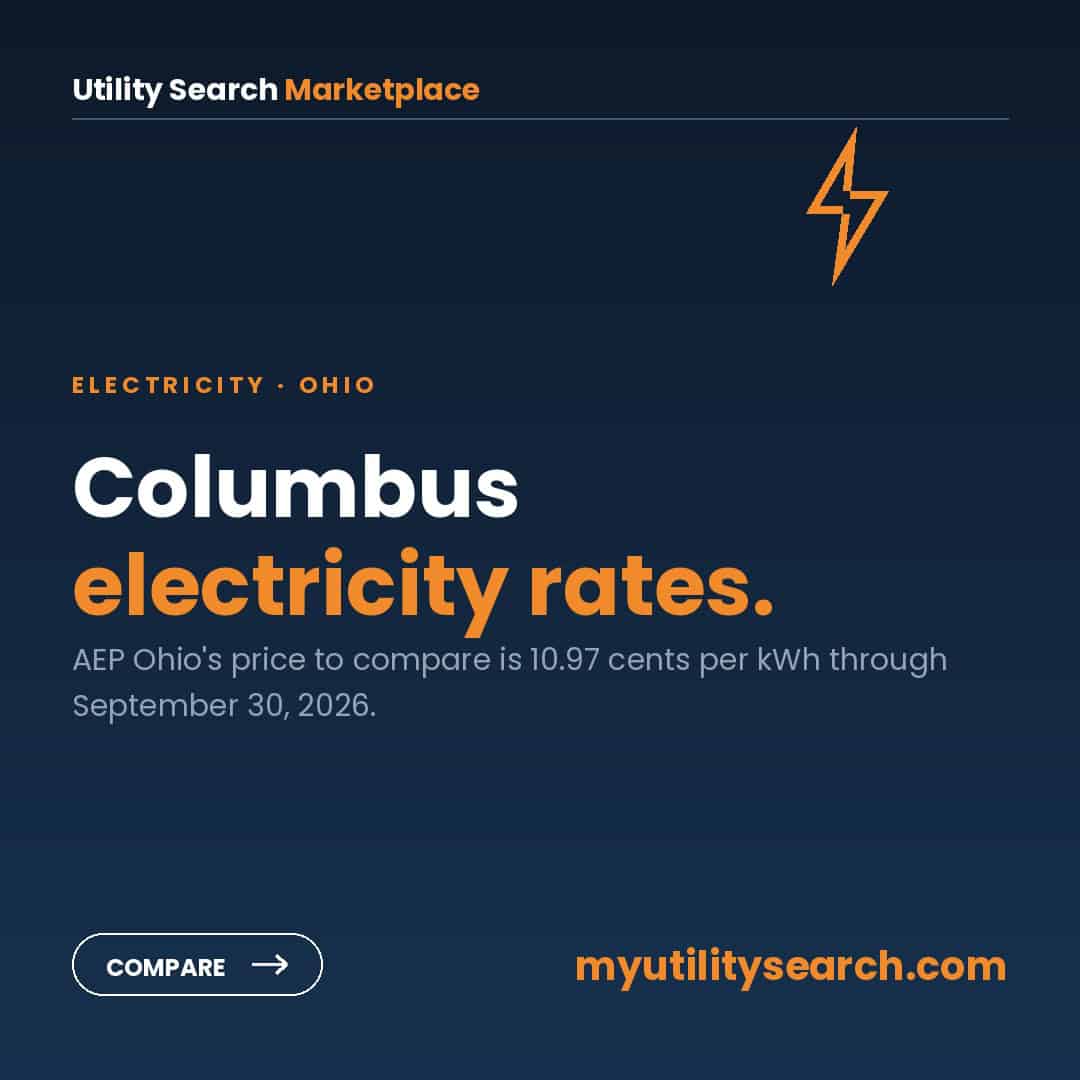
Columbus electricity rates start with one number: 10.97 cents per kWh. That is AEP Ohio’s price to compare for residential generation from July 1 through September 30, 2026 — the benchmark any competitive supplier offer has to beat. Ohio is a deregulated state, so you can shop the generation portion of your bill while AEP Ohio continues to deliver the power and handle outages either way.
TL;DR — Columbus electricity rates right now
- Price to compare: 10.97¢/kWh (AEP Ohio residential, Jul 1 – Sep 30, 2026).
- You can switch suppliers. Ohio has retail electric choice; AEP Ohio still owns the wires.
- Columbus is different: the city runs an opt-out aggregation program, so many residents are already on a negotiated rate.
- Check your bill before shopping — you may not be on the price to compare at all.
- Students: service must be in your name before move-in; set it up 1–2 weeks ahead.
- Watch for: teaser rates that expire, monthly fees, and early termination charges.
What is the price to compare for Columbus electricity rates?
AEP Ohio’s residential price to compare is 10.97 cents per kWh for July 1 through September 30, 2026. The price to compare is the generation rate you pay if you never shop — it is the default, and it is the only fair yardstick for judging a supplier’s pitch.
Two things it does not include: delivery and transmission. Those charges stay with AEP Ohio no matter which supplier you choose, which is why switching cannot cut your bill in half. Realistically, shopping affects roughly the generation half of what you pay. You can verify the current figure yourself on Ohio’s official Energy Choice Ohio comparison site, which the Public Utilities Commission maintains.
Why Columbus electricity rates work differently than the rest of Ohio
This is the part most rate guides miss, and it changes the advice completely. The City of Columbus operates a municipal electric aggregation program, which negotiates a supply rate on behalf of residents and enrolls eligible households automatically unless they opt out.
The practical consequence: if you live inside city limits, you may already be on an aggregation rate rather than AEP Ohio’s price to compare. Comparing a supplier’s offer against 10.97¢ is then the wrong comparison — you need the rate actually printed on your bill. Before shopping Columbus electricity rates, pull your most recent statement and find the supply line. Whatever number is there is your real benchmark.
Aggregation is also why a supplier calling to say they can “beat the utility rate” may be technically true and practically irrelevant. They may be comparing against a default you are not paying.
How do the charges on a Columbus electric bill break down?
| Charge | Who sets it | Can you shop it? |
|---|---|---|
| Generation / supply | AEP Ohio default, city aggregation, or your chosen supplier | Yes |
| Distribution (the wires to your home) | AEP Ohio, regulated by the PUCO | No |
| Transmission | AEP Ohio, regulated | No |
| Riders and surcharges | Regulated | No |
When you compare Columbus electricity rates between suppliers, you are comparing the first row only. That is worth remembering when an advertised rate looks dramatically lower than your effective cost per kWh — the advertised number is one component, not the whole bill.
What’s the best electricity plan in Columbus?
There is no single best plan, but there is a reliable way to judge Columbus electricity rates offers. A good offer in this market clears four tests:
- Fixed, not variable. Variable rates can reset monthly, and they reset upward far more often than down.
- Beats your actual supply rate — the one on your bill, not the price to compare, if you are on aggregation.
- No monthly service fee, or a fee small enough that it does not erase the per-kWh savings at your usage level.
- Term you can live with. A 12-month fixed rate with a modest cancellation fee is usually a better risk than a 36-month lock.
Run the math on your own usage rather than the marketing example. Multiply the rate difference by your average monthly kWh, then subtract any monthly fee. A one-cent improvement on 800 kWh is about $8 a month — real, but not worth a punitive contract.
Setting up electricity as an Ohio State student
Off-campus housing near campus almost always requires service in the tenant’s name, and Columbus electricity rates are a real line in a student budget. A few things worth knowing before move-in:
- Start service 1–2 weeks before your lease begins. Move-in week is the busiest period of the year for utility connections in a college town.
- Expect a deposit or a co-signer if you have no credit history. Ask about deposit alternatives when you call.
- Put the account in one roommate’s name and split it, or ask about splitting formally — but understand the named person carries the liability.
- Do not sign a door-to-door supplier contract during move-in week. That is peak season for aggressive sales in student neighborhoods.
- Schedule your shutoff when you move out. Summer subleases are where forgotten accounts quietly run up charges.
If you are also setting up internet, do both in the same sitting — see our guide to the best internet for college students for the connection side of move-in.
How to lower your bill beyond the rate
Shopping the supply rate is the fastest lever, but it is not the largest one. The Department of Energy’s Energy Saver guidance notes that heating and cooling account for roughly half of a typical home’s energy use — which means thermostat behavior often moves the bill more than a one-cent rate change does.
In older Columbus rentals, which describes much of the housing near campus, the highest-return moves are usually the cheapest: weatherstripping doors, covering window AC units in winter, and setting the thermostat a few degrees further from your comfort point while you are out. For a fuller list, read our guide to lowering your Ohio electric bill.
Why Columbus electricity rates moved this year
Generation prices across the eastern grid have been pushed up by capacity costs — the payments generators receive for promising to be available on the hottest and coldest days, separate from the electricity they actually produce. Capacity auction results across regional grids have risen sharply, and those costs land in supply rates the following season.
That is the honest explanation for why Columbus electricity rates and their neighbors moved together rather than because of anything specific to one utility. Demand is also growing: data centers have expanded significantly in central Ohio, adding load to a grid that was planned for slower growth. The U.S. Energy Information Administration publishes state-level price data if you want to see how Ohio compares nationally over time.
None of that is within your control. What is within your control is which supply rate you are sitting on, and whether it resets without you noticing.
Three mistakes that cost Columbus households money
- Letting a fixed term roll to variable. When a contract ends, most suppliers move you to a month-to-month variable rate rather than renewing the fixed one. This is the single most common way Columbus electricity rates quietly climb — put your contract end date in your calendar the day you sign.
- Comparing against the wrong benchmark. If you are on city aggregation, an offer that beats AEP Ohio’s 10.97¢ price to compare may still be worse than what you already pay.
- Signing at the door. Door-to-door and phone sales spike in student neighborhoods each August. A legitimate supplier will let you review the terms in writing and enroll online; nobody needs your decision today.
If you suspect you were switched without clear consent, Ohio’s Public Utilities Commission handles slamming complaints, and the state’s official comparison site lists every certified supplier — a useful check before you give anyone your account number.
Shopping Columbus Electricity — Or Moving In?
Compare electricity supply rates against what you are actually paying today — and if you are setting up a new place, line up internet at the same address in the same sitting.
Compare electricity rates →Compare internet plans →FAQ
What is the current price to compare for Columbus electricity rates?
AEP Ohio’s residential price to compare is 10.97 cents per kWh from July 1 through September 30, 2026. That is the default generation rate used as a benchmark against competitive supplier offers.
Can I choose my electricity supplier in Columbus?
Yes. Ohio has retail electric choice, so you can pick a competitive supplier for the generation portion of your bill. AEP Ohio still delivers the electricity and responds to outages regardless of which supplier you use.
Am I automatically enrolled in a Columbus aggregation program?
Many Columbus residents are. The city runs an opt-out municipal aggregation program, so you may already be on a negotiated supply rate rather than AEP Ohio’s price to compare. Check the supply line on your bill to confirm.
Does switching suppliers change who fixes an outage?
No. AEP Ohio owns and maintains the poles, wires, and meters, and handles all outages and emergencies no matter which supplier provides your generation.
When should a student set up electricity in Columbus?
One to two weeks before your lease starts. Move-in week is the busiest connection period of the year in a college town, and same-day service is not guaranteed.
Is a fixed or variable rate better in Columbus?
Fixed rates are generally safer for households that want predictable bills. Variable rates can change monthly and often reset higher, particularly heading into summer when demand and capacity costs rise.