Blog
Compare ESCOs in New York: NYC Rates and How to Switch in 2026

Updated on September 6, 2026
To compare ESCOs in New York, use the state’s official Power to Choose tool to see licensed supplier offers for your ZIP and utility, then weigh each offer against your utility’s default supply rate — because in New York an ESCO only changes who supplies your energy, not who delivers it. Your utility (Con Edison in NYC) still delivers the power, reads the meter, and handles outages no matter which supplier you pick.
Key takeaways
This guide shows you how to compare ESCOs in New York, whether they really save money, and how to switch in minutes.
Quick answer: To compare ESCOs in New York, check each supplier’s fixed supply rate, term, and fees against your utility’s default rate, then enroll online in minutes. The best way to compare ESCOs in New York is side by side for your exact address.
What is an ESCO in New York?
Definition — ESCO: An Energy Service Company is a non-utility business licensed to sell electricity and/or natural gas supply directly to customers in New York’s deregulated market. New York opened retail energy choice in the late 1990s, so you can buy your energy supply from an ESCO while your regulated utility continues to deliver it.
The distinction is the whole point. If you switch to an ESCO, only the supply portion of your bill changes. Con Edison (or National Grid, NYSEG, and so on) still owns the wires, delivers the power, reads your meter, and responds to outages — so there is no risk of losing service when you switch. (NY Dept. of Public Service)
How to compare ESCOs in New York
The right way to compare ESCOs in New York — including NYC ZIPs like 11201 in Brooklyn — is the state’s official comparison tool:
- Open the DPS Power to Choose tool at documents.dps.ny.gov/PTC — it lists licensed ESCO offers for residential customers.
- Enter your utility and service area so you only see offers available to you.
- Compare the rate, term, and offer type — fixed vs. variable, month-to-month vs. contract, and any early-termination fee.
- Check the DPS ESCO complaint statistics before you sign.
Definition — the three supply options. When you compare, you’re really choosing among three things:
| Your supply option | What it is | Watch for |
|---|---|---|
| Utility default supply | Con Ed / your utility buys power at market cost and passes it through with no markup | Rate changes monthly with the market |
| ESCO fixed-rate plan | A supplier locks your supply rate for a set term | Must not exceed the trailing 12-month utility average + 5% |
| ESCO renewable plan | Supply matched to New York–sourced renewable energy | Confirm it’s NY-sourced and read the price |
New York utility territories at a glance
Which utility delivers your energy determines which ESCO offers you’ll see. New York’s six major utilities are:
| Utility | Service area |
|---|---|
| Con Edison | New York City and Westchester County |
| National Grid | Upstate and Western New York |
| NYSEG | Central and Eastern upstate New York |
| RG&E | Rochester region |
| Central Hudson | Mid-Hudson Valley |
| Orange & Rockland | Lower Hudson suburbs northwest of NYC |
In NYC, all five boroughs — Manhattan, Brooklyn (including ZIP 11201), Queens, the Bronx, and Staten Island — are Con Edison territory.
Do ESCOs actually save money in New York?
This is where honesty matters more than a sales pitch: many New York residential ESCO customers have paid more than they would have on the utility default rate. State regulators have repeatedly stepped in over it.
Stat block: In April 2026, Governor Hochul and the Public Service Commission announced a settlement directing $71 million in billing adjustments and guaranteed savings to about 278,000 current and former residential and small-business ESCO customers, after nine NRG-affiliated ESCOs were found to have violated state rules. As part of the deal, those suppliers must offer a product guaranteeing 15% savings versus the utility price for a one-year term. (NY Governor’s Office)
Before you switch, compare ESCOs in New York on a total-cost basis, not just the headline rate. That’s why New York reformed the rules. Under the PSC’s 2019 “Reset Order,” a residential ESCO offer must either guarantee savings against the utility rate, cap a fixed price at the trailing 12-month utility average plus 5%, or be a renewable product sourced in or near New York. The takeaway for shoppers: an ESCO can save you money, but only if you compare the specific offer against your utility’s rate — never assume the switch saves automatically.
Stat block: New York’s average residential electricity price was about 24.4 cents per kWh in 2024, among the highest in the nation, per the U.S. Energy Information Administration — and Con Edison’s NYC rates run above that state average, which is exactly why comparing supply offers is worth the ten minutes. (EIA)
What to look for when you compare ESCOs in New York
When you compare ESCOs in New York, the lowest teaser rate is rarely the whole story. Use this checklist whenever you compare ESCOs in New York, because suppliers compete on more than price:
- Rate type. A fixed rate locks your supply price for the full term; a variable rate can start low and then climb. For budget certainty, most New York shoppers choose fixed.
- Contract term and fees. Check the term length and any early-termination fee before you sign — a low rate matters little if you are locked in when the market drops.
- The all-in supply price. Compare the total supply rate in cents per kWh, not a promotional first-month figure. That number decides whether ESCOs actually save money in New York.
- Renewal terms. Some plans roll to a higher month-to-month rate at term end. Know what happens on renewal so you can shop again on time.
- Green supply. Many ESCOs in New York offer renewable plans; if that matters, confirm it is included, not a paid add-on.
The fastest way to compare ESCOs in New York on an apples-to-apples basis is to line up each supplier rate, term, and fees against your utility current default rate. That one comparison tells you whether switching is worth it at your address.
How to switch to an ESCO in New York
Switching is straightforward and never interrupts your power:
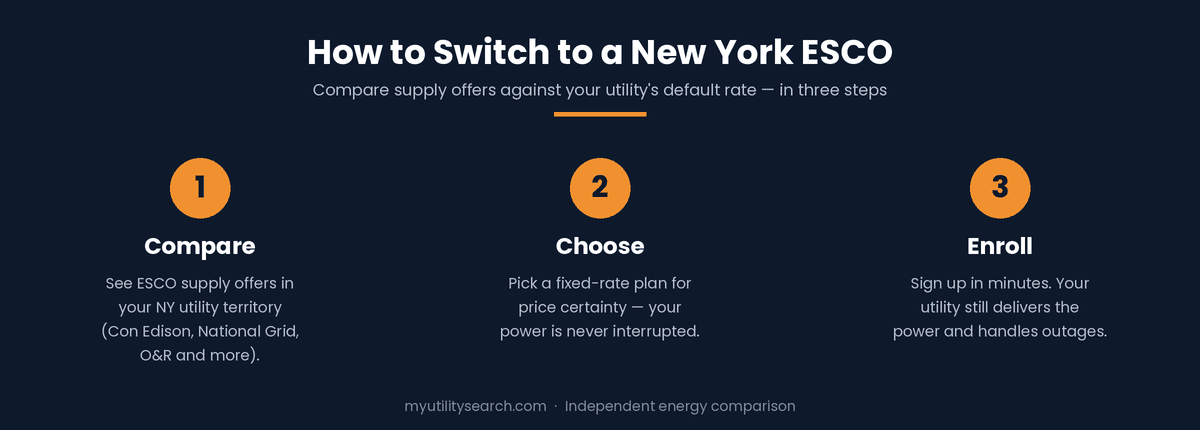
- Compare offers on the Power to Choose tool and pick one that beats your utility’s default rate or matches your renewable goals.
- Have your utility account details ready (your Con Ed or other utility account number).
- Sign the ESCO agreement. If you enroll by phone or in person, you’ll complete a Third-Party Verification.
- Watch for the confirmation. Your utility mails a verification letter confirming you chose an ESCO.
- Check your next bill — the ESCO should appear on the supply line; delivery stays with your utility.
Your utility continues to deliver your energy and respond to all emergencies even after you switch, so there is no service interruption at any point. (NY DPS)
Paying too much for electricity?
Compare supply offers in your New York utility territory against your default rate.
Frequently asked questions
How do I compare ESCOs in New York?
Use the official DPS Power to Choose tool at documents.dps.ny.gov/PTC to see licensed ESCO offers for your utility and service area, then compare each offer’s rate, term, and fees against your utility’s default supply rate. Only switch if the offer clearly beats the default or meets a renewable goal.
Do ESCOs save money compared to Con Edison?
Not automatically. Many New York residential ESCO customers have historically paid more than the utility default, which led to a $71 million state settlement in April 2026. Since the 2019 Reset Order, residential ESCO offers must guarantee savings or be a New York renewable product — but you should still compare the specific offer against your Con Edison rate.
Will my power be interrupted if I switch to an ESCO?
No. An ESCO only supplies your energy; your utility still delivers it, reads the meter, and handles outages. Switching changes the supply line on your bill and never interrupts service.
How often can I switch energy suppliers in New York?
You can switch suppliers or return to utility default supply, though some ESCO contracts include an early-termination fee for fixed-term plans. Check the contract term before signing, and use the Power to Choose tool to compare current offers any time.
Who reads my meter and fixes outages if I use an ESCO?
Your regulated utility — Con Edison in NYC — always reads the meter, maintains the wires, and responds to emergencies, regardless of which ESCO supplies your energy.
Bottom line: Compare ESCOs in New York against your Con Edison default supply rate on the official Power to Choose tool, and switch only when a specific offer clearly beats it.
Bottom line: to compare ESCOs in New York, put each supplier supply rate, term, and fees next to your utility default rate — then lock the plan that saves you the most.
Many New York ESCOs sell renewable products at a premium — read how green energy plans actually differ from regular supply before paying more for one.