






Blog
Why Is My Electric Bill So High? Causes and How to Lower It in 2026

Updated on September 7, 2026
Bottom line: if you keep asking why is my electric bill so high, most of the increase is structural — but shopping your supply rate in a deregulated state and trimming usage are the levers you actually control.
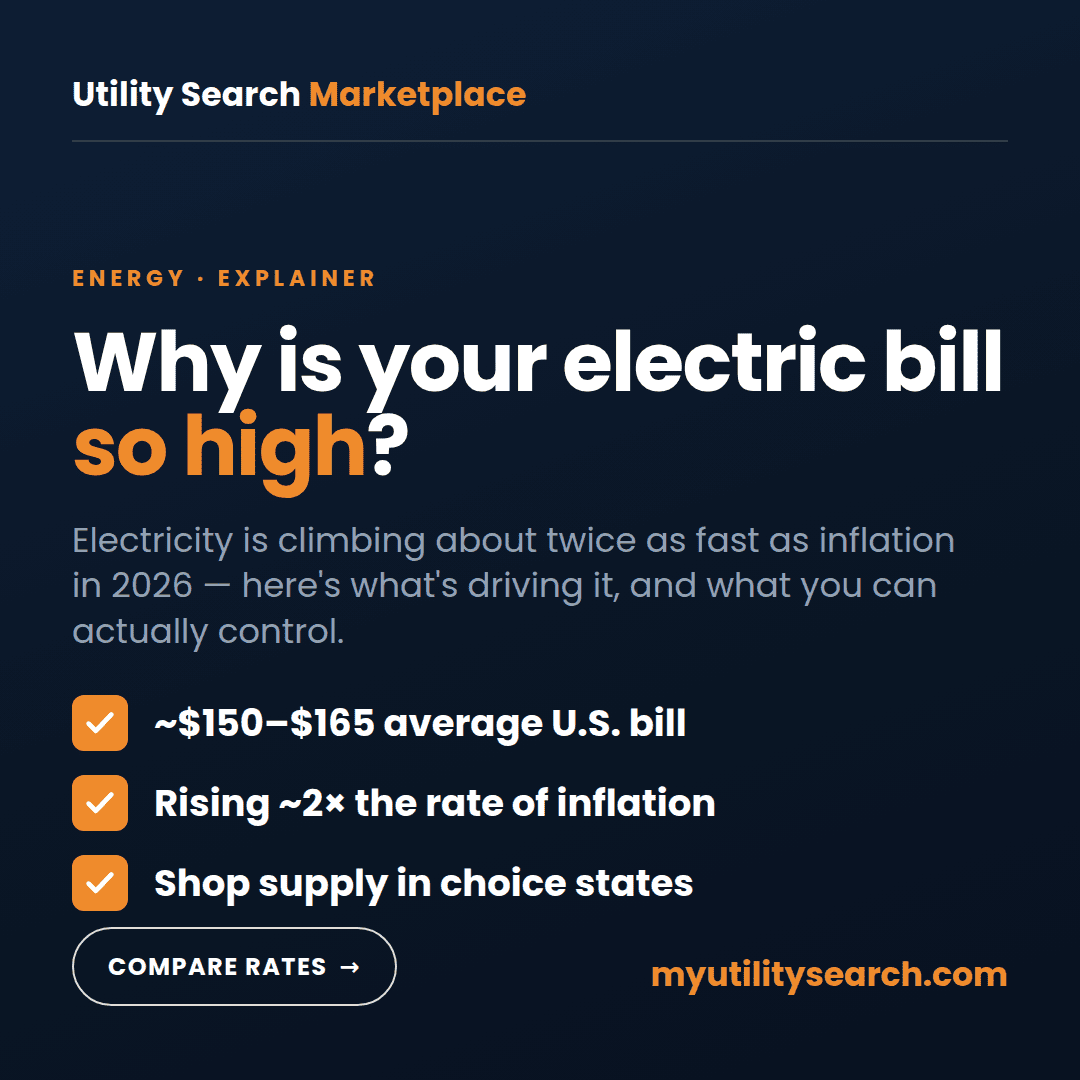
If you’re wondering why is my electric bill so high in 2026, the short answer is that electricity prices are rising about twice as fast as overall inflation — driven by surging power demand from AI data centers, aging-grid upgrades, and higher delivery charges. Even as gas prices fell in 2026, electricity kept climbing, because it’s a necessity you can’t easily cut. The good news: part of your bill is controllable, especially if you live in a state where you can shop your supplier.
Key takeaways
- If you keep asking why is my electric bill so high, the fastest win is shopping your supply rate in a deregulated state.
Quick answer: If you are wondering why is my electric bill so high, the usual causes are higher supply rates, heavy seasonal heating and cooling, rising delivery charges, and older appliances. The quickest win is to compare your supply rate against competitive offers — many households lower the bill without using less power. Below, we break down why is my electric bill so high and exactly how to fix it.
Why is my electric bill so high right now?
If you are asking why is my electric bill so high right now, the honest answer starts with the grid — not just your household.
The reason your electric bill is so high isn’t just you — it’s the whole grid. Through 2026, U.S. residential electricity prices have been climbing at roughly double the pace of headline inflation, and analysts expect little relief while power demand keeps surging. That’s a sharp contrast with the rest of the inflation picture: the June 2026 Consumer Price Index actually cooled to 3.5%, helped by gasoline falling 9.7%. Gasoline is easy to cut back on, so its price drops when demand softens. Electricity is the opposite — you can’t stop running your refrigerator — so its price keeps grinding higher even when other costs ease.
Stat block: U.S. average residential electricity prices rose about 9% year over year as of early 2026, according to the U.S. Energy Information Administration — well above the ~3.5% headline inflation rate — and the national average sits near 18.8¢ per kWh. (EIA)
Stat block: A major reason is new demand: the “frenzy” of AI data-center construction is pulling huge new loads onto the grid, and utilities are passing the cost of new generation and transmission through to households — one analysis found electricity prices climbing at about twice the rate of inflation with no near-term relief expected. (CNBC)
What actually makes up your electric bill?
To get to the bottom of why is my electric bill so high, split the bill into the part you can shop and the part you cannot.
To understand why your electric bill is so high, split it into its two real parts. Most of the number on the page isn’t the electricity itself — it’s everything around it.
Definition — supply vs. delivery: Supply is the cost of the actual energy (generation). Delivery is the cost of moving it to your home over poles, wires, and substations, plus your utility’s fixed charges and fees. Your utility always handles delivery; in a deregulated state, you can choose who provides the supply.
| Bill component | What it covers | Can you control it? |
|---|---|---|
| Supply / generation | The energy you use (per kWh) | Yes, in deregulated states — shop the rate |
| Delivery / transmission | Poles, wires, grid upkeep | No — set by your utility and regulator |
| Fixed customer charge | Flat monthly connection fee | No |
| Usage (kWh) | How much you actually consume | Yes — this is your biggest lever |
| Taxes & riders | State/local fees, surcharges | No |
What are the biggest reasons my electric bill is high?
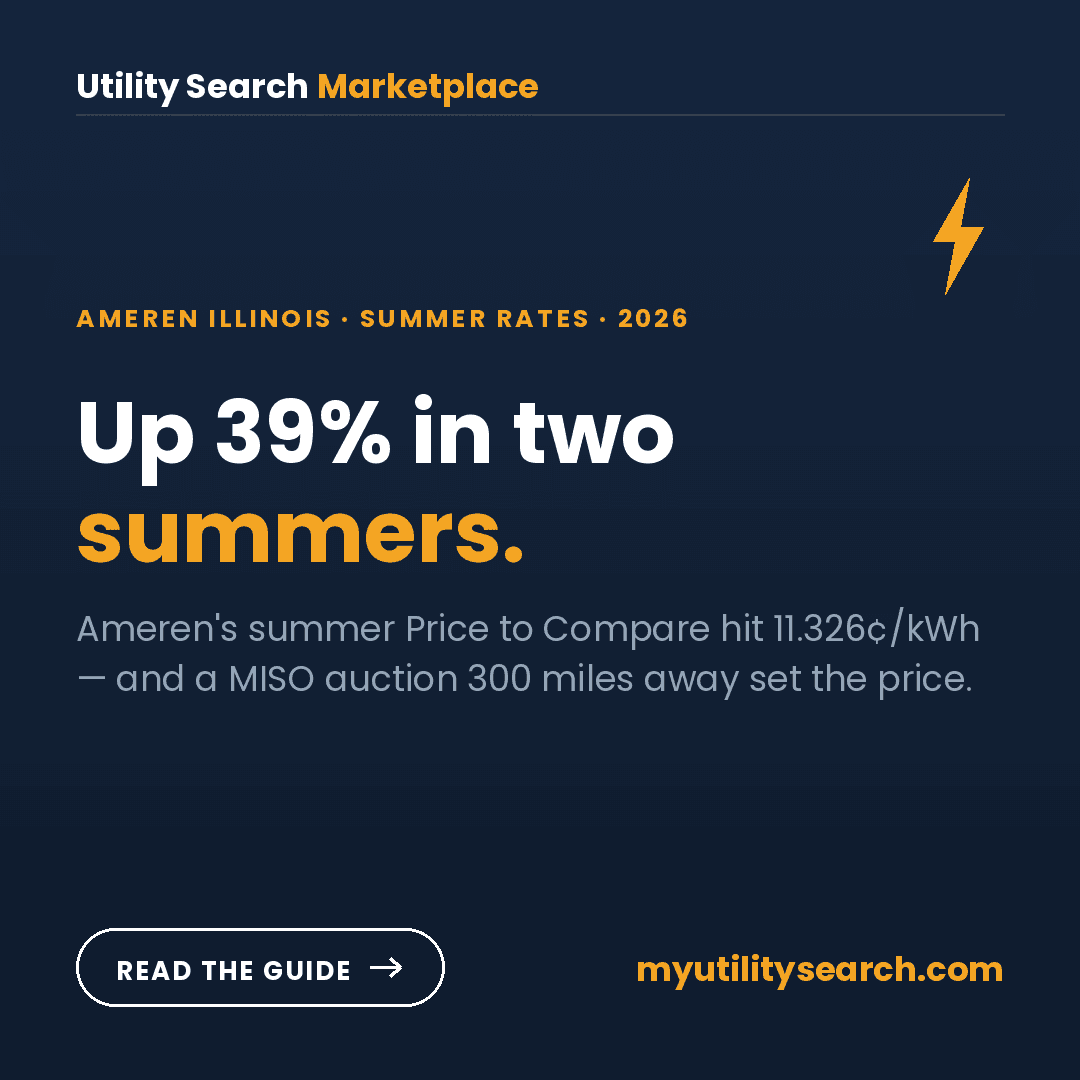
2026’s two structural drivers: in the PJM grid states (Pennsylvania, Ohio, Illinois, New Jersey), record capacity-auction costs began flowing into default utility rates with the June 2026 resets — that’s the line-item jump many households noticed mid-year. Layered on top, surging AI data-center demand is pushing wholesale power prices up nationwide — see our full analysis of data centers and electric bills. Neither driver is in your control, but in a deregulated state the supplier line of your bill is: comparing fixed-rate supplier offers is the one lever that beats both.
When people ask why is my electric bill so high, it almost always comes down to a handful of causes, usually in combination:
- Rate increases. Utilities across the country have filed for and won rate hikes to pay for grid upgrades and new demand — so the price per kWh is simply higher than last year.
- Delivery charges creeping up. The “delivery” side of the bill has grown faster than supply in many markets as utilities rebuild aging infrastructure.
- Air conditioning and heating. In summer, cooling can be 40–50% of the bill; in winter, electric heat does the same. Weather swings show up fast.
- An expensive or expiring rate. If your fixed-rate plan rolled onto a variable “hold-over” rate, or you’re on your utility’s default supply, you may be overpaying.
- Always-on load. Pools, EV charging, space heaters, old appliances, and phantom draw from electronics add up quietly.
- A bigger or older home. Square footage, insulation, and appliance age all move the number.
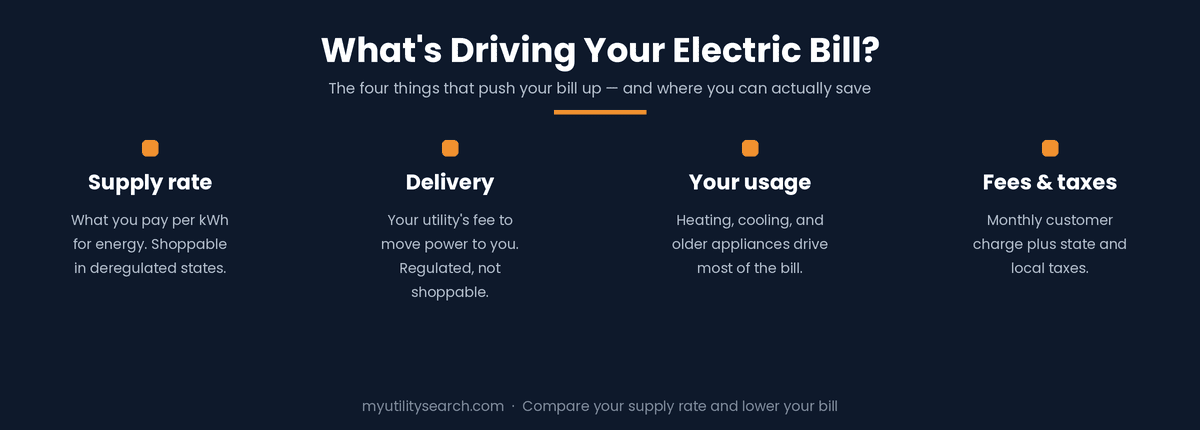
What’s Driving Your Electric Bill?
The four things that push your bill up — and where you can actually save
myutilitysearch.com · Compare your supply rate and lower your bill
How much is a normal electric bill in 2026?
If you are asking why is my electric bill so high compared with everyone else, start with the national benchmark below.
A “normal” U.S. electric bill in 2026 runs about $150–$165 per month, based on average usage of roughly 875–900 kWh at around 18.8¢/kWh — but that varies widely by state, home size, and season. The national average bill has climbed about 25% since 2022. If yours is far above that range, it’s worth diagnosing usage and checking whether you’re on a competitive supply rate. For a full breakdown by state and home size, see our average electric bill guide.
Compare internet, energy & home security at your address
Shop Internet Shop Energy Rates Shop Home SecurityHow do I lower my electric bill?
Once you know why is my electric bill so high, lowering it comes down to two levers — the rate you pay and the energy you use.
There are two levers: the rate you pay and the energy you use. Attack both.
- Shop your supply rate (deregulated states). If you live in a state with energy choice — Texas, Ohio, Pennsylvania, Illinois, New Jersey, New York and others — you can switch your supply to a cheaper or fixed rate without any change to your service or wires. This is the fastest cut for most people.
- Right-size your cooling and heating. Every degree on the thermostat matters; a smart or programmable thermostat and clean filters cut the single largest line item.
- Kill always-on waste. Unplug phantom loads, switch to LED and efficient appliances, and shift heavy use (laundry, EV charging) to off-peak hours if you’re on a time-of-use plan.
- Ask about budget billing and assistance. Level/budget billing smooths seasonal spikes, and programs like LIHEAP help qualifying households.
Paying too much for electricity?
Compare supply offers in your New York utility territory against your default rate.
This guide covers the ongoing, structural reasons your electricity bill runs high. If your bill suddenly spiked around a specific 2026 event, see why your energy bill went up in 2026.
Can I switch electricity providers to lower my bill?
If the real answer to why is my electric bill so high is simply an uncompetitive supply rate, switching is the fastest fix — where your state allows it.
Whether you can switch depends on your state. In deregulated (energy-choice) states, you can pick your supply company and lock a competitive rate, while your existing utility still delivers the power and handles outages — so there’s no service interruption. In regulated states (and municipal utilities like Austin Energy or CPS Energy), you can’t shop a retail supplier, so your savings come from usage, efficiency, and assistance programs instead. Either way, the first step is knowing which bucket you’re in.
Frequently asked questions
Do I need to give my Social Security number to compare energy plans?
No. You can compare supply rates without an SSN. Comparing is free, and on Utility Search Marketplace the providers pay us — never you.
Sourcing note: Inflation and energy figures reflect the U.S. Bureau of Labor Statistics Consumer Price Index report for April 2026 (headline CPI 3.8% year over year; energy index accounting for over 40% of the monthly increase; electricity up about 6% year over year; total energy index up roughly 18% year over year), as widely reported in late May 2026. Dollar examples are illustrative; confirm your exact rate on your bill or with your utility.
Why is my electric bill so high all of a sudden?
A sudden jump usually means one of three things: a utility rate increase took effect, the weather drove up heating or cooling use, or a fixed-rate plan expired onto a higher variable rate. Compare your kWh usage month over month in your utility app — if usage is flat but the bill jumped, it’s a rate change.
Is my electric bill high because of AI data centers?
Partly, yes. Rapid data-center and AI demand is adding large new loads to the grid, and the cost of new generation and transmission is being passed to households — a major reason 2026 electricity prices are rising about twice as fast as inflation. It’s not the only factor, but it’s a real one.
What is the average electric bill in the US in 2026?
About $150–$165 per month, based on roughly 875–900 kWh of usage at a national average near 18.8¢/kWh. Bills are far higher in states like Hawaii and California and lower in much of the South and Midwest.
How can I lower my electric bill without spending money?
Raise your thermostat a few degrees in summer, unplug phantom loads, run heavy appliances off-peak, and — if you’re in a deregulated state — switch to a cheaper supply rate, which costs nothing and changes nothing at home.
What’s the difference between supply and delivery on my bill?
Supply is the energy itself; delivery is moving it to your home over the utility’s wires. You can shop supply in deregulated states, but delivery is always set by your regulated utility.
Are electricity prices going to keep rising in 2026?
Most analysts expect continued increases while data-center demand and grid-upgrade costs stay high, with electricity outpacing overall inflation. That makes locking a competitive fixed supply rate more valuable if you’re able to shop.
Why is my electric bill so high in the summer?
Air conditioning is the reason — cooling can be 40–50% of a summer electricity bill. Every degree lower on the thermostat and every extra hour the AC runs adds up, so summer is when a high electric bill hurts most.
Why is my electric bill so high compared to my neighbors?
Home size, insulation, appliance age, and how many people are home all change usage. And if you are on a different or expiring rate, or your utility’s default supply, you can pay more for the same kWh — so comparing your supply rate is the quickest check.
Why is my electric bill so high when I barely use electricity?
Even low-usage homes pay a fixed monthly customer charge plus delivery fees, and always-on loads add up. If your usage really is low, a high bill usually points to your rate or delivery charges rather than your habits.
Why is my electric bill so high in the winter?
If you heat with electricity, winter does what summer AC does: electric heat and space heaters can dominate the bill during cold months, so a high winter electric bill usually tracks heating degree-days and thermostat settings.
Why is my electric bill so high after I moved?
A new home can mean a bigger space, older or less-efficient appliances, a different utility, and a different rate. After a move it is worth confirming your usage and, in a deregulated state, comparing your new supply rate against the default.
Bottom line: if you keep asking why is my electric bill so high, start by comparing your supply rate, then trim the usage that costs the most. Those two moves together are how most households finally bring the bill back down.
Compare internet, energy & home security at your address
Shop Internet Shop Energy Rates Shop Home Security


One thought on “Why Is My Electric Bill So High? Causes and How to Lower It in 2026”