Blog
Starter Homes Now Cost $1 Million in 242 U.S. Cities — Triple the Pre-Pandemic Count

Free Speech Friday | Last updated June 18, 2026 | By the Utility Search Marketplace team
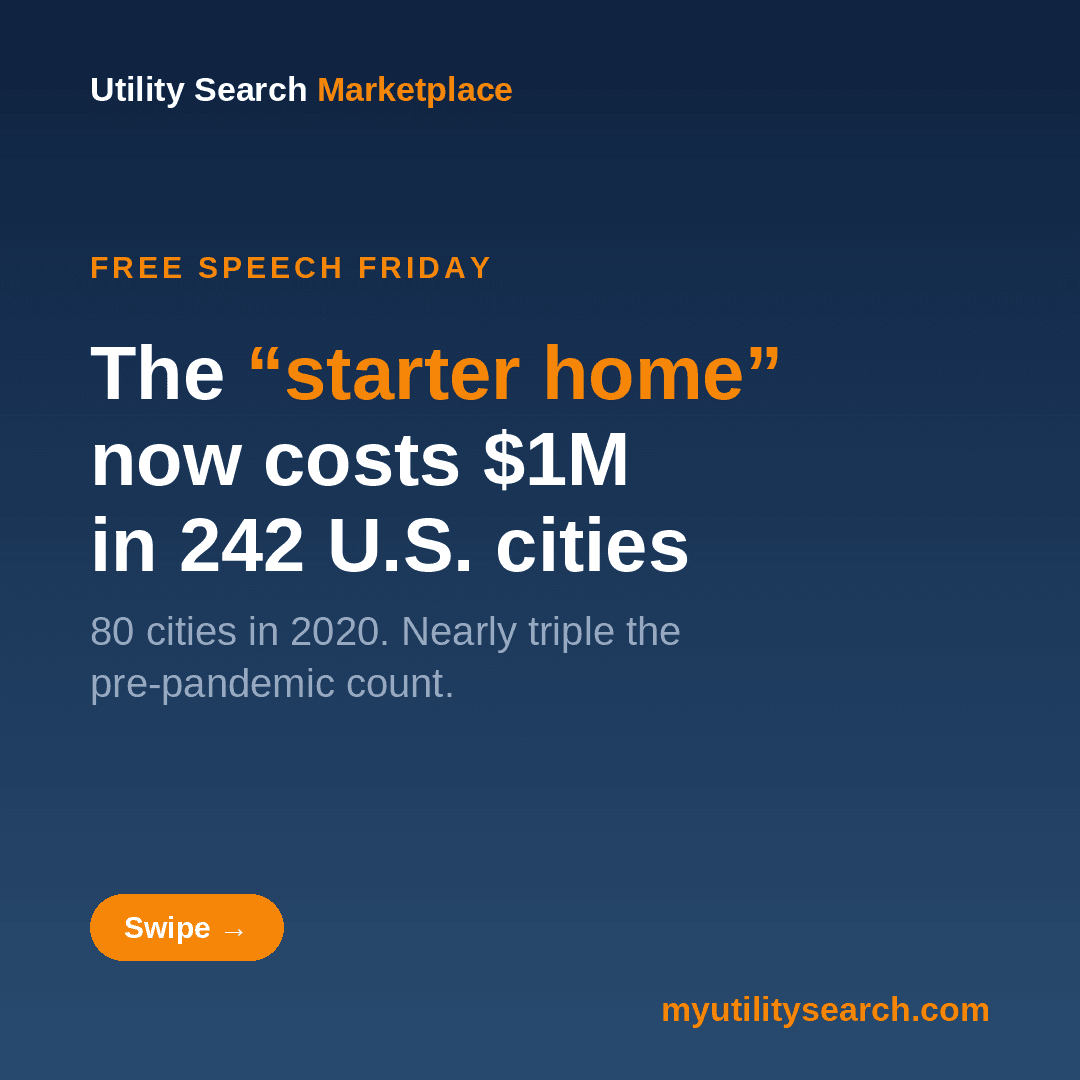
Million-dollar starter homes are no longer a coastal oddity. A record 242 U.S. cities now have a typical starter home worth $1 million or more — nearly triple the 80 cities before the pandemic, and up from 226 just a year ago. Below we break down where these million-dollar starter homes are, why the count keeps climbing, and what the affordability math means for renters and first-time buyers.
TL;DR: Million-dollar starter homes, by the numbers
A record 242 U.S. cities now have typical “starter homes” worth $1 million or more — nearly triple the 80 cities before the pandemic, and up from 226 just a year ago. California holds 105 of them; New York and New Jersey are growing fastest. The national typical starter home is still only $198,649, but the affordability math is the real story: the median U.S. household earns $83,730, while affording a median-priced home now takes an income above $106,000. When the entry rung of homeownership clears seven figures in 242 cities, more people rent longer — and the costs you can still control are the monthly ones.
How many U.S. cities now have million-dollar starter homes?
As of June 2026, 242 U.S. cities have a typical starter home worth $1 million or more, according to a Zillow analysis released June 15, 2026. That is nearly triple the 80 cities that hit that mark in February 2020, and up from 226 a year earlier. A “starter home” here means a home in the lowest third of values in its area — so this is the entry-level tier, not luxury listings.
What counts as a “starter home” in this data?
A starter home is a home in the bottom third of home values for its region. Zillow uses that definition so the comparison tracks the most affordable third of the market in each city — the homes a first-time buyer would realistically target. The headline isn’t that mansions cost $1M; it’s that the cheapest tier does, in a growing list of places. That is why million-dollar starter homes read as an affordability signal rather than a luxury-market milestone.
How does this compare to what people actually earn?
The median U.S. household earns $83,730 — an all-time high — yet affording a median-priced home now requires an income above $106,000. That gap is the affordability story behind the headline. The $83,730 median (2024 Census, the most recent data) is the most a typical household has ever earned, but buying the median-priced home at today’s mortgage rates takes about $106,731 a year — well above what the typical household brings in.
The rent-versus-buy split is even starker. Americans now need to earn roughly $116,633 a year to afford the typical home for sale — about 82% more than the $64,160 needed to afford the typical rental, according to Redfin. That gap has widened sharply from just 17% back in 2021, because home prices have climbed faster than rents. It’s the clearest reason so many would-be buyers are renting longer.
| Affordability measure | Amount | vs. median income | Source / note |
|---|---|---|---|
| Median household income (2024) | $83,730 | — | all-time high |
| Income to afford median home | $106,731 | +28% | today’s rates |
| Income to afford home for sale | $116,633 | +39% | Redfin |
| Income to afford typical rental | $64,160 | −23% | Redfin |
Sources: U.S. Census Bureau (median income, 2024); Visual Capitalist / HSH.com and Redfin (income-to-afford figures, 2026).
What did a starter home cost just a few years ago?
Worth a moment of perspective: a seven-figure starter home would have been almost unthinkable a decade ago. Zillow valued the typical U.S. starter home at about $170,289 in January 2023 — so the national figure has risen roughly 17% in about three years, to $198,649. Go back further and the contrast is sharper still: Zillow’s research pegged the typical first-time-buyer home around $140,000 in the late 2010s. The idea that the entry rung of homeownership should clear $1 million is a recent development, not a long-standing norm — which is exactly why million-dollar starter homes read as an affordability signal, not just a real-estate milestone.
California still leads by a wide margin, but the fastest growth is now in the Northeast. New York has jumped to 41 cities (from just 12 before the pandemic) and New Jersey to 26 (from only 1). Twenty-six states now have at least one such city, up from nine pre-pandemic — with interior states like Texas, Illinois, and Wyoming joining a list that used to be almost entirely coastal.
Which states have the most million-dollar starter homes?
| State | April 2026 | April 2025 | Feb 2020 |
|---|---|---|---|
| United States (total) | 242 | 226 | 80 |
| California | 105 | 106 | 52 |
| New York | 41 | 31 | 12 |
| New Jersey | 26 | 21 | 1 |
| Florida | 11 | 11 | 4 |
| Massachusetts | 10 | 10 | 1 |
| Washington | 8 | 8 | 7 |
| Texas | 7 | 6 | 0 |
Source: Zillow analysis, June 15, 2026. States shown are the eight with the most $1M+ starter-home cities.
Which metro areas have the most?
By metro, the New York City area — which spans parts of New Jersey and Pennsylvania — leads with 63 cities where a typical starter home tops $1 million. The Bay Area and Los Angeles follow.
| Metro area | Cities with $1M+ starter homes |
|---|---|
| New York City (incl. NJ, PA) | 63 |
| San Francisco | 37 |
| Los Angeles | 33 |
| San Jose | 13 |
| Miami | 8 |
| Seattle | 8 |
Source: Zillow analysis, June 15, 2026.
Why did this nearly triple since 2020?
The short version: a decade-long housing shortage collided with record-low pandemic mortgage rates and a surge in demand, pushing home values up fast. Zillow calls the effect durable — the price reset largely stuck. There is some relief: the typical buyer now breaks even versus renting after about six years, down from more than eight in late 2023, and inventory is slowly improving in Sun Belt markets that built more housing. The Northeast, where construction lagged, hasn’t had that relief — which is why so many of the new million-dollar starter homes are clustered there.
The longer arc is a wage-versus-price gap. Since 1980, U.S. home prices have risen about 551% while household incomes grew roughly 373%. Had incomes kept pace with home prices, the typical household would earn around $115,000 today instead of $83,730. Homes simply outran paychecks for four decades, and the pandemic accelerated it.
It shows up in how people feel about money, too. The University of Michigan Consumer Sentiment Index read 48.9 in early June 2026 — up from May’s record low of 44.8, but still far below the historical norm near 84 — with cost of living and inflation cited as consumers’ top concerns.
If buying is out of reach, what can you actually control?
Here’s the plain part. When a starter home costs seven figures, more people rent — and rent longer. You can’t single-handedly fix home prices or zoning. But the monthly bills attached to wherever you live are a different story. Electricity (in deregulated states), internet, and home security are all costs where the provider is often negotiable and rarely the cheapest option by default. Comparing providers is one of the few affordability levers a renter or first-time buyer fully controls — and it doesn’t require a down payment, a credit pull, or a Social Security number to start.
If you’re moving or settling in somewhere new, our summer moving and utility-setup guide walks through the order to set things up, and our guide to lowering your utility bills covers the monthly costs worth comparing first.
Frequently asked questions about million-dollar starter homes
How many cities have million-dollar starter homes in 2026? 242 U.S. cities, per Zillow’s June 15, 2026 analysis — up from 226 a year earlier and 80 in February 2020.
What is the typical starter home worth nationally? $198,649 as of the June 2026 report, up 1.7% from a year earlier — far below the million-dollar threshold seen in those 242 cities.
Which state has the most million-dollar starter homes? California, with 105 cities. New York (41) and New Jersey (26) are growing the fastest.
Which metro area has the most? The New York City metro, with 63 cities, followed by San Francisco (37) and Los Angeles (33).
How much income do you need to buy a home in 2026? Affording the median-priced home at current mortgage rates takes about $106,731 a year, and affording the typical home listed for sale takes closer to $116,633 — both well above the $83,730 median household income.
What did a starter home cost a few years ago? Zillow valued the typical U.S. starter home at about $170,289 in January 2023, versus $198,649 in 2026 — and around $140,000 for a typical first-time-buyer home in the late 2010s. Million-dollar starter homes are a recent phenomenon.
Is it cheaper to rent or buy right now? Zillow estimates the typical buyer breaks even versus renting after about six years, down from more than eight in late 2023 — so it depends heavily on how long you plan to stay.
Keep going
- Moving to Dallas–Fort Worth
- How to set up utilities when moving
- The hidden costs of owning a home
- Cheapest home insurance for first-time buyers
- Home insurance vs home warranty
Sources
- Zillow newsroom: A record 242 US cities now have starter homes that cost $1M (June 15, 2026)
- CBS News coverage of the Zillow analysis
- U.S. Census Bureau: Income in the United States, 2024 (median household income)
- Visual Capitalist / HSH.com: salary needed to afford a median-priced home (2026)
- Redfin: rent-vs-buy income gap
- University of Michigan Surveys of Consumers (sentiment index)
- Best Interest: home price-to-income ratio analysis
- Zillow: typical starter-home value, January 2023
Utility Search Marketplace is 100% free to use — providers pay us, never you, and no SSN is required to compare. Compare internet, electricity, and home security at myutilitysearch.com.