Blog
The 4.2% Lie: Why “Inflation Is Cooling” Feels Like a Slap in the Face


By The Utility Search Marketplace Team · Free Speech Friday
Published June 10, 2026
The number came out this morning, calm as ever: 4.2%. Right in line with what economists predicted. The kind of figure a news anchor reads in a steady voice before moving on to sports. And somewhere out there, a parent stood in a grocery aisle holding a package of ground beef that costs nearly half again what it did a few years ago, did the math on what’s left after rent, and felt something the report didn’t capture at all.
That gap — between the tidy percentage and the pit in your stomach — is the whole story of inflation since 2020. So let’s tell the true version.
The honest 30-second version: Yes, May inflation came in “as expected” at 4.2%. But that’s the highest in three years, the third straight month it’s accelerated, and — the part no headline leads with — consumer confidence just fell to the lowest level ever recorded in the roughly seventy years anyone has measured it. The yearly number looks mild because it resets every twelve months. What people actually carry is five years of increases that never came back down.
The number that should have been the headline
Here’s what led most coverage: inflation rose 4.2%, in line with forecasts. But the real story of inflation since 2020 isn’t the annual rate. Here’s what should have: the University of Michigan’s measure of consumer sentiment fell to 44.8 — the lowest reading in the roughly seven decades the survey has existed.
Sit with that. Not the lowest this year. Not the lowest since the pandemic, or 2008, or the stagflation of the 1970s. The lowest ever measured. More than half of the people surveyed said plainly that high prices were eroding their personal finances. When a number that’s tracked Americans’ mood through recessions, oil shocks, and a global pandemic hits an all-time low, “inflation came in as expected” is not the story. The story is that people are telling us, in the clearest terms the data allows, that they are not okay.
Why a “mild” 4.2% feels like a gut punch
Because you don’t live in year-over-year. You live in the gap between what something cost before and what it costs now.
The Consumer Price Index resets its clock every twelve months. So a year where groceries rise “only” 2.7% gets reported as relief — even though that 2.7% is stacked on top of years of increases that never reversed. Your memory doesn’t reset. You remember the $150 cart. You remember the $2.50 gallon of gas. The distance between then and now — the full run of inflation since 2020 — is the weight you carry to the register, and no annual percentage will ever describe it.
Here is that gap, laid out plainly. The orange bar is what this year’s report shows. The dark bar is the distance from 2020 to today.
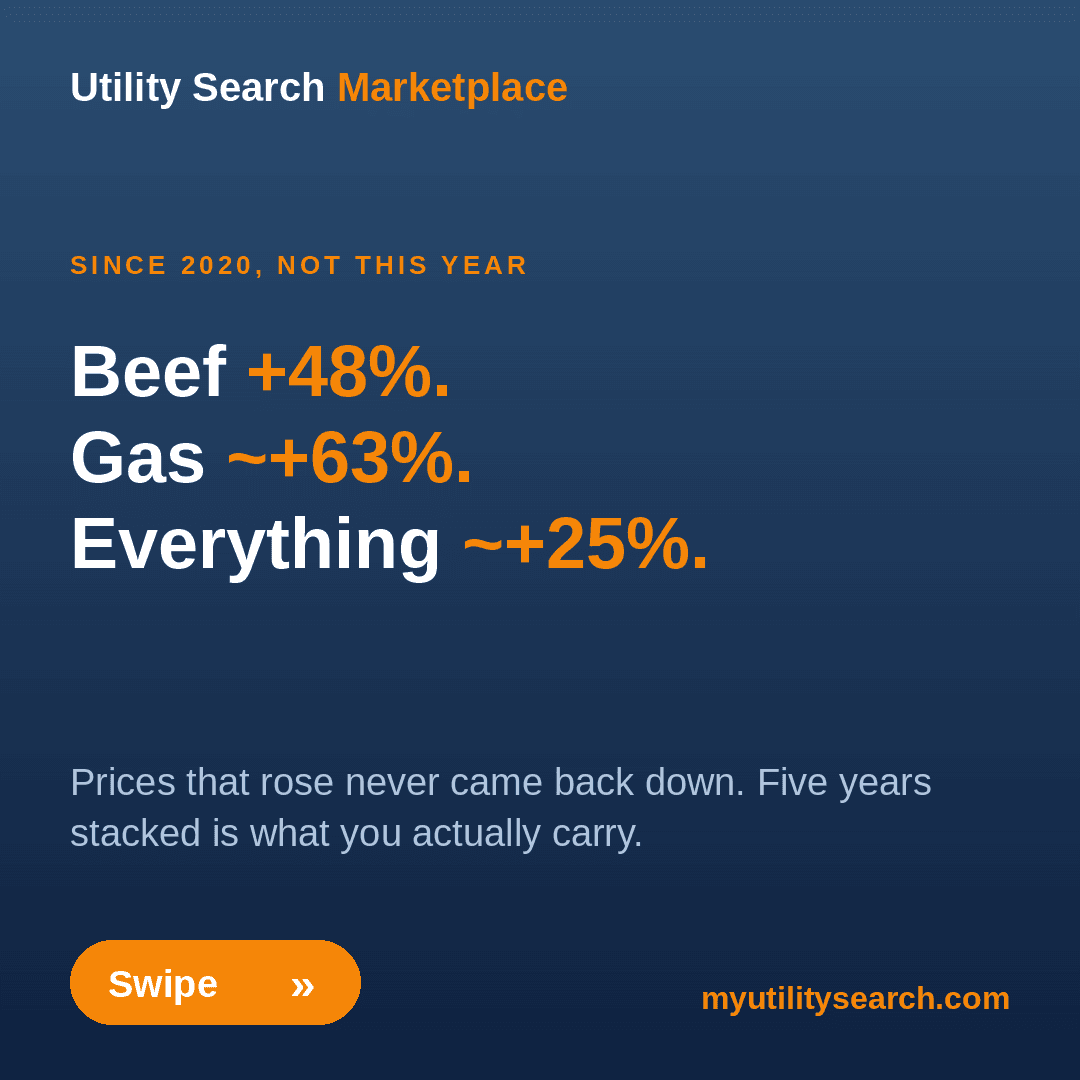
What five years actually did: inflation since 2020
Look at the dark bars, not the orange ones. Measured against 2020:
- Gasoline is up roughly 63% — about $2.54 a gallon in January 2020, around $4.15 now. The latest spike is the 2026 energy shock, but gas was already well above its 2020 level before that.
- Ground beef is up about 48% since mid-2020 — driven by the smallest U.S. cattle herd in decades, a supply squeeze that won’t resolve quickly.
- Groceries overall, shelter, and the entire cost of living are each up roughly a quarter since 2020 — meaning prices rose more in these five years than in the entire fifteen years before them.
None of these came back down. That is the part the yearly number is structurally incapable of showing you, and it’s exactly why “cooling inflation” lands like a slap when your own budget tells a different story.
The honest part nobody selling you something will say
We could stop here and let the outrage sit. Plenty of sites would. But here’s the candid truth: most of this is genuinely outside your control. You cannot negotiate the price of beef. You cannot vote down the price of gas at the pump. Five years of compounded grocery and housing inflation since 2020 is not coming back, no matter how angry the chart makes you.
So the only honest, useful thing left to say is this: focus your energy on the bills you can still change. Three of your recurring household costs are not fixed by global oil markets or cattle herds — electricity, internet, and home security. In deregulated states you can often switch your electricity supplier outright. Internet and security plans almost always have a better-priced option than the one you quietly auto-renewed into. Those are the levers still in your hand.
That’s not a sales pitch dressed as advice. It’s the one place the math actually moves in your favor this year.
What you can do this week
You can’t undo inflation since 2020 or five years of price increases. You can stop overpaying on the three bills that are still negotiable. Comparing electricity, internet, and home security for your address takes about five minutes, costs nothing, and is the rare move that pays you back every month instead of just once.
Beat inflation where you actually can. Compare electricity, internet, and home security for your address — free. myutilitysearch.com or call (844) 437-9527. 100% free to you — providers pay us, never you. No SSN required.
Frequently asked questions
Did inflation come in higher than expected in May 2026?
No — the May 2026 CPI rose 4.2% year-over-year, which was in line with economists’ forecasts. What makes it significant is that it’s the highest annual rate in three years and the third consecutive month of acceleration, not that it beat expectations.
How much have prices really gone up since 2020?
Measured against 2020, overall U.S. prices are up about 25%, groceries about 25%, shelter about 24%, gasoline roughly 63%, and ground beef about 48%. These cumulative figures — not the smaller year-over-year numbers — reflect what households actually experience, because prices that rose did not come back down.
Why is consumer confidence at a record low if inflation is “only” 4.2%?
Because people experience the cumulative price level, not the annual rate. University of Michigan consumer sentiment fell to 44.8 in May 2026, the lowest in the survey’s roughly 70-year history, as more than half of respondents said high prices were eroding their finances. The yearly figure looks mild; five years of stacked increases do not.
What can I actually do about high prices?
You can’t control gas, groceries, or five years of past inflation, but you can re-shop the recurring bills that aren’t set by global markets: electricity, internet, and home security. In deregulated states you can switch electricity suppliers, and most households can find a better internet or security plan than their current auto-renewed rate.
Is comparing utility providers really free?
Yes. On Utility Search Marketplace, comparing electricity, internet, and home security for your address is 100% free to you — providers pay us, never you — and no SSN is required. You enter your address once and see apples-to-apples options across all three.
Sourcing note: Year-over-year inflation and sentiment figures are from the U.S. Bureau of Labor Statistics May 2026 Consumer Price Index report and the University of Michigan Surveys of Consumers, as reported June 10, 2026. The 4.2% CPI reading was reported as in line with economists’ expectations. Five-year (since-2020) figures reflect the change in price level and are drawn from BLS CPI category indexes, BLS Average Price data (ground beef, about +48% since July 2020), and EIA/AAA retail gasoline data (about $2.54/gal in January 2020 to roughly $4.15 today, about +63%). Economic data is current as of June 10, 2026 and subject to revision.
Keep going
- How to lower your utility bills in 2026 (the practical guide)
- Energy hub: choose an electricity plan in a deregulated state
- Internet hub: compare plans by true all-in cost
- BLS Consumer Price Index (official report)
myutilitysearch.com · (844) 437-9527 · Free to you — providers pay us