Blog
Does Homeowners Insurance Cover Plumbing? What’s Covered and What’s Not

Does homeowners insurance cover plumbing? Usually yes for sudden, accidental failures — and usually no for slow leaks and worn-out pipes. Your policy is built to pay for damage, not for maintenance. A pipe that bursts overnight is a covered event. A faucet that has dripped for eight months is a repair bill.
TL;DR: Homeowners insurance covers sudden and accidental water damage from plumbing — burst pipes, frozen pipes, a supply line that lets go. It generally excludes gradual leaks, wear and tear, and in most cases the cost of repairing the pipe itself. That gap between “the damage” and “the pipe” is exactly where a home warranty picks up.
Last updated: July 19, 2026 · Reviewed by the MyUtilitySearch team
Does homeowners insurance cover plumbing? The short answer
Insurers draw one line, and almost every plumbing claim is decided by it: was the failure sudden and accidental, or did it happen gradually? The Washington State Office of the Insurance Commissioner puts it plainly: “Homeowner insurance usually covers sudden leaks, but may not cover gradual leaks.”
So when people ask does homeowners insurance cover plumbing, the honest answer is that it depends far less on the pipe and far more on the timeline. A washing machine hose that fails at 2 a.m. and floods a kitchen is the classic covered claim. The same kitchen, ruined slowly by a supply line that wept behind the cabinet for a year, is usually denied as a maintenance issue.
What plumbing damage homeowners insurance covers
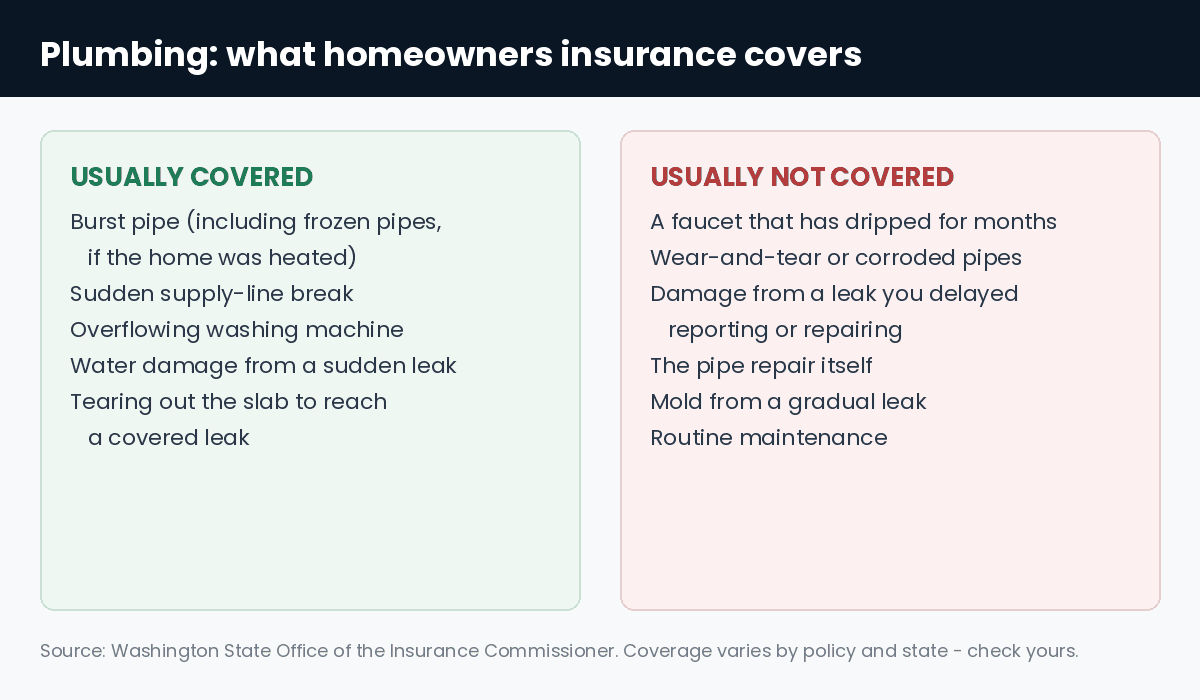
Most standard HO-3 policies cover water damage caused by a sudden plumbing failure inside the home. In practice, does homeowners insurance cover plumbing events like these? Generally, yes:
- Burst pipes, including frozen pipes — provided you kept the home reasonably heated.
- A supply line that suddenly gives way behind a toilet, sink, or washing machine.
- An overflowing appliance such as a washing machine or dishwasher.
- Water damage to floors, drywall, cabinets and belongings caused by that sudden failure.
- Tear-out costs — opening a wall, ceiling, or slab to reach the covered leak.
One condition matters more than homeowners expect: you have to act fast. Insurers typically require you to report the loss promptly and take reasonable steps to stop further damage. Delay repairs and a covered claim can turn into a denied one.
What plumbing homeowners insurance does not cover
This is where most denials happen. When homeowners ask does homeowners insurance cover plumbing repairs, the answer is usually no — policies pay to fix what the water ruined, not to fix the plumbing that failed. Commonly excluded:
- Gradual leaks. A dripping faucet or a slow seep behind a wall.
- Wear and tear. Corroded, aging, or failing pipes at the end of their service life.
- The pipe repair itself. Even on a covered claim, the pipe is often your cost.
- Mold resulting from a gradual leak. Regulators note mold, rot and rust are typically the homeowner’s responsibility unless they stem from covered water damage.
- Neglected maintenance, or damage worsened because a known leak went unrepaired.
- Sewer and drain backups, unless you bought that endorsement separately.
Does homeowners insurance cover slab leaks?
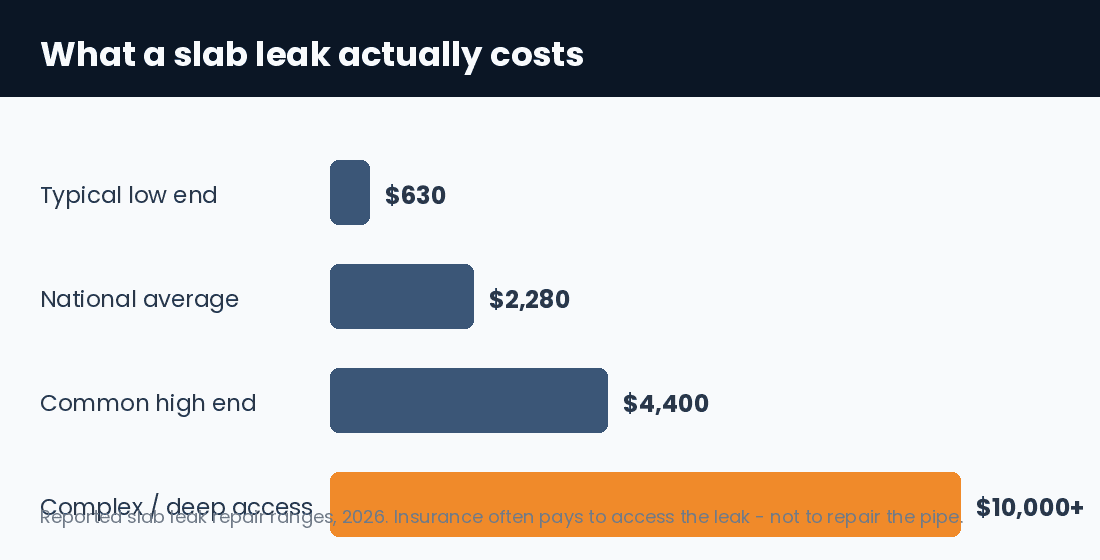
Slab leaks are the costliest version of this question, and the most misunderstood. Does homeowners insurance cover plumbing under a concrete slab? Typically it covers getting to the leak and repairing the resulting damage — the jackhammering, the tear-out, the flooring — if the leak qualifies as sudden and accidental. What it usually will not pay for is the broken pipe itself.
That distinction has real money attached. Reported slab leak repairs run from roughly $630 on the low end to about $4,400 at the high end, with a national average near $2,280 — and complex or deep-access jobs can exceed $10,000.
Slab leaks hit hardest in slab-foundation states like Texas, Arizona and Florida, where the plumbing runs beneath the concrete. If your home sits on a slab, it is worth knowing your deductible and your policy language before you need them.
Does homeowners insurance cover plumbing, or does a home warranty?
These two products are often confused, and the difference is simple. Homeowners insurance covers sudden damage. A home warranty covers mechanical failure from normal use. Ask does homeowners insurance cover plumbing that simply wore out, and the answer is almost always no — that is a home warranty’s job.
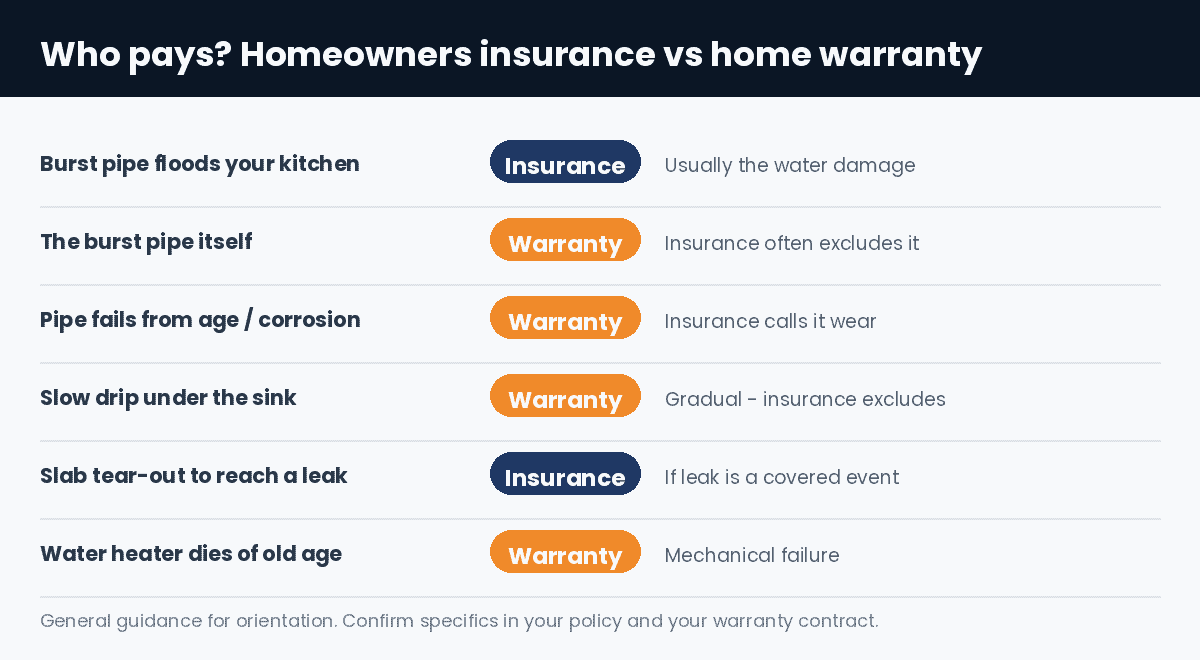
In an older home, the two work as a pair: insurance protects you from the catastrophic flood, while a warranty absorbs the routine failures of aging pipes, water heaters and fixtures. Our guide on the difference between home insurance and a home warranty breaks the coverage lines down further, and whether home warranty plans are worth it walks through the math on an older home.
The same split shows up with heating and cooling — see does homeowners insurance cover HVAC replacement, where a failed compressor follows exactly this logic.
Which one do you actually need?
If your home is newer and the plumbing is original, insurance alone may be enough — the pipes are years away from wear-related failure. The calculus flips in an older home. Once supply lines, shutoff valves and a water heater are all past the midpoint of their service life, the failures you are most likely to face are precisely the ones insurance excludes. Homeowners who ask does homeowners insurance cover plumbing in a 30-year-old house are usually discovering that gap the expensive way.
A practical test: price the replacement of your water heater, your main shutoff, and one section of supply line. If those numbers would strain your emergency fund, a service contract is doing real work. If they would not, self-insuring the wear items and keeping your policy for catastrophic loss is perfectly reasonable. Reviews like is Choice Home Warranty worth it and our American Home Shield vs Choice Home Warranty comparison are useful for checking what a given plan actually covers on the plumbing side — coverage caps and excluded components differ far more than the marketing suggests.
One more thing worth knowing before you shop: most warranty contracts exclude pre-existing conditions and impose a waiting period, typically around 30 days. Buying a plan the week your pipe starts leaking will not solve that leak. This is coverage you put in place before you need it — the same reason the answer to does homeowners insurance cover plumbing surprises so many people at the worst possible moment.
What to do the moment you find a plumbing leak
- Shut off the water at the fixture or the main. Stopping the loss protects both your home and your claim.
- Photograph everything before cleanup — standing water, damaged materials, and the failure point itself.
- Call your insurer promptly. Late reporting is a common reason claims get reduced or denied.
- Dry it out fast. Mold from delayed drying is often excluded, and it compounds the loss.
- Keep every receipt, including emergency mitigation. Those costs are frequently reimbursable.
- Read your declarations page for your deductible and any water-damage sublimit before you file — a $900 repair against a $2,500 deductible is not worth a claim on your record.
Coverage language varies meaningfully between carriers and states, so treat this as orientation and confirm the specifics in your own policy. If your premium has climbed, it is also a reasonable moment to compare home insurance rates.
Does homeowners insurance cover plumbing FAQs
Does homeowners insurance cover plumbing repairs?
Usually not. Homeowners insurance covers the water damage a sudden plumbing failure causes, but the repair of the pipe itself is typically the homeowner’s expense. A home warranty is the product designed to cover the plumbing system.
Does homeowners insurance cover plumbing leaks?
It depends on how the leak happened. Sudden and accidental leaks are usually covered. Gradual leaks — a faucet dripping for months, or a slow seep behind a wall — are generally excluded as maintenance.
Does homeowners insurance cover a burst pipe?
Yes, in most standard policies. Burst and frozen pipes are treated as sudden and accidental events, provided the home was kept reasonably heated and you report the loss promptly.
Does homeowners insurance cover slab leaks?
Typically it covers the cost of accessing the leak and repairing the resulting damage, including tear-out of the slab, when the leak is sudden and accidental. It usually does not cover repairing the pipe itself.
Why was my plumbing claim denied?
The most common reasons are that the insurer classified the leak as gradual or wear-and-tear, that the damage was worsened by delayed reporting or repair, or that the loss came in under the deductible. Mold from a long-running leak is also frequently excluded.
Should I file a claim for a small plumbing leak?
Compare the repair estimate to your deductible first. If the repair is close to or below the deductible, filing may cost you more in future premium than it returns, and the claim stays on your loss history.
Keep going
- Does homeowners insurance cover HVAC replacement?
- Home insurance vs home warranty
- Are home warranty plans worth it?
- Compare home insurance rates and save
- American Home Shield vs Choice Home Warranty
- Hidden costs of owning a home
- Whole-house water filter cost
The water-damage distinction that decides most claims
Most disputes over does homeowners insurance cover plumbing come down to a single question: was the water sudden and accidental, or gradual? Policies are built to pay for the first and to exclude the second, and that line explains outcomes that otherwise look arbitrary.
There is a second boundary worth knowing. Water that rises from outside the home is flood damage, which standard homeowners policies exclude entirely — that is a separate policy, as FEMA’s flood insurance program explains. So a burst supply line is typically a covered event, while groundwater entering the same basement on the same day is typically not.
Prevention strengthens your position either way. The EPA’s WaterSense monthly meter check catches slow leaks early, and documented maintenance is exactly the evidence that keeps an adjuster from classifying a failure as long-term neglect when you ask does homeowners insurance cover plumbing after a loss.