Blog
Does Home Warranty Cover HVAC? What’s Covered, Caps and Replacement


Updated on September 17, 2026
Does home warranty cover HVAC? Yes — a home warranty covers your heating and cooling system when it fails from normal wear: the furnace, central air conditioner, heat pump, thermostat and usually the ductwork. What it does not do is pay the full cost of a replacement. Every plan sets a dollar cap, and that cap is almost always smaller than a new system costs.
TL;DR: A home warranty covers HVAC repair and replacement caused by normal wear, regardless of the system’s age, as long as it worked when the contract began. But coverage is capped — commonly $1,500 to $5,000 per system — while a full HVAC replacement runs $6,500 to $16,000. The warranty absorbs a real chunk of that, not all of it. Pre-existing failures, poor maintenance and refrigerant beyond a low cap are the usual exclusions.
Last updated: July 20, 2026 · Reviewed by the MyUtilitySearch team
Does home warranty cover HVAC? What is included
A home warranty is a service contract that repairs or replaces covered systems when they break down from normal use. So when homeowners ask does home warranty cover HVAC, the answer is that it covers the mechanical heart of the system:
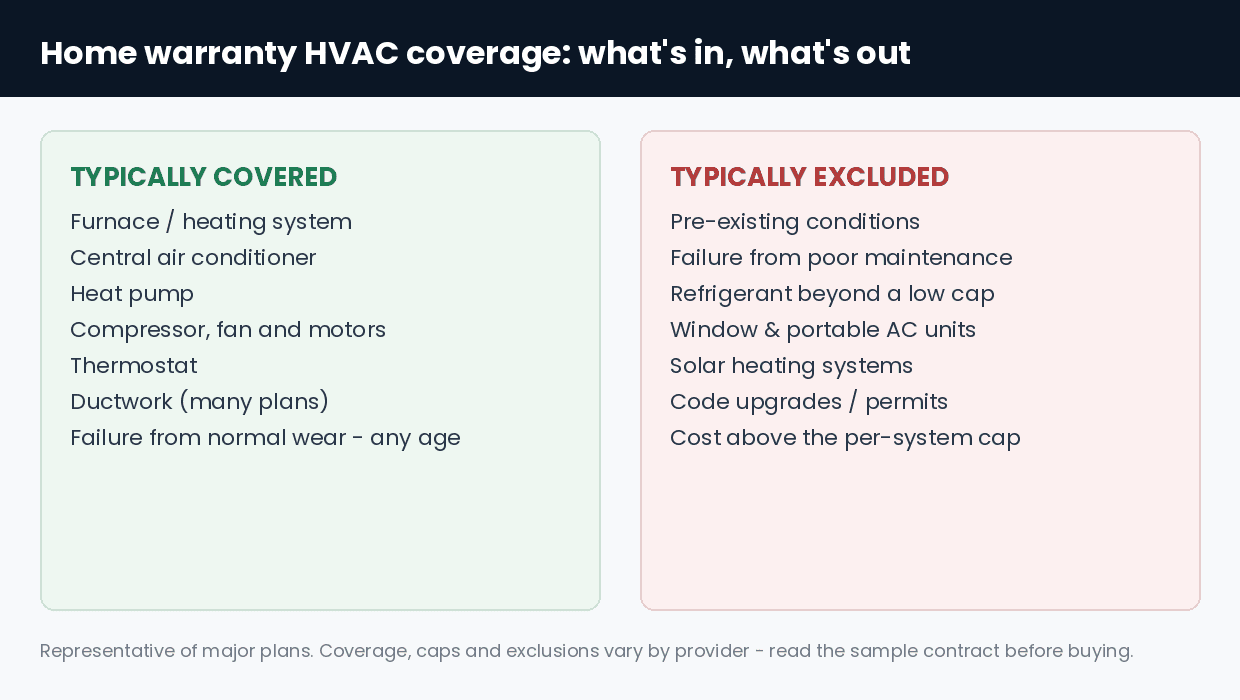
- Furnace and heating system, including heating elements.
- Central air conditioner, including the compressor, fan and motors.
- Heat pump systems.
- Thermostat.
- Ductwork, on many plans.
One feature makes a home warranty distinct from a manufacturer’s warranty: age generally does not matter. A manufacturer warranty expires; a home warranty typically covers an HVAC system regardless of how old it is, as long as the system was in working order when the contract started and later fails from ordinary wear. For an aging furnace or a 15-year-old condenser, that is exactly the failure profile a warranty is built for.
Get a Free Choice Home Warranty Quote →
What a home warranty will not cover on HVAC
The exclusions decide most HVAC claims, and they are consistent across providers. Ask does home warranty cover HVAC in these cases and the answer is usually no:
- Pre-existing conditions. A system already failing when you bought the plan is not covered.
- Improper maintenance. Warranties expect basic upkeep — filter changes and periodic servicing. Neglect is a common denial reason, and providers can request maintenance records.
- Refrigerant beyond a low cap. Many plans reimburse only a small amount of refrigerant, which can be a meaningful out-of-pocket cost on an older AC.
- Window units, portable heaters and solar heating. Typically excluded entirely.
- Code upgrades and permits. If replacement triggers a code requirement, the difference is usually yours.
- Anything above the per-system cap. The single most important number in the contract — covered next.
Does home warranty cover HVAC replacement in full?
This is where expectations and contracts diverge. A home warranty can replace an HVAC system it deems irreparable from a covered failure — but it pays only up to the plan’s coverage cap, and it replaces with comparable capacity and efficiency, not an upgrade.
The gap is real. HVAC coverage caps commonly run $1,500 to $5,000 per system. A full HVAC replacement in 2026 runs $6,500 to $16,000, with furnaces at $2,500–$8,000, air conditioners at $3,500–$10,000 and heat pumps reaching $14,000 or more.
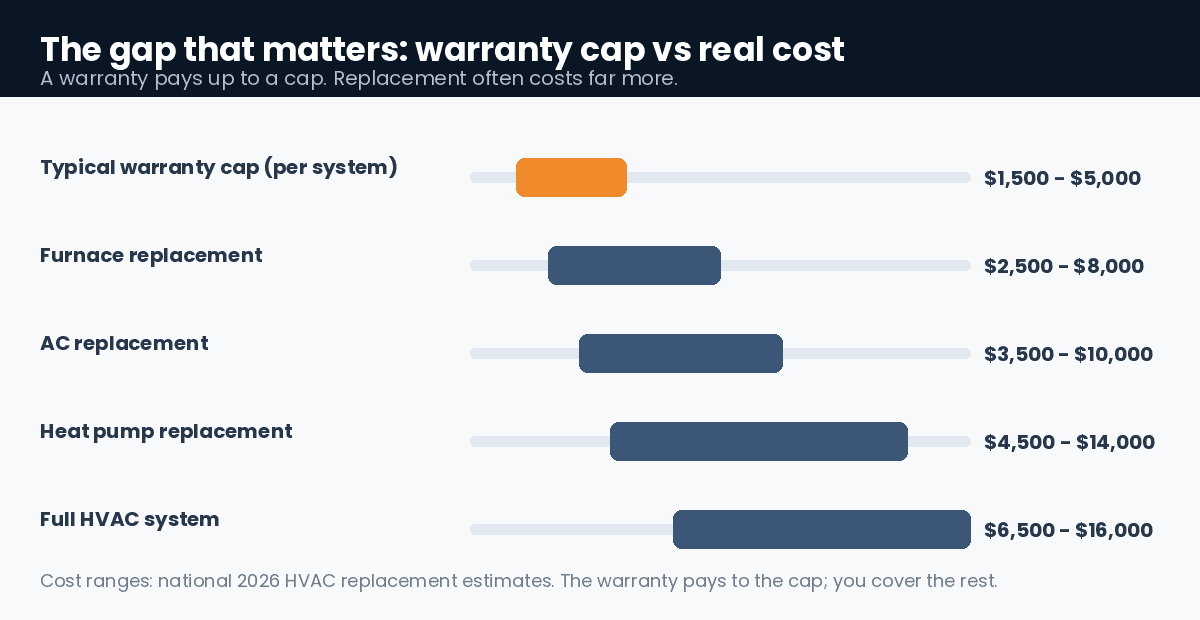
So the honest way to size the value: on a $10,000 system failure, a warranty with a $3,000 cap pays $3,000 and you cover the rest. That is not full coverage — but it is $3,000 you did not have, minus a service fee of roughly $65 to $125. Whether that math works depends on your system’s age and the plan’s specific cap, which is why the cap matters far more than the monthly premium when you compare plans.
How an HVAC claim actually works
Knowing the sequence prevents the two mistakes that get HVAC claims denied — acting without authorization, and skipping the maintenance question.
- File with the warranty company first. Most contracts require authorization before any work begins; a repair you arrange yourself is routinely denied.
- Pay the service fee when the assigned technician is dispatched — typically $65 to $125.
- The technician diagnoses the cause. Normal wear is generally covered; neglect, misuse or a pre-existing condition is not. This is the step where maintenance records matter.
- Repair or replacement proceeds to the cap. If the system is beyond repair, the plan replaces it with comparable equipment, up to the coverage limit, and you pay any balance above it.
Two practical notes. HVAC failures cluster in the hottest and coldest weeks of the year, exactly when contractor demand peaks — so ask your provider about response-time guarantees before you need one. And if the failure also caused property damage, such as water from a failed condensate line, that damage may be a homeowners insurance matter even though the unit itself is a warranty claim.
Does home warranty cover HVAC, or does homeowners insurance?
These two products are constantly confused, and the line between them is clean. A home warranty covers wear. Homeowners insurance covers sudden damage. An HVAC unit that dies of old age is a warranty claim. An HVAC unit destroyed by a covered peril — a fallen tree, a fire, a lightning strike — is an insurance claim.
Insurance will not pay when a compressor simply wears out, which is the most common way HVAC fails. For the insurance side in detail, see does homeowners insurance cover HVAC replacement, and our full home insurance vs home warranty comparison.
Is a home warranty worth it for HVAC?
It comes down to the age of your system. On a newer HVAC unit still under manufacturer warranty, a home warranty largely duplicates coverage you already have. On a system past the ten-year mark — where compressors, heat exchangers and blower motors start to fail — a warranty targets exactly the repairs you are most likely to face, and those repairs are precisely what homeowners insurance excludes.
A quick way to decide: compare the annual premium plus two service fees against the cost of one likely repair — a compressor replacement or a control-board failure often runs $1,500 to $3,000 on its own. If a single failure would strain your budget, the plan is doing real work. Our guide on whether home warranty plans are worth it runs the full math, and reviews like is Choice Home Warranty worth it and American Home Shield vs Choice Home Warranty show how the major providers differ on HVAC caps specifically.
One rule to remember before you shop: pre-existing conditions and a waiting period, usually around 30 days, are near-universal. The homeowner asking does home warranty cover HVAC after the furnace already quit has asked too late for that repair. This is coverage you buy before you need it.
Get a Free Choice Home Warranty Quote →
Does home warranty cover HVAC FAQs
Does home warranty cover HVAC replacement?
Yes, when the system is deemed irreparable from a covered wear-and-tear failure — but only up to the plan’s coverage cap, commonly $1,500 to $5,000 per system. Because a full replacement often costs $6,500 to $16,000, the warranty typically covers part of the bill, not all of it.
Does a home warranty cover an old HVAC system?
Usually yes. Unlike a manufacturer warranty, a home warranty generally covers HVAC regardless of age, provided the system worked when the contract began and later fails from normal wear rather than a pre-existing condition.
Does home warranty cover HVAC if I skipped maintenance?
Often no. Improper or neglected maintenance is a common exclusion, and providers can request service records. Keeping filter-change and annual-service documentation protects your claim.
Does a home warranty cover refrigerant (Freon)?
Only partially on most plans. Refrigerant is frequently capped at a low reimbursement amount, so a significant recharge on an older AC can leave a meaningful out-of-pocket cost.
What is the HVAC coverage cap on a home warranty?
Most plans cap HVAC at $1,500 to $5,000 per system per contract term, sometimes with separate caps for heating and cooling. The cap is the most important figure to compare between plans — it determines how much of a large repair or replacement is actually paid.
How much does a home warranty cost for HVAC coverage?
Plans generally run a monthly premium plus a per-visit service fee of about $65 to $125. Weigh both against the coverage cap and the age of your system to judge whether the plan pays for itself.
Get a Free Choice Home Warranty Quote →
Compare internet, energy & home security at your address
Keep going
- Home warranty guide: plans, costs and honest pros and cons
- Home warranty cost — average premiums, service fees and prices by provider
- Does homeowners insurance cover HVAC replacement?
- Does home warranty cover plumbing?
- Home insurance vs home warranty
- Are home warranty plans worth it?
- Is Choice Home Warranty worth it?
- American Home Shield vs Choice Home Warranty
- Hidden costs of owning a home
How to judge the coverage against what your system is worth
Before deciding whether a warranty is worth it, it helps to know what your equipment should cost to run and how long it should last. The Department of Energy’s heating and cooling guidance puts typical HVAC at around half of a home’s annual energy use, and notes that most central systems are designed for roughly 15 to 20 years of service with maintenance.
That matters for the question does home warranty cover hvac in a practical way. When you ask does home warranty cover hvac, age is the real variable: a system in year three rarely fails from wear, so the coverage mostly buys peace of mind. A system in year twelve is entering the window where compressors and heat exchangers do fail — and where a cap that pays a fraction of replacement becomes the deciding number. If your unit carries an ENERGY STAR rating and was installed recently, your money is often better spent on maintenance than on a contract.
One more angle on does home warranty cover hvac: coverage follows the failure, not the age, which is the detail most does home warranty cover hvac comparisons miss. Because most contracts pay for breakdowns from normal wear regardless of equipment age, an older system is where the math tilts toward buying — provided you have read the cap and the exclusions first.