Blog
Does Homeowners Insurance Cover HVAC? When It Pays & When It Won’t

Updated on October 25, 2026
12 min read
Does homeowners insurance cover HVAC systems? The answer depends on the cause of failure. When homeowners insurance cover HVAC claims are approved, it’s typically for sudden, accidental damage — not general wear and tear. Does homeowners insurance cover HVAC replacement? — the honest answer is: it depends on why it broke.The National Association of Insurance Commissioners (NAIC) provides resources to understand what standard homeowners insurance policies cover.
This is one of the most common questions homeowners ask after their AC or furnace dies — often in the worst possible timing (July heatwave, January freeze).
Let’s cut through the confusion.
The Short Answer
Yes, homeowners insurance covers HVAC damage — but only if the damage was caused by a covered peril.
No, homeowners insurance does NOT cover HVAC breakdowns from normal wear and tear, age, or mechanical failure.
That distinction is the entire ballgame.
Get a Free Choice Home Warranty Quote →
When Homeowners Insurance DOES Cover HVAC
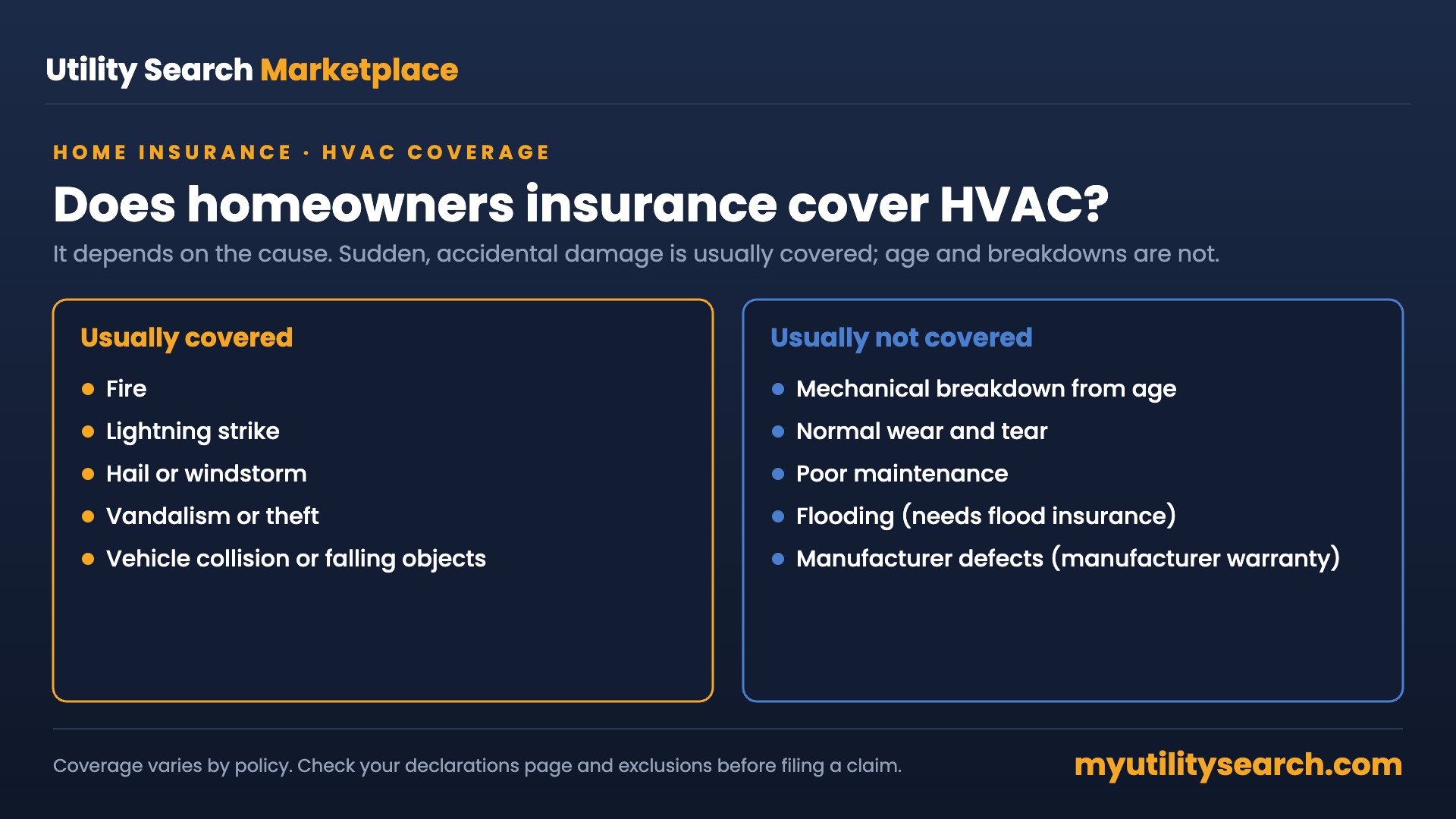
Your standard homeowners insurance policy will typically pay to repair or replace your HVAC system if it’s damaged by:
- Fire — a fire in your home damages the HVAC unit or ductwork
- Lightning strike — a direct lightning hit fries your AC compressor or furnace control board
- Vandalism — someone intentionally damages your outdoor condenser unit
- Theft — copper coils or components stolen from your outdoor unit (unfortunately common)
- Hail or windstorm — a severe storm crushes or damages the outdoor condenser (subject to your windstorm deductible)
- Vehicle collision — a car hits your outdoor unit
- Falling objects — a tree branch falls on and damages your unit
These are called “covered perils” — sudden, accidental events outside your control. Your policy will kick in after your deductible.
When Homeowners Insurance Does NOT Cover HVAC
This is where most homeowners get frustrated.
Homeowners insurance specifically excludes:
- Mechanical breakdown — your 14-year-old AC compressor dies from age and use
- Normal wear and tear — parts wearing out over time is expected and excluded
- Poor maintenance — failure to change filters, clean coils, or service the system annually can void claims
- Flooding — if your HVAC unit is damaged by a flood, standard homeowners insurance doesn’t cover it (you need separate flood insurance)
- Manufacturer defects — covered under manufacturer warranty, not your home policy
Here’s the reality: most HVAC failures are mechanical breakdowns — compressor failures, refrigerant leaks, heat exchanger cracks. These are almost never covered by homeowners insurance.
What Actually Protects Your HVAC Against Breakdown?
Three options:
1. Manufacturer Warranty
New HVAC equipment typically comes with 5–10 year manufacturer warranties on parts. Labor is often not included after year 1. Keep your registration card — many warranties require product registration to be valid.
2. Home Warranty
A home warranty is specifically designed to cover HVAC mechanical breakdowns. For $40–$65/month, most home warranty plans cover HVAC repair and replacement when the system fails from wear and tear.
This is the coverage gap that homeowners insurance leaves. A home warranty fills it directly.
See our full comparison: Home Insurance vs Home Warranty: What’s the Difference?
3. HVAC Service Contract
Some HVAC contractors offer their own service contracts — covering annual maintenance plus repair labor. These are more limited than full home warranties but can be valuable for aging systems.
HVAC Replacement Cost: What’s at Stake
This matters because the numbers are significant:
- Central AC unit replacement: $3,500–$7,500
- Furnace replacement: $2,500–$6,000
- Full HVAC system (AC + furnace + installation): $7,000–$15,000+
- Heat pump replacement: $4,000–$8,000
Without any coverage, an HVAC failure is one of the most expensive home repairs a homeowner faces. It’s also one of the most common — HVAC systems typically last 15–20 years.
If your system is 10+ years old, this risk is real and worth planning for.
How to File an Insurance Claim for HVAC Damage
If your HVAC was damaged by a covered peril (lightning, fire, hail, theft, etc.):
- Document the damage with photos and video immediately
- Get a written estimate from a licensed HVAC contractor
- Contact your insurance company to file a claim
- An adjuster will inspect the damage and confirm coverage
- Pay your deductible; insurance covers the rest up to your coverage limit
Don’t assume it’s not covered — always file and let the adjuster determine eligibility. Claim denials can be appealed.
Get a Free Choice Home Warranty Quote →
FAQs: Homeowners Insurance and HVAC
Does homeowners insurance cover AC unit replacement?
Only if the AC unit was damaged by a covered peril like lightning, fire, hail, or theft. It does not cover AC replacement due to old age, mechanical failure, or normal wear and tear.
Will homeowners insurance cover a furnace that stopped working?
Only if it stopped working due to a covered event (fire damage, lightning, etc.). Furnaces that fail from age, clogged filters, or mechanical breakdown are not covered by home insurance — they’re covered by a home warranty or HVAC service contract.
What is the difference between homeowners insurance and a home warranty for HVAC?
Homeowners insurance covers sudden, accidental damage from external events. A home warranty covers mechanical breakdowns from normal wear and tear. For HVAC, these two coverages are nearly complementary — you need both to be fully protected.
Does flood damage to HVAC get covered?
Not by standard homeowners insurance. Flood damage requires a separate flood insurance policy through the NFIP (National Flood Insurance Program) or a private flood insurer. If your outdoor AC unit or air handler was flooded, check your flood policy.
When Does Homeowners Insurance Cover HVAC Systems?
Homeowners insurance cover HVAC replacement when the damage is sudden and accidental — for example, if lightning strikes your AC unit or a fire damages your furnace. Standard policies typically will homeowners insurance cover HVAC equipment if it’s directly damaged by a covered peril like fire, wind, or a fallen tree. However, homeowners insurance cover HVAC claims are routinely denied for mechanical breakdown, wear and tear, or poor maintenance. If you want protection specifically for HVAC mechanical failure, consider a home warranty instead — it’s designed to cover what homeowners insurance cover HVAC policies typically exclude.
Homeowners insurance and HVAC: the questions people ask, answered
What people type after an HVAC failure, in their own words, answered as of October 2026. Policy language varies by carrier and state; your declarations page and your agent have the final word.
Lightning took out my HVAC unit. Is that covered by a normal homeowners policy?
Yes, in nearly every standard HO-3 policy. Lightning is a named peril, and the power surge it sends through the house is treated as lightning damage, so a condenser, air handler or furnace control board that fails after a strike is covered up to your dwelling limit, minus your deductible. The adjuster will want evidence: a weather-service record of strikes in your area that day, the HVAC technician’s report describing surge damage (scorched boards, failed capacitors, tripped breakers), and photos. The claim fails only when the technician’s report says ‘wear’ or ‘age’ rather than surge, so ask for the cause to be stated plainly. In Alabama and other states that follow standard policy language, the same rule applies: sudden lightning damage is covered, gradual failure is not.
Does homeowners insurance cover a broken or old HVAC unit that just stopped working?
No. Mechanical breakdown, age and wear are excluded from every standard homeowners policy, so a 15- or 20-year-old system that fails on its own is not a claim no matter how expensive the replacement is. Insurance covers sudden, external, named events (lightning, fire, wind, falling trees, vandalism, a burst pipe that floods the air handler); it does not insure the equipment against reaching the end of its life. For breakdown coverage you need a home warranty or an HVAC service contract, which is what most of the people searching this question actually need.
Can my air conditioner be replaced by homeowners insurance after severe weather (Nationwide, State Farm, Allstate)?
Yes, if the weather physically damaged it: hail dents the condenser fins, wind drops a limb on the unit, flying debris cracks the housing, or flooding submerges it (flood needs a separate flood policy). All major carriers, Nationwide included, treat these as covered wind and hail perils under the dwelling coverage. What they do not cover is a unit that happened to fail during or after a storm without physical storm damage, which the adjuster will call a mechanical failure. Photograph the damage before any repair and get the technician to document the storm-caused cause on the invoice.
Will insurance pay to replace my HVAC if the wrong refrigerant was put in it, or if I accidentally cut the AC line?
Usually not for the refrigerant mistake: a contractor’s error is excluded as faulty workmanship, and the fix is a claim against the contractor’s liability insurance or a complaint to the state licensing board, not your homeowners policy. The accidental cut line is closer: some policies cover ‘accidental direct physical loss’ to the dwelling, and a one-time accident by the homeowner can qualify under an HO-5 or an open-perils policy; under a standard HO-3 it is often denied as not a named peril. Call your agent and ask which form you have before you file, because a denied claim still shows on your record.
Is there insurance I can buy for my furnace and AC condenser specifically?
Yes, three kinds. A home warranty ($45 to $80 a month) covers mechanical breakdown of the whole HVAC system for a per-visit service fee of $75 to $125, and is the product most people mean. An HVAC service contract from a local dealer covers one system, usually with maintenance visits included. And some insurers sell an equipment breakdown endorsement on the homeowners policy for $25 to $50 a year that covers sudden mechanical and electrical failure of built-in systems; it is the cheapest option but excludes wear, and not every carrier offers it. Compare home warranty plans at the bottom of this page.
Do homeowners policies cover heat pumps and central air the same way?
Yes. Heat pumps, central air conditioning, furnaces, boilers and mini-splits are all treated as part of the dwelling when they are permanently installed, so the same rules apply: covered for named perils, excluded for breakdown and wear. Window units and portable air conditioners fall under personal property instead, with a lower limit and the same peril rules. Geothermal loops buried in the yard can be a gray area; ask your agent whether the underground piping is covered as dwelling or as ‘other structures’.
Should I tell my homeowners insurance company that I replaced my HVAC?
Yes, and it usually helps you. A new system lowers the carrier’s risk of a fire or water claim, several insurers give a small discount for updated major systems, and when the policy asks ‘has the heating system been replaced?’ they mean the furnace, boiler or heat pump that heats the house, not the thermostat or ductwork. Reporting the replacement also updates the dwelling value so a future claim pays for the new equipment rather than a depreciated old one. Keep the invoice; it is what the adjuster asks for.
What does it mean when the HVAC contractor is ‘authorized to complete the system’ by the insurance company?
It means the adjuster has approved the scope of work and the contractor can proceed and bill the insurer directly for the approved amount, less your deductible. It does not mean everything the contractor wants to do is covered: upgrades, code-required changes beyond what the policy includes, and anything the adjuster listed as pre-existing are your cost. Ask for the written approval and compare it line by line with the contractor’s quote before work starts.
What percentage of a replaced HVAC does insurance usually cover?
On a covered claim, the full replacement cost minus your deductible if your policy has replacement cost coverage, which most do for the dwelling; if you have actual cash value coverage, the insurer subtracts depreciation, so a 12-year-old $9,000 system might pay $3,000 to $4,000. There is no fixed percentage. The number that matters most is the deductible: with a $2,500 wind and hail deductible, a $7,000 condenser claim nets $4,500, and small claims are often not worth filing because of the premium impact.
Can I claim loss of use if my HVAC is not working?
Only if the HVAC failure is itself part of a covered claim and the home is uninhabitable as a result, for example a fire that destroyed the furnace in January. A mechanical failure in August is miserable but not a covered loss, so there is no loss-of-use payment for a hotel. Home warranties do not pay loss of use either; some offer a small emergency lodging credit when a covered repair runs past a set number of days.
My DIY HVAC installation was denied. Why, and what can I do?
Carriers deny claims on self-installed systems for two reasons: the damage is traced to improper installation (faulty workmanship is excluded), or the policy requires licensed installation for built-in equipment and a permit on file. If the loss was a covered peril unrelated to the installation, for example lightning, you can appeal with the technician’s cause report and the fact that the installation itself did not cause the loss. If the loss was caused by the installation, the policy will not pay, and a home warranty will also exclude it; the system needs to be brought up to code by a licensed contractor before any coverage applies going forward.
Could the siding repair crew have damaged my furnace, and is that an insurance claim?
Possibly, and it is a claim against the siding contractor, not your homeowners policy. If debris or paint chips entered the condenser or the furnace drain during the hail-damage siding work, the contractor’s general liability insurance covers the resulting damage; document the timing (drainage changed right after the work), keep the HVAC technician’s report and the unplugged-drain invoice, and send a written claim to the contractor. Your own carrier may help by adding it to the open hail claim if the siding work was part of that claim and the contractor was on their program.
Also searched as: does home insurance cover HVAC, does homeowners insurance cover AC units, home insurance HVAC replacement, HVAC insurance and will my homeowners insurance cover a new air conditioner. They all mean the same question.
Final Verdict
So, does homeowners insurance cover HVAC replacement in every situation? The answer depends on the cause.
Understanding whether homeowners insurance covers HVAC replacement can save you thousands of dollars.
Protect Your HVAC: Compare Coverage Options Free
Your homeowners insurance handles the unexpected disasters.
A home warranty handles the inevitable mechanical breakdowns.
At MyUtilitySearch.com, compare home warranty plans from top providers — including options that cover HVAC with no dollar caps — and find the right protection for your home.
Also explore:
Ready to Start Saving on Utilities?
Compare energy rates and internet plans side by side — free, in minutes.
Get a Free Choice Home Warranty Quote →
Also compare energy, home security and home warranty at your address
Electricity plans in 14 deregulated states. Security and warranty nationwide.