Blog
Does Home Warranty Cover Plumbing? What’s Covered and What’s Not

New: see how much a home warranty costs — average premiums, service fees, and prices by provider.
Does home warranty cover plumbing? Yes — most home warranty plans cover the plumbing system itself when it fails from normal use: leaks and breaks in supply lines, stoppages in main drains, toilets, faucets, valves and usually the water heater. What a home warranty does not cover is the water damage that failure caused. That side belongs to your homeowners insurance.
TL;DR: A home warranty covers plumbing that breaks down from age and wear. Homeowners insurance covers sudden damage the break causes. The two are complements, not substitutes — and the gaps that matter most are pre-existing conditions, waiting periods, coverage caps, and whether outside or underground lines are included.
Last updated: July 19, 2026 · Reviewed by the MyUtilitySearch team
Does home warranty cover plumbing? What is typically included
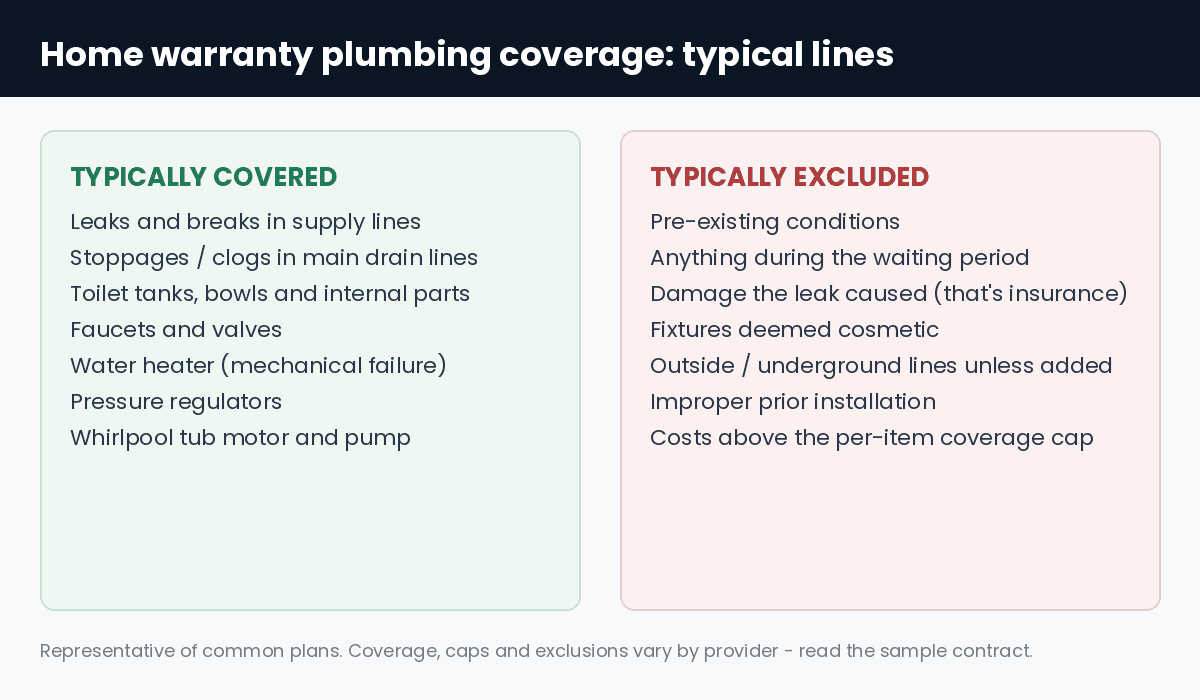
A home warranty is a service contract, not an insurance policy. It pays to repair or replace covered systems when they fail from normal wear. So when homeowners ask does home warranty cover plumbing, the practical answer is that it covers the working parts of the system:
- Leaks and breaks in water, drain, gas, waste or vent lines within the home’s foundation.
- Stoppages and clogs in main drain lines that are accessible through an existing cleanout.
- Toilets — tanks, bowls and internal mechanisms.
- Faucets, shower valves, and shutoff valves.
- Water heaters, when the failure is mechanical rather than age-based neglect.
- Pressure regulators and, on many plans, whirlpool tub motors and pumps.
What a home warranty will not cover on plumbing
The exclusions decide most claims, and they are consistent across the industry. Ask does home warranty cover plumbing in these situations and the answer is usually no:
- Pre-existing conditions. A leak that already existed when you bought the plan is not covered.
- Anything during the waiting period — commonly around 30 days from purchase.
- The resulting water damage. Ruined flooring and drywall are an insurance matter, not a warranty one.
- Outside or underground lines, unless you add that optional coverage.
- Improper prior installation or code violations from work done before you owned the plan.
- Costs above the per-item cap. This is the one people miss — see below.
Coverage caps: the number that actually matters
Every plan sets a dollar limit per covered item. If your plan caps plumbing at $500 and the repair runs $1,800, the plan pays $500 and you pay the rest. When comparing plans, the cap matters far more than the monthly premium — a cheaper plan with a low cap can leave you worse off on the one claim you actually file.
You will also pay a service call fee (commonly $75–$125) each time a technician is dispatched, regardless of whether the repair is approved. Budget for that as part of the real cost.
Two plan-level questions worth answering before you buy: does the plan let you choose your own contractor, and what is the process if a claim is denied? Our reviews of whether Choice Home Warranty is worth it and American Home Shield vs Choice Home Warranty walk through how the major providers differ on both.
Does home warranty cover plumbing in older homes?
This is where the question gets real. Plumbing has a service life: galvanized steel supply lines commonly last 40 to 60 years, copper 50 or more, and polybutylene — installed widely from the late 1970s into the mid-1990s — is known for failing early and is excluded outright by many plans. Homeowners in older housing stock asking does home warranty cover plumbing are usually asking at exactly the right time, because wear-related failure is the one thing insurance will not touch.
Two cautions specific to older homes. First, if a plan excludes polybutylene or galvanized pipe by name, a whole-house repipe will not be covered no matter how the failure presents. Second, most contracts cover repair rather than upgrade — if code now requires a different material, the difference in cost is typically yours. Read the sample contract for both before you buy, not after a claim.
How a plumbing claim actually works
- Shut off the water and stop the loss before anything else.
- File the claim with the warranty company first — most contracts require authorization before any work begins, and unauthorized repairs are routinely denied.
- Pay the service call fee when the assigned technician is dispatched.
- The technician reports the cause. This determines everything: normal wear is usually covered, while neglect, misuse or a pre-existing condition is usually not.
- Approved work proceeds up to the coverage cap, and you pay any balance above it.
If the damage extends beyond the plumbing itself — soaked flooring, ruined drywall, saturated insulation — open a homeowners insurance claim in parallel. The two claims cover different halves of the same event, and homeowners who only file one frequently leave money on the table.
Home warranty vs homeowners insurance for plumbing
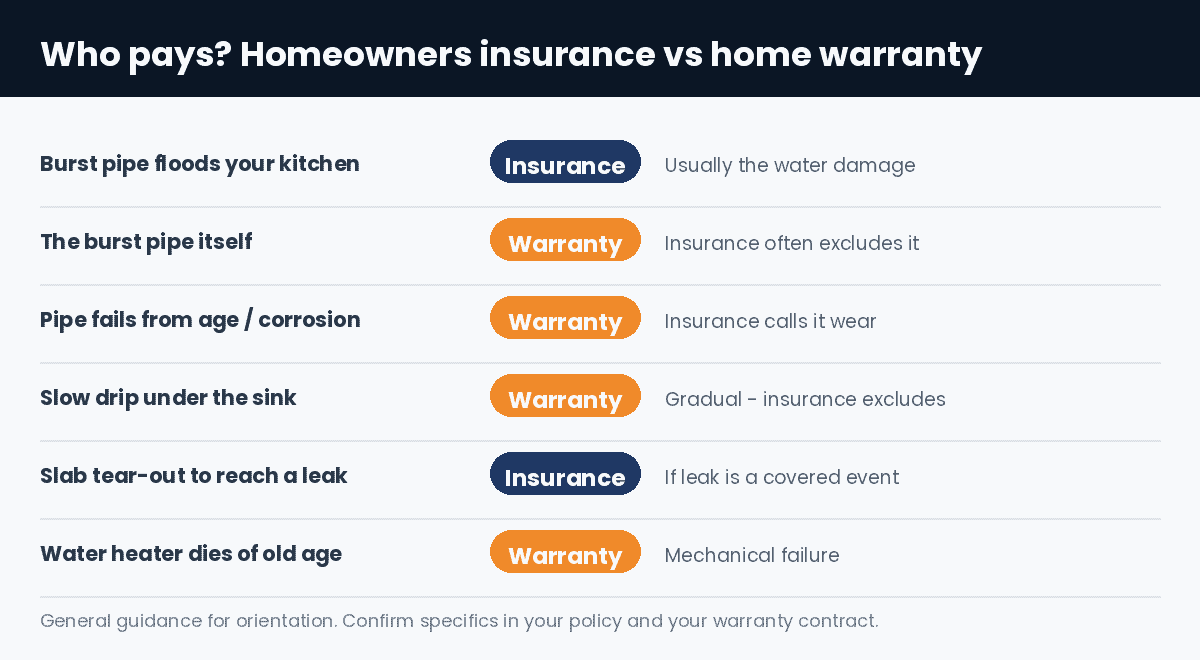
These two products get confused constantly, and the distinction is simple once you see it. Insurance responds to sudden events. A warranty responds to wear.
A pipe bursts and floods your kitchen: insurance handles the floor, the cabinets and the drywall; the warranty handles the pipe. A pipe corrodes and finally gives out after 28 years: insurance calls that wear and declines; the warranty is what pays. That is the whole logic, and it is why the answer to does home warranty cover plumbing so often depends on why the plumbing failed rather than what broke.
For the insurance half of this question in detail, see does homeowners insurance cover plumbing, and our full home insurance vs home warranty breakdown.
Is a plumbing home warranty worth it?
It depends almost entirely on the age of your plumbing. In a home under ten years old, supply lines and water heaters are unlikely to fail from wear, and you are largely paying for peace of mind. In a home past the twenty-year mark, the failures you are most likely to face are precisely the ones insurance excludes — which is when a service contract starts earning its keep.
A quick way to decide: add up the annual premium plus two service call fees, then compare it to the cost of one water heater replacement or one supply-line repair. If a single failure would strain your emergency fund, the contract is doing real work. If it would not, self-insuring the wear items is a defensible choice. Our guide on whether home warranty plans are worth it runs that math in more detail.
One last piece of practical advice: buy before you need it. Because pre-existing conditions and waiting periods are near-universal exclusions, the homeowner asking does home warranty cover plumbing while standing in a puddle has almost always asked too late.
Does home warranty cover plumbing FAQs
Does home warranty cover plumbing leaks?
Yes, in most plans, when the leak results from normal wear on a covered line inside the home’s foundation. Pre-existing leaks and leaks discovered during the waiting period are excluded, and the water damage the leak caused is handled by homeowners insurance rather than the warranty.
Does home warranty cover slab leaks?
Sometimes. Many plans cover leaks in lines within the foundation, but access to the pipe and repairs to the slab itself are frequently limited or excluded. Because slab work is expensive, check the specific language and the coverage cap before assuming you are protected.
Does home warranty cover water heaters?
Most plans cover water heaters for mechanical failure, subject to the plan’s coverage cap. Replacement is typically covered when repair is not practical, though the cap may not fund a full like-for-like replacement on higher-end units.
Does home warranty cover clogged drains?
Usually yes for stoppages in main drain lines that can be cleared through an existing accessible cleanout. Clogs caused by roots, collapsed pipe, or foreign objects are commonly excluded, as are lines that require excavation.
How much does a plumbing home warranty cost?
Plans generally run a monthly premium plus a per-visit service call fee, commonly $75 to $125. The more meaningful number is the per-item coverage cap, which determines how much of a large repair the plan will actually pay.
Can I buy a home warranty after a pipe already leaks?
You can buy a plan, but that specific leak will not be covered. Pre-existing conditions are excluded, and most contracts add a waiting period of roughly 30 days before coverage begins.
Keep going
- Does homeowners insurance cover plumbing?
- Home insurance vs home warranty
- Are home warranty plans worth it?
- Is Choice Home Warranty worth it?
- American Home Shield vs Choice Home Warranty
- Does homeowners insurance cover HVAC replacement?
- Hidden costs of owning a home
Reading the contract before you buy
The answer to does home warranty cover plumbing is written in the sample contract, not the sales page — and every reputable provider will give you that document before you pay. For does home warranty cover plumbing, three sections decide almost everything: the covered-items list, the exclusions, and the per-item dollar cap.
The FTC’s consumer guidance makes the general point that service contracts are only as good as their written terms, and that verbal assurances from a salesperson are not enforceable. Applied here: if a representative answers does home warranty cover plumbing by saying the plan handles slab leaks but the contract excludes access beneath the foundation, the contract wins.
It also helps to know what you are protecting against. The EPA’s WaterSense program notes that ordinary household leaks account for enormous annual water waste, and most of those are cheap fixes rather than the catastrophic failures a warranty is designed for. That distinction is the honest frame for does home warranty cover plumbing — the coverage earns its keep on the rare expensive failure, not the dripping faucet.