Blog
Deregulated Energy States Map: Where You Can Choose Your Electricity Provider (2026)

Updated on October 1, 2026
7 min read
By the Utility Search Marketplace Team · Last updated June 2026
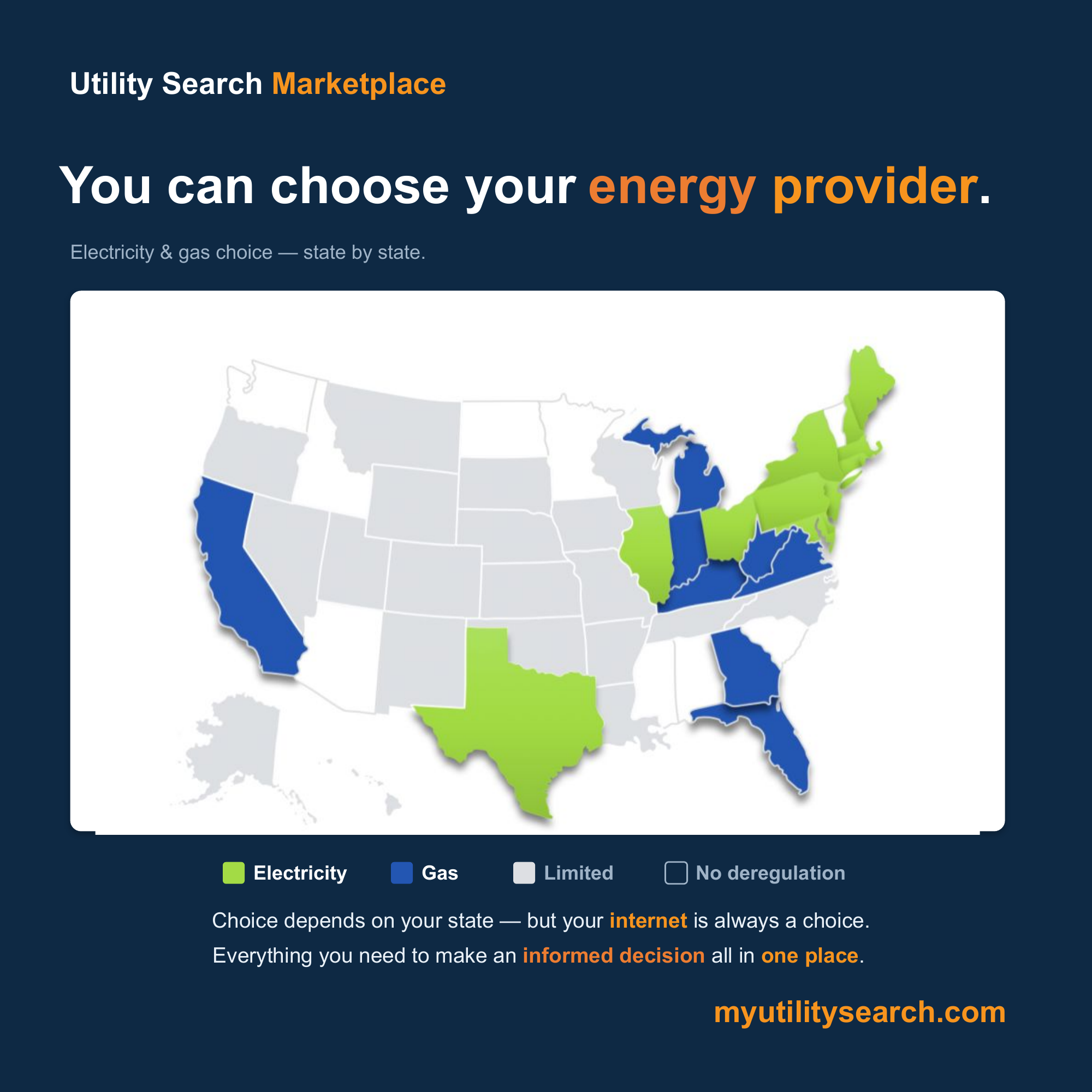
In the deregulated energy states, you can shop for a cheaper provider — but whether you can comes down to one thing: what state you live in. Energy “choice” actually comes in two flavors — electricity and natural gas — and they don’t line up state-for-state. In 13 states plus Washington, D.C., you can choose your electricity provider; 23 states plus D.C. allow you to choose a natural gas supplier; and only some states give you both. Everywhere else, a regulated utility sets the rate. This guide is the complete map: which states have electricity choice, which have gas choice, which have both, how it works, and — if your state is regulated — the utility you can always shop to save: your internet.
Key takeaways
- 13 states + D.C. have residential electricity choice in 2026: Texas, Ohio, Pennsylvania, Illinois, New York, New Jersey, Maryland, Massachusetts, Connecticut, Maine, New Hampshire, Rhode Island, and Delaware.
- In regulated states (most of the country) one utility owns generation and delivery — you can’t switch the provider for power.
- Internet is a choice in all 50 states — so if you can’t shop electricity, you can still compare internet (and home security) to lower your monthly bills.
Quick answer: which states are deregulated for electricity?
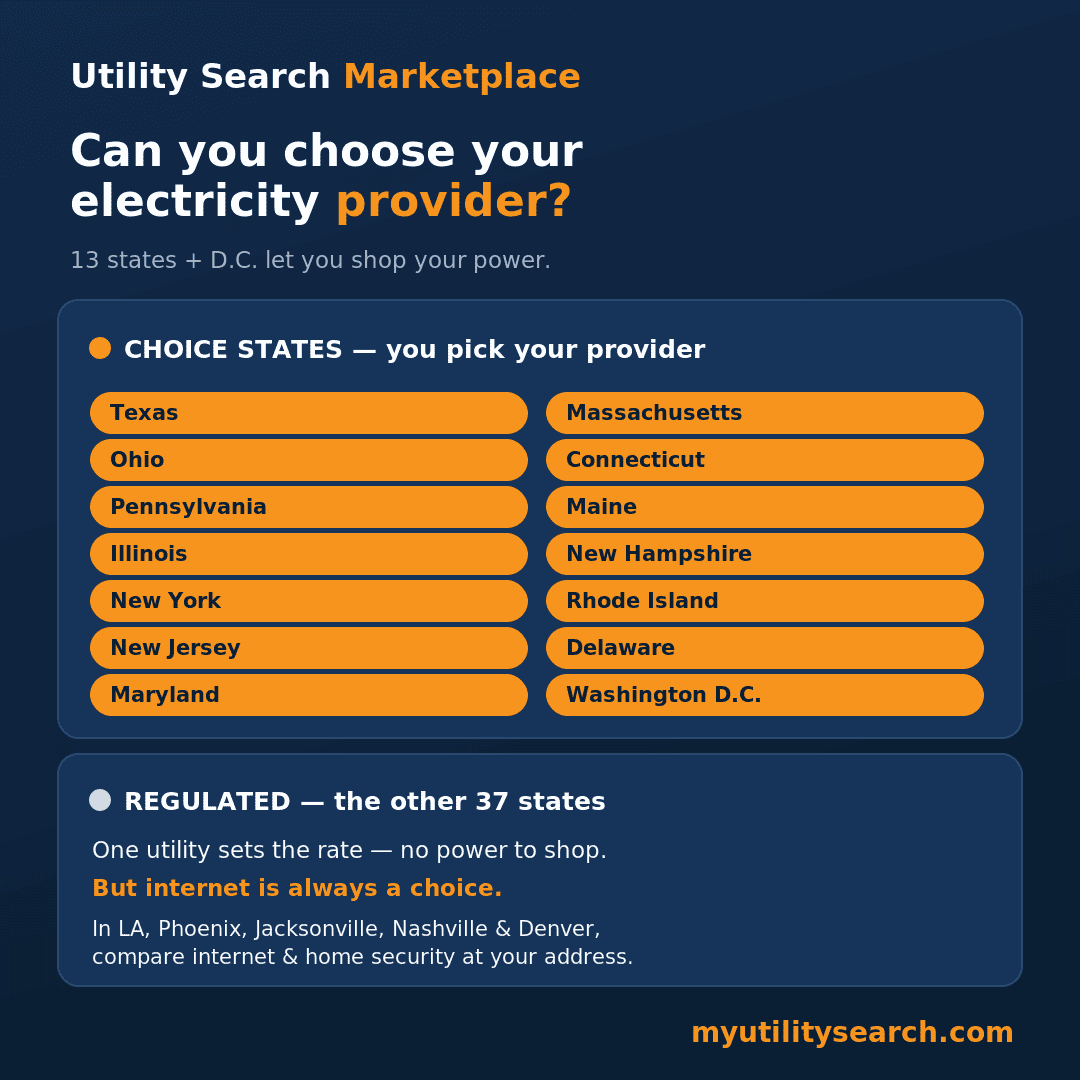
Thirteen states plus Washington, D.C. let residential customers choose their electricity provider in 2026: Texas, Ohio, Pennsylvania, Illinois, New York, New Jersey, Maryland, Massachusetts, Connecticut, Maine, New Hampshire, Rhode Island, and Delaware. In these markets a regulated utility still delivers the power and fixes outages, but you pick the supplier that sets your rate. The other 37 states are regulated — one utility sets the price and there’s no provider to shop. The deregulated energy states are concentrated in Texas and the Northeast.
What does “deregulated energy” actually mean?
In a deregulated (or “restructured”) market, the part of your bill that pays to generate electricity is opened to competition, while the wires that deliver it stay regulated. You choose a retail electric provider (REP) or supplier for the energy charge; the local utility still owns the poles and lines, reads your meter, and restores power after a storm — no matter which provider you pick. Switching is free and never interrupts service. In a regulated state, one vertically integrated utility does all of it, and the state public utility commission sets the rate you pay.
Deregulated energy states map: which states have electricity choice in 2026?
The deregulated states cluster in two regions — Texas, plus the Northeast/Mid-Atlantic corridor — with Illinois and Ohio in the Midwest. Here’s the regional breakdown:
| Region | Deregulated (choice) states |
|---|---|
| South Central | Texas |
| Midwest | Ohio, Illinois |
| Mid-Atlantic | Pennsylvania, New York, New Jersey, Maryland, Delaware, Washington D.C. |
| New England | Massachusetts, Connecticut, Maine, New Hampshire, Rhode Island |
A handful of other states — Michigan, Virginia, California, Oregon, Nevada, and Montana — have limited or business-only choice, or have paused residential choice, so for most households there they behave like regulated states.
Full state-by-state list: regulated vs. deregulated
Use this table to find your state. “Choice” = residential customers can pick a competitive supplier; “Regulated” = one utility, no provider to shop; “Limited” = business-only, capped, or paused for homes.
| State | Electricity market | State | Electricity market |
|---|---|---|---|
| Alabama | Regulated | Montana | Limited |
| Alaska | Regulated | Nebraska | Regulated |
| Arizona | Regulated | Nevada | Limited |
| Arkansas | Regulated | New Hampshire | Choice |
| California | Limited | New Jersey | Choice |
| Colorado | Regulated | New Mexico | Regulated |
| Connecticut | Choice | New York | Choice |
| Delaware | Choice | North Carolina | Regulated |
| Florida | Regulated | North Dakota | Regulated |
| Georgia | Regulated | Ohio | Choice |
| Hawaii | Regulated | Oklahoma | Regulated |
| Idaho | Regulated | Oregon | Limited |
| Illinois | Choice | Pennsylvania | Choice |
| Indiana | Regulated | Rhode Island | Choice |
| Iowa | Regulated | South Carolina | Regulated |
| Kansas | Regulated | South Dakota | Regulated |
| Kentucky | Regulated | Tennessee | Regulated |
| Louisiana | Regulated | Texas | Choice |
| Maine | Choice | Utah | Regulated |
| Maryland | Choice | Vermont | Regulated |
| Massachusetts | Choice | Virginia | Limited |
| Michigan | Limited | Washington | Regulated |
| Minnesota | Regulated | West Virginia | Regulated |
| Mississippi | Regulated | Wisconsin | Regulated |
| Missouri | Regulated | Wyoming | Regulated |
| Washington, D.C. | Choice |
*Status reflects residential electricity choice as of 2026 per the U.S. Energy Information Administration and state public utility commissions. “Limited” states offer business-only, capped, or paused residential choice.
What about natural gas choice?
Natural gas deregulation is separate from electricity — and broader: 23 states plus D.C. have residential natural gas choice programs, but they don’t perfectly overlap with the electricity-choice states. That’s why a complete energy map has four groups:
- Both electricity and gas choice: Illinois, Maryland, Massachusetts, New Hampshire, New Jersey, New York, Ohio, Pennsylvania, Rhode Island, and D.C.
- Electricity only: Texas, Connecticut, Maine, Delaware.
- Gas only: California, Colorado, Florida, Georgia, Indiana, Kentucky, Michigan, Montana, Nebraska, New Mexico, South Dakota, Virginia, West Virginia, Wyoming.
- Limited or no choice: the rest of the country.
Georgia is the standout — it has full residential natural gas choice (about 88% of homes buy from a competitive marketer) but no electricity choice. As with electricity, gas choice means you pick the supplier for the gas commodity while the local utility still delivers it and handles safety and leaks. Availability is often utility-territory specific, so confirm what’s offered at your address.
How does electricity choice work in a deregulated state?
You compare offers from competing suppliers and pick one; the utility keeps delivering the power. Each choice state runs an official comparison tool and a benchmark rate:
- Texas — choose a Retail Electric Provider on Power to Choose; a TDU (Oncor, AEP Texas, CenterPoint, TNMP) delivers.
- Ohio — pick a supplier on PUCO’s “Apples to Apples,” measured against the utility’s Price to Compare.
- Pennsylvania — shop suppliers on PaPowerSwitch, beating PPL/PECO/Duquesne’s Price to Compare.
The pattern is identical across all 13: a regulated wire company plus a competitive supplier you choose. Compare on the all-in cost at your usage, favor a fixed rate, and you can switch for free without any service interruption.
I’m in a regulated state — can I lower my bill at all?
Yes — and the lever is usually your internet bill, not your power bill. We mapped the footprints of the 19 largest wired internet providers against every ZIP code in the country. Nationally the median ZIP code has two providers and 26% have three or more — but several regulated-power states are unusually competitive on internet. Georgia leads: 52% of its ZIP codes have three or more providers, better than every deregulated-electricity state except New Hampshire.
If you can’t switch your electricity supplier, that is where the switchable money is.
| State (no electricity choice) | ZIP codes | Avg. internet providers | ZIPs with 3+ providers |
|---|---|---|---|
| Georgia | 762 | 2.62 | 52% |
| South Carolina | 280 | 2.36 | 44% |
| Tennessee | 679 | 2.33 | 43% |
| Alabama | 616 | 2.27 | 43% |
| Florida | 952 | 2.29 | 38% |
| Indiana | 756 | 2.31 | 38% |
| Oregon | 340 | 2.20 | 37% |
| Washington | 526 | 2.18 | 34% |
Yes — you can’t switch electricity providers, but you can choose your internet provider, and that’s where the savings are. Internet is competitive in all 50 states: in big regulated-market cities like Los Angeles, Phoenix, Jacksonville, Nashville, Denver, and Seattle, you typically have a choice of cable, fiber, and 5G home internet — and switching or renegotiating routinely beats paying a renewing promo rate. Adding home security (which runs on your home internet) is another lever. So even where power is a monopoly, you’re not stuck: compare your internet options and home security at your address.
How to compare — power or internet — in about 5 minutes
Enter your address once and compare what’s actually available where you live. In a choice state, that means electricity providers and plans; everywhere, it means internet and home security. Compare on the true all-in cost, not the teaser rate, and you’ll usually find a better deal than the one you’re auto-renewing into.
Compare electricity and internet at your address in about 5 minutes — free. myutilitysearch.com.
Paying Too Much for Electricity?
Rates change constantly, and loyalty rarely pays. Compare electricity plans available at your address — fixed-rate, variable, and green options, side by side.
Frequently asked questions
How many states have deregulated electricity? In 2026, 13 states plus Washington, D.C. offer residential electricity choice: Texas, Ohio, Pennsylvania, Illinois, New York, New Jersey, Maryland, Massachusetts, Connecticut, Maine, New Hampshire, Rhode Island, and Delaware.
Is my state deregulated for electricity? If you’re in one of those 13 states or D.C., you can choose your provider. A few states (Michigan, Virginia, California, Oregon, Nevada, Montana) have limited or business-only choice. Everywhere else is regulated — use the state-by-state table above to check.
What’s the difference between regulated and deregulated electricity? In a deregulated market you choose the supplier that sets your energy rate while a regulated utility delivers the power. In a regulated market, one utility does both and the state sets the rate.
Can I choose my electricity provider in California (or another regulated state)? Not for residential retail service in most cases. But you can always choose your internet provider and home security — which is how households in regulated states still cut their monthly bills.
Does switching electricity providers interrupt my power? No. The regulated utility still delivers your electricity and handles outages; switching only changes who supplies the energy portion, and it’s free.
Do deregulated states have cheaper electricity? Not automatically — but shopping lets you beat the default rate. Customers who compare and switch in deregulated markets typically save 15–30% versus staying on the standard offer.
Sources
- U.S. Energy Information Administration (EIA) · state public utility commissions (PUCT, PUCO, PA PUC, and others) · myutilitysearch.com data
Related posts
Internet choice in deregulated (and regulated) energy states

myutilitysearch.com · Free to compare