






Blog
Cox Is Now Spectrum: What Happens to Your Plan, Price, and Equipment


Updated on September 17, 2026
The Charter Cox merger closed on 19 August 2026, with Charter announcing completion on 20 August. Charter acquired Cox. Your Cox service, plan, price, equipment, email and login do not change today — Cox’s own transition page says so. What does change is the name: Spectrum becomes the brand in every former Cox market, with full Spectrum pricing and packaging arriving in mid-September 2026, and trucks, bills and buildings rebranding roughly a month after close.
Last updated: 10 September 2026 — Spectrum pricing, packaging and branding begin rolling into former Cox markets this week. Previously updated 8 September 2026 — added where the combined company is run from (Stamford plus the Sandy Springs campus), the 1,000-plus sales jobs in Cox markets, the ~30-day Spectrum rebrand and mid-September product launch, from Charter’s August 20 closing release, Fierce Network and the Atlanta Journal-Constitution.
TL;DR — the Charter Cox merger in six lines
- Closed 19 August 2026; announced 20 August. Charter bought Cox for $34.5 billion enterprise value.
- The naming is backwards from what most coverage implies. The parent company will rename to Cox Communications within a year. The consumer brand everywhere becomes Spectrum. The Cox name moves up the org chart, not onto your bill.
- Nothing changes for you right now. Cox says your account details, email, autopay, plan, pricing, promotions and equipment all continue as-is.
- Mid-September 2026 is the date to watch — that’s when Spectrum’s full product suite, pricing and packaging launch in Cox markets.
- There is no binding price protection anywhere except California. That is the single most important thing this article can tell you.
- Cox Homelife customers have no published transition plan. Cox stopped new signups in 2024, retired the app, and Spectrum has no equivalent security product.
Did Cox get sold?
Yes. Charter Communications acquired Cox Communications’ residential cable business and its commercial fiber and managed IT/cloud subsidiaries. The transaction was effective 19 August 2026 per Charter’s Form 8-K filed with the SEC; the completion press release is datelined 20 August, which is the date most coverage uses. Both are defensible — 19 August is the legal close.
Definition: what actually happened structurally
Cox Enterprises placed Cox’s cable business into a subsidiary (“Cox NewCo”). Part was sold to a Charter subsidiary; the residential cable equity was contributed to Charter Communications Holdings, LLC. Cox Enterprises now owns roughly 26% of the combined company on a fully diluted, as-converted basis — up from the ~23% announced in 2025. Charter trades on Nasdaq as CHTR. Alex Taylor, Cox Enterprises’ Chairman and CEO, becomes Chairman of the 13-member board for an initial three-year term; Chris Winfrey stays President and CEO.
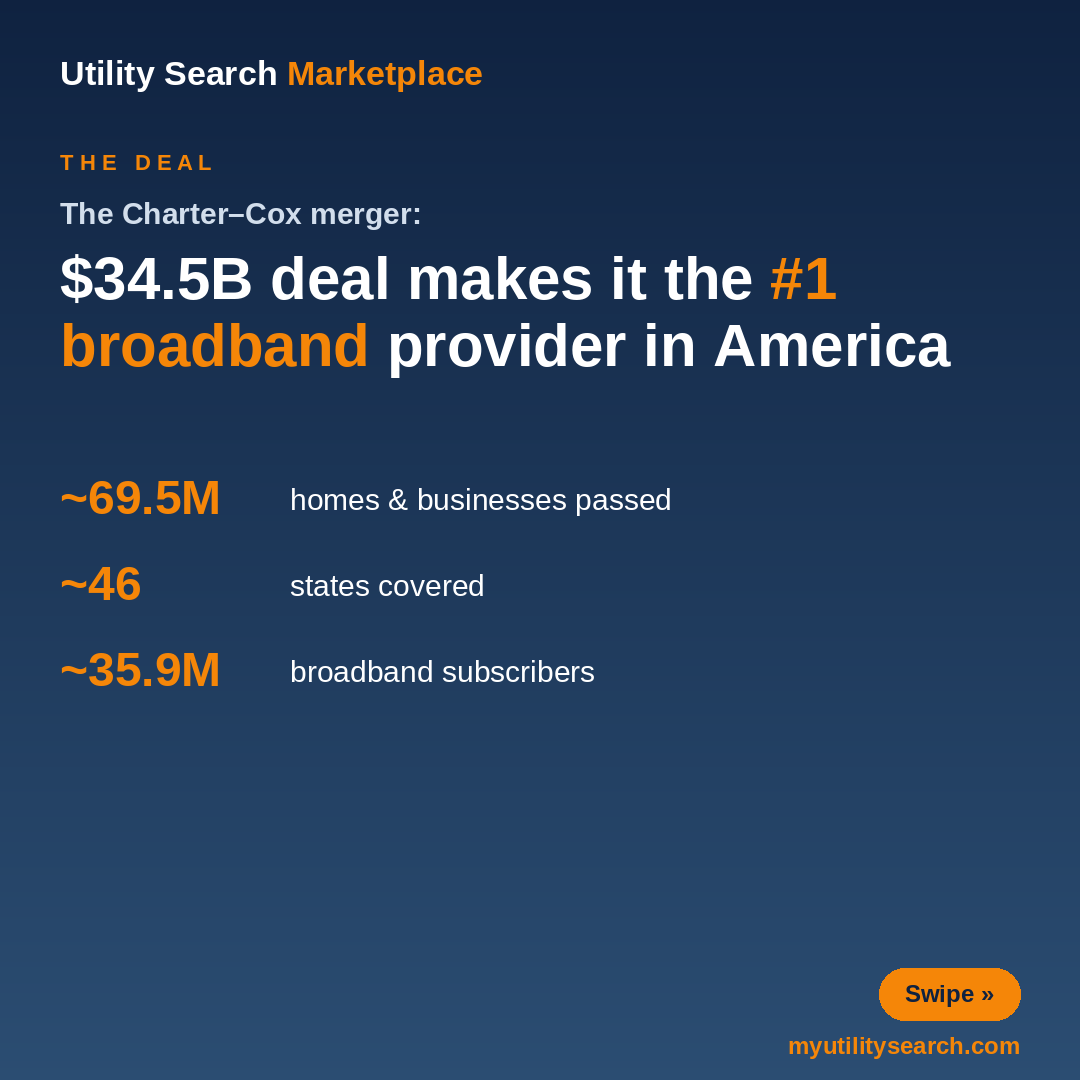
The combined company reaches more than 70 million homes and businesses across 45 states with roughly 37 million customers. Cox brought 6.3 million customers and 7.4 million broadband serviceable locations across 21 states and the District of Columbia (FCC Order DA 26-211, 27 February 2026).
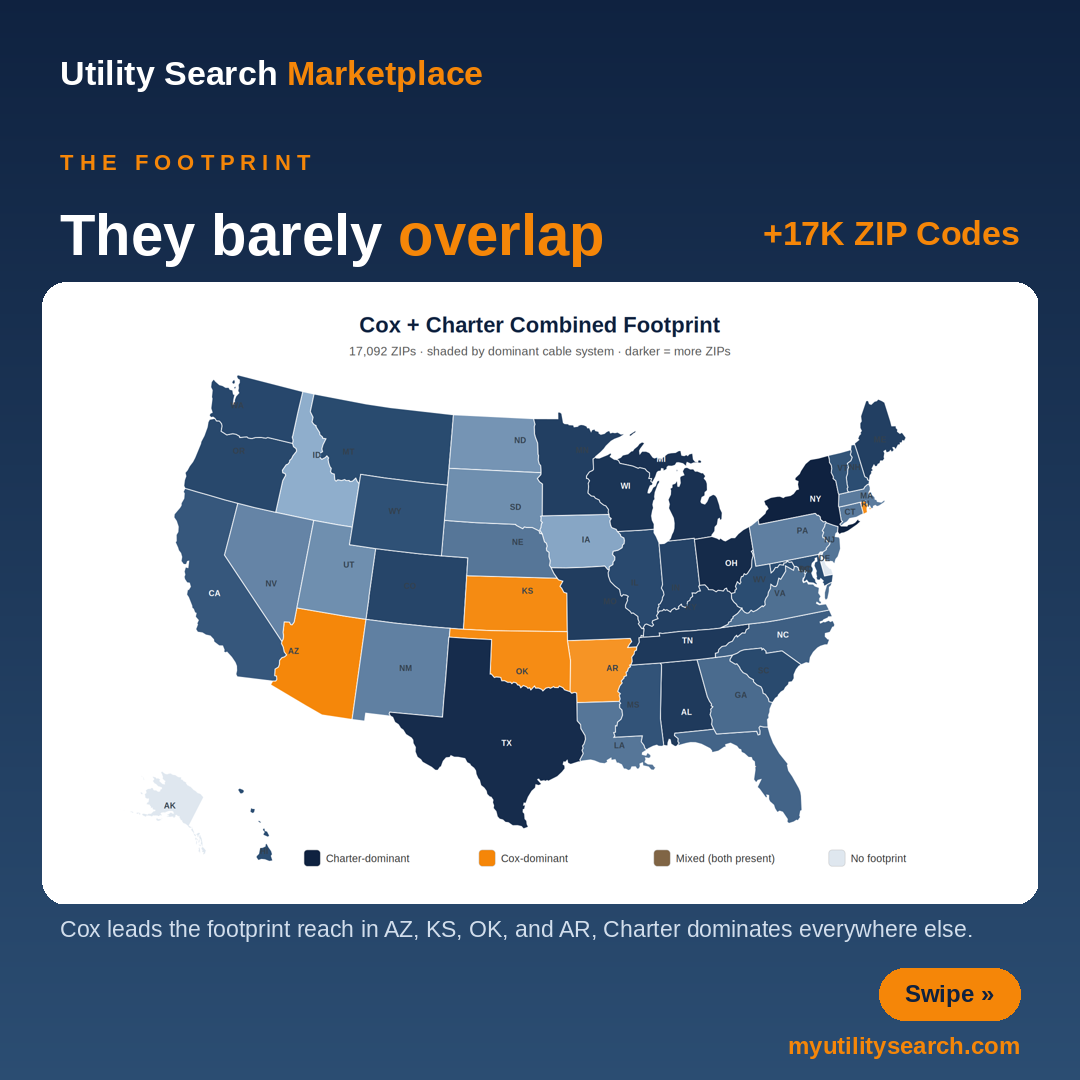
Charter and Cox overlapped on less than 0.09% of their combined footprint — 37,498 of 44.1 million serviceable locations. That is why regulators cleared it: in almost every market, no customer lost a competitor, because the two companies were never head-to-head.
Is Cox becoming Spectrum, or is Spectrum becoming Cox?
Both, in different places — and this is the detail nearly every summary of the Charter Cox merger gets wrong.
Charter’s own completion release says it plainly: “Within a year following the transaction, the company will change its parent company name to Cox Communications but will continue to operate as Spectrum across all markets.”
- The holding company will be called Cox Communications. That change has not happened yet — the SEC filing confirms the registrant remained Charter Communications, Inc. at closing.
- The brand on your bill, your app, your technician’s truck and your local storefront will be Spectrum.
If you are a Cox customer, the practical translation is short: you are becoming a Spectrum customer. The Cox name survives on a letterhead you will never see.
What does the Charter Cox merger change for customers, and when?
Here is the timeline as company sources have stated it.
| When | What happens |
|---|---|
| 19–20 Aug 2026 | Deal closes. No customer-facing change. Cox accounts, logins, email, autopay, plans and pricing continue as-is. |
| ~1 month after close (mid-to-late Sept) | Spectrum rebrand rolls through Cox markets — buildings, trucks, bills. |
| Mid-September 2026 | Spectrum’s full product suite, pricing and packaging launch in former Cox markets. |
| Within 12 months | Parent company renames to Cox Communications. Consumer brand stays Spectrum. |
| Not announced | Billing-system migration, Cox Mobile → Spectrum Mobile mechanics, cox.net email fate, Panoramic Wifi equipment. |
What Cox has committed to in writing (from Cox’s transition page):
- “Your account information won’t change” and “Your email and account details will remain the same.”
- “Autopay and billing will continue as-is” with “no changes to your current plan or pricing at this time.”
- “Any existing promotions, discounts or contract terms will be honored according to your current agreement.”
- “You can continue using your current equipment and apps. If changes are ever needed, we will guide you step-by-step.”
- Scheduled installs and service appointments proceed as planned.
What you actually get, new:
- Cox internet customers not already on Cox Mobile get a free year of mobile service.
- Eligible Contour TV plans get $100+/month of streaming apps added at no extra cost — HBO Max, Disney+, Hulu, ESPN, Paramount+, Peacock, AMC+ and ViX.
- Charter’s national commitments carry over: 100% U.S.-based customer service, same-day technician dispatch if requested before 5:00 pm, and bill credits for outages longer than two hours.
Is the combined company run from Stamford or Atlanta?
Both, and the split says something about how the Charter Cox merger will feel on the ground. Charter’s headquarters stays in Stamford, Connecticut, but the closing release commits to “a significant presence” in Cox’s Atlanta offices, and the Atlanta Journal-Constitution reported the combined company will establish its Southeast offices at the Cox Communications campus in Sandy Springs. Most of the industry assumed a Stamford consolidation; keeping the Atlanta campus as a second center is a signal that Charter wants Cox’s people and Cox’s markets, not just its plant.
The job math points the same way. Charter says it will add more than 1,000 residential and business sales positions in the former Cox territories, bring every Cox customer-service function back onshore over 18 months at a $20-an-hour minimum with benefits, and run a 24/7 U.S.-based service operation. CEO Chris Winfrey was candid that overlap will be trimmed — “of course there will be reduction of same-type of titles and overhead, but that’s a de minimis part of the overall company” — which in practice means corporate and duplicate management roles, not the field and sales staff a cable operator needs to keep in the markets it just bought.
For customers the near-term timeline is short. Charter said the Spectrum name goes on Cox buildings, trucks and bills within about a month of the August 20 close, and Spectrum’s full product lineup — including the free mobile line, same-day technician dispatch and outage credits described above — launches in former Cox markets by mid-September. Nothing on an existing Cox account changes until the customer changes it, and the parent company itself takes the Cox Communications name within a year while Spectrum remains the brand on every bill.
What has nobody promised?
This is where an honest article separates itself from a press release, so read this section twice.
Cox’s language is carefully hedged. “At this time.” “If changes are ever needed.” “According to your current agreement.” Those phrases are doing real work. Here is what is genuinely unresolved:
- Your cox.net email address. Cox says email “will remain the same.” No source says what happens when accounts migrate to Spectrum’s billing platform. For most households this is the single biggest practical question, and it is unanswered.
- Your account number. Same situation — committed to now, uncommitted past the systems cutover.
- Your Panoramic Wifi gateway. “Continue using your current equipment” is a present-tense statement. There is no commitment that Spectrum won’t eventually require a hardware swap, and no statement on whether Cox’s Panoramic fee converts to Spectrum’s equipment pricing.
- Cox Mobile. Whether numbers port automatically, whether devices and SIMs carry over, and whether Cox Mobile plan pricing is honored — none of it is published.
- What happens at renewal. Cox honors current agreements according to your current agreement. What your rate becomes when that agreement expires is the question nobody has answered, and it is where bill shock would land.
- Cox Homelife. Cox stopped enrolling new Homelife customers in 2024, states it is “only supporting existing Cox Homelife devices,” and has retired the dedicated app. Spectrum has no equivalent home security product. If you have Homelife, there is no published path forward — see our full breakdown of what Cox Homelife customers should do.
Will the Charter Cox merger raise my bill?
Nobody has promised it won’t — and that, not a predicted rate hike, is the honest story.
The FCC approved the deal on 27 February 2026 (WC Docket No. 25-233, Order DA 26-211) with commitments covering DOCSIS 4.0 network upgrades, onshoring 100% of sales and customer service within 18 months, a $20/hour minimum starting wage, and letting Cox customers keep their existing plans. It contains no price freeze and no rate cap.
The one place with real price protection is California. The CPUC approved the merger 5–0 on 13 August 2026 (Application A.25-07-016) with conditions the FCC never imposed:
| California condition | Detail |
|---|---|
| Network investment | $275 million, with symmetrical 1-Gig capability across legacy California service areas within 3 years |
| Low-income plan | $20/month broadband; five-year participation in California LifeLine |
| Price protection | Continued honoring of eligible residential “price for life” agreements |
| Outage credits | Automatic bill credits for outages of 2 hours or more |
| Equipment fees | Eliminated on upgrade or downgrade of qualifying residential cable |
| Digital inclusion | $30 million via the California Emerging Technology Fund; $5 million into CDFIs |
| Community | 5 years of free broadband for 50 community anchor institutions; 72-hour backup batteries |
Trade coverage put California’s mandate at roughly $310 million in upgrades the FCC never required.
If you are not in California, none of that applies to you. Advocacy groups — the California Alliance for Digital Equity, Digital Equity LA, Media Alliance and TURN — did not settle, and their objection was not a price forecast. It was structural: “we caution against the continued and rapid consolidation of the marketplace without sufficient regulatory safeguards.” That is the accurate way to state the risk.
Compare internet, energy & home security at your address
What should Cox customers do right now?
Five things, in order of how much they’re worth.
- Screenshot your current plan and price today. Plan name, speed, monthly rate, promotional end date, contract terms, equipment fees. Cox has committed to honoring your current agreement — the way you enforce that is by having a record of what it says.
- Note your promotional expiry date and put a reminder 30 days before it. Mid-September brings Spectrum pricing and packaging to your market. The moment your promo ends is the moment your rate is repriced against a new card you haven’t seen yet.
- If you’re a Cox internet customer without Cox Mobile, claim the free year. For what Cox charges today, see current Cox internet plans and prices. It is a real offer with real value and it costs nothing to take.
- If you have Cox Homelife, start planning now. Maintenance mode with no transition plan is not a position to be caught out by. Price alternatives before your equipment fails, not after.
- Compare before you accept a new Spectrum offer. In most Cox markets Charter and Cox never competed, so consolidation didn’t remove an option — but fiber and 5G home internet may have arrived in your area since you last looked.
Charter Cox merger FAQ
Is Cox Communications going away?
The consumer brand is. Cox service becomes Spectrum service in every market, with the rebrand rolling out roughly a month after the 19 August 2026 close. The name Cox Communications survives as the parent holding company’s name, changing within a year of close — but it will not appear on your bill.
Do I have to do anything as a Cox customer?
No. Cox states there is “nothing to do here” — your plan, price, equipment, email, login and autopay continue. Keep a record of your current plan terms, and watch for your promotional end date.
Will my Cox email address still work?
Cox says your “email and account details will remain the same.” That commitment is present-tense and no company source addresses what happens after the eventual migration to Spectrum’s billing systems. Nobody has published an answer. Back up anything important.
Will my Cox bill go up after the Charter Cox merger?
There is no price freeze in the FCC’s approval. Existing agreements are honored for their term. California is the only state with real protections — including honoring eligible “price for life” agreements — because the CPUC imposed them as merger conditions. Everywhere else, your rate at renewal is unprotected.
What happens to Cox Homelife?
Cox is in maintenance mode: no new signups since 2024, the dedicated app retired, and Cox states it is only supporting existing devices. Spectrum has no equivalent home security product and no transition plan has been published for Homelife customers.
When does Spectrum pricing arrive in my area?
Mid-September 2026, per Charter’s completion announcement — that’s when Spectrum’s full product suite, pricing and packaging launch in former Cox markets.
The Charter Cox merger is done; what happens to your bill now depends on the record you keep and the comparison you run before you accept a new offer.
Compare internet, energy & home security at your address
Sources
- Charter Communications, Charter and Cox Communications Complete Transaction (August 20, 2026) — $15B consideration to Cox Enterprises plus ~$12B assumed debt; 70M+ homes, 45 states; Stamford HQ with “significant presence” in Atlanta; parent renamed Cox Communications within one year, Spectrum consumer brand; 100% U.S.-based customer service within 18 months, $20/hr minimum; Cox Enterprises ~26%; Alex Taylor chairman, Chris Winfrey CEO.
- Fierce Network, Charter closes its Cox acquisition, elaborates on immediate plans — 1,000+ new sales positions in former Cox markets; Spectrum rebrand of buildings, trucks and bills within about a month; full Spectrum product suite in Cox markets by mid-September; Winfrey on “de minimis” overhead reductions.
- Atlanta Journal-Constitution, Here’s what the Cox-Charter merger could mean for you (August 2026) — Southeast offices at the Cox Communications campus in Sandy Springs; re-shoring; ~37M customers across 45 states.
Keep going
- Spectrum price increase 2026: who pays and how to fight back
- Spectrum internet review — what you’ll be offered once your market converts
- Spectrum outages: what to do — the new outage-credit commitment in practice
- Cox Homelife: what happens now — the security side of this merger
- Telecom consolidation, explained — why this keeps happening
- Internet data caps and overage fees — how Cox and Spectrum policies differ
- Best cheap internet plans — if the new pricing doesn’t work for you










One thought on “Cox Is Now Spectrum: What Happens to Your Plan, Price, and Equipment”