
Blog
Home Warranty 2026: Best Plans, Costs & Honest Pros and Cons


By Christopher Burg · Last updated September 17, 2026
A home warranty is a one-year service contract that pays to repair or replace major home systems and appliances when they break down from normal wear. In 2026 a plan costs about $56 a month on average, plus a $75 to $125 service fee per repair visit. It is not insurance, and the fine print on caps and exclusions decides what it is worth.
- Plans cover wear-and-tear failures: HVAC, plumbing, electrical, water heater and kitchen and laundry appliances.
- Average cost: $56 a month ($672 a year), typical range $47 to $82 a month, plus $75 to $125 per service call.
- The good: about 83% of plan holders say they are satisfied, and 90% say their latest claim was approved.
- The bad: denied claims trace back to pre-existing conditions, uncovered items and dollar caps — all of it in the contract before you buy.
- It does not replace homeowners insurance, which covers fire, storm and theft damage.
Get a Free Choice Home Warranty Quote →
Disclosure: myutilitysearch.com may earn a commission if you request a quote through the Choice Home Warranty links on this page. It does not change what you pay.
What is a home warranty?
It is a contract between a homeowner and a warranty company. You pay a monthly or annual premium.
When a covered system or appliance fails, you file a claim, pay a flat service fee, and the company sends a contractor to repair or replace it.
The Federal Trade Commission puts it plainly: these plans “are really service contracts.” They are different from the builder warranty that comes with a new home, or the manufacturer warranty that comes with an appliance. This kind of coverage costs extra and is bought separately.
How much does a home warranty cost in 2026?
The average plan costs $56 a month, or $672 a year. Most plans fall between $47 and $82 a month ($564 to $984 a year).
Those figures come from This Old House research covering more than 4,000 quotes from 13 companies across all 50 states, last updated June 17, 2026.
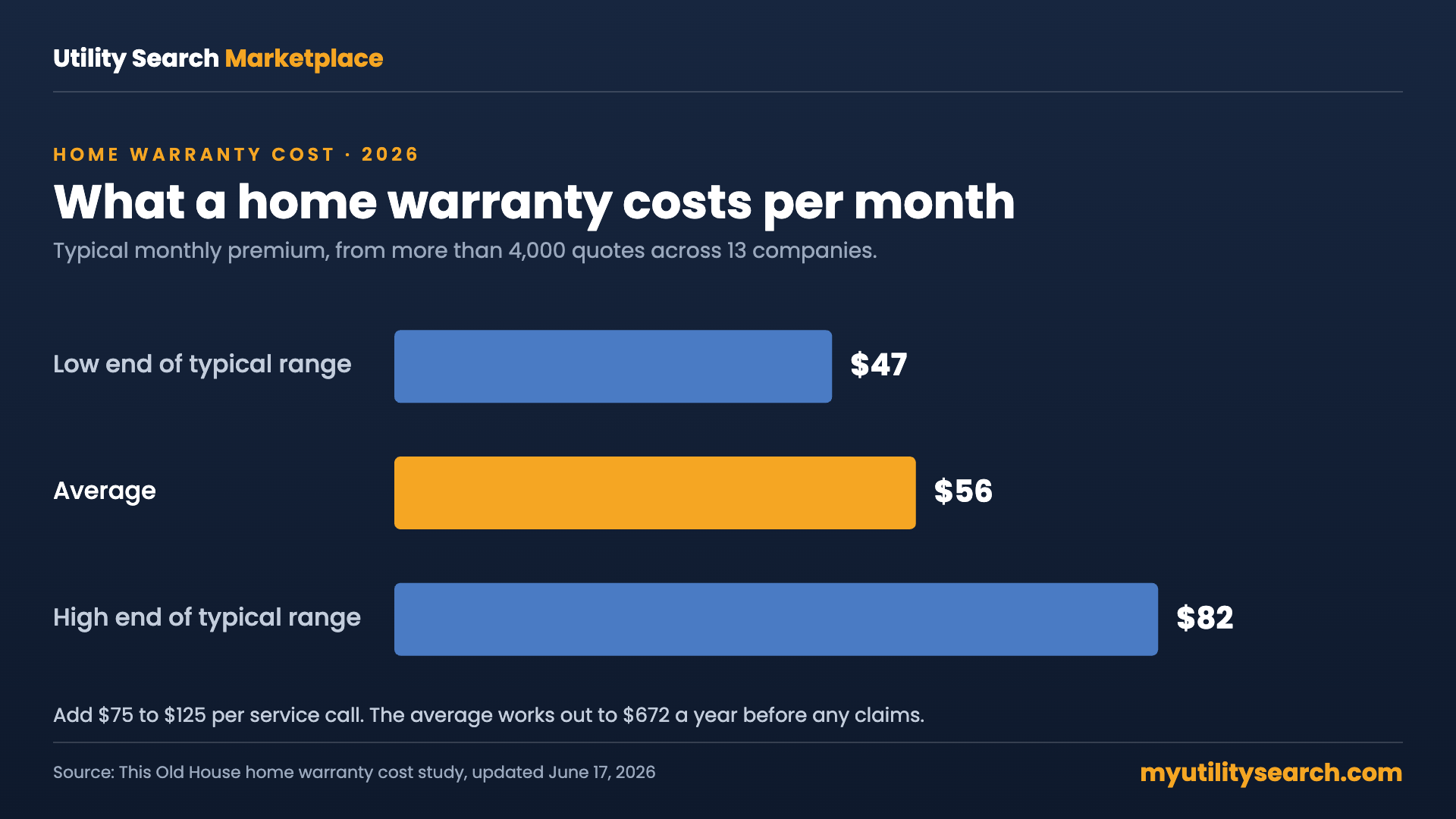
| Cost item | Typical 2026 figure |
|---|---|
| Average monthly premium | $56 |
| Average annual premium | $672 |
| Typical range | $47–$82 a month ($564–$984 a year) |
| Service call fee | $75–$125 per technician visit |
| Choice service call fee | $100 per claim |
Sources: This Old House home warranty cost study (updated June 17, 2026); Choice Home Warranty FAQ. Verified September 17, 2026.
Quotes and real bills are not the same thing. In the same publication’s homeowner survey, the most commonly reported payment was about $1,200 a year. That is roughly double the average quote, most likely because owners add higher tiers and optional coverage.
Price moves with the size of the home, the plan tier and the add-ons you choose. For a provider-by-provider breakdown, see our guide to warranty costs, service fees and top providers.
What does a home warranty cover?
Coverage comes in tiers. A basic plan covers core systems and kitchen appliances. A top plan adds air conditioning, the refrigerator and the laundry pair.
Choice publishes its two plans openly, which makes it a useful example of how the tiers work:
| Covered item | Basic Plan | Total Plan |
|---|---|---|
| Heating, electrical and plumbing systems | Yes | Yes |
| Plumbing stoppage and water heater | Yes | Yes |
| Oven, range, cooktop, dishwasher, built-in microwave | Yes | Yes |
| Garbage disposal, ductwork, garage door opener, ceiling and exhaust fans | Yes | Yes |
| Air conditioning system | No | Yes |
| Refrigerator | No | Yes |
| Clothes washer and dryer | No | Yes |
Source: Choice Home Warranty “What’s Covered” page, verified September 17, 2026. Optional add-ons include pool and spa, well pump, sump pump, septic system, limited roof leak, second refrigerator and stand-alone freezer.
What do people actually claim? About 49% of recent claims in the This Old House survey were for a home system, nearly 40% were for an appliance, and 9% involved an add-on item.
The two systems people ask about most are heating and cooling, and pipes. We cover each in detail: HVAC coverage and plumbing coverage.
What does a home warranty not cover?
Three limits cause most denied claims.
Pre-existing conditions. Choice states that it does not cover “known or unknown pre-existing conditions, misuse, abuse, or failure to clean or maintain the covered systems and appliances.” Most companies write a similar clause.
Dollar caps. Every contract limits what it pays per item or per contract term. Choice, for example, limits its liability to $3,000 per covered item per 12-month period under its user agreement (modified December 31, 2025). A cap below the price of a new air conditioner means you pay the difference.
The waiting period. Coverage rarely starts on day one. Choice coverage begins 30 days after enrollment and payment, and the contract typically runs 365 days.
Is a home warranty worth it? What homeowners really say
Online reviews swing between glowing and furious. Survey data gives a calmer picture than either extreme.
The good. In January 2026, This Old House surveyed 2,000 homeowners who hold a plan. About 83% said they were satisfied or very satisfied. Ninety percent said their most recent claim was approved, nearly 4% were denied, and 6% were still pending.
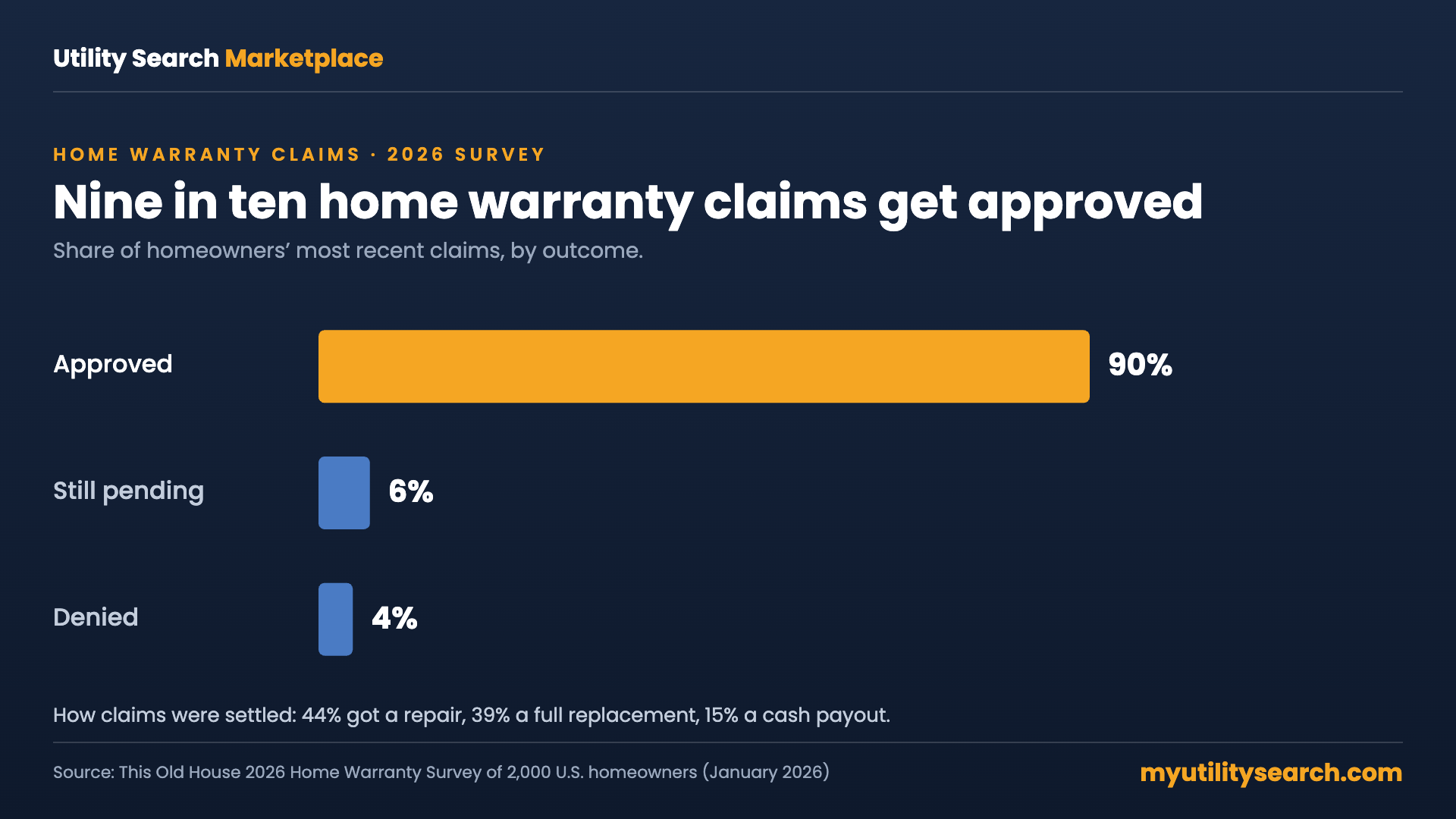
Speed was better than the horror stories suggest. Nearly half of owners said the repair was finished within one week, and another 29% said two to three weeks.
The bad. Among owners who do not plan to renew, 28% said the plan costs too much and 26% pointed to a poor claims experience. Another 26% simply wanted a different provider.
Cash payouts are a common sore spot. About 15% of claims ended in a cash payment instead of a repair or replacement. Contracts often let the company pay its own cost for the part, which can be less than retail. Choice’s terms say exactly that.
Review sites tell two stories at once. The same large provider can average about 1 star across thousands of Better Business Bureau complaints and 4 stars across tens of thousands of Trustpilot reviews. Happy customers post on one site, disputes land on the other. Read both before you decide.
Why home warranty claims get denied, and how to avoid it
Only a small share of claims are denied, but the reasons are consistent. Homeowners with a denied claim named four causes.

Three of the four are written into the contract before you pay a dollar. That makes them avoidable.
- Keep your inspection report. A home inspection from the purchase shows the system worked on the contract start date. It is the best answer to a pre-existing-condition denial.
- Save maintenance receipts. Filter changes, HVAC tune-ups and water heater flushes are proof against a lack-of-maintenance denial.
- Match the plan to the house. If the air conditioner is the item you worry about, a basic tier that leaves it out is the wrong plan at any price.
- Check the cap against the replacement. Compare the per-item limit with what a new system costs in your area, and budget for the gap.
How a home warranty claim works, step by step
- Something breaks. A covered system or appliance fails from normal use after the waiting period has passed.
- You file a claim. Most companies take claims online or by phone around the clock. Choice accepts claims 24 hours a day, 365 days a year.
- You pay the service fee. The fee is flat per claim, typically $75 to $125. Choice charges $100 no matter what the repair costs.
- A contractor diagnoses the problem. The warranty company picks the technician from its network and decides whether the failure is covered.
- Repair, replacement or cash. In the 2026 survey, 44% of claims ended in a repair, 39% in a full replacement and 15% in a cash payout.
- The work is guaranteed for a short window. Under Choice’s agreement, work that fails within 30 days is corrected without a new service fee.
Home warranty vs. homeowners insurance
| Home warranty | Homeowners insurance | |
|---|---|---|
| Pays for | Repairs and replacements when systems and appliances wear out | Damage from covered events such as fire, storms and theft |
| Required by lenders | No | Usually, with a mortgage |
| You pay per claim | Flat service fee ($75–$125) | Deductible |
The two do not overlap, which is why many owners carry both. Our insurance vs. warranty comparison walks through what each one pays for.
Compare internet, energy & home security at your address
How to choose the best home warranty
The best home warranty is the one whose caps and exclusions match the age of your home’s systems. The FTC recommends four checks before you buy:
- Total cost. Add the premium to the fees. The FTC warns about “costs that may be hidden, like deductibles or fees.”
- Coverage limits. Find the dollar cap for HVAC, plumbing and each major appliance, and the rules on cancellation.
- The claims process. Ask how fast a technician is dispatched and who chooses the contractor.
- Reputation. Search the company name with “review” and “complaint” before you pay.
One red flag stands apart. The FTC warns about telemarketers who call unprompted to sell service contracts while fishing for money or personal information. A legitimate company will let you read the full contract first. Report pushy or deceptive calls at ReportFraud.ftc.gov.
For a head-to-head on the two largest names, see American Home Shield vs. Choice. For our partner’s plans, pricing and fine print, see our Choice review.
Get a Free Choice Home Warranty Quote →
Who should buy a home warranty, and who should skip it
Why do people buy? In the 2026 survey, 31% wanted protection for older systems and appliances, and 22% wanted to protect newer ones. Nearly 20% bought after a costly repair. One in five received coverage as part of a home purchase.
Coverage tends to fit:
- Owners of homes with systems and appliances past the ten-year mark.
- First-time buyers who spent their cushion on the down payment and have no repair fund yet.
- Landlords and out-of-town owners who want one phone number and a predictable cost.
- Sellers who want to reassure a buyer during the first year.
It is a weaker deal for:
- New construction still covered by builder and manufacturer warranties.
- Owners with a healthy emergency fund who prefer to pick their own contractor.
- Homes with known problems, since pre-existing conditions are excluded.
We run the numbers in are these plans worth it.
Home warranty FAQ
What is a home warranty?
A home warranty is a one-year service contract that pays to repair or replace major home systems and appliances when they fail from normal wear. The Federal Trade Commission notes that home warranties are really service contracts: they are bought separately and cost extra, unlike a builder or manufacturer warranty.
How much does a home warranty cost?
A home warranty costs about $56 a month, or $672 a year, on average in 2026, with most plans running $47 to $82 a month. You also pay a service call fee of $75 to $125 each time a technician visits, according to This Old House pricing research covering more than 4,000 quotes.
Are home warranties worth it?
For many owners, yes. In a 2026 This Old House survey of 2,000 homeowners, about 83% said they were satisfied with their plan and 90% said their most recent claim was approved. A home warranty is a weaker deal for new construction that is still under builder and manufacturer warranties.
Why do home warranty claims get denied?
The most common reasons are pre-existing conditions and items the plan does not cover, each cited by about 29% of homeowners with a denied claim. Repair costs above the coverage cap (20%) and lack of maintenance (13%) come next, according to the This Old House 2026 survey.
How long does a home warranty claim take?
Nearly half of homeowners said their repair was resolved within one week, and another 29% said it took two to three weeks, according to the This Old House 2026 survey.
Does a home warranty cover pre-existing problems?
Usually not. Most contracts exclude pre-existing conditions. Choice Home Warranty, for example, states that it does not cover known or unknown pre-existing conditions, misuse, or failure to clean or maintain covered systems and appliances.
Is a home warranty the same as homeowners insurance?
No. Homeowners insurance pays for damage from covered events such as fire, storms and theft. A home warranty pays for repairs when systems and appliances wear out. Many homeowners carry both because neither one covers what the other does.
When does home warranty coverage start?
Most plans have a waiting period. Choice coverage begins 30 days after enrollment and payment, and a contract typically runs 365 days.
Get a Free Choice Home Warranty Quote →
Compare internet, energy & home security at your address
Sources
- Federal Trade Commission, “So what’s the deal with home warranties?” (February 24, 2023)
- This Old House, 2026 Home Warranty Survey of 2,000 homeowners (January 2026; updated June 16, 2026)
- This Old House, home warranty cost study (updated June 17, 2026)
- Choice Home Warranty, “What’s Covered”, “Frequently Asked Questions” and user agreement pages (checked September 17, 2026)