Blog
Business Fiber Internet: Frontier’s $69.99 Gig Beats AT&T and Verizon — and Two “Fiber” Plans Are Really Cable

Updated on October 28, 2026
8 min read
Last updated October 16, 2026 · Every price below was read from the provider’s own business internet page on October 16, 2026. Availability is decided by your street address, not your ZIP.
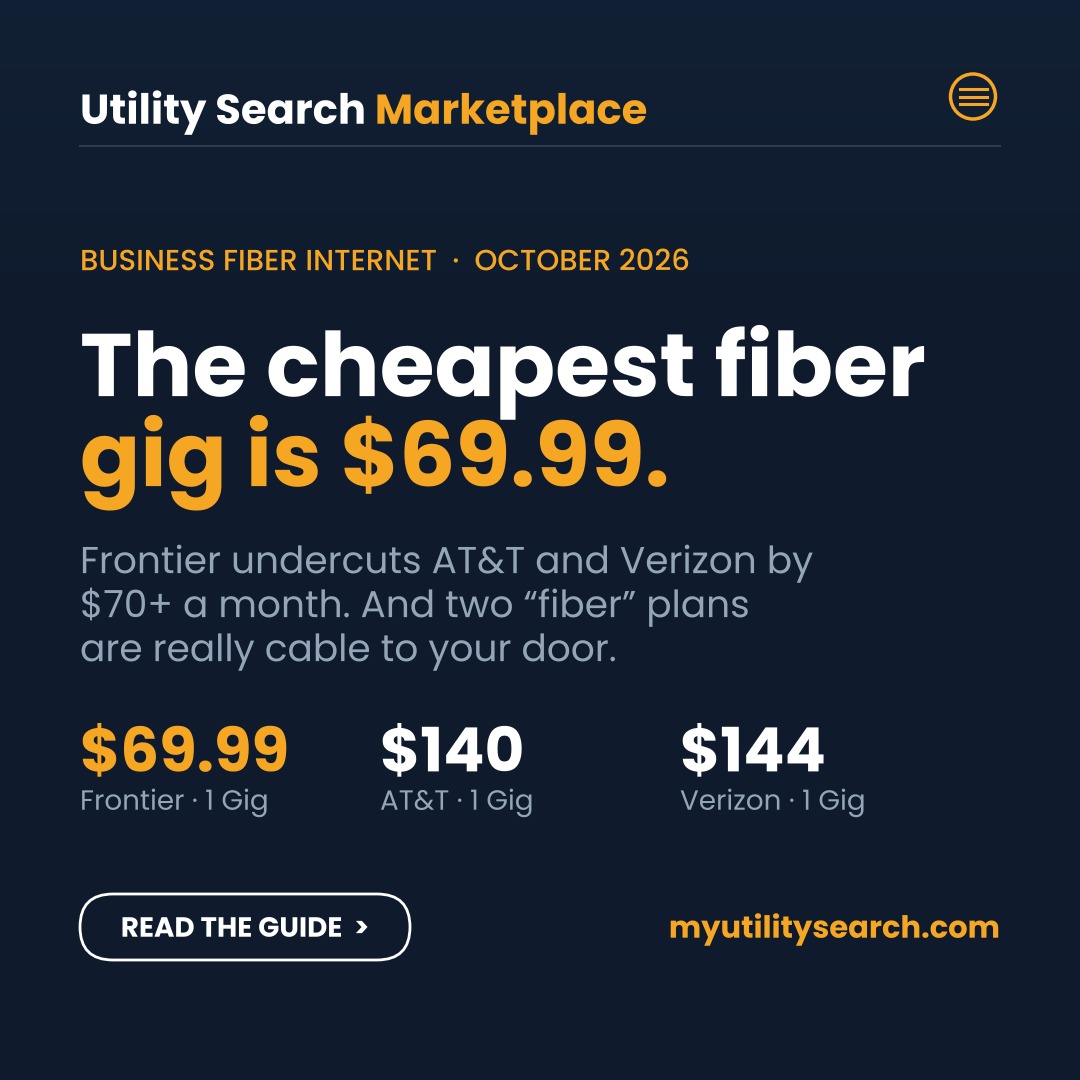
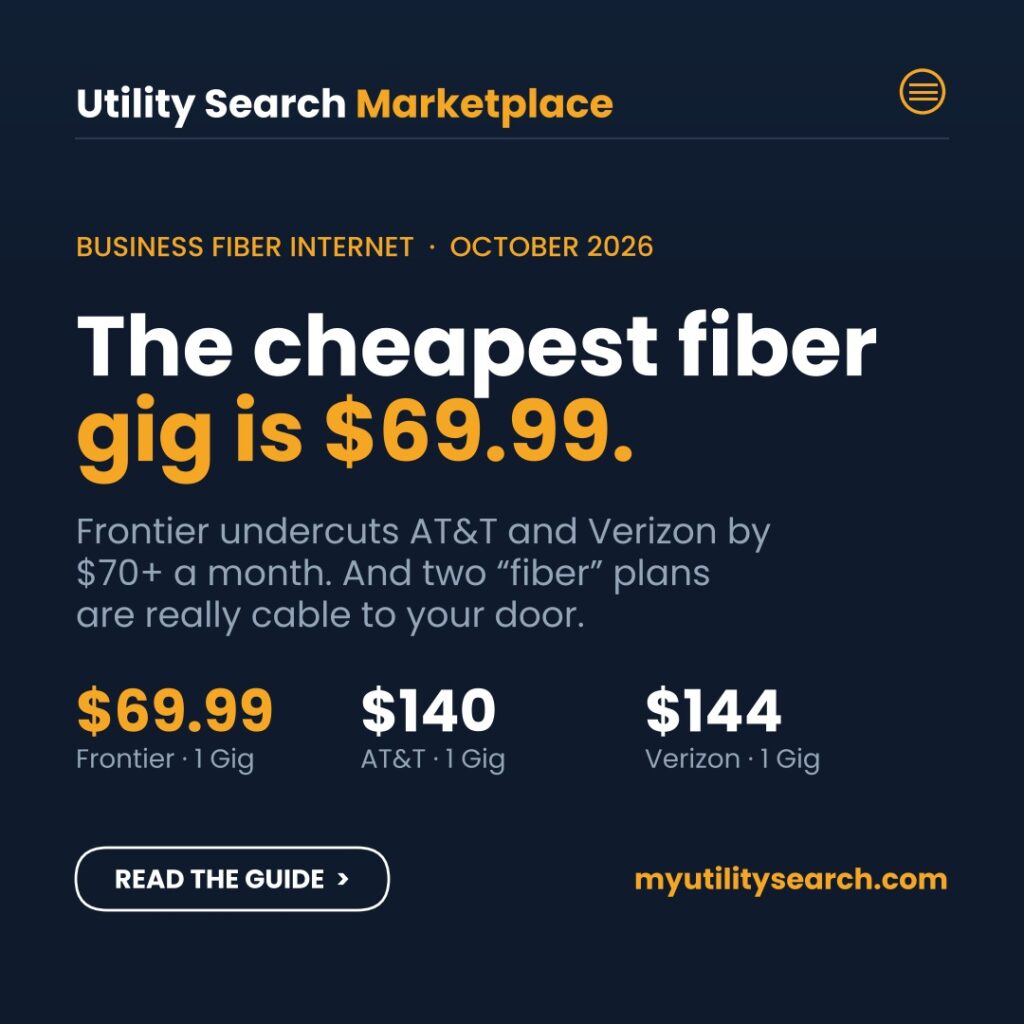
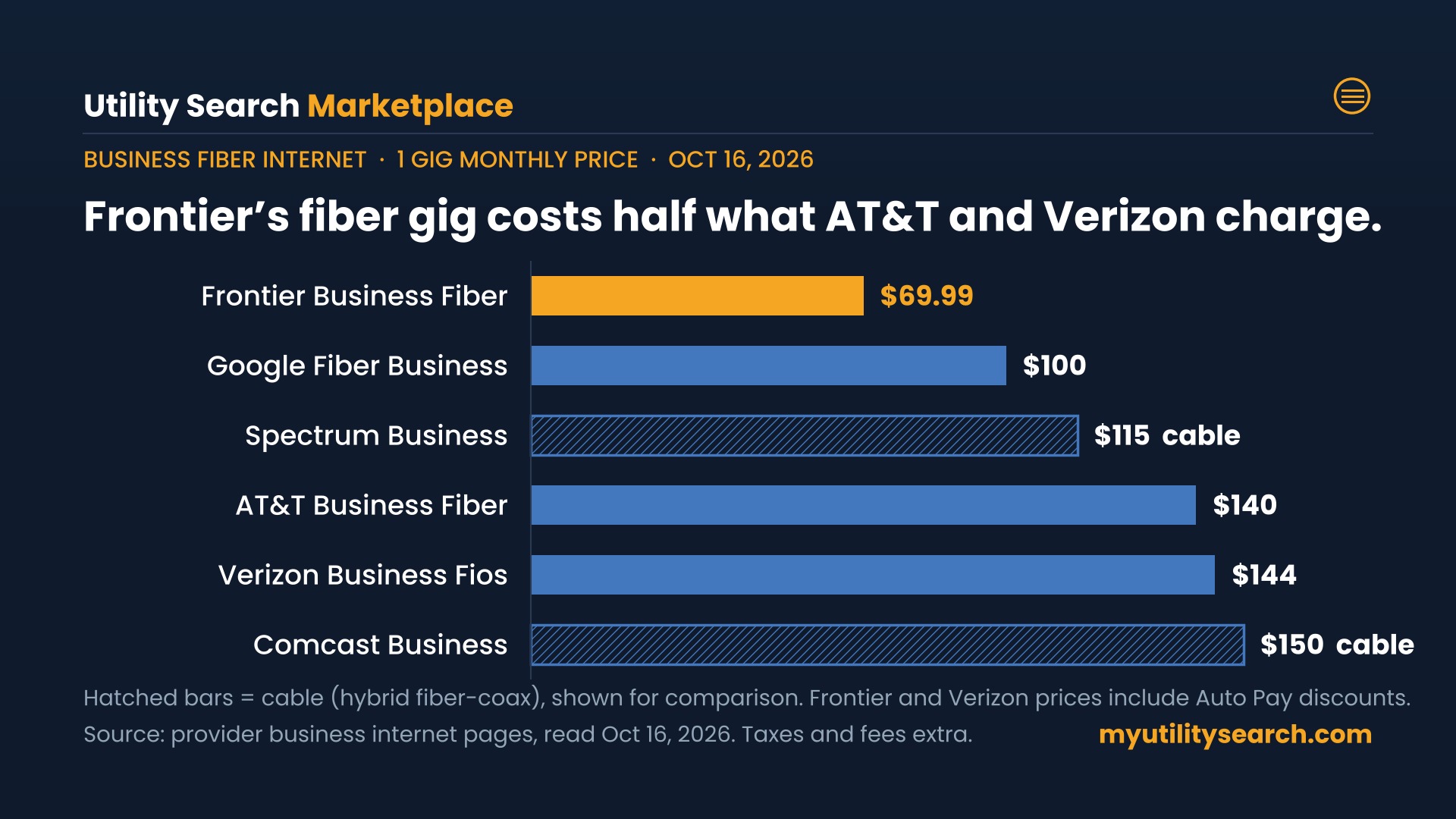
Business fiber internet costs $69.99 to $144 a month for 1 Gig in October 2026, and the cheapest real fiber gig is Frontier’s at $69.99 with a two-year price lock. AT&T charges $140, Verizon Fios $144 with Auto Pay. Before you compare, check one thing: two of the biggest “fiber-powered” business plans are cable to your door.
TL;DR: business fiber internet, October 2026
- Cheapest fiber gig: Frontier Business Fiber 1 Gig, $69.99/mo with bank Auto Pay, price locked 24 months.
- Most expensive mainstream gig: Verizon Business Fios 1 Gig, $144/mo with Auto Pay on a 2-year term.
- The trap: Comcast Business and Spectrum Business call their networks “fiber-powered,” but both reach the building over coaxial cable.
- Shared vs. dedicated: every plan in our table is shared business fiber internet. Guaranteed bandwidth (DIA) is quoted, not listed.
- Bundle math: adding a business mobile line cuts AT&T’s gig from $140 to $90 and gives Verizon customers a $20/mo credit.
What is business fiber internet?
Business fiber internet is a broadband connection that runs on fiber-optic glass all the way into your building. It delivers symmetrical speeds, so upload matches download, and it holds up better at peak hours than cable.
Definition: fiber-to-the-premises (FTTP)
FTTP means the glass fiber ends inside or at your building. Hybrid fiber-coax (HFC), the network cable companies run, carries fiber to a neighborhood node and copper coaxial cable the rest of the way. Only FTTP counts as true business fiber internet.
That last mile matters more than any headline speed. Upload speed decides how well video calls, cloud backups, VoIP phones and point-of-sale systems run. A cable plan with a 1 Gig download often uploads at a fraction of that.
How much does business fiber internet cost in 2026?
A 1 Gig business fiber internet plan costs $69.99 to $144 a month from the major fiber providers, before taxes and equipment. Entry tiers start at $49.99 for 500 Mbps. These are the published prices on October 16, 2026.
| Provider | Network to your door | Entry tier | 1 Gig | Top tier | Terms |
|---|---|---|---|---|---|
| Frontier Business Fiber | Fiber | 500 Mbps $49.99 | $69.99 | 5 Gig $119.99 | 24-month price lock; includes $10 bank Auto Pay discount; no annual commitment |
| Google Fiber Business | Fiber | 1 Gig $100 | $100 | 2 Gig $250 (1 static IP) | Wi-Fi 6 router included; limited metros |
| AT&T Business Fiber | Fiber | 300 Mbps $60 | $140 ($90 with AT&T wireless) | 5 Gig $285 | No annual contract; 5G backup gateway on 1 Gig+ |
| Verizon Business Fios | Fiber | 300 Mbps $64 | $144 | 2 Gig $174 | 2-year term, auto-renews; $49 activation; prices with Auto Pay |
| Spectrum Business | Cable (hybrid fiber-coax) | 500 Mbps $50 | $115 | 2 Gig (select markets) | No contract; promo pricing for a limited period |
| Comcast Business | Cable (hybrid fiber-coax) | 300 Mbps $70 | $150 (1.25 Gbps) | 2 Gig $180 | 5-year price lock requires a 1-year contract |
Source: each provider’s business internet page, read October 16, 2026. Taxes, equipment and install fees extra unless stated. Spectrum and Comcast are listed for comparison; they are cable, not business fiber internet.
Is “fiber-powered” business internet really fiber?
Not always. Spectrum says its business internet is “powered by fiber and connected to the premises by coaxial lines.” Comcast Business calls its network “fiber-powered” without saying each plan is fiber. Both are hybrid fiber-coax networks, so the connection into your office is cable.
That is not a scam. Cable business internet is fast, widely available and often cheaper. But it is not business fiber internet, and it does not deliver symmetrical upload. If upload speed is why you are shopping, ask every salesperson one question: “Does fiber terminate inside my building?”
Who has the cheapest business fiber internet?
Frontier has the cheapest business fiber internet among the national providers, at $69.99 for 1 Gig and $119.99 for 5 Gig. The catch is that the price depends on paying by bank account. Card Auto Pay adds $5 a month, and no Auto Pay adds $10.
Frontier also locks the base rate for 24 months, but the lock excludes equipment, install charges and promotions. Unreturned equipment can cost up to $500 per device when you leave, so keep the boxes.
Google Fiber Business is the simplest offer: $100 for 1 Gig with the router included. It is only sold in Google Fiber’s metros, so most businesses will not see it at their address.
What does premium business fiber internet buy you?
AT&T and Verizon charge roughly double Frontier’s gig. Here is what the extra money buys, read straight from their pages.
- Backup built in (AT&T): the 1 Gig plan and up includes a gateway with 5G backup. It does not work in a power outage, and static IPs and AT&T VoIP do not fail over to it.
- Longer locks (Verizon): the Fios price guarantee runs 3 years on 1 Gig and 5 years on 2 Gig, against a 2-year term.
- Switching money: AT&T covers up to $750 of your old provider’s termination fee; Verizon covers up to $1,500 in select areas, both by prepaid card.
- Bundle pricing: with an eligible AT&T wireless line, the gig drops to $90. Verizon and Frontier offer a $20 monthly credit with a qualifying business smartphone plan.
The honest read: if your business already uses AT&T or Verizon mobile, the bundle can close most of the gap. If it does not, Frontier is hard to beat on business fiber internet price alone.
Compare internet, energy & home security at your address
Shared business fiber vs. dedicated fiber (DIA)
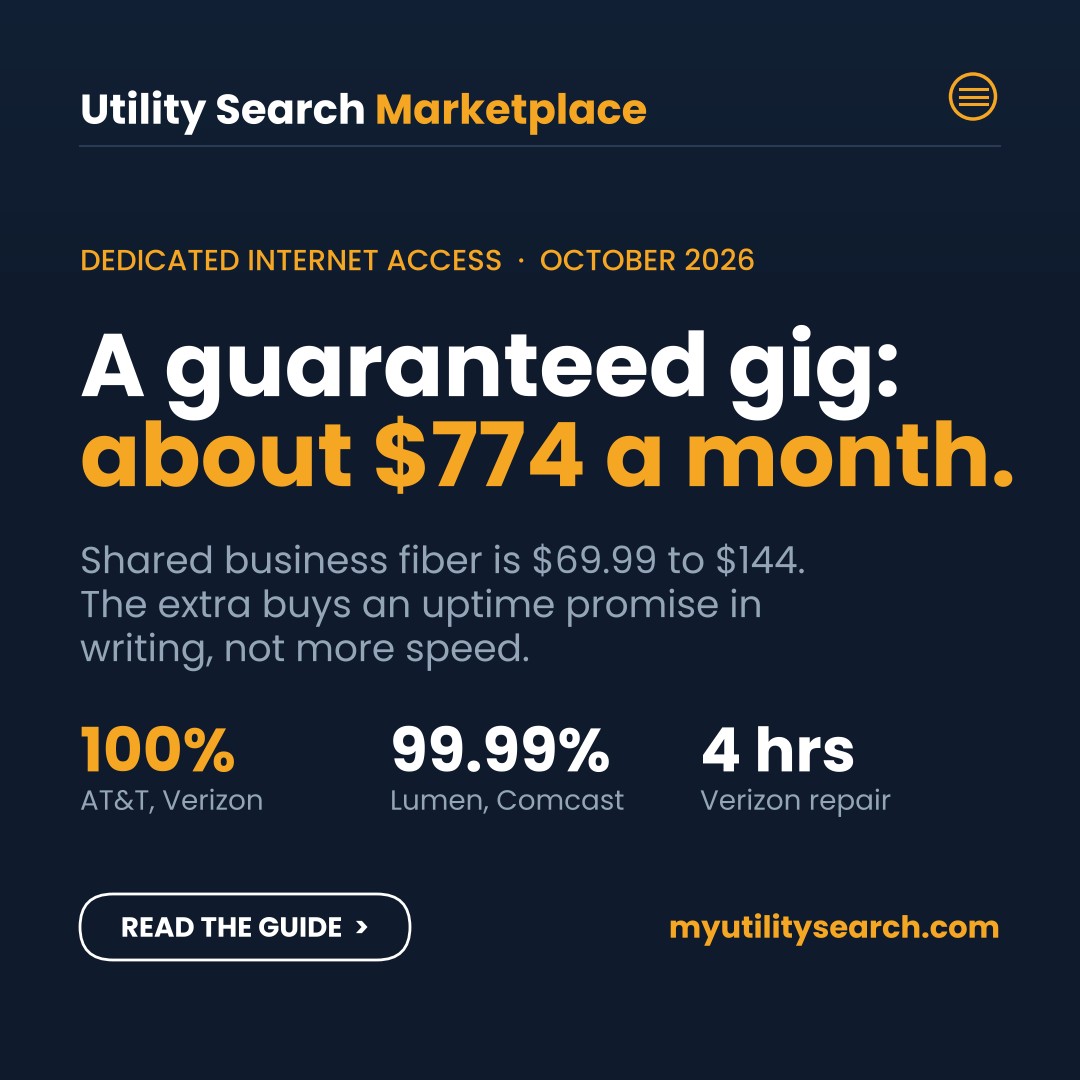
Every plan in the table above is shared business fiber internet. You get fiber to the building, but the provider’s network capacity is shared with other customers. Speeds are “up to,” and the provider does not promise them in writing.
Dedicated internet access (DIA) reserves bandwidth for your business alone. It comes with a service-level agreement (SLA) that spells out uptime, repair time and the credit you get when they miss. DIA is priced by quote, not on a public rate card, and install lead times run weeks.
| Question | Shared business fiber | Dedicated fiber (DIA) |
|---|---|---|
| Speed promise | “Up to” | Guaranteed in the SLA |
| Pricing | Published, $49.99 to $285 a month | Custom quote |
| Install time | Days, where fiber is already lit | Weeks; may need construction |
| Best for | Offices, retail, restaurants, clinics | Call centers, multi-site firms, anything that cannot go down |
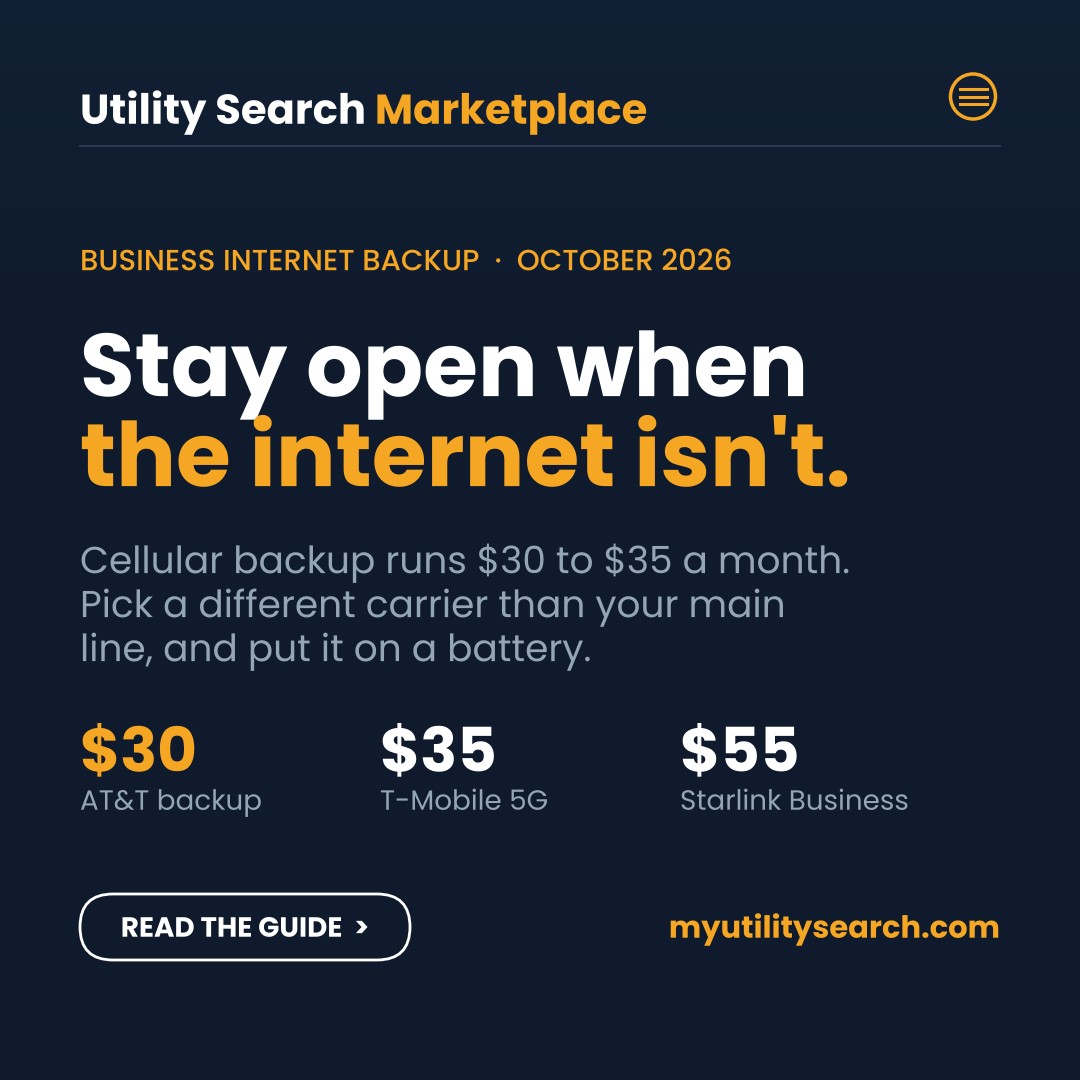
Most small businesses do not need DIA. A shared business fiber internet plan plus a 5G or fixed-wireless backup line covers most of the same risk for far less.
Which business fiber internet speed does your business need?
Most small businesses do not need the fastest tier. Match the speed to how many people work at once and what they upload.
- Retail shop, salon or small office (1 to 5 people): 300 to 500 Mbps handles card payments, VoIP phones and guest Wi-Fi. Frontier’s 500 Mbps at $49.99 or AT&T’s 300 Mbps at $60 are the entry points.
- Restaurant, clinic or 10-person office: 1 Gig gives room for video calls, cloud apps and a busy guest network at the same time.
- Design, video, engineering or 25+ staff: 2 Gig and up pays off when large files move to the cloud all day. Symmetrical upload is the reason to buy business fiber internet here.
- Several locations: price each site separately, and ask about managing them together with SD-WAN.
Buy for the next two years, not just today. Ask how an upgrade or downgrade affects the price lock before you sign.
What shoppers like and dislike about business fiber internet
What owners like: upload that finally matches download, video calls that stop freezing at 4 p.m., and flat pricing with no data caps. Frontier and AT&T both advertise no annual contract on their fiber plans.
What frustrates them: availability. Business fiber internet reaches far fewer addresses than cable, and a fiber line across the street does not mean fiber in your suite. The second complaint is fine print: activation fees, equipment-return penalties and Auto Pay rules that quietly change the monthly price.
How to get business fiber internet at your address
- Check the exact street address. Fiber is qualified building by building. Use the FCC National Broadband Map to see which providers report fiber there.
- Ask whether fiber terminates in your building. “Fiber-powered” and “fiber network” can still mean coax to your door.
- Compare 1 Gig across at least two providers, including the price after any promotion ends.
- Price the extras: static IPs, activation, equipment and the Auto Pay method.
- Plan the phones and the backup together. If calls run over the connection, read our guide to replacing copper business lines.
Frequently asked questions
How much does business fiber internet cost?
In October 2026, 1 Gig business fiber internet costs $69.99 (Frontier) to $144 (Verizon Fios) a month from the major fiber providers, before taxes and fees. Entry tiers start at $49.99 for 500 Mbps.
Is Comcast Business or Spectrum Business fiber?
Not to the building. Both run hybrid fiber-coax networks: fiber reaches a nearby node, and coaxial cable connects your premises. Spectrum says so in its own fine print.
What is the difference between business fiber and dedicated internet access?
Business fiber internet shares network capacity and advertises “up to” speeds at published prices. Dedicated internet access reserves bandwidth for one business, guarantees it in an SLA, and is priced by quote.
Does business fiber internet require a contract?
Often not. Frontier and AT&T advertise no annual contract on business fiber internet. Verizon Business Fios uses a 2-year term that auto-renews.
Is business fiber internet worth it for a small business?
Yes, if your work depends on upload: video calls, cloud backup, VoIP or card payments. Symmetrical fiber handles those better than cable, and Frontier’s gig now costs about the same as many cable plans.
Bottom line on business fiber internet
Business fiber internet is cheaper than it has ever been, led by Frontier’s $69.99 gig. Confirm the fiber actually reaches your building, price the plan after the promotion and the Auto Pay rules, and pair it with a backup line if downtime costs you money.
Compare internet, energy & home security at your address
Sources
- Frontier Business Fiber plans and fine print (read Oct 16, 2026)
- AT&T Business Fiber plans (read Oct 16, 2026)
- Verizon Business Fios internet plans (read Oct 16, 2026)
- Google Fiber Business plans (read Oct 16, 2026)
- Spectrum Business internet plans (read Oct 16, 2026)
- Comcast Business internet plans (read Oct 16, 2026)
- FCC National Broadband Map
Talk to a business internet specialist
For quotes on business fiber, backup connections, phones and IT at your location, call (866) 328-7973 or use BOX by TechGuidance to pull every serviceable connection for your address.
Are you a residential customer?
Shopping for home internet instead? Compare home internet plans at your address or call our residential team at (844) 437-9527.
Keep going
- Business internet providers compared: fiber, cable and fixed wireless
- What business internet costs, by provider and speed
- How to find every business internet provider at your address
- Business utilities checklist for a new location
- AT&T copper line shutdown: what businesses replace them with
- Why the AI fiber boom won’t cut your business internet bill yet