Blog
Hotwire Internet: No Rate Card, 6,555 FCC Labels — What Fision Bulk Fiber Really Costs Residents and Boards

Updated on September 9, 2026
Hotwire internet has no public rate card, and that is the first thing to understand about it. Hotwire Communications sells its Fision fiber service in bulk to homeowner associations, condo boards and apartment owners, so for most of its 1,180-plus communities the base internet plan is paid through HOA dues and the only prices a resident ever sees are upgrades.
Hotwire’s machine-readable FCC labels — 6,555 of them, one per community and tier, dated September 7, 2026 — show what those upgrades cost: a symmetrical gig is most often $39.99 to $99.99, 2.5 Gig runs $99.99 to $134.99, 5 Gig $149.99 to $159.99, and the 8 Gig Fision Max tier $249.99 to $259.99, with a $100 one-time fee on every label. Off-bulk, Hotwire’s retail sheet still lists a gig at $259.99.
Last updated: 7 September 2026. Prices analyzed from Hotwire’s FCC broadband-label CSV files published at gethotwired.com/fcc on September 7, 2026, plus the retail rate sheet linked from the same site; refreshed monthly. Hotwire does not offer an address or community lookup for pricing.
TL;DR — Hotwire internet in September 2026
- How it is sold: bulk fiber to HOAs, condos and apartments under the Fision brand; the base tier (typically 500 Mbps to 1 Gig symmetrical) is in your dues, and faster tiers are upgrades billed to you.
- Upgrade prices (FCC labels, 6,555 community-tier rows): Gigabit 1000/1000 median $74.99 (most common $99.99, then $39.99); 2.5 Gig median $124.99; 5 Gig median $149.99; Fision Max (up to 8 Gig) median $249.99; 500/500 median $34.99. One-time fee $100 on every label; no intro rate, no contract.
- Retail (non-bulk) rate sheet: 50 Mbps $109.99 → 1 Gig $259.99, plus $15.99 HD tech fee and $29.99 install — the price of not having a bulk agreement.
- Speeds on the labels: typical download over-delivers — 2.5 Gig tests at ~2,600 Mbps, 5 Gig at ~5,500, Fision Max at ~6,700; median latency ~5 ms; unlimited data.
- Footprint: Florida (South Florida core), Georgia, the Carolinas, Texas, Arizona, Nevada; 1,180+ properties, 4,300+ business customers; FisionX new-build partnership with Lennar.
- Ownership: founded 2002 in Fort Lauderdale by Kristin Johnson (CEO); Blackstone invested 2021; Brookfield Infrastructure agreed to buy Blackstone’s stake in June 2025 in a deal reported near $7 billion.
How is Hotwire internet sold, and why is there no price list?
Hotwire internet is a bulk product. Hotwire signs a multi-year agreement with a community — a gated HOA in Boca Raton, a condo tower in Hallandale Beach, a 55-plus development in Sarasota — builds fiber to every unit, and the association pays a per-door rate that lands in residents’ dues. Hotwire’s own pitch to boards is that its packages are “priced at half the rate of existing providers,” and the reason that can be true is that it is selling to 400 doors at once with no marketing cost per customer.
For a resident, that means the base tier shows up whether you want it or not, and gethotwired.com is a login portal rather than a shop: you sign in with an access code from your community, and the prices you see are the upgrades and add-ons for your building. There is no address checker and no public plan page, which is why every comparison site either lists nothing for Hotwire or reprints the retail rate sheet.
What do Hotwire’s FCC labels say the upgrades cost?
The FCC requires a broadband label for every plan sold, and Hotwire internet publishes them as four CSV files with a row for each community-and-tier combination — 6,555 rows in the September 7, 2026 set. We read all of them. Every row says “no introductory rate” and “no contract,” carries a $100 one-time charge, and lists unlimited data. The prices vary by community because each bulk agreement is negotiated separately, so the table below shows the spread rather than a single number.
| Hotwire tier (label name) | Speed (down / up) | Label rows | Most common price | Median price | Range across communities |
|---|---|---|---|---|---|
| High Speed Internet 500/500 | 500 / 500 Mbps | 568 | $34.99 | $34.99 | $9.99 – $84.99 |
| Gigabit Internet 1000/1000 | 1,000 / 1,000 Mbps | 864 | $99.99 (then $39.99) | $74.99 | $19.99 – $208 |
| Gigabit Internet 1000 (coax) | 1,000 / ~200 Mbps typical | 329 | $74.99 | $74.99 | $64.99 – $99.99 |
| 2.5 Gig / 2.5 Gig | 2,500 / 2,500 Mbps | 1,235 | $99.99 | $124.99 | $49.99 – $255 |
| 5 Gigabit Internet | 5,000 / 5,000 Mbps | 1,206 | $149.99 | $149.99 | $74.99 – $499.99 |
| Fision Max Internet | Up to 8,000 / 8,000 Mbps | 1,143 | $249.99 | $249.99 | $129.99 – $299.99 |
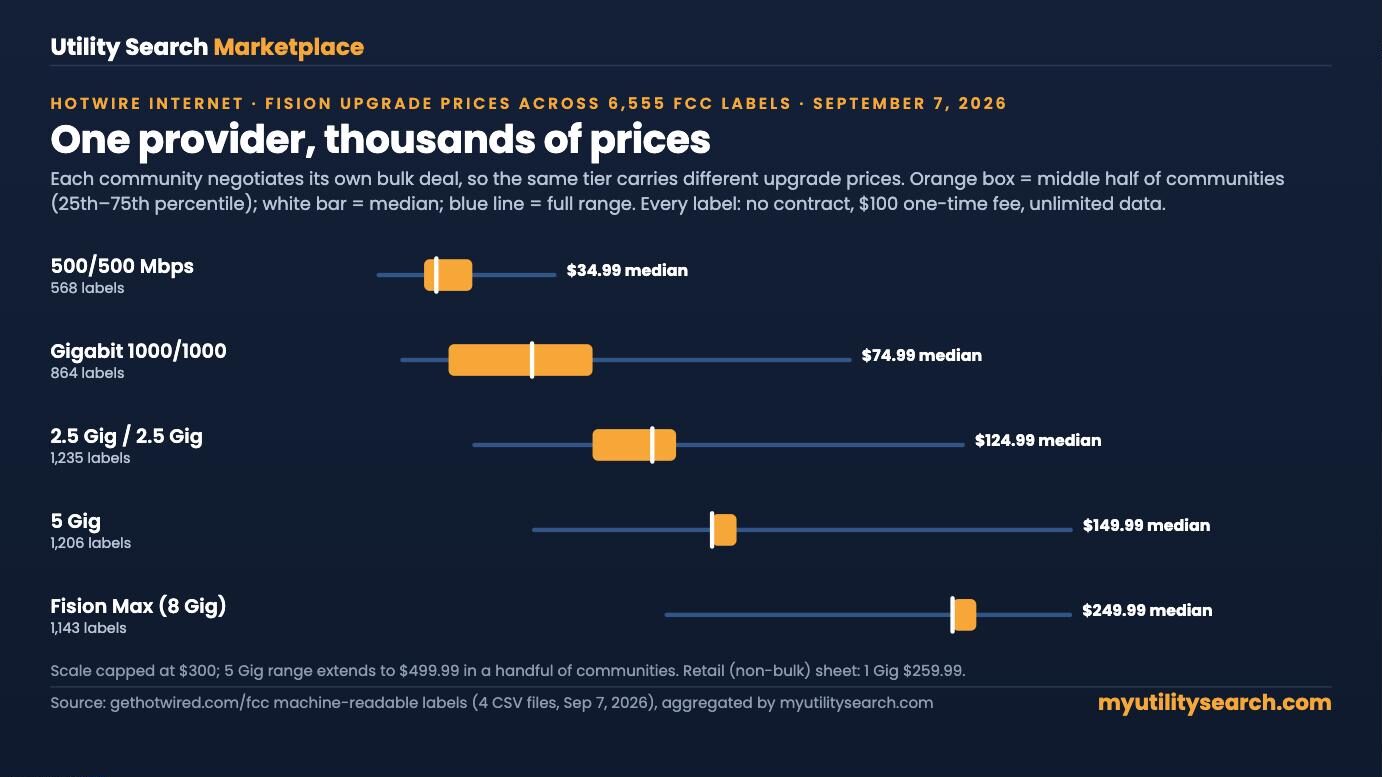
Read the ranges with the bulk model in mind. When a community’s dues already cover 500 Mbps, the “Gigabit 1000/1000” row for that building is the step-up — which is why $39.99 is the second most common gig price. When the base is a gig, the 2.5 Gig row is the step-up at $99.99. And the $19.99 and $9.99 floors are communities where the association has bought a high base tier and Hotwire internet charges only a token amount for the next rung.
What does Hotwire internet cost without a bulk agreement?
The Hotwire internet retail rate sheet, still linked from gethotwired.com, is the answer, and it explains why the bulk pitch works. Off-bulk, High Speed Internet 50 (50/10 Mbps) is $109.99 a month, 100 Mbps is $129.99, 250 Mbps is $169.99, 500 Mbps is $199.99 and Gigabit 1000 is $259.99, with a $15.99 HD tech fee, $12.99–$18.99 set-top boxes and a $29.99 installation charge. Nobody is expected to pay those numbers; they exist so the board can see the discount.
| Line item | Cost | Source |
|---|---|---|
| Base internet tier (bulk) | In HOA or rent; varies by agreement | Community bulk contract |
| Speed upgrade | $9.99 – $259.99/mo by tier and community | FCC labels, Sep 7, 2026 |
| One-time fee on upgrades | $100 | FCC labels (SinglePurchaseFee) |
| Contract / early termination | None on any label | FCC labels |
| MaxFi whole-home Wi-Fi | Included with multi-gig upgrades; add-on otherwise | FisionX page |
| Retail (non-bulk) internet | $109.99 – $259.99/mo | Retail rate sheet |
| Retail HD tech fee / install | $15.99/mo / $29.99 | Retail rate sheet |
| Fision TV+ / Stream, Fision Voice, security | Optional add-ons priced per community | gethotwired.com portal |
Compare internet, energy & home security at your address
How fast is Hotwire internet really?
Faster than the tier name, according to Hotwire internet’s own labels. The typical-speed columns show the 2.5 Gig tier testing at roughly 2,600 Mbps down and 2,570 up, 5 Gig at about 5,500 down and 5,300 up, and Fision Max at 6,700 to 7,900 Mbps in both directions depending on the community. Median latency across all 6,555 rows is about 5 ms. Hotwire has also tested 25G and 50G PON with Nokia in Florida, which is why its top tier already reads “up to 8 Gbps” while most fiber providers stop at 5.
Not every Hotwire building is fiber to the unit. A minority of labels — “Gigabit Internet 1000” without the “/1000,” “High Speed Internet 250,” “350,” “400” — describe older coax or Ethernet-riser buildings where upload is a fraction of download; the 1000-only rows test at about 900 down and 220 up. If you are buying into a Hotwire internet community, ask whether the building is on Fision fiber or a legacy plant before you count on symmetrical speed.
Where is Hotwire internet available?
Hotwire internet’s parent, Hotwire Communications, was founded in Fort Lauderdale in 2002 by Kristin Johnson, who remains CEO, and grew up alongside South Florida’s gated communities and condo towers. Its Fision footprint today covers Florida from Miami-Dade and Broward through Palm Beach, the Treasure Coast, Southwest Florida, Central Florida and North Florida, plus Georgia, North and South Carolina, Texas, Arizona and Nevada. As of the Brookfield announcement it served more than 1,180 properties and 4,300 business customers, and its FisionX program wires new Lennar homes so the internet is live at closing.
Ownership has changed twice in five years. Blackstone bought in alongside the founders in April 2021; in June 2025 Brookfield Infrastructure agreed to acquire Blackstone’s stake and become Hotwire’s owner “alongside the management team,” a transaction Light Reading reported at roughly $7 billion including debt. Because Hotwire internet is sold to communities rather than households, availability is a question for your board or landlord, not an address checker — enter your address in our internet comparison tool to see which retail providers also reach your building.
How does Hotwire internet compare to Xfinity, AT&T Fiber and 5G?
| Option in a Hotwire community | Speed (down / up) | Price | Price hold | Notes |
|---|---|---|---|---|
| Hotwire Fision base tier (bulk) | 500–1,000 / same | In dues | Life of the bulk contract | No choice to opt out; no contract, no cap |
| Hotwire Gigabit 1000/1000 upgrade | 1,000 / 1,000 Mbps | $39.99–$99.99 typical | Standard rate | $100 one-time fee |
| Hotwire 2.5 Gig upgrade | 2,500 / 2,500 Mbps | $99.99–$134.99 typical | Standard rate | $100 one-time fee; MaxFi Wi-Fi |
| Xfinity Gigabit (South Florida) | 1,000 / 35 Mbps cable | $70–$80 promo | 12–24 months | xFi gateway $15/mo extra |
| AT&T Fiber 1 Gig | 1,000 / 1,000 Mbps | $80 | Standard rate | Wi-Fi included; taxes extra |
| T-Mobile Rely 5G | 170–354 / ~20 Mbps | $50 ($35 w/ voice line) | 5 years | Often the only opt-out in a bulk building |
The comparison is unusual because the base Hotwire internet tier is not optional. If your community has a bulk agreement, you are paying for Fision whether you use it or not, so the practical question is whether to add a second provider on top. Against Xfinity, the answer is almost always no: a symmetrical gig you already own beats a 1,000/35 cable connection you would pay $85 for. Against AT&T Fiber, the products are equivalent and the only reason to double up is a specific need Hotwire’s building does not meet. Against 5G, the carriers matter mainly for renters who move often and want a connection that is theirs.
Is Hotwire internet worth it?
If your community already has it, yes — the labels show a genuine symmetrical fiber network with sub-5 ms latency, over-delivering speed tiers and no contract on upgrades, and the per-door bulk rate is almost always below what any resident could buy retail. The 2.5 Gig step-up at $99.99 is fair for the speed, and the $39.99 gig step-up in 500 Mbps communities is one of the cheapest gig upgrades on this site.
Be more careful as a board member evaluating Hotwire internet for the first time. The retail sheet’s $259.99 gig is the comparison Hotwire wants you to make; the honest comparison is against AT&T Fiber’s $80 standard gig or Xfinity’s promo, multiplied by the share of residents who would actually subscribe. Bulk locks every unit into the same provider for the contract term, so the questions to ask are term length, the per-door rate escalator, whether the base tier is fiber to the unit, and what the $100 one-time upgrade fee covers.
What comes with Fision TV, Fision Voice, MaxFi and FisionX?
Fision TV+ and Fision Stream are the Hotwire internet IPTV and streaming products, with thousands of on-demand titles and set-top boxes priced per community; the retail sheet lists TV packages from $35.99 to $213.99 for reference. Fision Voice is home phone.
MaxFi is the whole-home Wi-Fi 7 mesh that is included with multi-gig upgrades and sold as an add-on otherwise. Hotwire also sells home security and automation, a 24/7 Total Device Support plan, and community amenity Wi-Fi at pools and fitness centers as part of bulk deals. FisionX is the newest piece: a Lennar partnership in which new homes are pre-wired so “your home is online from day one,” with Gig+ internet in the base package and upgrades to 8 Gbps.
Hotwire internet FAQ
How much does Hotwire internet cost?
For most residents the base Fision tier is paid through HOA dues or rent under a bulk agreement. Upgrades on Hotwire’s September 2026 FCC labels run about $39.99–$99.99 for a symmetrical gig, $99.99–$134.99 for 2.5 Gig, $149.99–$159.99 for 5 Gig and $249.99–$259.99 for the 8 Gig Fision Max tier, plus a $100 one-time fee. Retail, non-bulk pricing is $109.99–$259.99.
Can I get Hotwire internet at my house?
Only if your community, building or new-construction development has a bulk agreement with Hotwire. Hotwire does not sell to individual addresses and has no public availability checker; residents sign in at gethotwired.com with a community access code.
Is Hotwire internet fiber?
Mostly. Fision is fiber-to-the-unit in most communities, with symmetrical tiers from 500 Mbps to 8 Gig. A minority of older buildings are served over coax or Ethernet risers with lower upload speeds; the FCC labels for those show “Gigabit Internet 1000” without a matching upload.
Does Hotwire have a contract or data cap?
No on both for residents. Every Hotwire FCC label lists no contract, no early-termination fee and unlimited data. The bulk contract is between Hotwire and your association, not you.
Can I opt out of Hotwire in a bulk community?
Usually not — the per-door rate is in your dues regardless of use. You can add a second provider such as AT&T Fiber, Xfinity or a 5G carrier on top, but you will pay for both.
Where is Hotwire available?
Florida (Miami-Dade, Broward, Palm Beach, Treasure Coast, Southwest, Central and North Florida), Georgia, North Carolina, South Carolina, Texas, Arizona and Nevada — more than 1,180 properties as of 2025.
Who owns Hotwire Communications?
Brookfield Infrastructure, which agreed in June 2025 to acquire Blackstone’s stake in a deal reported near $7 billion, alongside co-founder and CEO Kristin Johnson and the management team.
What is FisionX?
Hotwire’s new-construction program with Lennar: homes are built with Fision fiber already active, Gig+ internet in the base package paid through the HOA, Wi-Fi 7, and optional upgrades to 8 Gbps, MaxFi mesh, TV, voice and security.
That is Hotwire internet in September 2026: a bulk fiber provider whose real prices live in 6,555 FCC labels rather than a rate card, a symmetrical gig upgrade for as little as $39.99 where the base is 500 Mbps, an 8 Gig tier that tests at nearly 7,000 Mbps, and a retail sheet that exists mainly to make the bulk rate look good. If your building has it, use it; if you are on the board deciding, compare it to the retail fiber at your address first.
Compare internet, energy & home security at your address
Sources
- Hotwire Communications, FCC Broadband Labels (machine readable) — four CSV files dated September 7, 2026, 6,555 community-tier rows; prices, typical speeds, latency, $100 one-time fee, no intro rate, no contract, unlimited data. Our aggregation: medians and most-common prices by tier.
- Hotwire, Retail Rate Sheet — High Speed Internet 50 $109.99 through Gigabit 1000 $259.99; TV $35.99–$213.99; HD tech fee $15.99; install $29.99.
- gethotwired.com — sign-in portal, access-code model, “We provide bulk service to HOAs, community associations, developers and more.”
- Hotwire, Fiber-to-the-Home for Communities — bulk model, “100% symmetrical, fiber optic internet,” amenity Wi-Fi.
- Hotwire, FisionX — Lennar partnership, Gig+ base, up to 8 Gbps, Wi-Fi 7, MaxFi.
- Hotwire, Broward County — “priced at half the rate of existing providers.”
- Light Reading, “Brookfield’s Hotwire buy reportedly worth $7B” (June 2025) — seven states, 1,180+ properties, 4,300+ business customers, Nokia 25G/50G PON trial.
- Hotwire, Brookfield Infrastructure investment announcement — Blackstone exit, founded 2002, Kristin Johnson quote.
Keep going
- Internet providers in Miami — the retail options in Hotwire’s home market
- Internet providers in Boca Raton — gated-community country, where bulk fiber is the norm
- Utilities-included apartments — how bulk internet in rent actually works
- Best fiber internet near me — the retail fiber to compare a bulk quote against
- Xfinity internet — the cable incumbent in most Hotwire communities
- Cox internet — the incumbent in Hotwire’s Arizona and Nevada buildings
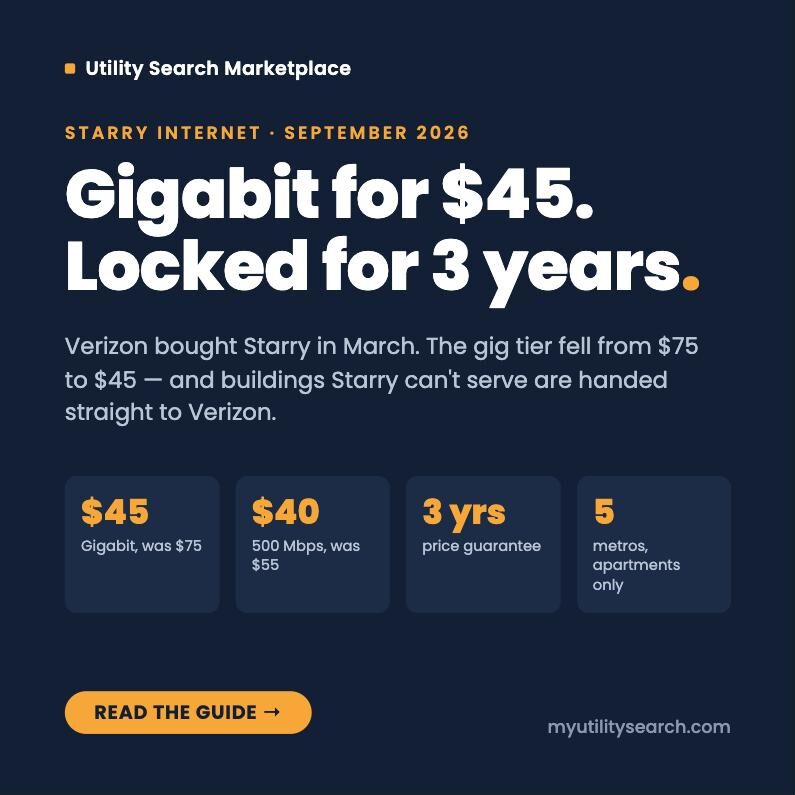
- Starry internet — the other apartment-only provider, rooftop wireless at $45 for a gig