Blog
Business Internet: Compare Fiber, Cable & Fixed-Wireless (2026)

Updated on September 17, 2026
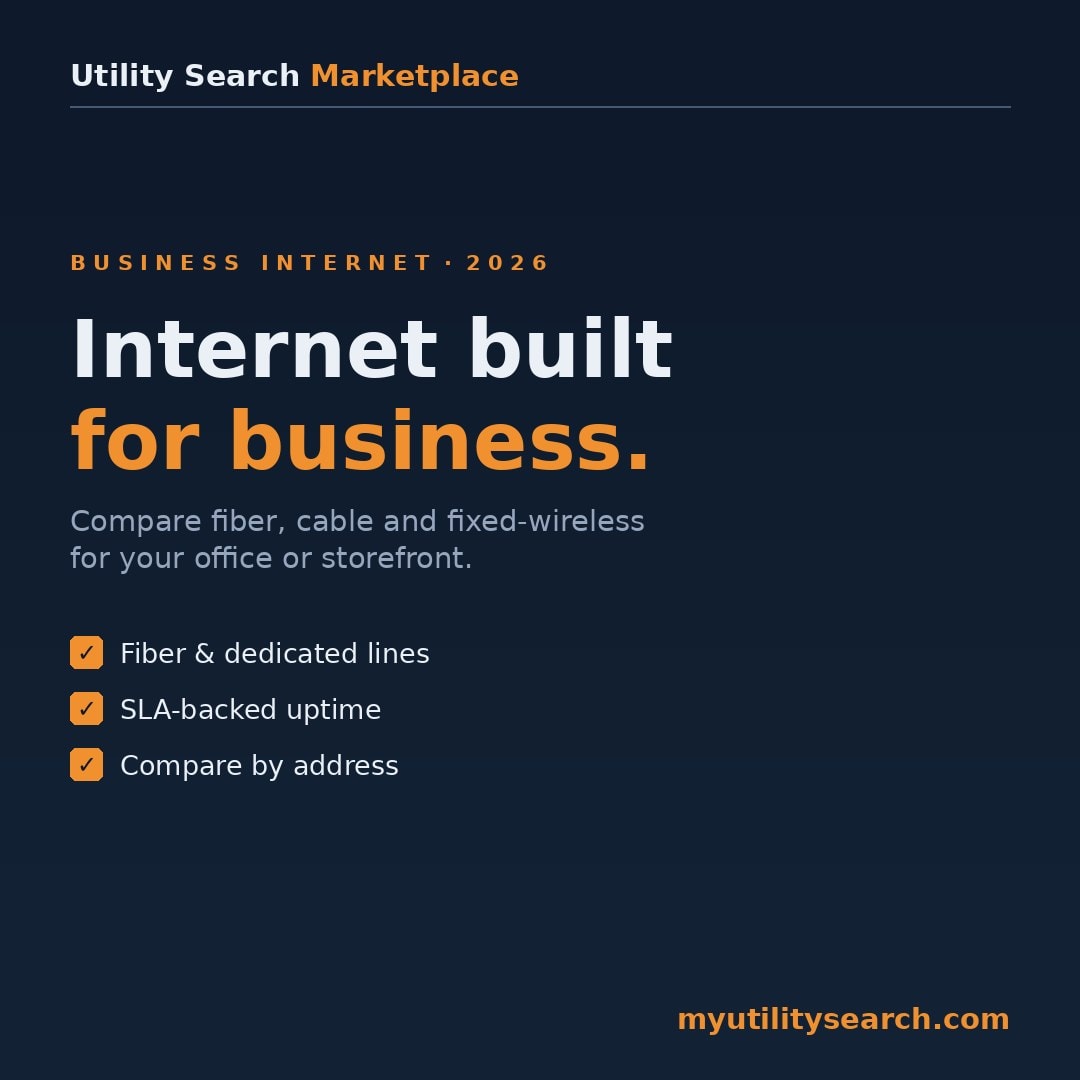
The right business internet depends on your size and location: fiber for reliability and symmetrical speed, cable for value, and fixed-wireless or 5G where fiber has not reached yet. What sets business internet apart from home service is the guarantee behind it — service-level agreements, faster repair, static IPs, and priority support. Compare providers by your exact address, and prioritize uptime and upload speed over headline download numbers.
TL;DR — choosing business internet
- Fiber is the top pick for reliability and symmetrical upload; cable is the value option; fixed-wireless/5G fills gaps.
- Business internet adds an SLA, static IPs, and priority support that home plans do not.
- Size your bandwidth to your team and your cloud tools, not just download speed.
- Availability is address-specific — compare business internet where your office actually sits.
What is business internet?
Business internet is internet service built for offices, storefronts, and teams rather than households. On paper the speeds can look similar to consumer plans, but the difference is in the guarantees: business internet typically comes with a service-level agreement that promises a level of uptime, faster repair windows when something breaks, optional static IP addresses for hosting and remote access, and support that answers as a business rather than a consumer. For anything that loses revenue when the connection drops — card payments, cloud phones, e-commerce — those guarantees are the whole point.
SLA, explained: A service-level agreement is the provider committing in writing to a level of uptime (often 99.9%+) and a repair time. It is the single biggest reason a business pays more for the same speed a home gets — the connection is treated as critical.
Types of business internet
Four connection types cover almost every business, and the right one depends on what is available at your address and how much downtime you can tolerate.
| Type | Best for | Trade-off |
|---|---|---|
| Fiber | Reliability, symmetrical upload, cloud-heavy teams | Not available everywhere yet |
| Cable | Value and wide availability | Slower upload; shared network |
| Fixed wireless / 5G | Locations fiber and cable have not reached | Speed varies with signal |
| Dedicated (DIA) | Guaranteed bandwidth for larger offices | Highest cost; install lead time |
How much does business internet cost?
Pricing spans a wide range because business internet spans everything from a small shop to an enterprise office. A small business on cable or fiber often runs roughly $70 to $250 a month; a dedicated internet-access (DIA) circuit with a guaranteed speed and a strict SLA can run several hundred to a few thousand a month. What you are paying for above the home price is the guarantee, the symmetrical upload, and the support — not just raw download speed.
How to choose business internet
Start with three questions: how many people and devices need to be online at once, how much you rely on the cloud (video calls, VoIP phones, backups, e-commerce), and how much a single hour of downtime would cost you. Heavy cloud and VoIP use means upload speed and an SLA matter more than a big download number. Then check what is actually available at your address, compare the providers that reach it, and leave room to scale as you grow.
Business internet vs. home internet
You can sometimes run a very small business on a home plan, but you give up the guarantees. Home internet has no SLA, deprioritizes upload, and treats an outage as a consumer ticket. Business internet costs more but backs the connection with uptime commitments and faster repair — the difference between a slow afternoon and a day of lost sales.
How much bandwidth does a business need?
Match bandwidth to your team and your tools rather than buying the biggest plan on offer. A small crew mostly on email and web runs comfortably on modest speeds, while a busy office doing constant video calls, cloud backups, and card processing needs both more capacity and strong upload. As a rough guide, a handful of light users are fine on entry tiers; a dozen or more people, or heavy cloud and VoIP use, calls for mid-tier fiber with symmetrical upload; and a large office that cannot tolerate downtime wants a dedicated circuit with a guaranteed rate. When you are unsure, size up on upload — it is the number that video meetings and backups actually strain, and the one home plans skimp on most.
Setting up or switching at a new location
Whether you are opening a new office or replacing a provider that keeps dropping, the process is the same. Confirm exactly what is available at the street address, compare the connection types and providers that reach it, and mind the install lead time — fiber and dedicated circuits can take weeks to provision, so start early. If you are relocating, line up service before the move so you do not open your doors with no connection. Before you sign, ask about contract length, install and equipment fees, and whether the uptime guarantee and any static IPs you need are included or billed as add-ons. Getting those details in writing up front is what separates a smooth cutover from a week of workarounds.
Compare business internet at your address
See which providers, speeds, and dedicated lines reach your office or storefront — free, no markup.
Frequently asked questions
What is business internet?
Internet service built for offices and teams, with a service-level agreement, faster repair, optional static IPs, and priority support that home plans do not include.
Is a business plan worth it over home internet?
If downtime costs you money — payments, VoIP, e-commerce — yes. The SLA and faster repair are what you are paying for.
What speed does a business need?
It depends on team size and cloud use. Cloud-heavy or VoIP-reliant offices should prioritize upload speed and an SLA over raw download.
Is fiber the best option for a business?
Usually, where it is available — fiber offers symmetrical speeds and the best reliability. Cable and fixed-wireless are the alternatives when fiber has not reached your address.
How much does it cost?
Small-business cable or fiber often runs $70 to $250 a month; dedicated circuits with strict SLAs cost more, from several hundred to a few thousand.
What is a business internet SLA?
A written commitment to a level of uptime and a repair time. It is the main reason business internet costs more than the same home speed.
Can I run my business on home internet?
For a very small operation, sometimes — but you lose the SLA, upload priority, and business-grade support.
Does it come with a static IP?
Often as an option. Static IPs help with hosting, remote access, and some security setups.
Keep going
- Business internet cost — prices by provider and speed tier
- Compare the best internet providers for 2026
- Cable internet: how it works & providers
- What internet is available in my area
- Best fiber internet near me
- Why is my internet not working?
Confirm which providers serve your address on the FCC National Broadband Map.