
Blog
Slab Leak Repair Cost 2026: What You’ll Pay and What Insurance Covers


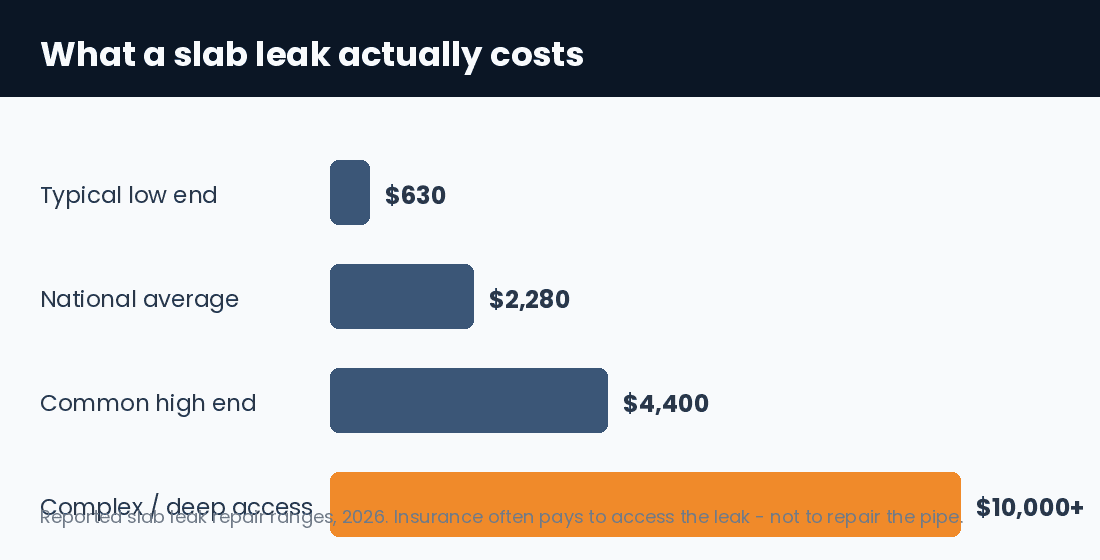
Slab leak repair cost typically runs from about $630 on the low end to roughly $4,400 at the high end, with a national average near $2,280. Complex jobs — deep pipe, difficult access, or a full reroute — can push past $10,000. The wide range comes down to one thing: how hard the pipe is to reach.
TL;DR: Slab leak repair cost is driven by access, not by the pipe. Detection runs $150–$500, opening the slab $500–$1,500, the repair or reroute $600–$4,000, and restoration $500–$3,000. Homeowners insurance often pays to reach the leak and repair the damage — but commonly excludes the pipe repair itself.
Last updated: July 19, 2026 · Reviewed by the MyUtilitySearch team
What is a slab leak?
A slab leak is a leak in a water line running beneath the concrete foundation of your home. Because the pipe sits under several inches of concrete, the leak is usually invisible until it announces itself indirectly — a warm spot on the floor, the sound of running water with every tap closed, an unexplained jump in the water bill, cracked flooring, or a musty smell.
Slab leaks are most common in slab-foundation states like Texas, Arizona, California and Florida, where plumbing is routed under the pad rather than through a basement or crawlspace. Homes with older copper supply lines, poor water chemistry, or shifting soil are the usual candidates.
Slab leak repair cost by stage
Quotes vary because slab leak repair cost is really four separate costs bundled together. Understanding the breakdown is the fastest way to tell whether a bid is reasonable:
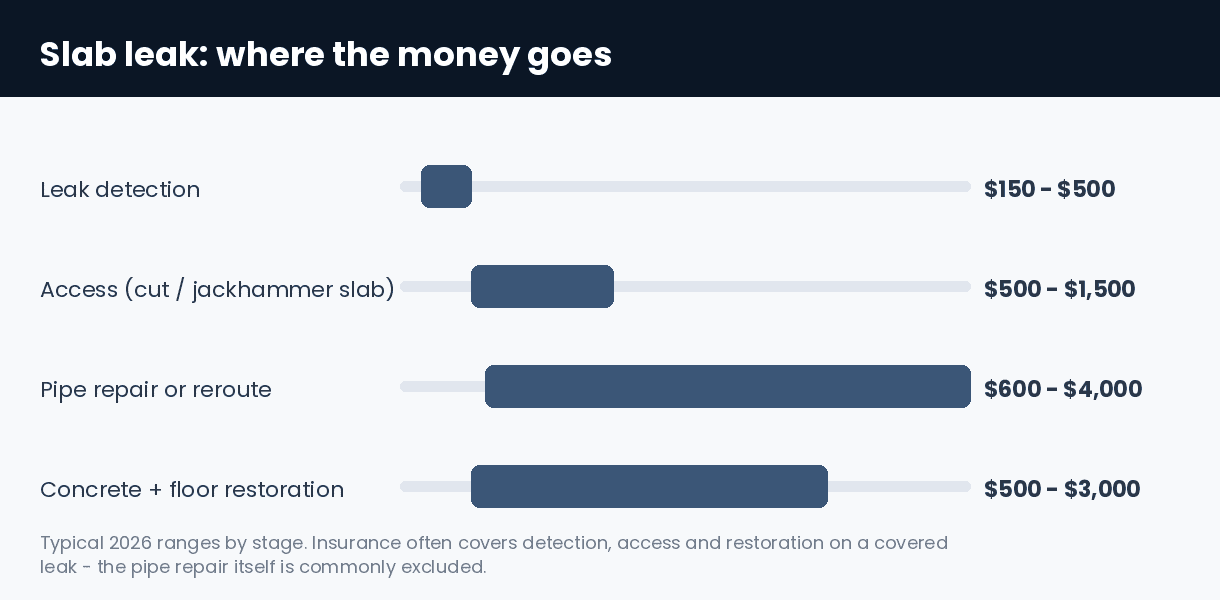
- Leak detection ($150–$500). Acoustic equipment, pressure testing or thermal imaging to pinpoint the leak before anything is cut.
- Access ($500–$1,500). Cutting or jackhammering through the slab to expose the pipe.
- Repair or reroute ($600–$4,000). Spot-repairing the section, or abandoning the line and rerouting new pipe overhead.
- Restoration ($500–$3,000). Re-pouring concrete and replacing the flooring you had to destroy.
That last item surprises people. If the leak sits under tile, hardwood or a kitchen island, restoration alone can exceed the plumbing work.
Spot repair vs reroute: which is cheaper?
A spot repair fixes the single failed section and is cheaper up front, typically landing in the low-to-middle part of the range. It makes sense when the plumbing is otherwise sound and the leak is a one-off.
A reroute abandons the under-slab line entirely and runs new pipe through walls or the attic. It costs more initially but avoids future slab work on that line. If you have already had one slab leak, the odds of a second on the same aging line are high enough that many plumbers recommend rerouting rather than repeatedly opening the foundation. A full repipe is the most expensive path and is usually reserved for systemic pipe failure.
What drives slab leak repair cost up
Two identical-sounding leaks can differ by thousands of dollars. These are the variables that move the number most:
- Depth and location of the pipe. A line under an open living room is far cheaper to reach than one beneath a kitchen island, a staircase or a load-bearing wall.
- Flooring type. Carpet lifts and relays cheaply. Tile, natural stone and glued hardwood often cannot be salvaged, and matching discontinued material can cost more than the plumbing.
- Hot line vs cold line. Hot-water lines fail more often and sit deeper in many builds, which raises access cost.
- Water chemistry and pipe age. Acidic water pinholes copper from the inside; where one pinhole appears, others usually follow — which changes the math toward a reroute.
- Secondary damage. Mold remediation or foundation movement can dwarf the plumbing bill, and both scale with how long the leak ran.
- Emergency timing. After-hours and weekend dispatch carries premium labor rates.
Regional differences
Slab leak repair cost skews higher in metros with elevated labor rates and in regions where slab foundations dominate, simply because demand and complexity are both greater. Texas is a clear example — the combination of slab construction, shifting clay soils and hard water makes slab leaks routine, and the local trade prices accordingly. Homeowners across Texas metros, including San Antonio, should expect quotes toward the middle of the range rather than the bottom — and it is worth reviewing how Texas utility costs stack up while you are budgeting the repair.
One practical note before you accept any bid: confirm the plumber carries liability insurance and pulls the permit where your municipality requires one for slab work. An uninsured cut-rate job on a foundation is the wrong place to save a few hundred dollars, and unpermitted work can complicate both your insurance claim and a future sale.
Does insurance cover slab leak repair cost?
Partly — and the split matters. Most standard policies treat a sudden slab leak as a covered event and will pay for access and restoration: the tear-out, the concrete, the flooring, the damage the water caused. What they commonly exclude is the pipe repair itself, along with any leak they classify as gradual or wear-related.
So a homeowner facing a $3,500 slab leak repair cost may find insurance covers a substantial share of it — or almost none, depending on how the cause is characterized. Full detail is in our guide to whether homeowners insurance covers plumbing.
The pipe side is where a service contract can help: see does home warranty cover plumbing, keeping in mind that slab access and coverage caps are frequently limited even when the line itself is covered.
How to reduce your slab leak repair cost
- Act early. Cost scales with damage. A leak caught by a water-bill anomaly is far cheaper than one found when the flooring buckles.
- Pay for detection separately. Knowing the exact location prevents exploratory demolition, which is the most avoidable line item.
- Get three itemized bids broken out by stage — detection, access, repair, restoration — so you can compare like with like.
- Ask about reroute pricing even if you came in expecting a spot repair. On an older line it is often the better long-run number.
- File the insurance claim before demolition where possible, and document everything with photographs.
- Check your water pressure. Pressure above roughly 80 psi accelerates pipe failure, and a regulator is far cheaper than another slab leak.
Slab leak repair cost FAQs
How much does slab leak repair cost on average?
The national average is around $2,280, with most homeowners paying between roughly $630 and $4,400. Complex jobs involving deep pipe, difficult access or a full reroute can exceed $10,000.
How do I know if I have a slab leak?
Common signs include a warm spot on the floor, running-water sounds with all fixtures off, an unexplained spike in your water bill, cracked or buckling flooring, low water pressure, and a persistent musty odor.
Does homeowners insurance cover slab leak repair cost?
Typically it covers accessing the leak and repairing the resulting damage when the leak is sudden and accidental, including tear-out and restoration. The repair of the pipe itself is commonly excluded, as are leaks judged to be gradual or wear-related.
Is it better to repair or reroute a slab leak?
A spot repair costs less up front and suits a one-off failure on otherwise sound plumbing. A reroute costs more initially but avoids repeat slab work, which often makes it the better value on older lines or after a second leak.
How long does slab leak repair take?
Detection usually takes a few hours. A straightforward spot repair is often completed in one to two days, while a reroute or extensive restoration can run several days to a week depending on concrete curing and flooring work.
Can a slab leak be left alone?
No. An untreated slab leak keeps eroding soil beneath the foundation and can lead to foundation movement, mold and far higher repair costs. Delay also increases the chance an insurer treats the damage as gradual and denies the claim.
Keep going
- Does homeowners insurance cover plumbing?
- Does home warranty cover plumbing?
- Home insurance vs home warranty
- Are home warranty plans worth it?
- Compare home insurance rates and save
- Hidden costs of owning a home
- Whole-house water filter cost
Catching a slab leak before the repair bill grows
The single biggest driver of slab leak repair cost is how long the leak ran before anyone found it. Water under a foundation does not announce itself, and the damage compounds quietly — which is why two households with identical pipe failures can end up thousands of dollars apart.
The EPA’s WaterSense program estimates that household leaks waste roughly one trillion gallons nationally each year, and recommends a simple monthly check: read your water meter, avoid all water use for two hours, then read it again. Any movement means water is escaping somewhere. That two-hour test is the cheapest tool available for catching a slab leak while the slab leak repair cost is still a spot repair rather than a full re-pipe.
The Department of Energy’s hot water guidance is a useful companion here, since a hot-side slab leak shows up on both the water and the energy bill. Other early signals worth taking seriously: a warm patch on the floor, the sound of running water with every fixture off, unexplained cracking, or a water bill that climbs without a change in habits. Acting on any one of them typically keeps you at the low end of the slab leak repair cost range instead of the high end.