Blog
Apartment Submetering Laws by State

Updated on September 9, 2026
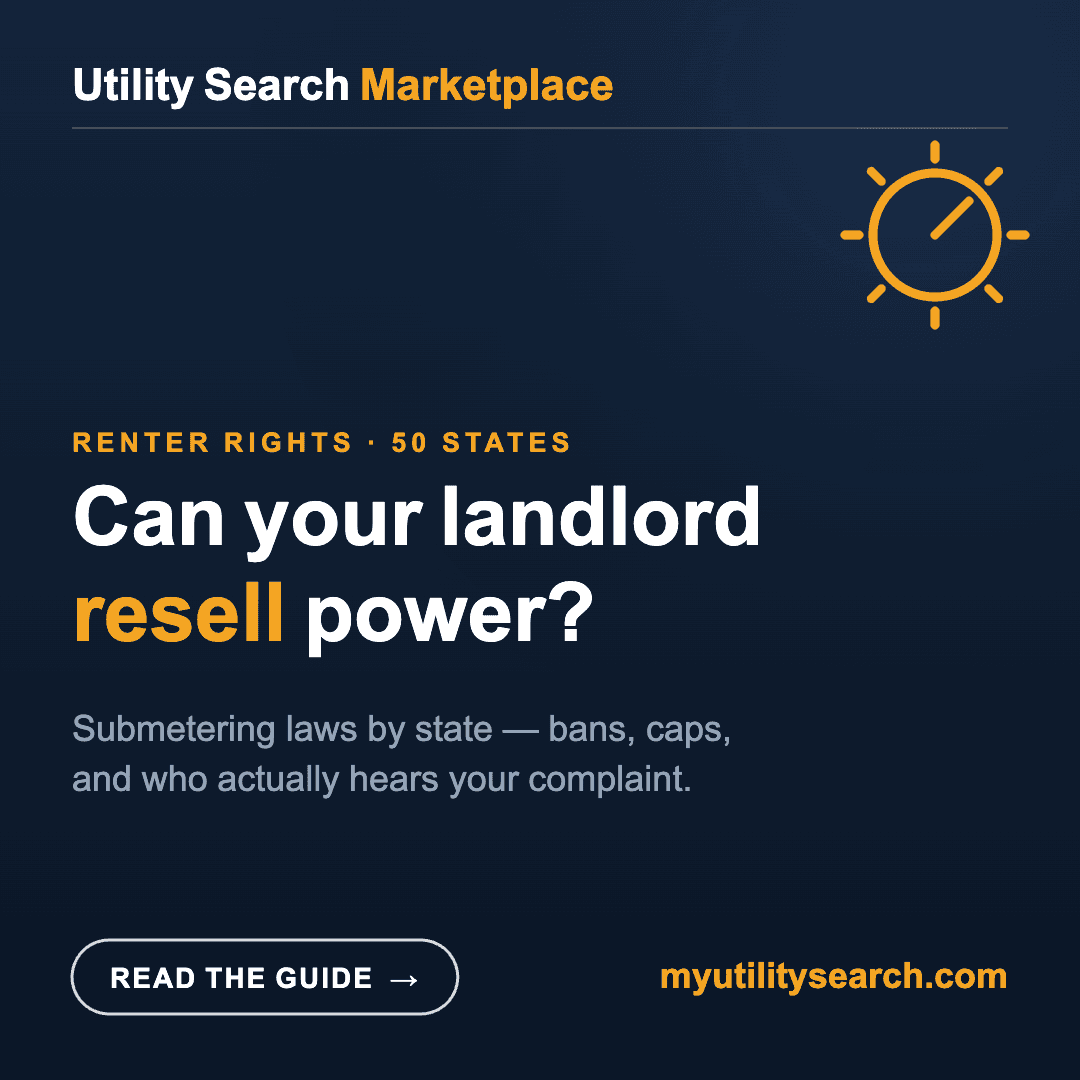
Under apartment submetering laws by state, most states let a landlord submeter electricity but not profit on it — charges are capped at what the utility bills the property. A few states ban residential electric submetering outright as unlawful resale. And in April 2026 the Ohio Supreme Court held that a company buying electricity and reselling it to tenants is a public utility, subject to state regulation. The rules on what you can be charged are only half the story; who hears your complaint varies just as much, and in several states the answer is nobody with real power.
Last verified: 23 August 2026. Next scheduled review: February 2027, or immediately on any state ruling.
TL;DR — apartment submetering laws by state
- Massachusetts bans residential electric submetering as resale.
- New York and Maryland require approval before a landlord can submeter.
- Texas, Illinois, Pennsylvania and Delaware permit it but ban markup.
- Ohio just switched models — by court ruling, not legislation.
- New Jersey’s rules are genuinely unsettled, and that is the finding.
- Enforcement is the hidden variable. In Maryland, a submetered tenant is expressly not a utility customer and has no complaint rights before the Public Service Commission.
What is submetering?
Definition
Submetering means the building has one master utility meter, and the owner installs individual meters on each unit to measure actual usage and bill each tenant for what they used.
It is different from RUBS (Ratio Utility Billing System) or energy allocation, which estimate each unit’s share from square footage, occupancy or bedroom count rather than measuring it. Several states regulate the two differently — Maryland, for example, requires Commission approval for allocation systems in older buildings under a separate statute from the one governing submeters.
And it is different from direct metering, where the utility itself meters your unit and you are the utility’s own customer. That distinction is what determines whether the state regulator will hear your complaint.
Apartment submetering laws by state: the master comparison table
Last verified 23 August 2026.
| State | Permitted? | Markup allowed | Pre-approval | Who hears complaints |
|---|---|---|---|---|
| Massachusetts | No — electric submetering prohibited as resale | — | — | Local board of health (not the DPU) |
| New Jersey | Effectively no for gas and electric except older existing systems | — | BPU, contested | Unclear |
| Connecticut | Narrow — only where power comes from a Class I renewable source or CHP, or PURA approves | No | PURA | PURA |
| New York | Yes | No — capped at the utility’s direct-metered residential rate | PSC petition | PSC (HEFPA) |
| Maryland | Yes | No — actual utility cost plus a maximum $1/month administrative fee | PSC for allocation systems | County landlord-tenant commission / consumer protection / AG — not the PSC |
| Texas | Yes | No charge above what the utility bills the owner | PUCT registration | Owner–tenant; PUCT enforces the rules |
| Illinois | Yes | No — building total may not exceed the utility’s bill | No | ICC; Chicago RLTO adds rights |
| Pennsylvania | Yes | Landlord is not a public utility under 66 Pa.C.S. §102 | No | PUC (weak for non-customers) |
| Delaware | Yes | No — actual cost only, including cost charged by a company the landlord owns | No | Landlord-tenant code remedy |
| Ohio | Yes | Being determined — see below | Not yet | PUCO, as of April 2026 |
| New Hampshire | Yes (electric, gas, water) — but Liberty Gas and Yankee Gas prohibit gas submetering by tariff | Unverified | — | — |
| Maine | State largely silent; Portland and Belfast permit water/wastewater | Unverified | — | — |
| Rhode Island | No statute or PUC regulation covers residential electric submetering. The state’s only submetering order is a 2008 gas tariff order permitting submetering for cost allocation but not resale | — | — | — |
| District of Columbia | Not authorized for residential. 15 DCMR Chapter 44 covers nonresidential units only; residential master-metered buildings fall under 15 DCMR Chapter 4 | — | — | — |

The National Conference of State Legislatures counts 22 states, three counties and the District of Columbia with statutes, regulations or rulings on utility submetering — though that count dates from January 2016 and now materially understates the picture. Ohio alone has changed since.
That three-way distinction is the backbone of apartment submetering laws by state — most statutes regulate each mode differently.
How to read this table
Three things it tells you that a simple yes/no list cannot.
First, “permitted” and “protected” are different questions. Maryland permits submetering and bans markup — and then tells you the Public Service Commission will not hear your complaint. Pennsylvania permits it and exempts the landlord from being a public utility, which means the PUC’s leverage over your dispute is thin. Permission without a forum is not much protection.
Second, the caps are structured differently. Texas bars any charge above what the retail electric provider or utility bills the owner. New York caps the rate at what the utility charges comparable direct-metered residential customers. Illinois caps the building total rather than the individual bill. Those produce different outcomes in edge cases, and it is worth knowing which one applies to you.
Third, several states are moving. Ohio’s model changed by court ruling in April 2026 and the legislative response is unresolved. Treat this table of apartment submetering laws by state as a snapshot with a date on it, not a permanent fixture.
The ban states — Massachusetts, Connecticut, New Jersey
Start where apartment submetering laws by state are strictest.
Massachusetts — outright ban. Electric submetering is prohibited because it constitutes the resale of electricity. The owner must pay for each unit’s electricity unless the unit has a separate meter installed, maintained and read by a utility company, with a written rental agreement. Rent inclusion is allowed only if the owner does not measure usage or charge based on it.
The authority is §335 of Chapter 164 of the Acts of 1997 — the Restructuring Act — which grants owners of residential properties the right to submeter only through a single meter installed before 1 July 1997. That is the grandfather clause, and it is narrow.
Enforcement is the striking part: the Department of Public Utilities does not adjudicate submetering complaints. They go to the local board of health, under the State Sanitary Code at 105 CMR 410. Water submetering is handled separately under a different statute.
Connecticut — narrow carve-out. Until 2013, only campgrounds and marinas could submeter; landlords were prohibited by law. Public Act 13-298 restructured the rule. Submetering is now permitted in multifamily residential buildings only where the electric power comes from a Class I renewable energy source or a combined heat and power system, or where PURA approves it specifically (CGS §16-19ff). The rate may not exceed what the main meter customer pays.
New Jersey — jurisdictionally murky, and the murk is the finding. BPU jurisdiction over submetering is contested. The reported position is that submetering is not allowed for gas and electric except for existing, older systems. The New Jersey Apartment Association has lobbied to permit gas and electric submetering. This is unsettled, not a rule.
The approval states — New York and Maryland
The middle tier of apartment submetering laws by state: permitted, but only with the regulator’s sign-off.
New York — the hardest gatekeeping in the country. Governed by 16 NYCRR Part 96 plus the Home Energy Fair Practices Act (HEFPA).
- The owner must petition and receive PSC authorization before submetering. Part 96 §96.3 governs authorization filings for master-to-submeter conversions and for new premises; §96.5 sets out what the petition must contain.
- Rate cap: §96.6(c) — “the submeterer shall not charge more than the applicable rate cap.” Absent a specific order, that cap equals the distribution utility’s rates for comparable direct-metered residential customers.
- HEFPA applies. §96.6(e): “the submeterer shall comply with the requirements imposed by HEFPA.” §96.6(h) extends termination-related protections even where there is no shutoff equipment.
- The penalty has teeth. Under §96.8, violations can cut the rate cap by up to 40%, retroactively up to two years, with refunds to tenants.
- Exceptions exist for co-ops and condominiums, and campgrounds, trailer parks, marinas and parking need no approval at all.
Maryland — no markup, but no PSC recourse. Public Utilities Article §7-303 authorizes submetering in apartment houses, office buildings and shopping centres. The owner may not charge more than the actual Commission-authorized utility cost, plus a maximum $1 per month administrative fee. Allocation must track actual usage. Mid-lease installation triggers a savings pass-through. Occupants may inspect records. The owner is expressly not a public service company.
Energy allocation systems — the estimation-based alternative — require Commission approval before direct billing under §7-304, and the Commission must forward consumption complaints to the Attorney General’s Consumer Protection Division.
And then COMAR 20.25.01.07, which is the quotable part: “Any dispute relating to the occupant’s bill and to the accuracy of his submeter is between the owner and the occupant, and excludes the utility… An occupant is not a customer of the utility. An occupant is not entitled to have complaint or other customer rights before the Commission.”
Compare internet, energy & home security at your address
The no-markup states — Texas, Illinois, Pennsylvania, Delaware
Most apartment submetering laws by state land in this tier: submetering is legal, but strictly at cost.
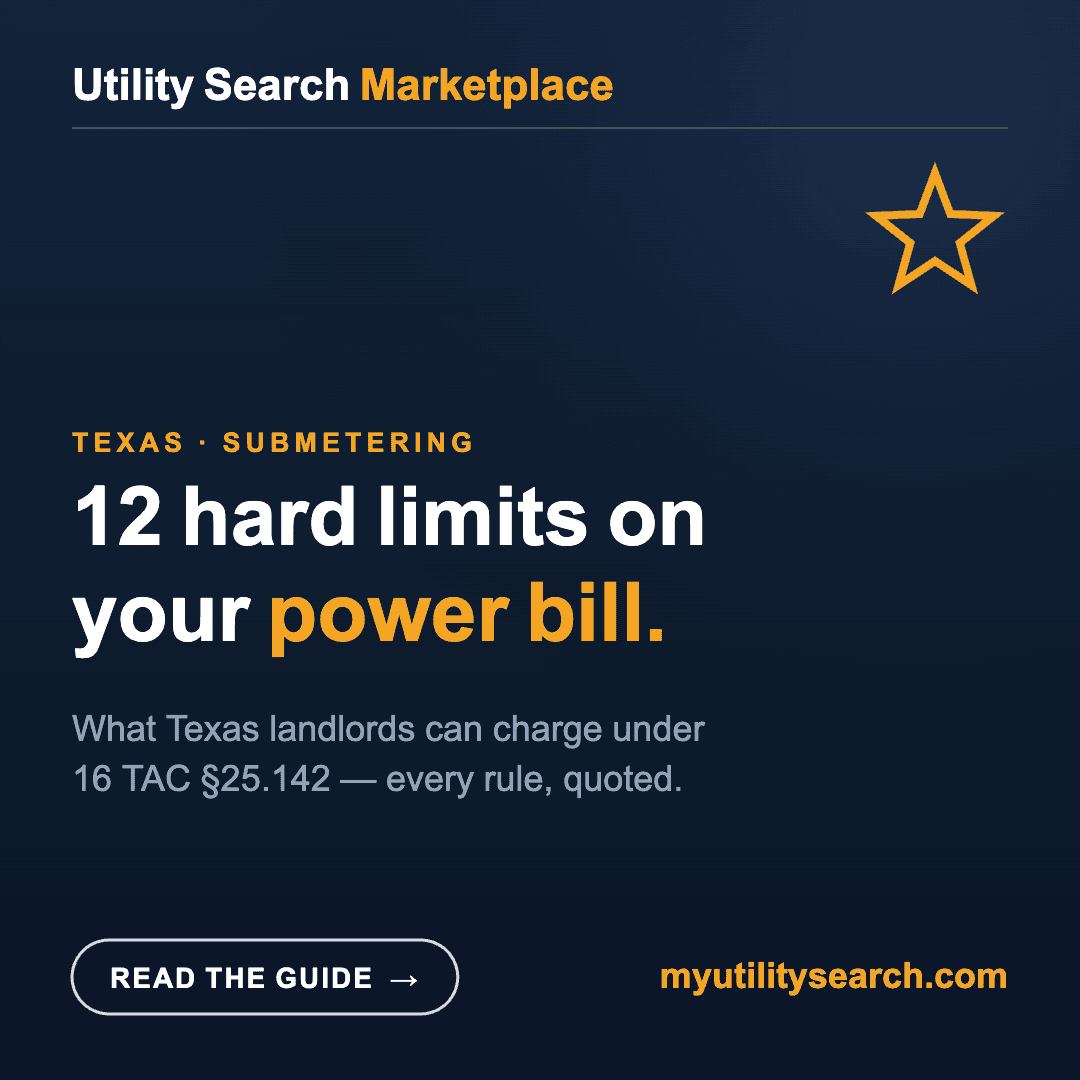
Texas — the most prescriptive rules in the country. 16 Texas Administrative Code §25.142 governs submetering for apartments, condominiums and mobile home parks; §25.141 covers central systems and non-submetered master metering; Texas Utilities Code Chapter 184 provides the statutory basis, with §184.013 authorising submetering and requiring PUC-compliant equipment.
What §25.142 actually requires:
- No charge above cost. “The owner shall not impose any extra charges on the tenant over and above those charges which are billed by the retail electric provider or utility to the owner.”
- Common areas are the owner’s problem. “Utility consumption at all common facilities will be the responsibility of the owner and not of the tenant.”
- Late penalty capped at 5%, once, and only with a written lease provision.
- Reading schedule. “The submeters shall be read within three days of the scheduled reading date of the electric utility’s master meter.”
- Back-billing limited to six months — “unless the owner can produce records to identify and justify the additional amount.” The cap is rebuttable.
- Underbilling of $50 or more requires the owner to offer a deferred payment plan for the same length of time as the underbilling.
- Records: current month plus 12 prior, inspectable during business hours.
- Billing must be separate from rent, not bundled.
- The owner must give the tenant a copy of the rule, or a PUCT-approved summary, at lease signing.
- Rent-increase clawback: under §184.013, raising rent within 90 days before installing submeters triggers a remedy.
Separately, Texas Property Code §92.008(b) prohibits a landlord from interrupting utility service furnished as an incident of the tenancy, except for bona fide repairs, construction or emergency. Remedies include actual damages, one month’s rent plus $1,000, fees and costs.
Illinois — state floor plus a Chicago overlay. The Tenant Utility Payment Disclosure Act, 765 ILCS 740, requires the landlord to give written documentation of the allocation formula before demanding payment, and to make the utility bills available on request. The cap is at building level: “The total of payments under the formula for the building as a whole for a billing period may not exceed the sum demanded by the public utility.” Chicago’s Residential Landlord and Tenant Ordinance adds further tenant rights on top.
Pennsylvania. 66 Pa.C.S. §102 excludes from the definition of “public utility” building owners who own and manage the internal distribution system and supply electric power to occupants. That exemption is what makes submetering lawful — and it is also why PUC leverage over a submetered tenant’s dispute is limited.
Delaware — property law, not utility law. 25 Del. C. §5312 caps the charge at actual cost, with a clause that reads as though it was written with third-party billing companies in mind: the landlord may not charge more than “the actual cost of the utility service as determined by the cost of the service charged by the provider to the landlord or to any company owned in whole or in part by the landlord.” Proration is allowed provided the total across units doesn’t exceed actual cost, and the tenant may inspect the bills and records behind the charges.
Ohio — the state that just switched models
Status as of 23 August 2026 — this is moving, check the date.
On 22 April 2026 the Ohio Supreme Court decided In re Complaint of Ohio Power Co. v. Nationwide Energy Partners, L.L.C., 2026-Ohio-1406 (No. 2024-0207). Writing for the majority, Justice Patrick DeWine held that a company that buys electricity and resells it to apartment tenants through submeters is an “electric light company” and therefore a public utility under R.C. 4905.03(C), subject to PUCO jurisdiction.
The Court abandoned PUCO’s long-standing three-part Shroyer test as an “extratextual” gloss, holding that jurisdiction turns on the statutory text: tenants who purchase electricity are consumers of electricity, and a company in the business of supplying electricity is a public utility. The case was reversed and remanded to PUCO.
Read the scope carefully. The decision reaches third-party submetering companies that purchase and resell — the defendant bought at the utility’s commercial rate and billed tenants based on its higher residential rate. A landlord supplying utilities to its own tenants incident to the tenancy was not held to be a public utility.
What happened next: the Ohio legislature passed HB 173, which would have set a rate cap slightly below the standard residential rate. Governor DeWine vetoed it on 24 June 2026, writing that the bill would mean “Ohio, for the first time, would be legitimizing and legalizing this flawed submetering model.” Companion SB 108 and a competing bipartisan HB 265 — which would define submeterers as public utilities — remain pending. No override has been recorded.
So where does that leave markup in Ohio? Neither prohibited nor capped. HB 173’s cap died with the veto. The question is live on remand at PUCO and in the legislature. The active PUCO proceedings are the remand of Case No. 21-990-EL-CSS and the AEP Ohio electric-reseller tariff dockets 24-106-EL-ATA and 24-107-EL-AAM.
→ Full breakdown: Ohio submetering rules after the 2026 ruling
What you can do, wherever you live
- Find out whether you’re submetered or direct-metered. If the utility bills you directly, you’re their customer with all the protections that carries. If your landlord bills you, you’re not — and everything above applies.
- Ask for the master bill. Illinois, Delaware, Texas and Chicago all give tenants a right to see the records behind the charge. Even where no right exists, asking is free and the answer is informative.
- Check the math against the cap in your state. In most states the total charged across the building cannot exceed what the utility billed the property. If it does, that is your case.
- Find out who actually hears your complaint before you file. In Massachusetts it’s the local board of health. In Maryland it’s a county commission or the Attorney General, not the PSC. Filing with the wrong body loses months.
- If you’re in a deregulated state, remember what you can and cannot control. A submetered tenant usually cannot choose their own retail supplier — the building’s supply contract is the landlord’s. What you can control is your usage and, at your next move, whether you rent a submetered unit at all.
Apartment submetering laws by state: FAQ
Can my landlord make a profit on my electric bill?
In most states, no. Texas bars any charge above what the retail electric provider or utility bills the owner. New York caps the rate at the utility’s direct-metered residential rate. Illinois caps the building total at the utility’s bill. Maryland allows actual cost plus a maximum $1/month administrative fee. Massachusetts prohibits residential electric submetering altogether. Ohio is currently unsettled.
Is apartment submetering legal?
It depends on the state, and on whether you mean electricity, gas or water. Massachusetts bans residential electric submetering as resale. Connecticut permits it only where power comes from a Class I renewable source or CHP, or PURA approves. New York and Maryland require pre-approval. Texas, Illinois, Pennsylvania and Delaware permit it with a no-markup rule.
Who do I complain to about my submetered bill?
This varies more than the rules do. New York and Texas route to the utility regulator. Maryland routes to a county landlord-tenant commission, local consumer protection, or the Attorney General — Maryland regulation states expressly that a submetered occupant is not a utility customer and has no complaint rights before the Commission. Massachusetts routes to the local board of health. New Jersey is unclear.
What changed in Ohio?
On 22 April 2026 the Ohio Supreme Court held that a company buying and reselling electricity to tenants is a public utility under R.C. 4905.03(C), subject to PUCO jurisdiction — abandoning the previous three-part test. The legislature’s response, HB 173, was vetoed on 24 June 2026. Markup is currently neither banned nor capped while the question sits on remand at PUCO and in the legislature.
Can I choose my own electricity supplier if I’m submetered?
Usually not. In a submetered building the account with the retail supplier belongs to the property, so the landlord chooses the supplier and the contract. That is one of the real trade-offs of a submetered unit in a deregulated state — you lose the ability to shop your rate.
Methodology
Every entry in this apartment submetering laws by state reference was checked against the primary source — the statute, administrative code section, PUC order or court opinion cited in that row — and the date of checking is recorded. Where a source could not be verified, the row says so rather than filling the gap with a plausible answer.
Verified against primary sources: Massachusetts (Restructuring Act §335; 105 CMR 410), Connecticut (CGS §16-19ff; P.A. 13-298), New York (16 NYCRR Part 96; PSL §30 et seq.), Maryland (Pub. Util. §§7-303, 7-304; COMAR 20.25.01.07), Texas (16 TAC §§25.141, 25.142; Tex. Util. Code §184.013; Tex. Prop. Code §92.008), Illinois (765 ILCS 740), Pennsylvania (66 Pa.C.S. §102), Delaware (25 Del. C. §5312), Ohio (2026-Ohio-1406; R.C. 4905.03(C)), Rhode Island (815-RICR-30-00-1; RIPUC Docket 3881), District of Columbia (15 DCMR Chapters 4 and 44).
Not verified, and flagged as such in the table: New Hampshire and Maine markup rules; New Jersey BPU docket history; specific Pennsylvania PUC operational limits; Chicago RLTO section numbers.
This reference is free to cite and reproduce with attribution. A link back is appreciated.
That is where apartment submetering laws by state stand today: a patchwork of bans, approval regimes and no-markup rules, moving fastest in Ohio — check the last-verified date before you rely on any row.
Compare internet, energy & home security at your address
Keep going
- Ohio submetering rules after the 2026 ruling — the state that just switched models
- Texas submetering rules — the most prescriptive rulebook in the country
- Deregulated energy states map — where you can choose a supplier
- How to switch electricity providers in Texas — if you’re direct-metered
- Best internet providers for renters — the other half of a rental utility setup
- First apartment utilities checklist — what to ask before you sign