Blog
Mortgage Rates Just Hit a Painful 7.28% — Yet Buyers Hold Their Best Leverage in a Decade

13 min read
Last updated: October 3, 2026 · By Chris Burg, founder, Utility Search Marketplace
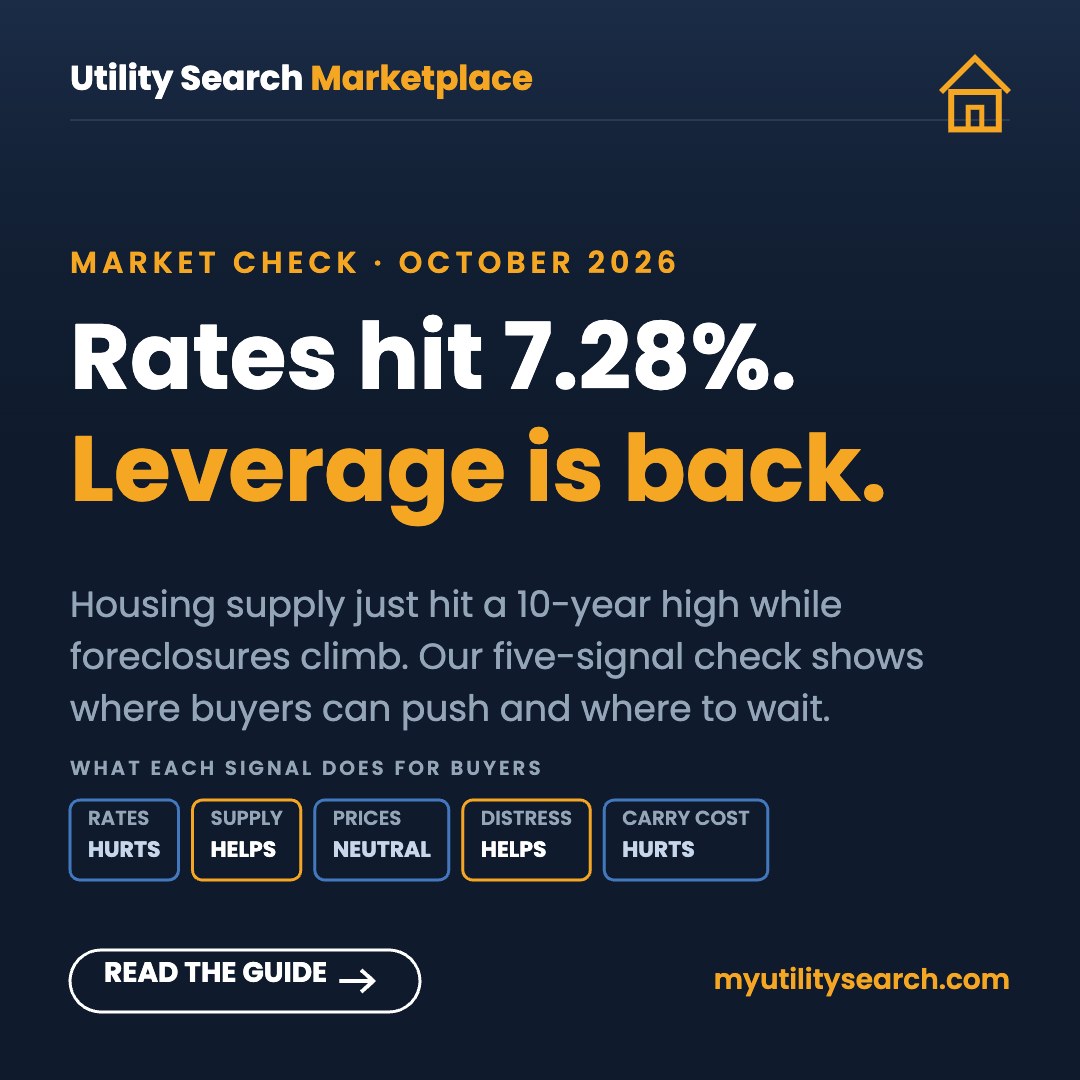
Is now a good time to buy a house? For a buyer whose payment still works at today’s 7.28% mortgage rate, October 2026 is a good time to buy a house on terms — housing supply is at its highest level in more than a decade and foreclosures are rising. For anyone stretching to qualify, waiting is the safer call.
That answer sounds like a hedge. It isn’t. The market just sent two loud signals in opposite directions at the same time, and most “is it a good time to buy a house” articles only read one of them. Mortgage rates jumped a full quarter point in a single week. Meanwhile, sellers are sitting on more unsold homes than at any point since 2015.
We built a five-signal composite — the Buyer Leverage Check — to read both at once. It pulls the latest numbers from Freddie Mac, the National Association of Realtors, ATTOM, the Mortgage Bankers Association, ICE, the New York Fed and the U.S. Energy Information Administration, then adds the cost most market reports skip: what the house costs to run after closing.
Key takeaways
- The 30-year fixed rate averaged 7.28% on October 1, 2026, up from 6.34% a year earlier — about $242 more per month on a median-priced home.
- Unsold inventory reached 4.9 months’ supply, the highest in over ten years. That is balanced-market territory, and it hands buyers negotiating room.
- The national median price is $429,100, up just 1.6% from a year ago. Zillow’s 12-month forecast is flat.
- Foreclosure filings are up 13% year over year and completed foreclosures are up 42% — but activity is still below historical norms.
- Our verdict: two signals help buyers, two hurt, one is neutral. It is a good time to buy a house to negotiate, not a time to chase.
The Buyer Leverage Check: is it a good time to buy a house right now?
The check scores five forces that decide whether a buyer has the upper hand. Each signal gets one of three readings: it helps buyers, it hurts buyers, or it is neutral. No single number answers whether it’s a good time to buy a house — the balance between them does.
Buyer Leverage Check (definition): a five-signal composite built by myutilitysearch.com that rates mortgage rates, housing supply, price momentum, foreclosure distress and post-closing carrying costs as helping, hurting or neutral for home buyers. It is a reading of negotiating power, not a price prediction.
| Signal | Latest reading | Context | For buyers |
|---|---|---|---|
| Mortgage rates | 7.28% (Oct 1, 2026) | 6.34% a year ago; 6.76% on Sep 10 | Hurts |
| Housing supply | 4.9 months; 1.62 million homes | Highest months’ supply since Nov 2015 | Helps |
| Price momentum | $429,100 median, +1.6% YoY | Zillow 12-month forecast: 0.0% | Neutral |
| Foreclosure distress | 40,277 filings in Aug, +13% YoY | Still below historical norms | Helps (locally) |
| Carrying costs | Electricity 18.2¢/kWh avg in 2026 | Nearly 5% above 2025 | Hurts |
Two for, two against, one neutral. In plain terms, the market is no longer rewarding speed. It is rewarding preparation — a buyer with a locked budget and a pre-approval can ask for things that would have been laughed out of the room in 2022.
Signal 1: How much did a 7.28% rate add to the monthly payment?
A lot, and fast. Freddie Mac’s weekly survey put the 30-year fixed at 7.28% on October 1, 2026, up from 7.03% the week before and 6.34% a year earlier. The 15-year fixed averaged 6.60%.
Run that through the median-priced home. At $429,100 with 10% down, the loan is about $386,190. Principal and interest cost roughly $2,400 a month at last year’s rate. At 7.28%, the same loan costs about $2,642 — an extra $242 a month, or nearly $2,900 a year.
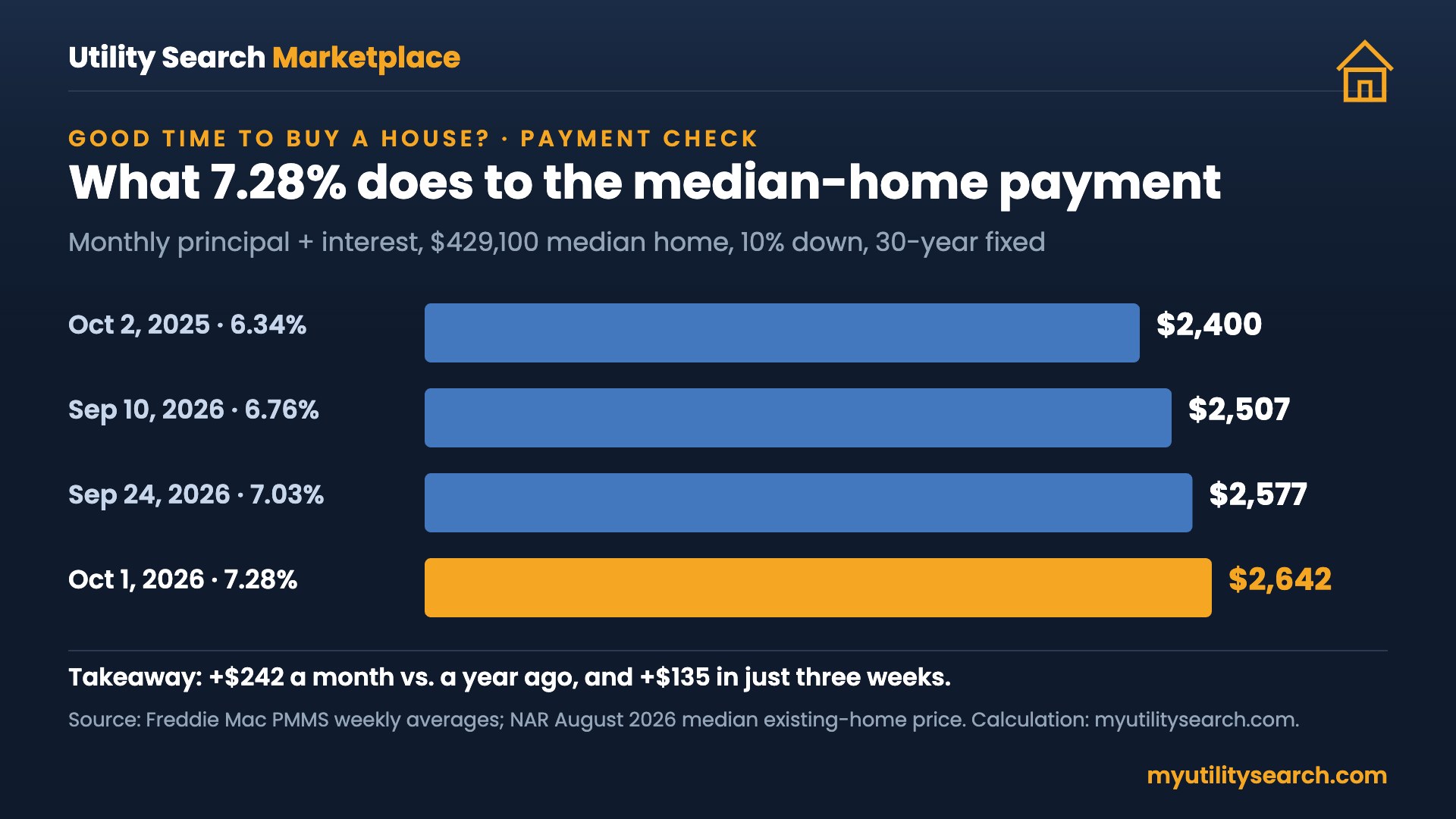
The speed matters as much as the level. Three weeks earlier, on September 10, the rate was 6.76%. That move alone added about $135 a month. On this loan size, every quarter point is worth roughly $65 a month.
This is the one signal that clearly hurts buyers. It is also the one a buyer can partly manage. Rate quotes vary between lenders on the same day, which is why getting several quotes matters more at 7% than it did at 3%. If the payment only works at a rate you can’t actually get, it is not a good time to buy a house for you, whatever the headlines say.
Signal 2: Does rising supply make it a good time to buy a house?
Because unsold homes are leverage. The National Association of Realtors reported 1.62 million homes for sale at the end of August 2026 — the first time inventory topped 1.6 million since November 2019. At the current sales pace, that is a 4.9-month supply, the highest in more than ten years.
The National Association of Home Builders notes that 4.5 to 6 months’ supply is generally considered a balanced market. For most of the past five years, the country sat well below that line, which is why bidding wars felt normal. That era is over for now, and it is the main reason this fall can be a good time to buy a house for patient shoppers.
Sales are moving the other way. Existing-home sales fell 2% in August to a 3.98 million annual pace, the slowest since June 2025. Homes sat for a median of 31 days. When fewer buyers chase more homes, sellers start paying for things: closing costs, repairs, and rate buydowns.
That last one is the quiet opportunity. A seller-paid buydown can take the sting out of Signal 1, and a seller staring at a fifth month on the market is far more likely to say yes. This is the strongest argument that it’s a good time to buy a house for a well-prepared buyer.
Signal 3: Are home prices going to drop?
Nationally, probably not by much — and that is why we rate prices neutral. The median existing-home price was $429,100 in August, up 1.6% from a year earlier. That was the 38th straight month of annual gains, even as inventory climbed. Prices alone don’t settle whether it’s a good time to buy a house.
Zillow’s economists see the next year as flat. Their updated outlook projected a 0.0% change in the Zillow Home Value Index from June 2026 to June 2027, after small downgrades through the spring.
Regionally, the picture splits. NAR’s August data showed the Northeast median at $556,900 (up 4.3%), the Midwest at $340,400 (up 3.3%), the South at $366,500 (up 0.7%) and the West at $619,100 (down 0.2%). Zillow’s metro outlook pointed to gains in smaller Northeast and Midwest markets such as Rockford, Illinois, and Syracuse, New York.
The takeaway for buyers: don’t wait for a national crash to decide whether it’s a good time to buy a house. A flat market with rising supply means the discount comes from negotiation, not from the headline price falling.
Signal 4: Where are foreclosures rising, and does that help buyers?
Foreclosures are rising, but from a low base. ATTOM counted 40,277 U.S. properties with a foreclosure filing in August 2026, up 13% from a year earlier. Completed foreclosures — bank repossessions — jumped 42% to 5,794 homes. ATTOM’s CEO said volumes remain well below historical norms.
For the first half of 2026, ATTOM counted 227,548 properties with filings, up 21%. The states with the worst rates were South Carolina, Florida, Delaware, Indiana and Nevada. The fastest increases came from places few people associate with distress.
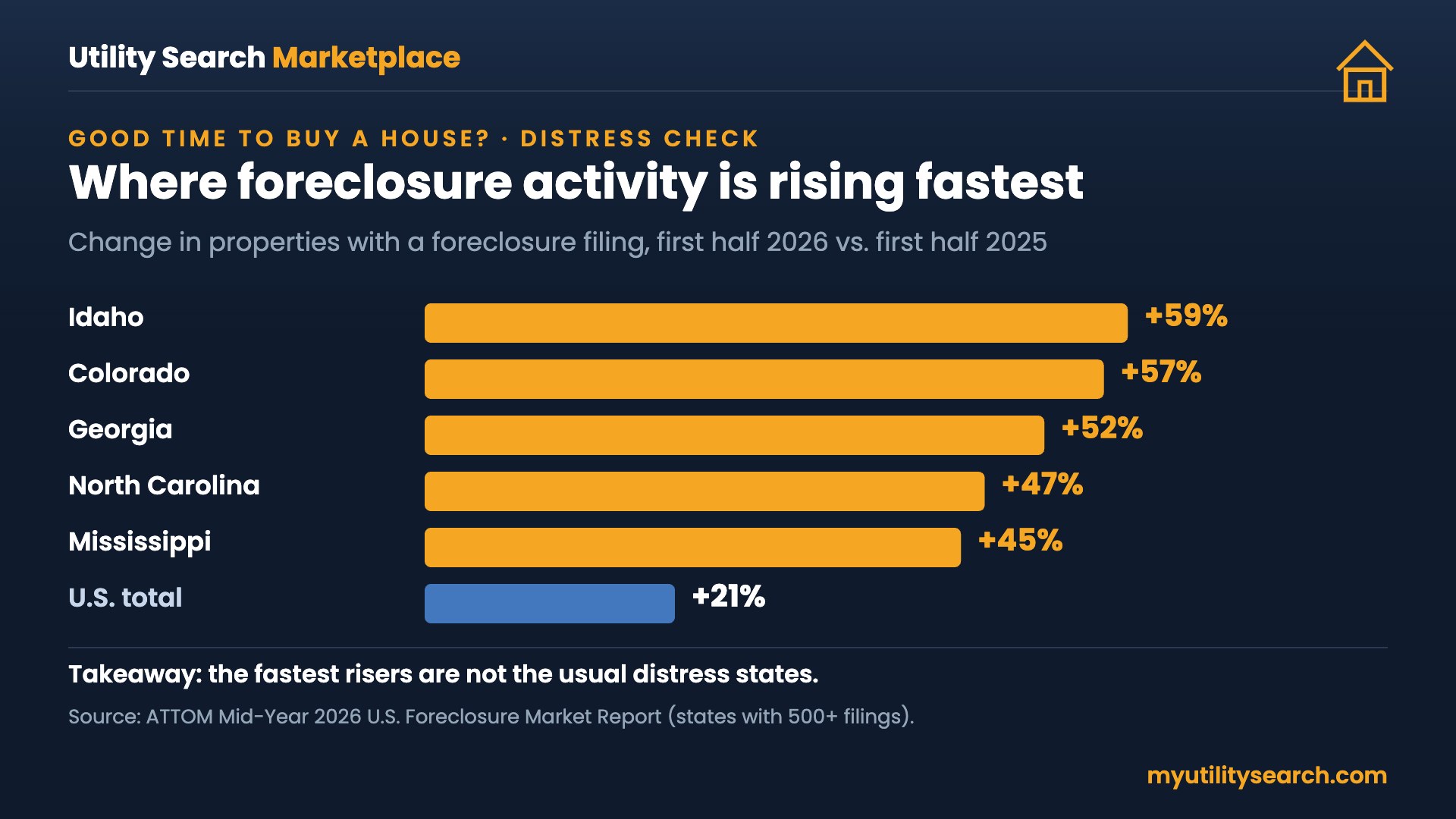
Here is the pattern worth noticing. ICE reported that Idaho had the lowest share of mortgages behind on payments in August, at 2.00%. Yet ATTOM shows Idaho with the fastest-rising foreclosure activity. Colorado shows the same split, and it also ranked among the five states where the non-current share rose fastest over the past year.
We call these early-turn markets: still healthy on paper, but with the first cracks showing. Sellers there may not have adjusted their expectations yet, which means patience can pay.
| Market type | Where | What the data shows | Buyer play |
|---|---|---|---|
| Distress leaders | Punta Gorda, Cape Coral, Jacksonville and Ocala FL; Columbia SC | Punta Gorda had 0.50% of homes with a filing in H1; Columbia had the worst metro rate in August | Most room to negotiate; budget hard for insurance and upkeep |
| Bank-owned (REO) heavy | Houston, Dallas, San Antonio, Phoenix, Baltimore | Houston led with 448 repossessions in August; Texas had 1,835 statewide | Look at bank-owned listings; expect as-is condition |
| Early-turn | Idaho, Colorado | Low delinquency, fast-rising foreclosure filings | Watch price cuts; don’t overpay for last year’s market |
| Deep South stress | Louisiana, Mississippi, Alabama, Arkansas | Highest non-current mortgage shares (LA 8.41%, MS 8.33%) | Lower prices, but check local job and wage strength |
| Low-stress West | California, Washington, Oregon, Montana | Lowest non-current shares (2.2%–2.5%) | Less seller desperation; leverage comes from supply, not distress |
| Improving | Cleveland, Washington DC | Foreclosure starts fell sharply year over year | Fewer distressed deals; normal negotiation applies |
One caution on reading distress as opportunity: a neighborhood with many foreclosures can also mean a weak local economy. A bargain only stays a bargain if jobs, insurance costs and resale demand hold up. In these markets, a good time to buy a house depends on the street, not the state.
Signal 5: What does the house cost to run after closing?
This is the signal most market checks ignore, and it is where our own data lives. The U.S. Energy Information Administration expects residential electricity to average 18.2 cents per kilowatt-hour in 2026, nearly 5% above 2025. EIA data also showed residential rates up 7.3% between April 2025 and April 2026.
At 18.2 cents, every 1,000 kWh a home uses costs about $182 before fees. A bigger house, an older HVAC system or a pool can push that much higher. Prices also vary widely by state: New York averaged 29.45 cents per kWh in April 2026, well above the national figure.
Internet, home security and a home warranty add more fixed costs on top of the mortgage. None of these show up in the listing price, but all of them show up on the monthly budget. That is why we rate carrying costs as a signal that hurts buyers in 2026. A good time to buy a house on paper can still strain a budget once the first summer electric bill arrives.
The good news: many of these costs are shoppable. Homes in deregulated electricity states such as Texas, Ohio, Pennsylvania, Illinois, New Jersey and New York can choose a retail supplier. Internet prices also vary sharply by address — our September price checks found gigabit plans ranging from $25 to $90 a month across major providers.
Is it a good time to buy a house with an FHA loan or as a first-time buyer?
It can be — with a bigger safety margin than the lender requires. FHA loans are where today’s mortgage stress is concentrated. The Mortgage Bankers Association put the FHA delinquency rate at 11.79% in the second quarter, compared with 2.72% for conventional loans.
ICE reported that FHA loans made up a record 55% of seriously past-due mortgages this spring. Many of those borrowers are recent first-time buyers. Gen Z alone accounted for 27% of FHA purchase mortgages in the second quarter, according to ICE.
None of this means FHA loans are bad. It means the first year of ownership is when budgets break. Repairs, insurance changes and utility bills arrive before the equity does. For a first-time buyer, a good time to buy a house is when the budget can absorb a surprise repair without missing a payment.
Student loans are the other trap. Federal Student Aid data shows 9.3 million borrowers in default, and a New York Fed analysis found defaulted borrowers’ credit scores fell 91 points on average. A federal student loan default can also block approval for a federally backed mortgage. Fix that first.
Compare internet, energy & home security at your address
What you control: a six-step plan if now is a good time to buy a house for you
The market sets the backdrop. These six moves decide whether late 2026 is a good time to buy a house for you.
- Stress-test the payment at 7.5%. Rates moved 0.52 points in three weeks. If the home only works at today’s quote, it doesn’t work.
- Get at least three lender quotes on the same day. Freddie Mac has long advised that shopping around for a rate can save buyers thousands.
- Ask for a seller-paid rate buydown. With 4.9 months of supply, credits toward a buydown or closing costs are a reasonable request.
- Use the distress map, carefully. In Florida, South Carolina and the REO-heavy Texas metros, motivated sellers are more common. Verify the local economy before you count on a bargain.
- Price the utilities before you close. Ask the seller for 12 months of electric bills, check which internet providers serve the exact address, and shop supply in deregulated states.
- Don’t build the budget around a refinance. Rates may fall, but a purchase should stand on today’s payment, not a hoped-for one.
Follow those steps and the question shifts from “is it a good time to buy a house?” to “is this a good house at this payment?” That is a much easier question to answer.
Why the U.S. isn’t facing a Vancouver-style foreclosure wave
Headlines out of Canada this fall show court-ordered sale listings in Metro Vancouver at 457 in September 2026, above the prior peak of 363 set in October 2012, based on Greater Vancouver Realtors data charted by analyst Steve Saretsky. It is fair to ask whether the U.S. is next.
The structure says probably not. Most Canadian mortgages renew at current rates every few years, so a rate spike reaches existing owners quickly. Most U.S. homeowners hold 30-year fixed loans and are untouched by today’s 7.28%.
The U.S. numbers reflect that. The MBA put the overall delinquency rate at 4.37% in the second quarter, with just 0.67% of loans in foreclosure. ICE’s August delinquency rate of 3.53% was below every pre-pandemic August on record. Stress is real, but it is concentrated — FHA borrowers, subprime credit, and specific Southern and Mountain West markets — rather than spread across all owners. For most U.S. buyers, whether it’s a good time to buy a house hinges on their own payment, not on a coming wave of forced sales.
Frequently asked questions
Is now a good time to buy a house in October 2026?
It is a good time to buy a house for buyers who can afford the payment at about 7.3% and want negotiating room. Supply is at a 4.9-month level, the highest in over a decade, so sellers are more open to credits and price cuts. Buyers stretching to qualify should wait or lower their price range.
Will mortgage rates go down in late 2026?
No one can say with confidence. The 30-year fixed rose from 6.76% on September 10 to 7.28% on October 1, according to Freddie Mac. Rates can fall as quickly as they rose, but buyers should budget for today’s rate and treat any future refinance as a bonus.
Are home prices going to drop?
Nationally, a large drop looks unlikely. The median price was $429,100 in August, up 1.6% from a year ago, and Zillow forecasts roughly flat values over the next 12 months. Individual metros with rising inventory and foreclosures can still see price cuts.
Is it a good time to buy a house or keep renting?
It depends on how long you’ll stay. Buying usually makes sense for five years or more, when closing costs can be spread out. Zillow’s September forecast expects rents to rise about 2.1% year over year in the fourth quarter, so renting is not getting cheaper either.
Which states have the most foreclosures right now?
In the first half of 2026, South Carolina, Florida, Delaware, Indiana and Nevada had the highest foreclosure rates, according to ATTOM. Florida led the nation in foreclosure starts in August, followed by Texas, California, Illinois and Georgia.
The bottom line
So, is it a good time to buy a house? The honest answer for October 2026 is that the market has flipped from rewarding speed to rewarding preparation. Rates and carrying costs work against buyers. Supply and rising distress work for them.
Buyers who lock their budget, shop their lender and price the utilities before closing will find more room to negotiate than at any time in a decade. For a prepared buyer with a payment that works, this can be a good time to buy a house. We’ll update the Buyer Leverage Check as new rate, sales and foreclosure data lands.
Compare internet, energy & home security at your address
Sources
- Freddie Mac — Primary Mortgage Market Survey (weekly rates through October 1, 2026)
- National Association of Realtors — Existing-Home Sales, August 2026
- NAHB Eye on Housing — balanced-market definition and days on market
- ATTOM — August 2026 U.S. Foreclosure Market Report
- Mortgage Bankers Association — National Delinquency Survey, Q2 2026
- ICE — First Look at Mortgage Performance, August 2026
- U.S. Energy Information Administration — Short-Term Energy Outlook, electricity
- Federal Reserve Bank of New York — Federal Student Loan Defaults Return After Pandemic Pause