Blog
How Much Is Internet per Month? The Shocking 2026 Price Ladder, Brand by Brand

10 min read
Last updated: November 7, 2026. Prices checked at live addresses in McKinney TX (AT&T), Keller TX (Frontier) and Brooklyn NY (Verizon Fios), and on provider plan pages the same day.
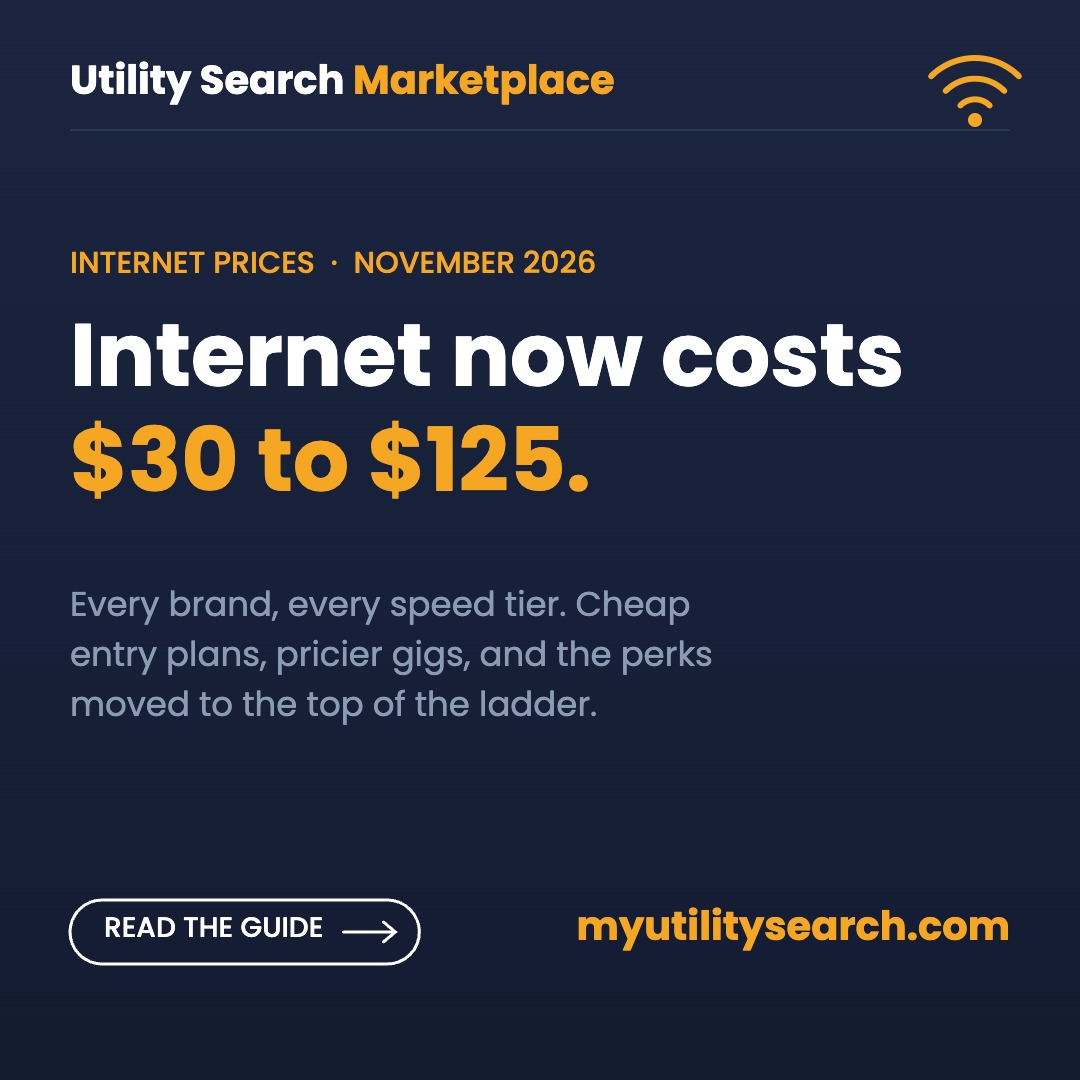
How much is internet per month? In November 2026, most U.S. households pay $30 to $85 a month for home internet before taxes. Entry plans (100 to 300 Mbps) start near $30, 500 Mbps runs $40 to $75, 1 Gig runs $60 to $85, and multi-gig plans cost $80 to $125. Satellite costs $55 to $130 for far less speed.
TL;DR — how much is internet per month in 2026
- Entry tier got cheaper: $30 is now the floor at Spectrum, Cox, Fios and Frontier. AT&T cut its 300 Mbps plan from $50 to $35.
- The middle is squeezed: 500 Mbps now sits just $10 to $20 below the gig.
- The gig went up: from about $50 this summer to $60 to $85.
- Multi-gig got the perks: free months, TVs, gift cards and 5-year locks start at 1 Gig and up.
- The pattern: providers are building a barbell, cheap plans to stop 5G home internet and rich bundles for high-income homes.
How much is internet per month by speed tier?
The answer to how much is internet per month depends mostly on the speed you pick. Here is the typical new-customer range for each tier across the major brands we checked.
| Speed tier | Typical monthly price | Price per Mbps | Who it fits |
|---|---|---|---|
| 100 to 300 Mbps | $30 to $45 | $0.10 to $0.30 | 1 to 2 people, streaming, work email |
| 500 Mbps | $40 to $75 | $0.08 to $0.15 | 3 to 4 people, several streams |
| 1 Gig | $60 to $85 | $0.06 to $0.085 | Busy homes, big uploads, gaming |
| 2 Gig | $80 to $100 | $0.04 to $0.05 | Power users, home offices |
| 5 to 7 Gig | $100 to $125 | About $0.02 | Enthusiasts and future-proofing |
| Satellite (Starlink) | $55 to $130 | $0.33 to $0.55 | Rural homes with no wired option |
Prices are new-customer rates with AutoPay, before taxes and fees except where noted. Your address decides which of these you can actually buy, so how much is internet per month for you depends on where you live.
How much is internet per month from each provider? The full matrix
This is the complete ladder. Each row is one provider, and each column is a speed tier, so you can see exactly how much is internet per month at every step.
| Provider | Type | Entry tier | 500 Mbps | 1 Gig | 2 Gig | 5 Gig+ | Price lock |
|---|---|---|---|---|---|---|---|
| AT&T Fiber | Fiber | 300 Mbps $35 | $50 | $65 | — | 5 Gig $110 | First-year discount |
| Verizon Fios | Fiber | 300 Mbps $30 | $65 | $80 | $90 | 5 Gig $100 | 3 yr (300/500), 5 yr (1 Gig+) |
| Frontier | Fiber | 200 Mbps $29.99 | $44.99 | $64.99 | $79.99 | 5 Gig $104.99, 7 Gig $124.99 | 3 / 4 / 5 yr by tier |
| Xfinity | Cable | 300 Mbps $45 | $50 | $60 | $100 | — | 5 yr |
| Spectrum | Cable | 100 Mbps $30 | $40 | $60 | — | — | 12 months |
| Cox | Cable | 100 Mbps $30 | $50 | $60 | $80 | — | 12 months |
| Optimum | Cable/fiber | — | — | $55 ($45 online) | — | — | 1 yr |
| IQ Fiber | Fiber | 250 Mbps $65 | $75 | $85 | $95 | 5 Gig $125 | Flat rate |
| Quantum Fiber | Fiber | — | $50 | $50 (offer ends Dec 1) | $70 | 8 Gig $165 | Promo |
| T-Mobile 5G Home | 5G | Rely $50 (up to 354 Mbps) | Amplified $60 | All-In $70 (not a gig) | — | — | Price lock |
| Starlink | Satellite | 100 Mbps $55 | — | — | — | MAX $130 (400+ Mbps) | None |
AT&T’s FCC broadband labels list $60, $75, $90 and $135 as the regular monthly prices for these tiers. Fios prices are all-in, with taxes and fees included. Quantum and T-Mobile prices come from their published listings; the rest were checked at a live address or on the provider’s plan page on November 7.
Why internet prices run from lower left to upper right
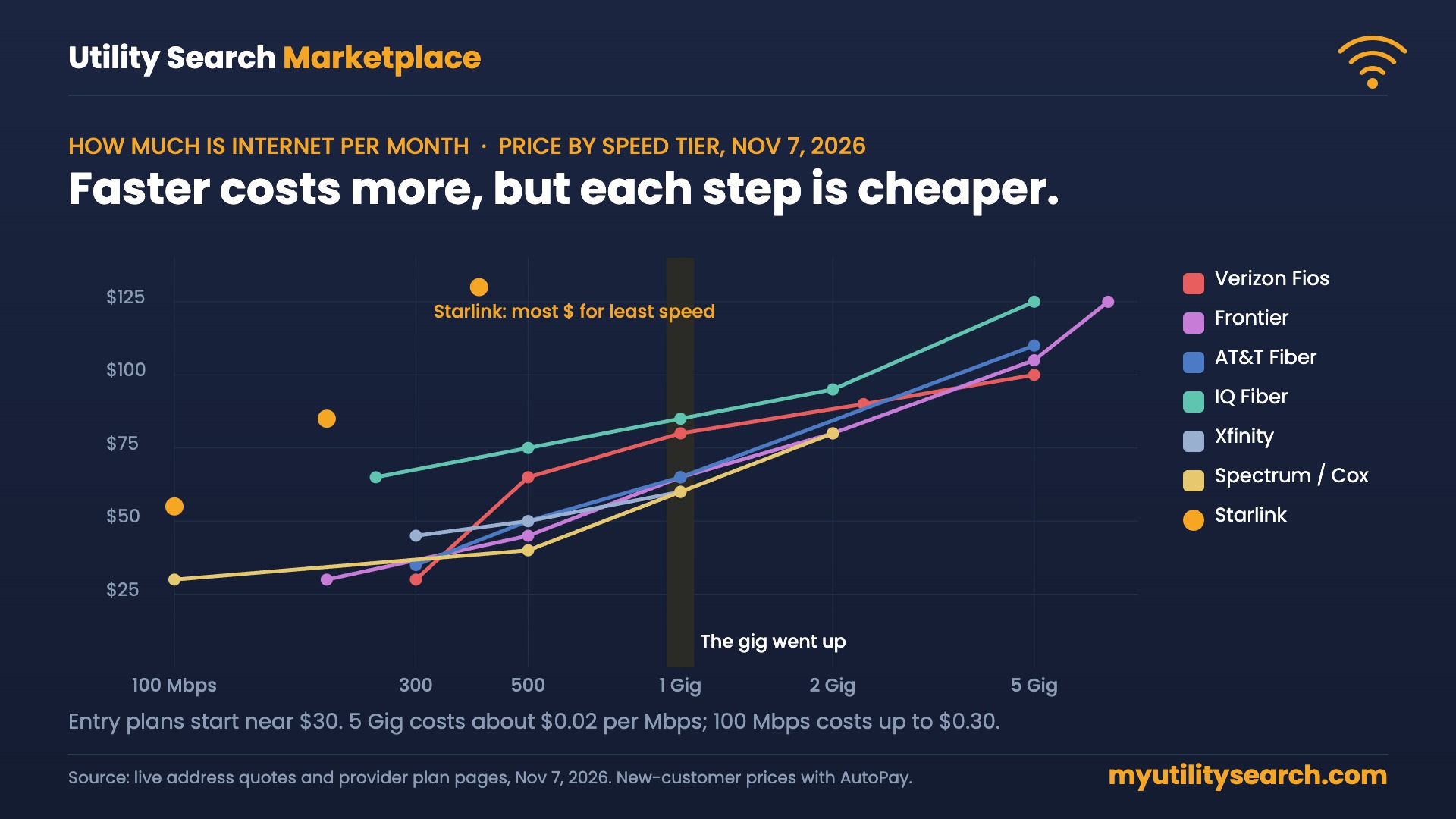
Plot every plan by speed and price and you get a staircase: the faster the plan, the higher the price. That holds for every wired brand.
The steps are not even, though. The price per Mbps falls sharply as you climb. An entry plan costs about $0.10 to $0.30 per Mbps. A gig costs about $0.06 to $0.085. A 5 Gig plan costs about $0.02.
That staircase is the real answer to how much is internet per month: it depends on which step you buy.
The pricing is on purpose. Each step up is priced to look like a small upgrade. Fios charges $80 for 1 Gig and only $100 for 5 Gig, five times the speed for $20 more.
Starlink breaks the pattern. It sits in the upper left of the chart: $130 a month for up to 400 Mbps, the most money for the least speed.
How much is internet per month in each price group, and what changed
1. Entry tier (100 to 300 Mbps): cheaper and faster
For most budgets, the answer to how much is internet per month starts here. The entry tier moved down, and about $30 is now the floor: Spectrum and Cox sell 100 Mbps for $30, Fios sells 300 Mbps for $30, and Frontier sells 200 Mbps for $29.99.
AT&T moved the most. At our McKinney, TX address its 300 Mbps plan dropped from $50 in October to $35 in November. These plans are built to stop households from leaving for 5G home internet, which sells for $35 to $70.
2. Middle tier (500 Mbps): squeezed
The 500 Mbps tier now sits just $10 to $20 below the gig. Xfinity charges $50 for 500 Mbps and $60 for 1 Gig. Spectrum charges $40 and $60. Frontier charges $44.99 and $64.99.
A gap that small mostly exists to make the gig look like the obvious choice. When a family asks how much is internet per month for several users, 500 Mbps at $40 to $65 is still the usual answer.
3. The gig: up
If you are asking how much is internet per month for a gig, plan on $60 to $85. The gig is where prices rose. This summer, several brands sold 1 Gig for about $50. Now it costs $60 to $85 from the major brands. We cover that shift in detail in our 1 gig internet price breakdown.
4. Multi-gig (2 to 7 Gig): flattest prices, richest perks
How much is internet per month at the top? About $80 to $125 for 2 to 7 Gig. The top of the ladder also got the extras. Fios and Frontier offer two free months plus a Samsung 43-inch TV and soundbar or gift cards, but only on 1 Gig and faster. AT&T’s $100 reward card and three months of YouTube TV also start at 1 Gig. Frontier adds a $150 Visa card on 2 Gig.
The longest price locks and the best Wi-Fi gear sit here too. Frontier locks 1 Gig and faster for five years and includes eero Wi-Fi 7 routers on its faster plans.
The barbell: why internet providers are pricing this way
Put the four groups together and you get a barbell. One end is a cheap entry plan. The other end is a premium plan loaded with perks. The middle is a stepping stone.
The cheap end defends against 5G home internet and keeps price-sensitive households from leaving. The premium end chases homes that can spend more and rewards them for buying the top tier.
That is why how much is internet per month now has two very different answers. The fall 2026 price changes fit this shape. Entry prices fell, gig prices rose, and the gifts moved up the ladder. Comcast’s own executives said in October that $30 to $40 gigs are hard to sustain, so the middle and the gig absorbed the increases.
Who internet providers are targeting now
The pricing tells you who each company wants, and why how much is internet per month differs so much by household. Three customer groups stand out in 2026.
High-income single-family homes
These homes get the multi-gig plans, the gifts, the 5-year locks and the Wi-Fi 7 gear. Providers also want them on a phone plan. AT&T said in April that nearly 45% of its advanced home internet customers also have AT&T wireless.
Phone bundle households
Every big brand now discounts home internet for its own mobile customers. Frontier takes $15 off every tier with a Verizon line. AT&T shows its gig as low as $45 with discounts. Xfinity, Spectrum and Cox include a free mobile line for a year.
Apartment and community residents
Price-sensitive households are increasingly served through the building, not one home at a time. Providers sign bulk contracts with property owners, and internet comes with the unit.
The big brands all run dedicated units for this: Spectrum Community Solutions, Xfinity Communities, AT&T Connected Communities and Verizon Enhanced Communities. Spectrum Community Solutions says its move-in-ready service covers a 41-state footprint.
Hiring shows the push. In 2026, job boards list MDU business development roles at fiber builders and cable companies alike, including a VP of MDU at Ezee Fiber, MDU account executives at ALLO and an MDU sales executive at GFiber in Nashville.
Renters want it too. Parks Associates found that 41% of apartment renters expect internet to be ready at move-in, and 65% of residents who already have bulk internet call move-in-ready service highly important.
How much is internet per month in an apartment?
In an apartment, how much is internet per month may already be decided for you. In many newer communities, internet is part of the lease. The property signs a bulk deal and adds a technology or amenity fee to your rent, often with managed Wi-Fi already working when you move in.
If your building has bulk internet, ask what the fee covers, what speed you get, and whether you can upgrade. In buildings without a bulk deal, you pay the same retail prices shown in the matrix above.
What adds to your internet bill each month?
The advertised price is rarely the whole bill. Watch for these add-ons when you work out how much is internet per month for your home.
- Losing the AutoPay discount: usually $5 to $10 a month. Frontier’s gig is $74.99 without it.
- The regular rate: AT&T’s FCC label lists $90 for the gig it advertises at $65.
- Fees and taxes: AT&T charges a Texas cost recovery fee of $0.47 a month on its gig. Fios is the exception, with taxes and fees included.
- Wi-Fi upgrades: AT&T’s Wi-Fi 7 package costs $25 a month. Frontier’s Wi-Fi Security Plus is $10.
- Equipment not returned: AT&T charges $150 for a gateway you keep.
How much is satellite internet per month?
For rural homes, how much is internet per month often comes down to satellite: $50 to $130 a month, with speeds well below wired plans.
| Satellite plan | Monthly price | Speed | Latency |
|---|---|---|---|
| Starlink Residential 100 | $55 | Up to 100 Mbps | About 25 to 60 ms |
| Starlink Residential 200 | $85 | Up to 200 Mbps | About 25 to 60 ms |
| Starlink Residential MAX | $130 | Up to 400+ Mbps | About 25 to 60 ms |
| Viasat Essentials | $89.99 | 57 Mbps typical (FCC label) | About 610 ms |
| Viasat Unleashed | $119.99 | 24 Mbps typical (FCC label) | About 610 ms |
| HughesNet | About $50 to $100 | Up to 100 Mbps | About 600 ms |
| Amazon Leo | Not announced | Not announced | — |
Viasat’s pricier plan tests slower than its cheaper one on its own FCC labels. Satellite makes sense only where cable, fiber and 5G do not reach.
How to pay less for internet each month
These five moves cut how much is internet per month for most homes.
- Start one tier lower. Most homes do well on 300 to 500 Mbps, which now starts near $30 to $50.
- Compare the 24-month cost. A plan that jumps after 12 months can cost more than a slightly higher locked price.
- Read the FCC broadband label. It shows the regular price, fees and typical speeds in one place.
- Take a long lock if you plan to stay. Fios, Frontier and Xfinity lock prices for up to five years with no contract.
- Bundle only if you wanted the phone plan anyway. Mobile discounts help only if you were switching carriers.
How much is internet per month: shopper questions
How much is internet per month in 2026?
How much is internet per month depends mostly on speed. Most households pay $30 to $85 a month for home internet in November 2026, before taxes. Entry plans start near $30, 1 Gig costs $60 to $85, and multi-gig plans cost $80 to $125.
What is a good price for internet per month?
A good price is about $30 to $50 for 300 to 500 Mbps, or $60 to $65 for 1 Gig with a long price lock. Anything above $85 for a gig is high for a new customer in 2026.
Why is the gig more expensive than last summer?
Providers ended a 2026 price war in which some sold 1 Gig for $30 to $50. In the fall they raised gig prices and moved free months, TVs and gift cards to the faster tiers instead.
Is internet cheaper in an apartment?
Often, if the building has a bulk deal. The property buys service for every unit and adds a fee to the rent, usually with Wi-Fi ready at move-in. Without a bulk deal, you pay normal retail prices.
How much is satellite internet per month?
Satellite internet costs about $50 to $130 a month. Starlink runs $55 for 100 Mbps to $130 for 400+ Mbps, while Viasat and HughesNet are slower with much higher latency.
Also compare energy, home security and home warranty at your address
Electricity plans in 14 deregulated states. Security and warranty nationwide.
Business shopper? Compare business internet → or talk to a specialist.
Sources
- FCC: Broadband Consumer Labels
- Charter: Spectrum Community Solutions launches Spectrum Ready
- Xfinity Communities: multifamily solutions
- Parks Associates: 41% of renters expect move-in-ready internet
- AT&T first-quarter 2026 results (SEC filing)
- Fierce Network: Comcast Q3 2026 broadband results
- Broadband Communities: MDU connectivity at Summit 2026
- Live address quotes, November 7, 2026: AT&T (McKinney, TX), Frontier (Keller, TX), Verizon Fios (Brooklyn, NY); plan pages for Xfinity, Spectrum, Cox, Optimum, IQ Fiber and Starlink checked the same day.