Blog
1 Gig Internet in 2026: Is It Available at Your Address?

Updated on October 30, 2026
7 min read
Author: Utility Search Marketplace
If you have shopped for home internet lately, you have seen 1 gig internet plastered across every provider’s homepage — gigabit speeds, fiber to the home, “fastest in your area.” But two questions actually matter before you sign anything: is a true 1 Gig (1,000 Mbps) plan even available at your address, and does your household actually need that much speed? This guide answers both in plain English, the apples-to-apples way, with no SSN required and no sales pressure. The honest answer is that gig-tier fiber is now within reach for far more homes than it was even a year ago — and for the right household, it is the single best connectivity upgrade you can make.
Best for most households considering 1 Gig: take it on fiber if the price is within about $10 of the 500 Mbps tier — on October 2026 quotes, AT&T charged $10 more and Xfinity $10 more on its five-year lock. Families with several people streaming, gaming and working from home benefit most; one or two light users rarely notice the difference.
.
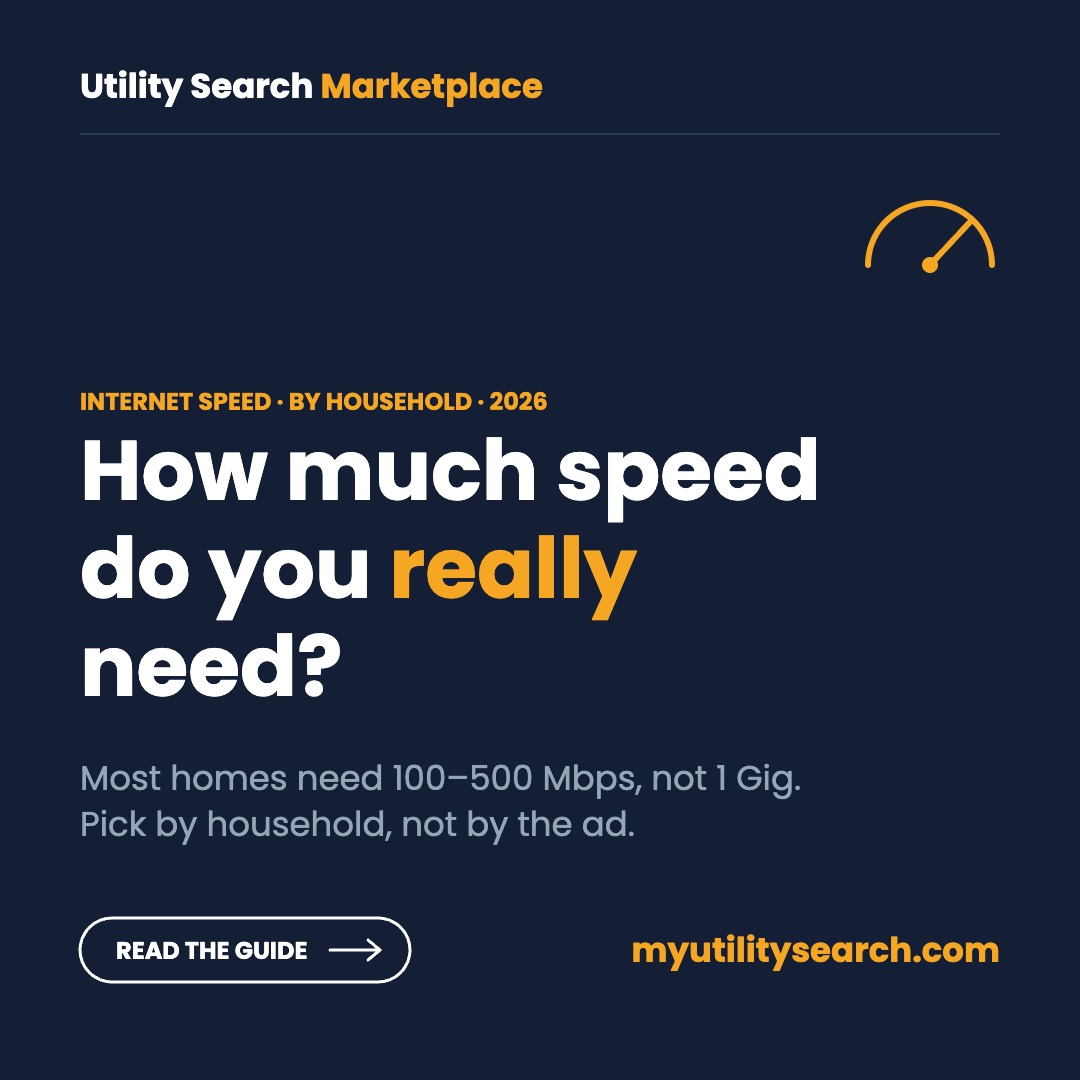
Not sure you need a gig at all? See how much internet speed do I need for answers by household and a quick speed picker.
How to Check If 1 Gig Internet Is Available at Your Address
The most important fact about gigabit internet is that availability is hyper-local. Two homes on the same street can have completely different options depending on which provider has run fiber down the block. Here is how to find out what you can actually get, in about five minutes:
- Check by address, not by ZIP code. ZIP-level lookups overstate coverage. Fiber builds street by street, so always verify at the exact service address.
- Identify the wire, not just the brand. A “gig plan” delivered over aging cable behaves differently from one delivered over fiber. Fiber gives you symmetrical upload and download; most cable gig plans give you fast downloads but far slower uploads. For video calls, backups, and uploading large files, that upload number matters.
- Compare every wire serving your home at once. This is where most shoppers leave money on the table — they check one provider, see a gig plan, and stop. Comparing all the providers mapped to your address is the only way to find the best price per megabit.
Our free comparison tool maps the providers actually serving your address so you can see your real gig options side by side. Compare internet plans for your address — it takes about five minutes and there is no SSN required. Prefer to talk it through? Call (844) 437-9527.
Why a 1 Gig Plan Matters for a Whole-Home, Multi-Device Household
A single laptop does not need a gigabit connection. A modern household running many things at once is a different story. Speed is shared across every device on your network, so the real question is not “how fast is one device” but “how much total demand hits the connection at peak time.”
A household with two remote workers on video calls, kids streaming and gaming, a few smart-home cameras uploading footage, and the usual phones and tablets can easily saturate a 200–300 Mbps plan during the evening crunch. That is when calls stutter and streams buffer — not because any one device is greedy, but because they are all competing. A 1 Gig or multi-gig plan removes that ceiling.
Multi gig internet (2 Gig and up) is now common on fiber and is worth considering specifically for large or device-dense homes, or households that move a lot of data — uploading 4K video, running home servers, or backing up to the cloud nightly.
If you are upgrading the whole home’s connectivity, it is the natural moment to make sure the rest of your home setup is not quietly overpaying. The same five-minute, apples-to-apples approach works for your electricity plan in deregulated states — and a connected, multi-device home is exactly the kind of home worth protecting. A modern security system ties cameras, sensors, and smart-home control into the network you are about to upgrade. To talk through professionally monitored options, call the Vivint line at (844) 646-6587.
Best 1 Gig and Multi-Gig Fiber Providers in 2026
Gigabit availability has expanded dramatically. Fiber-to-the-home reached well over half of U.S. addresses in early 2026, driven by aggressive private buildouts and federal broadband funding. The providers most likely to offer a true 1 Gig (or faster) fiber plan at your address include national fiber builders and fast-growing regional players:
- National fiber & cable gig providers: AT&T Fiber, Xfinity, Spectrum, Optimum, Cox, Frontier, and Verizon all offer gig-tier plans in their fiber or upgraded-cable footprints.
- Fixed-wireless & 5G home gig options: T-Mobile and Verizon 5G Home reach gig-class speeds in select areas — useful where wired fiber has not arrived yet.
- Regional fiber builders: Brightspeed, Omni Fiber, and similar regional providers are bringing 100% fiber, symmetrical multi-gig service to communities that historically had one or zero good choices.
Because the best gig provider is entirely address-dependent, the comparison matters more than the brand. Federal coverage data from the FCC National Broadband Map is a useful sanity check on what is wired to your area, and you can confirm real plans and pricing through our address-level internet comparison.
Compare internet, energy & home security at your address
What 1 Gig internet costs by provider (checked October 2026)
These are live quotes and published broadband labels we checked in the first week of October 2026. Promotional prices are shown with what they become afterward, because the post-promo price is what you actually pay for most of the contract.
| Provider | Type | 1 Gig price | After promo / notes |
|---|---|---|---|
| AT&T Fiber | Fiber, symmetrical | $70/mo | Not a promo rate; $50 with an AT&T wireless line (McKinney, TX quote, Oct 6) |
| Xfinity | Cable (symmetrical on upgraded nodes) | $70/mo | Locked for five years; $60 on a one-year term (Houston and Nashville quotes, Oct 1) |
| EarthLink Fiber | Fiber, symmetrical | $49.95/mo for 3 months | Then $64.95, plus $14.95 modem; 12-month term (McKinney, TX quote, Oct 6) |
| MetroNet | Fiber, symmetrical | $49.95/mo | Rises to $89.95 after 12 months, per its FCC broadband label |
What this means for you: the cheapest first-month gig is rarely the cheapest gig. Over two years, a $70 price-locked plan can cost less than a $49.95 promotion that jumps to $89.95. Add up 24 months, including equipment fees, before you compare.
Frequently Asked Questions
Is 1 gig internet worth it for a normal household?
For a home with several heavy users or many connected devices, 1 gig internet is worth it — it removes the peak-time bottleneck that slows video calls and streaming. For a one- or two-person home with light use, a 300–500 Mbps plan is usually plenty and cheaper.
How much does 1 gig internet cost in 2026?
Most 1 Gig plans run roughly $50 to $90 a month before promotions, with pricing varying by provider and address. Comparing every provider serving your address is the only reliable way to find the lowest real price. Federal resources like the FCC also track broadband availability and consumer protections.
What is the difference between 1 Gig and multi gig internet?
1 Gig internet delivers up to 1,000 Mbps; multi gig internet delivers 2,000 Mbps (2 Gig) or more. Multi-gig is worth it mainly for very device-dense homes or heavy uploaders; most households are well served by a 1 Gig plan.
Can I get 1 Gig internet without fiber?
Yes — some cable and 5G home internet plans reach gig-class download speeds. The trade-off is upload speed: fiber is symmetrical, while cable and fixed-wireless gig plans typically have much slower uploads.
How do I find 1 Gig internet providers by address?
Enter your exact service address into a comparison tool that maps every provider serving that location. Our free tool does this with no SSN required, so you see your true gig options side by side in about five minutes.
How much does 1 Gig internet cost?
On October 2026 quotes, 1 Gig ran $70 a month from both AT&T Fiber and Xfinity (Xfinity locked for five years), while EarthLink and MetroNet promoted $49.95 that later rises to $64.95 and $89.95. Expect roughly $50 to $90 a month depending on the provider and whether you are paying a promotional price.
Is 1 Gig internet worth it?
It is worth it for households with four or more people streaming, gaming and working at the same time, or anyone who uploads large files on symmetrical fiber. For one or two people who browse and stream, 300 to 500 Mbps is enough, and the savings add up over a two-year term.
Ready to See Your Real Options?
Check 1 gig internet availability at your address, compare every provider apples-to-apples, and lock the best price. Start your free comparison or call (844) 437-9527. Moving soon? Use our moving-day utility checklist to set up internet, electricity, and security before you unpack.
Are you a commercial customer?
Business internet, phones and IT for an office, store or multi-site location are quoted by address, not from a posted rate. Call our business internet desk at (866) 328-7973, or use BOX by TechGuidance to see every serviceable business connection at your location.
Keep going
- Brightspeed 1 Gig fiber — 940/940 Mbps for $49.99 with a Wi-Fi 7 router
- Compare the best internet providers for 2026
- Best internet for gaming
- Best internet for streaming
- How internet data caps and overage fees work
- Most reliable internet for remote work
- How to find the best internet provider in your area