Blog
PJM Capacity Auction: Why Electric Bills Are Rising Across 13 States

Updated on September 17, 2026
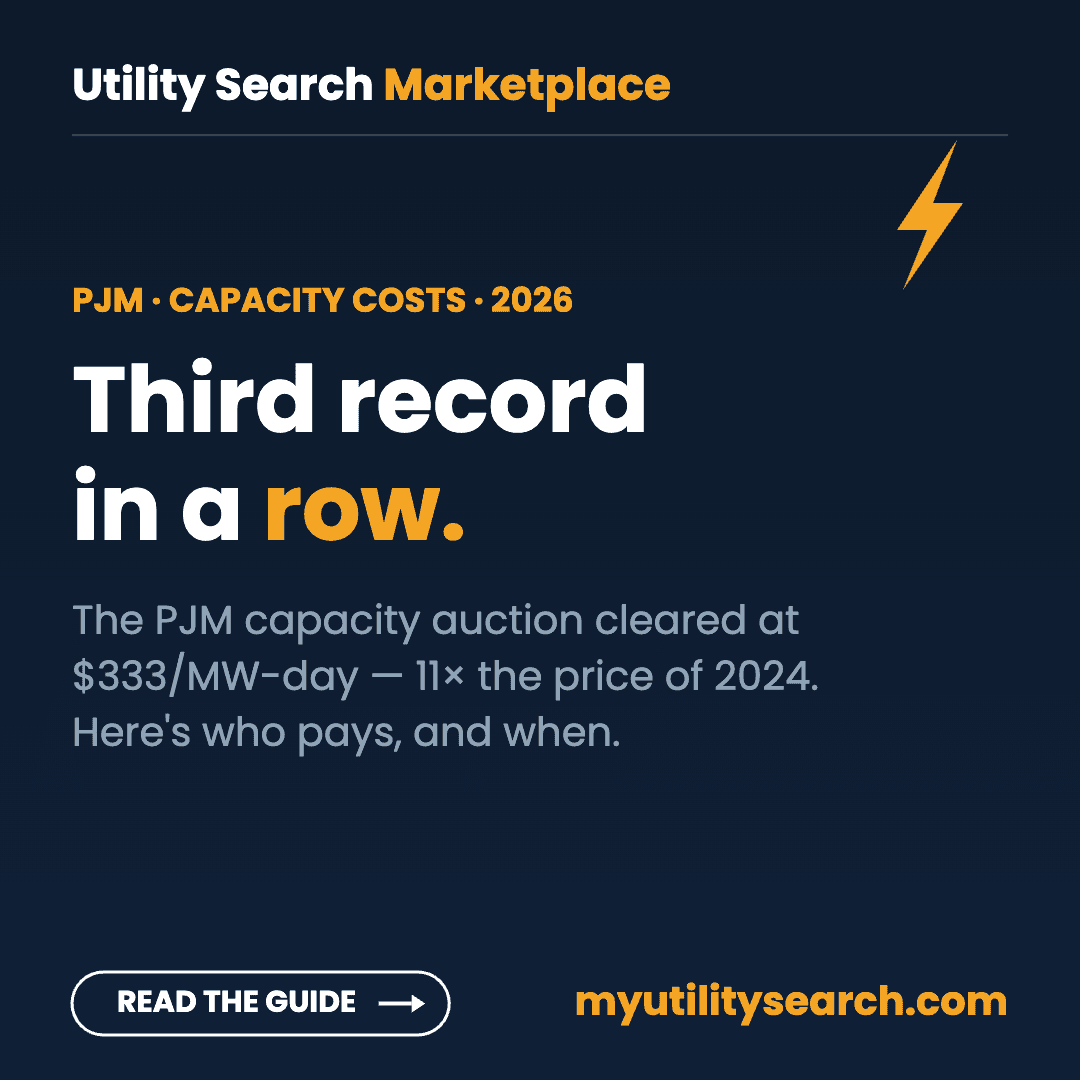
The PJM capacity auction is the annual auction where the largest U.S. grid operator buys backup power capacity for 13 states and Washington, D.C. — and it has now cleared at a record price three years in a row. The 2027/28 auction cleared at $333.44 per megawatt-day, up from $28.92 just four years earlier, and those costs flow directly onto electric bills in PA, OH, IL, NJ, MD, DE, and D.C.
TL;DR
- The PJM capacity auction has set a record price three consecutive years: $269.92 → $329.17 → $333.44 per MW-day.
- Without a negotiated price cap, the 2027/28 PJM capacity auction would have cleared roughly 60% higher — about $531/MW-day.
- Data centers account for nearly all of the 5,250 MW jump in projected peak demand driving prices up.
- Households in PJM states are seeing roughly 1.5%–5% bill increases from capacity costs alone, layered on top of other rate hikes.
- In deregulated states (PA, OH, IL, NJ, MD, DE, D.C.), you can’t avoid the capacity charge — but you can control the supply side of your bill by comparing suppliers.
What is the PJM capacity auction?
Definition: The PJM capacity auction — formally the Base Residual Auction (BRA) — is how PJM Interconnection, the grid operator serving 65 million people from Chicago to the Jersey Shore, secures commitments from power plants to be available three years into the future. Generators bid the price at which they’ll promise to run during peak demand; every electricity customer in the footprint pays for those commitments through a capacity charge embedded in their bill.
Think of it as the grid’s insurance policy: you’re not paying for the electricity itself, you’re paying generators to guarantee they’ll show up on the hottest and coldest days. When the auction clears high, that insurance premium rises for everyone — regardless of which supplier or utility serves you.
How does the PJM capacity auction actually work?
The PJM capacity auction runs roughly three years ahead of the electricity it secures — the auction held in December 2025 bought commitments for the June 2027–May 2028 “delivery year.” Power plant owners submit offers stating the price at which they’ll commit their capacity; PJM stacks those offers from cheapest to most expensive against a demand curve built from its peak-load forecast, and the price where supply meets demand becomes the clearing price nearly everyone pays.
Three details in that design explain the bill impact. First, the clearing price is paid to all cleared capacity, not just the marginal plant — so when the last megawatt needed is expensive, every megawatt gets that price. Second, the auction clears by zone: constrained areas can separate and clear far higher, which is how the BGE zone in Maryland reached $466.35/MW-day while most of the footprint paid $269.92. Third, the demand side is a forecast — so when PJM projects a data-center-driven surge, that projection alone raises what gets bought and what it costs, years before the load ever materializes.
The most recent PJM capacity auction shows how tight the market is: it procured a reserve margin of just 14.8% — the lowest PJM has ever recorded — even while paying record prices.
How high have PJM capacity auction prices gone?
The run-up is unlike anything in the auction’s history. Three straight record clearing prices, per PJM’s official auction results:

| Delivery year | Clearing price ($/MW-day) | What happened |
|---|---|---|
| 2024/25 | $28.92 | The old normal |
| 2025/26 | $269.92 | ~9× spike — first record; $14.7B total cost |
| 2026/27 | $329.17 | +22%, second record; $16.1B total; a price cap negotiated with Pennsylvania Gov. Shapiro kept it from reaching ~$389 |
| 2027/28 | $333.44 | Third straight record — cleared at the cap again; without the cap, ~$531/MW-day (60% higher) |
Constrained areas fare worse: in 2025/26 the BGE zone in Maryland cleared at $466.35/MW-day and Dominion’s zone at $444.26, per Utility Dive’s auction coverage.
Why does the PJM capacity auction keep setting records?
Three forces are converging:
Data-center demand is exploding. PJM projects peak load for 2027/28 to be roughly 5,250 MW higher than the prior year — with data centers accounting for nearly the entire increase. We’ve covered how this shows up on household statements in our post on data centers and electric bills.
Supply is retiring faster than it’s being replaced. Older coal and gas units keep exiting the market, and new generation is stuck in interconnection queues. The 2027/28 auction procured a 14.8% reserve margin — the lowest PJM has ever recorded.
The auction is clearing at its price cap. For two consecutive auctions, prices hit the maximum allowed. That cap exists only because Pennsylvania’s governor negotiated it in 2025 — a temporary shield, not a fix. When supply is this tight, the PJM capacity auction is effectively telling the market: build more power plants, fast.
Who pays for the PJM capacity auction — and when does it hit your bill?
Every customer in the PJM footprint pays, but the timing and size differ by state and utility. Capacity costs from each auction flow into bills starting June 1 of the delivery year — so the $329.17 price began hitting bills in June 2026, and the $333.44 price arrives June 2027. Regulators and consumer advocates estimate capacity costs alone are adding roughly 1.5% to 5% to bills, layered on top of transmission and distribution increases.
Where it lands in your footprint:
- Pennsylvania — PECO, PPL, Duquesne, Met-Ed, Penelec, West Penn. PPL customers are already absorbing increases; see our PPL rate increase breakdown.
- Ohio — AEP Ohio, Duke, FirstEnergy utilities, AES Ohio.
- Illinois — ComEd territory in northern Illinois; capacity costs are a named driver of recent hikes, as we covered for ComEd business customers.
- New Jersey — PSE&G, JCP&L, Atlantic City Electric, Rockland.
- Maryland, Delaware, D.C. — BGE, Pepco, Delmarva, Potomac Edison. BGE’s zone has cleared among the highest prices in the entire footprint.
How it reaches you depends on your plan. On utility default service, capacity costs flow through when the utility resets its supply rate. On a competitive fixed-rate plan, your supplier priced expected capacity costs into the rate when you signed — which is why a plan locked before an auction repriced the market can look like a bargain a year later, and why suppliers quoting today have the 2027/28 clearing price baked in. Businesses with demand meters see it more directly, as a capacity or “PLC” line tied to their usage during PJM’s five peak hours.
Compare internet, energy & home security at your address
What can you actually do about PJM capacity auction costs?
Here’s the honest version: the capacity charge itself is non-bypassable. No supplier switch removes it. But in every deregulated PJM state, the supply portion of your bill — the price per kWh you pay for the energy itself — is shoppable, and that’s where the savings live while capacity costs climb.
- Lock a fixed supply rate before the next flow-through. The $333.44 auction hits bills June 2027. A competitive fixed-rate plan locked now insulates the largest shoppable piece of your bill. Start with your state: Pennsylvania electricity rates, Ohio electricity providers, or Illinois electricity rates.
- If you’re on the utility’s default service, compare it. Default-service rates reset to reflect these auctions; suppliers price around them.
- For the full picture of what’s driving 2026 increases — capacity is one line among several — see our guide to electric rate increases in 2026.
What happens next with PJM capacity auction prices?
The next PJM capacity auction — for the 2028/29 delivery year — is the one to watch, because two opposing forces collide there. On one side, the price cap negotiated with Pennsylvania expires with the 2027/28 auction unless extended, which would let clearing prices float toward the levels PJM estimated without it (~$531/MW-day). On the other, record prices are doing what price signals do: the last auction attracted 2,669 MW of new unforced capacity and a demand-response fleet that grew to 7,299 MW cleared. If new supply keeps answering and load forecasts hold, prices could stabilize; if data-center growth outruns the interconnection queue again, a fourth record is on the table.
For shoppers the takeaway doesn’t change: capacity costs are already known through May 2028. What isn’t set is the supply rate you agree to pay — the piece worth locking now.
PJM capacity auction FAQ
What is the PJM capacity auction in simple terms?
It’s the auction where PJM, the grid operator for 13 states and D.C., pays power plants today to guarantee they’ll be available during peak demand three years from now. Customers fund those guarantees through a capacity charge on every electric bill in the footprint.
How much did the 2027/28 PJM capacity auction clear at?
$333.44 per MW-day ($121,705/MW-year) — the third consecutive record, clearing at the price cap. PJM estimates the uncapped price would have been about 60% higher, roughly $531/MW-day.
Does the PJM capacity auction affect my bill if I never switched suppliers?
Yes. The capacity charge applies to every customer in PJM territory — default-service and competitive-supply alike. Switching suppliers changes the energy portion of your bill, not the capacity portion, which is exactly why comparing supply rates matters more when capacity costs rise.
Which states are affected by PJM capacity auction prices?
All or part of Pennsylvania, Ohio, Illinois, New Jersey, Maryland, Delaware, Virginia, West Virginia, Kentucky, North Carolina, Tennessee, Indiana, Michigan, and Washington, D.C. The deregulated states among them — PA, OH, IL, NJ, MD, DE, and D.C. — are where customers can shop the supply side. See our deregulated energy states map.
What is the capacity charge on my electric bill?
It’s your share of what the PJM capacity auction paid generators to guarantee availability during peak demand. Residential customers usually see it blended into the supply rate rather than as its own line; commercial customers often see it broken out and tied to their peak-load contribution (PLC).
When will PJM capacity auction prices come back down?
Not before the 2028/29 delivery year at the earliest, and only if new generation clears the queue faster than data-center demand grows. With a record-low 14.8% reserve margin and the auction pinned at its cap, the market signal points to elevated capacity costs through at least 2028.
Compare internet, energy & home security at your address
Keep going
- Electric rate increases in 2026: every driver explained
- Data centers and electric bills: how AI demand reaches your statement
- Best electricity rates in Pennsylvania
- Best electricity providers in Ohio
- Best ways to lower your Ohio electric bill
- Deregulated energy states map: where you can choose your supplier