Blog
PA Price to Compare: Critical June 2026 Rate Update

Updated on September 9, 2026
By The Utility Search Marketplace Team · 20+ years in consumer home services. Last updated: June 1, 2026.
If you live in Pennsylvania, your PA Price to Compare just changed. As of June 1, 2026, every major utility in the state reset its default electricity supply rate — and for most households, it went up. This guide explains exactly what the PA Price to Compare is, what your utility’s new number is, why it climbed, and the five-minute move that can put a lower rate on your next bill.
What the PA Price to Compare actually is
The PA Price to Compare is the benchmark rate printed on your electric bill. It represents what you pay per kilowatt-hour for the generation (supply) portion of your service if you stay on your utility’s default plan and never choose a competitive supplier.
Pennsylvania deregulated its electricity market in 1996. That means your utility — PECO, PPL, Met-Ed, Penelec, Penn Power, West Penn Power, or Duquesne Light — still delivers the power and maintains the lines, but you can buy the actual electricity supply from any licensed competitive supplier. The PtC exists so you have a single, apples-to-apples number to measure those competitive offers against. If a supplier quotes you a rate below your PtC, that is a direct saving on the supply line of your bill. This is the same principle behind shopping your rate in any of the deregulated electricity states.
The PtC is not your full bill. It covers supply only. Your delivery charges, which the utility sets and you cannot shop, are separate. But supply is typically the largest variable piece, which is why the PtC matters so much when rates reset.
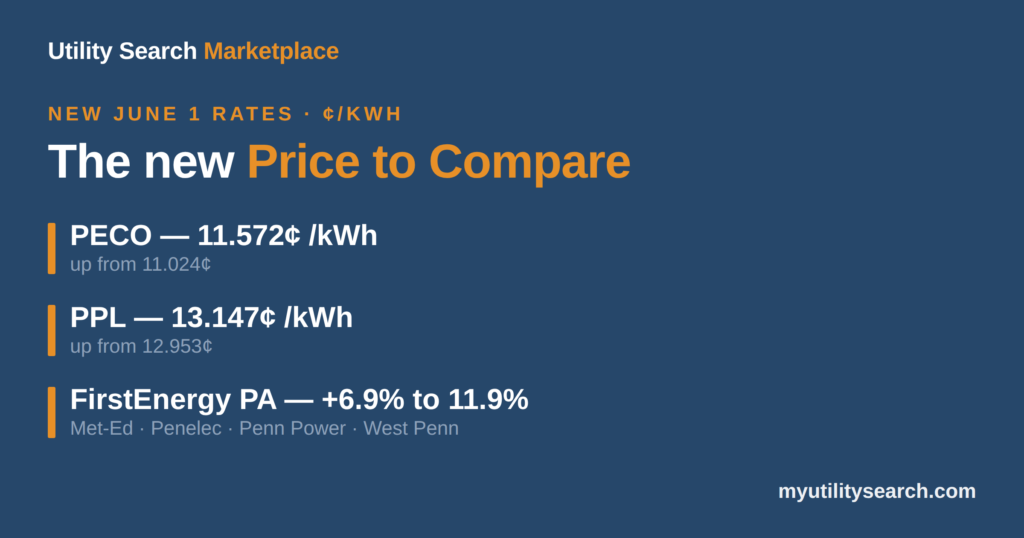
The June 1, 2026 PA Price to Compare rates by utility
Pennsylvania utilities reset the PtC twice a year, on June 1 and December 1. The June 1, 2026 reset pushed rates up across nearly every territory. Here are the confirmed residential numbers:
- PECO: rose from 11.024¢ to 11.572¢ per kWh — the largest commercial jump in the state at roughly 15% for business customers.
- PPL: rose from 12.953¢ to 13.147¢ per kWh, continuing a climb that has lifted PPL’s PtC sharply since 2020.
- FirstEnergy PA utilities (Met-Ed, Penelec, Penn Power, West Penn Power): new Price to Compare rates with estimated increases of 6.9% to 11.9%, with double-digit jumps in some territories.
For a typical home using about 1,000 kWh a month, even a one-cent move in the PtC is roughly $10 a month, or $120 a year, on the supply line alone. For more detail on the PPL change specifically, see our breakdown of the June 1 Pennsylvania electric rate increase.
Why the PA Price to Compare keeps going up
The increases are not arbitrary. Three forces are converging:
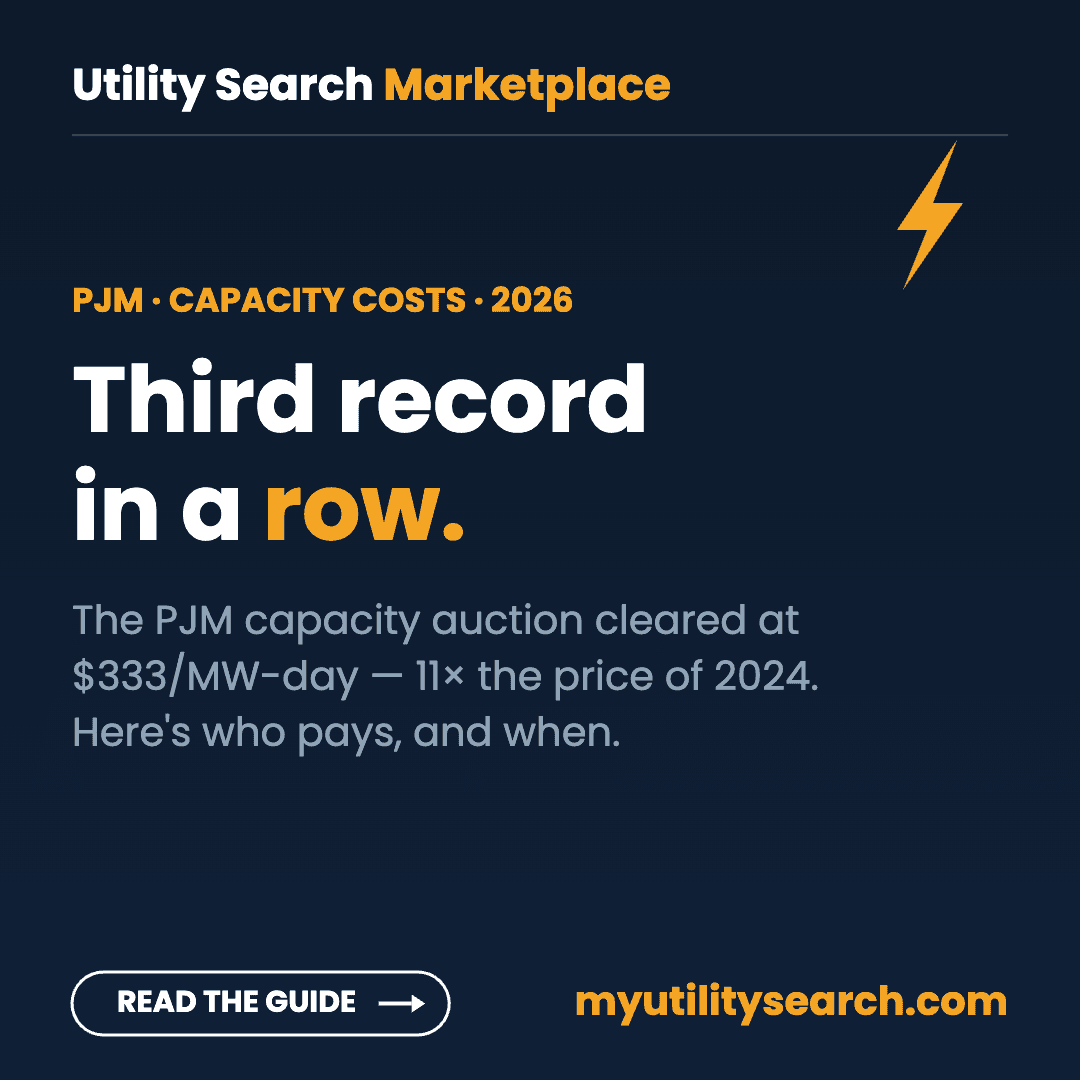
- PJM capacity costs. PJM Interconnection runs the regional grid serving Pennsylvania and 12 other states. Its capacity auction — essentially what generators are paid to guarantee power is available — stepped up sharply again for the June 2026 delivery period. Those costs flow straight into the supply rate.
- Retiring generation and rising demand. Older power plants are coming offline faster than new generation replaces them, while demand keeps climbing — including from new, power-hungry data centers. Less supply plus more demand pushes the wholesale price up.
- Distribution settlements. Separately, utilities like PPL reached distribution rate settlements in 2026 that affect the delivery side of the bill. That is not part of the PtC, but it compounds the total you pay.

How to switch and beat your PA Price to Compare
Here is the part that actually saves money. Because Pennsylvania is deregulated, you can shop the supply portion and lock in a competitive fixed rate — often before the next reset hits. The same five-minute switching process that works in Texas applies in Pennsylvania.
- Find your current PtC. It is printed on your bill and listed on your utility’s website. Write down the number (e.g. 11.572¢ for PECO).
- Compare licensed supplier offers. Look for a fixed-rate plan that beats your PtC. Compare the full terms, not just the headline rate: contract length, early termination fees, and whether the rate is fixed or variable.
- Enroll. Switching is paperwork only. Your utility keeps delivering the power, the lines do not change, and there is no service interruption. The new rate takes effect at your next meter read, typically within one to two billing cycles.
- Set a reminder for the next reset. PtC changes again December 1. A fixed-rate contract protects you through the resets in between.
You can verify your utility’s official Price to Compare and find the state’s supplier shopping tool through the Pennsylvania Public Utility Commission’s PA Power Switch site.
Paying Too Much for Electricity?
Rates change constantly, and loyalty rarely pays. Compare electricity plans available at your address — fixed-rate, variable, and green options, side by side.
PA Price to Compare FAQ
What is the PA Price to Compare right now?
As of June 1, 2026, PECO’s residential Price to Compare is 11.572¢/kWh and PPL’s is 13.147¢/kWh. FirstEnergy’s Pennsylvania utilities — Met-Ed, Penelec, Penn Power, and West Penn Power — reset to new Price to Compare rates with increases of roughly 6.9% to 11.9%. Check your specific bill for your exact number, since it varies by utility.
How often does the PA Price to Compare change?
Most Pennsylvania utilities reset the Price to Compare twice a year, on June 1 and December 1. Some smaller utilities adjust on a quarterly schedule. A fixed-rate competitive plan lets you lock a rate that holds steady through those resets.
Does switching suppliers affect my electricity service?
No. Switching changes only who supplies your electricity, not who delivers it. Your utility still owns the wires, reads the meter, and restores power after outages. There is no interruption, no new equipment, and no change in reliability — only the supply rate on your bill changes.
Is a rate below the PA Price to Compare always a better deal?
Usually, but read the full terms. A fixed rate below your Price to Compare saves you on the supply line, but check the contract length and any early termination fee. A very low teaser rate that converts to a high variable rate after a few months can cost more over a year than the PtC itself.
Sourcing note: Rate figures reflect the Pennsylvania PUC’s June 1, 2026 residential Price to Compare update (published May 20, 2026) and utility filings. Figures are residential supply rates and exclude delivery charges, which vary by territory.