Blog
GFiber + Astound Merger: Alphabet Sells Majority Stake to Stonepeak

Updated on October 28, 2026
13 min read
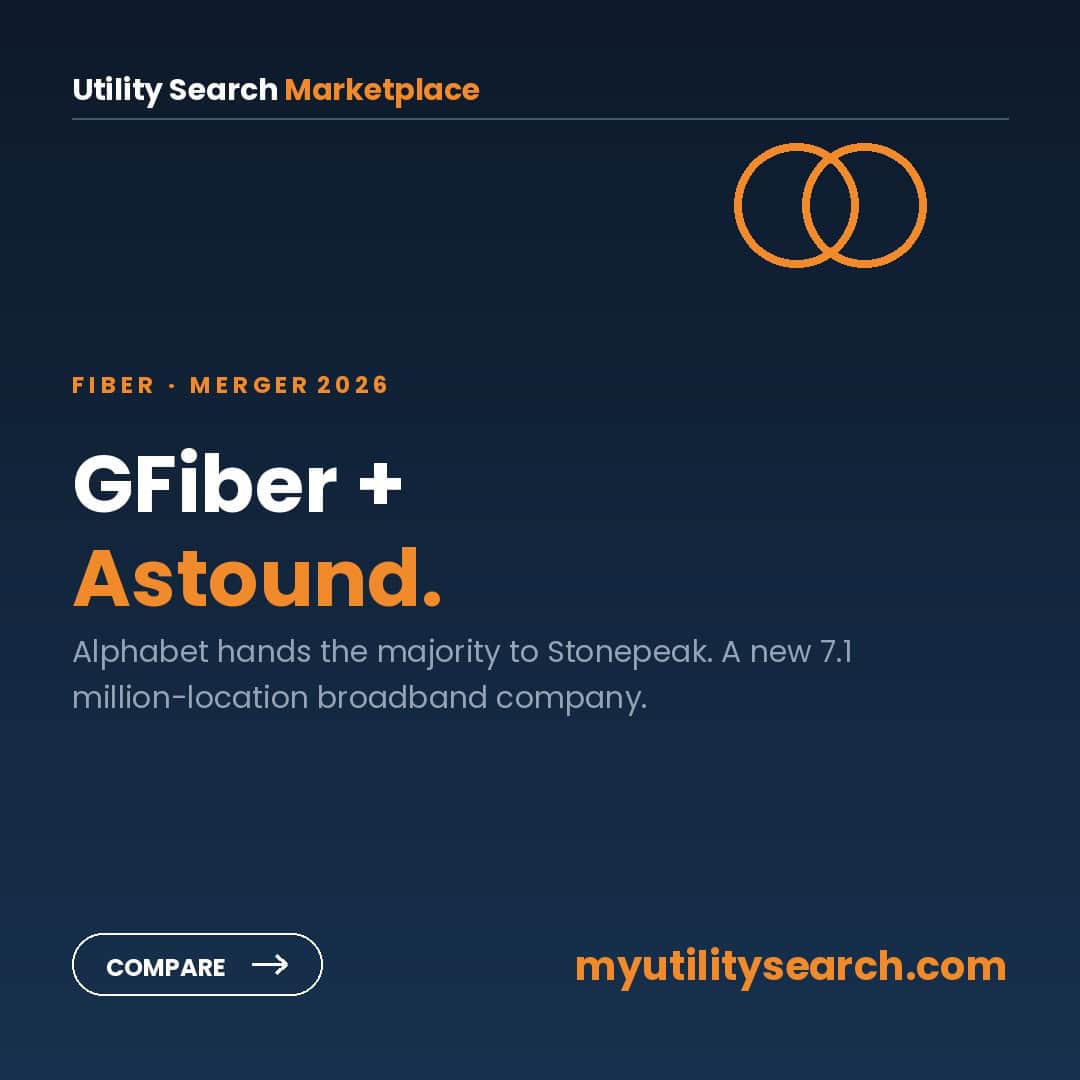
GFiber and Astound Broadband are combining into one independent internet company. Alphabet announced on March 11, 2026 that it is selling a majority stake in GFiber — the business formerly called Google Fiber — to infrastructure investor Stonepeak, which also owns Astound Broadband. The gfiber astound merger puts roughly 7.1 million U.S. locations under one roof and creates a genuine fourth force in broadband that is neither a cable giant nor a national wireless carrier.
TL;DR — the gfiber astound merger
- Announced March 11, 2026. Expected to close in Q4 2026, pending regulatory approval.
- Stonepeak takes majority ownership; Alphabet keeps a significant minority stake.
- GFiber’s management team leads the combined company.
- ~7.1 million combined locations across the two footprints.
- Financial terms were not disclosed.
- Nothing changes for customers yet — the deal has not closed.
Latest update — October 25, 2026
The deal is still pending regulatory approval and the companies continue to guide to a fourth-quarter 2026 close. GFiber and Astound are operating as two separate companies under one pending owner, with Astound still selling under its own name (and the RCN, Grande and Wave labels still on bills). GFiber’s executive team leads the combined business, so expect GFiber’s approach — flat pricing, no contracts, fiber-first builds, one online presence — to shape Astound over time, not on day one. No rebrand has been announced. For current Astound pricing see our Astound plans and prices page.
What exactly was announced?
Under the gfiber astound merger, Alphabet is stepping back from operating a consumer internet provider without walking away entirely. Stonepeak, which acquired Astound Broadband in 2020, takes majority control of the combined business. Alphabet retains a significant minority interest, and the existing GFiber leadership team runs the merged company.
The two networks in the gfiber astound merger are complementary rather than overlapping. GFiber is fiber-to-the-home in a set of metro markets it built out selectively over a decade. Astound is a cable operator with a substantial fiber component, assembled from regional brands including Wave, RCN, and Grande. Combining them produces a national-scale challenger without the two companies having to compete for the same streets.
Does anything change for GFiber or Astound customers?
Not yet, and this is the important distinction between the gfiber astound merger and the other 2026 deals. This one has been announced, not closed. Until regulators sign off and the transaction completes — expected in Q4 2026 — GFiber and Astound continue operating exactly as they do today, with separate plans, separate billing, and separate support.
When it does close, expect the familiar sequence we have tracked across every deal this year: ownership changes first, bundle and cross-sell offers appear next, billing platforms merge months later, and the brand decision comes last. Whether the combined company keeps “GFiber,” keeps “Astound,” or launches something new has not been announced.
One practical note: because this deal is still pending, you do not need to take any action, re-sign anything, or accept new terms. Any message claiming otherwise is not from your provider.
Why is Alphabet selling GFiber?
The reason behind the gfiber astound merger is simple: building fiber is capital-intensive, slow, and structurally unlike Alphabet’s other businesses. GFiber launched in 2010 with enormous attention and then expanded far more cautiously than expected, because trenching neighborhoods costs thousands of dollars per home and pays back over many years. That is a natural fit for an infrastructure fund with a long time horizon — and an awkward one for a company whose margins come from software.
Selling the majority to Stonepeak while keeping a minority stake lets Alphabet stop funding the buildout without writing off what it built. For Stonepeak, bolting GFiber onto Astound converts two subscale assets into one platform with real negotiating power. It is the same logic driving the rest of the wave — see our telecom consolidation tracker for how the deals compare.
Is a private-equity-backed provider good or bad for customers?
Worth answering honestly rather than reflexively, because the gfiber astound merger puts an infrastructure fund in charge of a consumer brand, because “private equity buys your ISP” invites a cynical read that is only half right.
The case for: infrastructure funds like Stonepeak invest on 10-to-20-year horizons, not quarterly earnings cycles, which is genuinely better suited to fiber than public-market pressure. Scale also gives the combined company leverage on programming and equipment costs it did not have separately, and a credible independent competitor is good for a market where the alternative is three national carriers.
The case against: infrastructure investors need returns, and in broadband those often arrive through price increases, fee restructuring, and tighter promotional discipline. GFiber built its reputation on simple, flat, no-nonsense pricing. Whether that survives contact with a returns-driven owner is the open question — and it is the thing worth watching on your bill in 2027, not 2026.
What should you do right now?
- Nothing urgent. The gfiber astound merger has not closed; your service and pricing are unaffected today.
- Note your renewal date. If you are on a promo that expires in 2027, that is when new-owner pricing is most likely to show up.
- Lock simple pricing if offered. GFiber’s flat-rate plans are the asset most at risk of being “optimized” post-close.
- Re-check your address annually. A 7.1 million-location company will expand differently than two smaller ones did.
Who has to approve the gfiber astound merger?
Broadband deals do not close because two companies agree. Three separate layers of review stand between announcement and close, and each can attach conditions.
- The FCC must approve the transfer of the licenses and authorizations each company holds. The commission reviews whether the transfer serves the public interest, and it routinely attaches conditions — as it did when it required AT&T to accelerate a spectrum deployment earlier this year.
- Federal antitrust review at the Department of Justice Antitrust Division examines whether combining the two reduces competition. Because GFiber and Astound largely serve different markets, this is a more straightforward review than a deal between direct competitors.
- State and local regulators weigh in wherever the companies hold franchises or state-level authorizations. This layer is the usual source of delay — the Charter–Cox deal has spent months waiting on a single state commission.
That is why “expected to close in Q4 2026” is a target rather than a promise. If you want a sense of how long the tail can be, compare it against the other deals in our consolidation tracker, where announcement-to-close has run anywhere from eight months to well over a year.
What does each company bring to the gfiber astound merger?
The two businesses are genuinely different animals, which is the strategic point of combining them.
| GFiber | Astound Broadband | |
|---|---|---|
| Network type | Fiber to the home | Cable, with substantial fiber |
| Origin | Launched by Google in 2010 | Assembled from Wave, RCN, Grande and others |
| Footprint style | Selected metro markets | Regional clusters across multiple states |
| Pricing reputation | Simple, flat, few fees | Conventional cable pricing and promos |
| Owner after close | Stonepeak majority, Alphabet minority | |
Because the footprints barely overlap, the combined company is not removing a competitor from anyone’s street. That is the strongest consumer argument in favor of this particular deal, and it is a real distinction from cable-on-cable consolidation. The open question is cultural rather than structural: GFiber’s flat pricing is the exception in this industry, and merging it into a conventional cable operation is where that could quietly erode.
What to watch between now and close
Four concrete signals will tell you more than any press release about how the gfiber astound merger will land:
- Whether GFiber’s flat pricing survives the first post-close price sheet. This is the single best indicator of the new owner’s intentions.
- Whether equipment and service fees appear. GFiber historically bundled the router; cable operators historically charge for it.
- Which brand is retired. Keeping GFiber signals a premium fiber strategy; folding into Astound signals a conventional one.
- Whether buildout accelerates. Infrastructure capital exists to be deployed — new market announcements would be a genuinely good sign for coverage.
Meanwhile, you can check what already reaches your address today. The FCC’s National Broadband Map shows the providers reporting service at your location, which is a useful reality check against what any single provider’s marketing claims.
FAQ
Is Google Fiber being sold?
Yes, in part. Alphabet announced on March 11, 2026 that it is selling a majority stake in GFiber to infrastructure investor Stonepeak, which will merge it with Astound Broadband. Alphabet retains a significant minority stake.
When does the gfiber astound merger close?
The companies expect the deal to close in Q4 2026, subject to customary closing conditions and regulatory approvals. It had not closed as of July 2026.
Will my GFiber or Astound plan change?
Not right now. The deal is announced but not closed, so both providers continue operating separately with their existing plans, billing, and support. Changes typically follow months after a close, not before it.
How big is the combined company?
The combined GFiber and Astound footprint reaches approximately 7.1 million U.S. locations.
Who will run the merged company?
The existing GFiber management team will lead the combined business, with Stonepeak holding majority ownership.
What was the deal worth?
Financial terms were not disclosed by Alphabet or Stonepeak.
GFiber and Astound merger: the questions people ask, answered
What people search for about this deal, in their own words, answered as of October 25, 2026.
Who owns GFiber?
Today, Alphabet, Google’s parent company, owns GFiber (the company formerly branded Google Fiber) outright. When the Astound combination closes, expected in the fourth quarter of 2026, ownership flips: Stonepeak, the infrastructure investment firm that already owns Astound, becomes the majority shareholder of the combined company and Alphabet keeps a significant minority stake. GFiber’s existing executive team, led by CEO Dinni Jain, runs the combined business.
Who owns Astound Broadband?
Stonepeak, a New York infrastructure investment firm, has owned Astound since 2021, when it bought the company (then operating as RCN, Grande and Wave) from TPG Capital for about $8.1 billion. Astound is privately held, not publicly traded, and is not owned by a telecom conglomerate; the ‘powered by RCN / Grande / Wave’ labels on bills are legacy brand names, not separate owners. After the GFiber deal closes, Astound and GFiber sit under the same Stonepeak-majority company.
Is GFiber being acquired by Astound, or is Astound being acquired by Google Fiber?
Neither, strictly. It is a combination: Alphabet is contributing GFiber into a new company that Stonepeak will majority-own, and Stonepeak is contributing Astound. In practical terms the money and the majority stake come from Astound’s owner, while the leadership comes from GFiber. So if you want the one-line version: Stonepeak’s side owns it, GFiber’s side runs it.
Who owns Stonepeak?
Stonepeak is an independent, privately held investment firm founded in 2011 and headquartered in New York, owned by its partners and managing capital for pension funds, insurers and sovereign funds. It specializes in infrastructure: fiber and data centers, ports, energy and transport. Besides Astound it has owned or invested in Cologix data centers, Xplore in Canada and a long list of fiber and tower assets, which is why it is the natural buyer for a fiber business Alphabet wanted to step back from.
Is Astound publicly traded? Can I buy stock in GFiber or Astound?
No. Astound is private, GFiber is a subsidiary of Alphabet and will become part of a private, Stonepeak-controlled company at close, so there is no ticker for either. The only public exposure is Alphabet stock (GOOGL / GOOG), and GFiber is far too small to move it. Reports that Astound was ‘for sale’ in 2025 and 2026 referred to Stonepeak exploring options, which ended in this combination rather than a sale.
Has the FCC approved the GFiber-Astound merger?
As of October 2026 the review is still underway. The deal needs FCC consent to transfer licenses and authorizations, Hart-Scott-Rodino antitrust clearance from the Department of Justice or FTC, and sign-off from several state utility commissions and city franchise authorities in Astound’s footprint. None of those have raised public objections, and the companies continue to guide to a fourth-quarter 2026 close. We update this page when approvals land.
Will Astound become Google Fiber? Will RCN, Grande and Wave be renamed?
No rebrand has been announced. The companies have said the deal brings no changes for customers at close, and for at least the near term the two sides operate as separate companies under one owner, with Astound selling under its own name and the RCN, Grande and Wave labels still appearing on bills. Because GFiber’s leadership runs the combined business, it is reasonable to expect GFiber’s habits to spread over time: flat pricing without promotional rates, no contracts, symmetrical fiber builds and a single online presence. Treat any announcement about brand names as the signal that the second phase has started, and expect it after close, not before.
Is GFiber taking over Colorado Springs, and is that part of the merger?
GFiber’s Colorado Springs build is a separate GFiber expansion, announced before the Astound deal, and it continues on its own schedule. Astound has no footprint in Colorado, so the merger does not change who serves that city. The confusion comes from both stories landing in the same news cycle.
Will my Astound or GFiber bill change because of the merger?
Not at close. Promotional rates, Price for Life locks and GFiber’s flat plans all carry over as written. The changes to watch are later and gradual: Astound customers may see GFiber-style simplified pricing when their current promo ends, and both customer bases may eventually share one app and one support operation. If your Astound promo expires in the next year, the month-12 anniversary is still the moment to re-shop, merger or not.
What does ‘GFiber’s management team leads the combined company’ mean in practice?
That decisions about pricing philosophy, network strategy and the customer experience come from GFiber’s executives, even though Stonepeak owns the majority. GFiber has spent a decade selling fiber at flat prices with no promos, no data caps and no contracts, and expanding city by city; Astound grew by buying cable systems and competes on 12-month promotional pricing. When one team runs both, the GFiber model is the one that tends to win over time, which is good news for Astound customers tired of promo cliffs and a reason for GFiber customers to expect little change.
What should I do if I am an Astound customer right now?
Nothing urgent. Keep your plan, note when your promotional rate ends, and use that date to compare every provider at your address, which is what the box above does. If you are considering switching to Astound now, the Price for Life gig plan at $45 is the safest choice because a locked rate survives an ownership change intact. If you are a GFiber customer, nothing about your service is scheduled to change.
Is Astound now Google Fiber?
Not yet, and not at close. Astound and GFiber remain two separately branded companies under one owner until the companies say otherwise. If you have seen a GFiber truck, mailer or app in an Astound town, it is either a GFiber build that was already planned or early co-marketing; your Astound account, bill and support line are unchanged until Astound tells you directly. When a rebrand is announced we will post the date and the markets here first.
RCN, Grande or Wave to GFiber: what would the switch look like?
Based on how GFiber has absorbed markets before, a switch would come market by market, not all at once: a letter and email announcing the new name and a date, the same bill amount through the end of any promo or Price for Life term, a new app and account login, and over a longer period a move from Astound’s cable tiers to GFiber’s flat fiber plans where the fiber has been built. Nothing in that sequence requires you to re-sign, re-install or return equipment on day one. The thing to protect is a locked rate: write down the promo end date or Price for Life terms before any transition letter arrives.
My Astound bill says GFiber. What happened?
If a bill or statement carries the GFiber name, the brand transition has reached your market. The amount owed should match your existing plan; if it does not, call the number on that bill and ask for the plan and rate you were on before the change, which carries over under the terms of the deal. Then compare what GFiber now sells at your address against every other provider, because a brand change is also the moment pricing structures change, and it may be cheaper to move to a flat GFiber plan than to stay on a legacy promo.
Also searched as: g-fiber, g fiber and astound, Google Fiber Astound merger, gfiber new owner and Stonepeak gfiber. They all mean the GFiber–Astound combination.
Also compare energy, home security and home warranty at your address
Electricity plans in 14 deregulated states. Security and warranty nationwide.
Are you a commercial customer?
Business internet, phones and IT for an office, store or multi-site location are quoted by address, not from a posted rate. Call our business internet desk at (866) 328-7973, or use BOX by TechGuidance to see every serviceable business connection at your location.