Blog
Telecom Bankruptcies: The Shocking 10-Year History of Debt, Deals and Downsizing

11 min read
Telecom bankruptcies are not a sign the industry is broken. They are one of the tools it runs on. In the last ten years Windstream, Frontier, Intelsat, Ligado and Dish DBS all went through Chapter 11, cut billions in debt, and kept customers connected the whole time. Lumen and Brightspeed did the same thing out of court. Optimum is negotiating its version right now. This is the 2016–2026 history of telecom bankruptcies, debt deals and downsizing, and what each one meant for the people paying the bills.
Last updated: November 3, 2026. We update this page as filings, closings and court rulings happen.
TL;DR: telecom bankruptcies, 2016–2026
- Five big Chapter 11 cases: Windstream (2019), Frontier (2020), Intelsat (2020), Ligado (2025) and Dish DBS (2026).
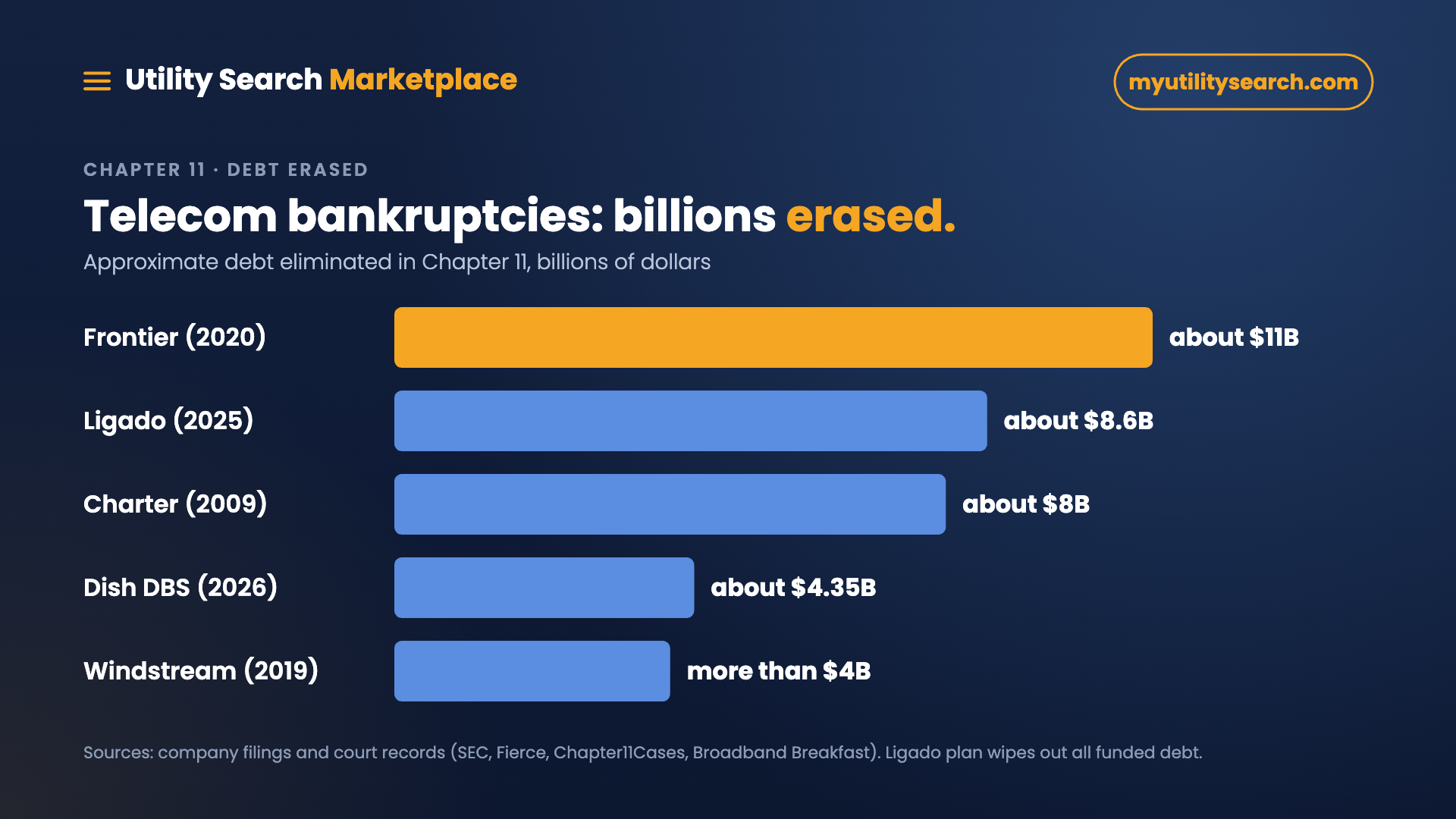
- Billions erased: Frontier shed about $11 billion of debt, Windstream more than $4 billion, Dish DBS about $4.35 billion.
- Service kept running: in every case, phones, TV and internet stayed on while lawyers rewrote the balance sheet.
- The loop: Verizon sold lines to Frontier in 2016, Frontier went bankrupt in 2020, and Verizon bought Frontier back in January 2026.
- Under pressure: Breezeline took a US$1.2 billion write-down in June 2026 after a leadership overhaul.
- Next up: Optimum is preparing a Chapter 11 filing to hand control to its lenders and restructure about $26 billion of debt.
Why are telecom bankruptcies so common?
Because networks are built with borrowed money and paid back over decades. Laying fiber, launching satellites or buying spectrum costs billions up front. Customers pay that back a few dollars a month for 20 or 30 years. When customers leave faster than planned, or interest rates rise, the debt keeps coming due anyway.
Chapter 11 is how the industry resets that math. A company keeps operating, a judge freezes collections, and lenders trade some of what they are owed for ownership of the business. The network, the trucks and the customer accounts do not disappear. The debt does. That is why telecom bankruptcies tend to look less like a collapse and more like a change of owners.
Definitions worth knowing
Chapter 11: court-supervised reorganization. The company keeps running and proposes a plan to cut or swap its debt.
Prepackaged Chapter 11: the deal with lenders is agreed before filing, so the case can finish in weeks or a few months.
Liability management (out of court): a company swaps, extends or reshuffles debt directly with lenders, without a bankruptcy filing.
The playbook was written in 2002 and 2009
The last decade did not invent this. The dot-com telecom bust set the pattern. WorldCom filed for Chapter 11 on July 21, 2002, listing $107 billion in assets, the largest U.S. bankruptcy at the time, after an accounting fraud that eventually reached $11 billion. Global Crossing, Adelphia, XO Communications and Williams Communications all filed the same year. By September 2002, sociologist Paul Starr counted 23 telecom bankruptcies and about half a million lost jobs in two years.
Seven years later, Charter Communications showed how a prearranged filing could work for a big cable company. Charter filed on March 27, 2009, cut about $8 billion of debt, roughly 40 percent of the total, and emerged on November 30, 2009. Customers barely noticed. Charter is now the parent of Spectrum, the second-largest cable company in the country.
Telecom bankruptcies and debt deals, 2016–2026
Here is the ten-year record in one table. Court filings are Chapter 11 unless noted; out-of-court deals are marked.
| Date | Company | What happened | Outcome |
|---|---|---|---|
| Feb 25, 2019 | Windstream | Filed after losing a bondholder lawsuit over its 2015 Uniti spin-off | Cut $4B+ of debt; emerged Sept 2020; merged with Uniti Aug 2025 |
| Apr 14, 2020 | Frontier | Filed with about $17.5B of debt | Emerged Apr 30, 2021 about $11B lighter; bought by Verizon Jan 20, 2026 |
| May 13, 2020 | Intelsat | Satellite operator filed with $14.8B of debt | Emerged Feb 2022 with about $7B of debt; sold to SES July 2025 |
| Mar 22, 2024 | Lumen | Out-of-court deal covering $15B+ of debt | 2027 maturities cut from $9.5B to $0.8B; sold consumer fiber to AT&T Feb 2026 |
| Aug 2024 | Brightspeed | Out-of-court loan amendments | About $1.1B of debt cut, $3.7B of new capital |
| Nov 2024 | Dish / DirecTV | DirecTV deal to buy Dish DBS for $1 plus debt | Collapsed when bondholders refused a haircut |
| Jan 5, 2025 | Ligado Networks | Filed with about $8.6B of debt | Plan wipes out funded debt; built on a spectrum deal with AST SpaceMobile |
| Jun 2, 2026 | Breezeline (Cogeco) | About US$1.2B write-down after losing 23,000 broadband customers in a year | No filing; U.S. asset sale not ruled out |
| Jun 30, 2026 | Dish DBS & Dish Wireless | Prepackaged filing in Houston | About $4.35B of debt cut; Dish DBS out Oct 1, 2026 |
| Aug 3, 2026 | Hughes Satellite Systems | HughesNet parent filed, citing Starlink competition | Case ongoing; HughesNet service continues |
| 2026, ongoing | Optimum | $21.8B of operating-company debt; lenders sued Sept 28, 2026 | Preparing Chapter 11 to hand control to lenders; not filed as of Nov 3 |
The loop: sell the lines, watch the buyer go bankrupt, buy them back
The strangest pattern in telecom bankruptcies is how often the same copper and fiber changes hands. Big carriers sold aging rural and suburban phone lines to smaller, debt-funded buyers. Several of those buyers ended up in court.
- Verizon Hawaii: sold to Carlyle in 2005 for $1.6 billion. As Hawaiian Telcom, it filed for bankruptcy in December 2008 and was later bought by Cincinnati Bell in 2018.
- Verizon in Maine, New Hampshire and Vermont: sold to FairPoint, closing in March 2008. FairPoint filed for bankruptcy in October 2009, cut its debt by 64 percent, and was bought by Consolidated in 2017.
- Verizon and AT&T lines to Frontier: Frontier bought Verizon lines in 14 states in 2010, AT&T’s Connecticut business in 2014 for $2 billion, and Verizon’s California, Texas and Florida lines in April 2016 for $10.54 billion.
Four years after that last purchase, Frontier filed for Chapter 11. It emerged in 2021, spent heavily on fiber, and on January 20, 2026, Verizon closed its roughly $20 billion purchase of Frontier. In practical terms, Verizon bought back networks it had sold a decade earlier, now upgraded and cleaned of most of the old debt. Our Frontier–Verizon merger guide covers what changed for those customers.
The out-of-court route: Lumen and Brightspeed
Not every rescue needs a judge. In March 2024, Lumen completed a deal with lenders covering more than $15 billion of debt. It pushed out what it owed in 2027 from about $9.5 billion to about $0.8 billion, without filing. Two years later it sold its consumer fiber business, Quantum Fiber, to AT&T, which closed on February 2, 2026.
Brightspeed, the rural phone and fiber company owned by Apollo, did something similar in August 2024. It cut about $1.1 billion of debt by amending its loans and raised about $3.7 billion in new capital from its lenders and Apollo. These deals are legal, but they are controversial. Lenders left out of them often sue, and that same fight is now playing out at Optimum.
Is Optimum going bankrupt?
Optimum is preparing to file for Chapter 11, though it had not filed as of November 3, 2026. Its operating company, CSC Holdings, carries about $21.8 billion of debt, with about $6.2 billion due in 2027, including $4.1 billion in April 2027. Some reports put total debt above $26 billion.
In June 2026, Optimum moved its Optimum East systems and its stake in Lightpath into a new subsidiary that its lenders cannot reach, then raised money against it. Lenders including Apollo and Oaktree sued on September 28, 2026, calling the company insolvent. Optimum says the claims have no merit. In late October, Bloomberg Law and The Wall Street Journal reported that Optimum is preparing a Chapter 11 filing to carry out a deal handing control to its lenders and restructure about $26 billion of debt, with a filing expected before the end of 2026.
If it happens, expect it to look like Charter in 2009 or Frontier in 2020: internet, TV and phone keep working, and the change shows up in who owns the company. For prices and plans in the meantime, see our Optimum internet guide.
Dish, Hughes and the satellite squeeze
Satellite companies have had the roughest stretch. In November 2024, DirecTV agreed to buy Dish’s TV business for $1 plus about $9.75 billion of debt, then walked away when Dish bondholders refused to take a loss. In May 2026, the FCC approved EchoStar’s roughly $40 billion of spectrum sales to AT&T and SpaceX.
Dish DBS and Dish Wireless then filed a prepackaged Chapter 11 on June 30, 2026, when about $2 billion of notes came due before the AT&T sale closed. The plan was confirmed September 29 and Dish DBS was out on October 1, about $4.35 billion lighter. Hughes Satellite Systems, the parent of HughesNet, filed separately on August 3, 2026, pointing to Starlink. Our Dish Network bankruptcy explainer has the customer side.
Breezeline: leadership out, a $1.2 billion write-down in
Breezeline has not filed for bankruptcy, but it shows the earlier stage of the same pattern: shrinking customers, a leadership overhaul and a write-down. Breezeline is the U.S. cable business of Canada’s Cogeco, serving parts of Ohio, Pennsylvania, Maryland, Virginia, the Carolinas, Florida, New Hampshire and Maine.
In mid-2024, Cogeco folded Breezeline’s commercial, operational and technical teams into a single North American organization run from Canada. Breezeline president Frank van der Post left, and many top U.S. executives had their last day on August 30, 2024, when the company’s leadership webpage went dark. That September, Cogeco’s CFO said parts of Breezeline could be sold.
On June 2, 2026, Cogeco took a preliminary charge of about C$1.7 billion (about US$1.2 billion) against Breezeline’s goodwill and intangible assets, citing fiber and fixed-wireless competitors that undercut it on price and lock customers into long-term guarantees. Breezeline ended that quarter with 609,751 broadband customers, about 23,000 fewer than a year earlier. On its October 29, 2026 earnings call, Cogeco reported continued customer losses and did not rule out selling U.S. assets. For current plans and prices, see our Breezeline internet guide.
Extreme downsizing: where the jobs went
Debt pressure shows up in headcount long before it shows up in court. Between 2016 and 2025, AT&T’s reported workforce fell from about 268,000 to 133,030, and Verizon’s fell from 160,900 to 89,900. That is roughly 206,000 positions gone at two companies, as tracked in our telecom layoffs by company report.
Cable is now catching up. Comcast booked a charge of more than $1 billion for the largest restructuring in its history, covered in our Comcast layoffs breakdown. Lumen cut about 90 partner-channel roles in July 2026. Breezeline, above, has already gone through its own leadership overhaul.
Why telecom bankruptcies keep happening now
- Cord cutting: cable and satellite TV, once the cash engine, keeps shrinking.
- New competitors: 5G home internet from T-Mobile and Verizon and Starlink from space pull customers from cable, DSL and satellite.
- Higher interest rates: refinancing billions costs far more than it did before 2022.
- The fiber race: companies that cannot fund fiber upgrades lose customers to those that can, while the $42.45 billion federal BEAD program favors builders with strong balance sheets.
- Consolidation: the strong buy the weak, often after bankruptcy has cleaned up the debt. Our telecom consolidation tracker follows each deal.
What telecom bankruptcies mean for your service
In almost every case, your service keeps working. Frontier, Windstream and Dish customers kept their connections through Chapter 11. What changes is slower: price increases, fewer promotions, trimmed customer service staff, and sometimes a new brand name on the bill. If your provider is in trouble, now is a good time to see what else serves your address.
FAQ
What was the biggest telecom bankruptcy in U.S. history?
WorldCom. It filed for Chapter 11 on July 21, 2002, listing $107 billion in assets, which made it the largest U.S. bankruptcy at the time. In the last ten years, Frontier’s 2020 filing with about $17.5 billion of debt was the largest among internet providers.
Is Optimum going bankrupt?
Not yet, but it is preparing to. As of November 3, 2026, Optimum had not filed. The Wall Street Journal and Bloomberg Law report it is preparing a Chapter 11 filing to hand control to its lenders and restructure about $26 billion of debt, likely before the end of 2026. Service is expected to continue.
Does my internet stop working if my provider files Chapter 11?
No, not in the cases on this page. Chapter 11 lets a company keep operating while it restructures debt. Frontier, Windstream, Charter and Dish all kept service running during their cases.
Is Breezeline going bankrupt?
No. As of November 3, 2026, Breezeline has not filed for bankruptcy. Its parent, Cogeco, took a write-down of about US$1.2 billion on Breezeline in June 2026 after customer losses and has not ruled out selling U.S. assets, but service continues normally.
Did Dish Network go bankrupt?
Dish DBS, the company behind Dish TV and Sling, filed a prepackaged Chapter 11 on June 30, 2026 and exited on October 1, 2026 after cutting about $4.35 billion of debt. Dish TV and Sling kept operating.
Why do telecom companies carry so much debt?
Networks cost billions to build and are paid back slowly through monthly bills. Companies borrow to build, buy rivals and buy spectrum. When customers leave or rates rise, the debt can outrun the cash coming in.
Also compare energy, home security and home warranty at your address
Electricity plans in 14 deregulated states. Security and warranty nationwide.
Are you a commercial customer?
Business internet, phones and IT for an office, store or multi-site location are quoted by address, not from a posted rate. Call our business internet desk at (866) 328-7973, or use BOX by TechGuidance to see every serviceable business connection at your location.
Sources
- CNN Money: WorldCom files for bankruptcy (2002)
- Paul Starr, The American Prospect: The Great Telecom Implosion (2002)
- Charter Communications 8-K on emergence (2009)
- Fierce: Windstream reaches agreements with creditors and Uniti
- Fierce: Frontier files for Chapter 11 (2020)
- Verizon 8-K: Frontier acquisition closes (Jan 2026)
- Via Satellite: Intelsat emerges from bankruptcy (2022)
- Lumen SEC filing: transaction support agreement (2024)
- Fiber Broadband Association: Brightspeed recapitalization (2024)
- Chapter11Cases: Ligado $8.6 billion restructuring
- Broadband Breakfast: Dish Wireless and DBS file for bankruptcy (2026)
- Broadband Breakfast: Creditors sue Optimum (2026)
- Bloomberg Law: Optimum mulls possible bankruptcy (Oct 2026)
- The Wall Street Journal Pro Bankruptcy: Optimum prepares Chapter 11 to restructure $26 billion of debt (Oct 2026)
- CableTV.com: Optimum prepares to file for bankruptcy (Nov 2026)
- Broadband Breakfast: Cogeco takes $1.2 billion hit on Breezeline (2026)
- Next TV: Cogeco combines U.S. and Canadian cable operations (2024)
- Policyband: CFO says Cogeco could sell Breezeline assets (2024)
Keep going
- EchoStar spectrum sale and the SpaceX–Boost talks
- Telecom consolidation tracker: every major 2026 merger
- Telecom layoffs by company: what the SEC filings show
- Comcast layoffs 2026: the biggest restructuring in its history
- Frontier is now Verizon: what changed for customers
- Is Dish Network going out of business?
- Compare the best internet providers for 2026