Blog
Frontier Is Now Verizon: What Actually Changed for Your Internet and Bill

Updated on August 29, 2026
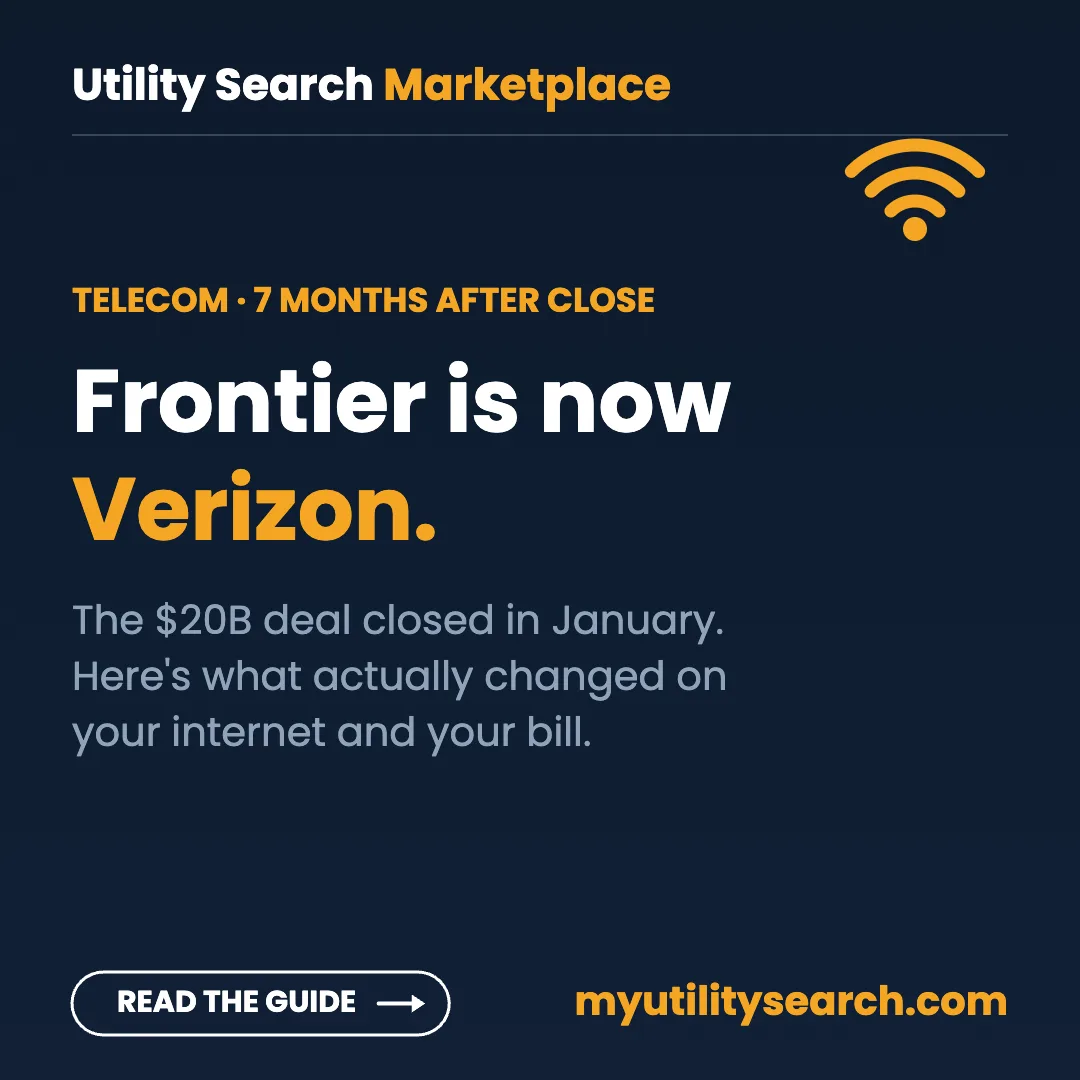
The Frontier Verizon merger closed on 20 January 2026. Verizon paid $38.50 per share in cash, valuing Frontier at roughly $20 billion including debt. Frontier now operates as “Frontier, a Verizon Company” — it has not been rebranded to Verizon, and no rebrand date has been announced. Your Frontier plan, price, promotions, rewards and equipment did not change, and your Frontier and Verizon bills stay separate.
Last updated: 24 August 2026
TL;DR — the Frontier Verizon merger in six lines
- Closed 20 January 2026, about 16½ months after the September 2024 announcement.
- Frontier still operates under its own name and its own app. No migration date has been published.
- Nothing changed for existing customers. Verizon: “Your current Frontier plan, deals and discounts don’t change and your Frontier ForMe Rewards don’t change.”
- Frontier says plans will “eventually standardize across the entire Verizon territory” — with no date.
- Pennsylvania customers have a tariffed rate cap through 1 January 2028. Most people in Pennsylvania don’t know this.
- Combined footprint: ~30 million homes and businesses across 31 states plus Washington, D.C.
Did the Frontier Verizon merger actually close?
Yes, and the date matters because a lot of coverage still reads as though it’s pending.
Verizon’s Form 8-K puts the effective time at 20 January 2026, with Frontier surviving as a wholly owned Verizon subsidiary. Verizon announced on 15 January that California’s approval that day cleared the path. Frontier stock stopped trading on Nasdaq 16 January; delisting was effective 30 January. Frontier repaid about $2.1 billion of debt at closing.
Definition: what “a Verizon Company” means
Frontier was not merged into Verizon’s consumer operation. It is a wholly owned subsidiary operating under its own brand, its own billing system and its own app. You still manage your account through Frontier and MyFrontier. Verizon’s stated long-term plan is to integrate Frontier’s consumer network into Fios standards — but no conversion schedule has been published.
At announcement Frontier had 2.2 million fiber subscribers and 7.2 million fiber passings across 25 states. By Q3 2025 — its last reported quarter — that was 8.8 million total fiber passings with a record 133,000 fiber net adds. Verizon’s target for the combined company is 35–40 million passings, building 1 million-plus a year.
What changed for Frontier customers?
Almost nothing on the service side. Quite a lot on the offer side.
| What | Status |
|---|---|
| Your Frontier plan | Unchanged |
| Your price and promotional discounts | Unchanged — “deals and discounts don’t change” |
| Frontier ForMe Rewards | Unchanged |
| Your equipment | Unchanged — “You don’t need to change your Frontier equipment or take any action” |
| Your bill | Separate from any Verizon mobile bill; account merging possible later “with advance notice” |
| AutoPay | Not required; remains an optional mobile-plan discount qualifier |
| Your @frontier.com email | Not addressed by either company. Unknown. |
| Brand | Still Frontier. No rebrand date announced. |
What became available after close (announced 22 January 2026):
- Mobile at $20/line/month for Frontier fiber customers, or $40/month for a single unlimited line with AutoPay
- Up to $15/month Mobile + Home discount
- Six months of fiber internet free, up to 1 Gig, when bundling — that promotion had an April 2026 deadline, so check whether a successor offer exists before counting on it
- iPhone 17 on us with each new line, no trade-in required, plus up to $800 trade-in credit
The merger also removed a competitor — in 375 ZIP codes
Verizon now owns both Fios and Frontier. In most places that is a branding question rather than a competitive one. But we mapped both footprints across every ZIP code in the country, and in 3,357 ZIP codes the two brands overlap — that is 55% of Frontier’s entire footprint.
In the large majority of those ZIP codes other companies still compete, so nothing about your options really changed. The exception is 375 ZIP codes where Fios and Frontier were the only two wired providers. Before 20 January those addresses had a choice between two companies. Today they have two brands owned by one company — and if you were planning to leave Frontier for Fios, or the reverse, you would now be switching within Verizon rather than away from it.
| State | ZIP codes where two brands became one company |
|---|---|
| Illinois | 92 |
| West Virginia | 40 |
| Indiana | 38 |
| Minnesota | 37 |
| Pennsylvania | 30 |
| Texas | 26 |
| Iowa | 23 |
| California | 23 |
Why this matters more in some states. Of the 375, 165 are in states with retail electricity choice — places where households are used to shopping their power supplier and may reasonably assume the same is true of internet. In those ZIP codes it now is not.
One honest caveat: this counts the 19 largest wired providers we track. A household in one of these ZIP codes may still have satellite or fixed-wireless options, which are genuine alternatives for some uses and poor substitutes for others. What changed is the wired choice, which is the one that usually determines price.
What did regulators make Verizon promise?
This is the part worth reading, because several of these are enforceable consumer protections that customers can actually invoke — and they vary enormously by state.
Federal. The FCC approved on 16 May 2025 (WC Docket No. 24-445, DA 25-421) at the bureau level, imposing no additional conditions beyond Verizon’s voluntary commitments: complete Frontier’s build to ~10 million locations, deploy fiber to 1 million-plus homes annually, retire legacy copper across 25 states, assume all Universal Service Fund obligations, and offer Verizon Forward at $20/month for 300 Mbps nationwide for low-income households.
By state — the protections most customers don’t know about:
| State | What you got |
|---|---|
| Pennsylvania | Rate cap on residential and small-business tariffs through 1 January 2028 (excluding taxes and surcharges). Network audit within 10 months; 75% of reported plant issues resolved within 90 days; Verizon Forward available for at least 4 years (PA PUC) |
| California | 75,000 new fiber locations in 5 years prioritizing areas at or below 90% of county median income; 250 new 5G macro sites in 7 years; 100/20 Mbps upgrades to 88 rural wire centers; $20/month Verizon Forward for 10 years; 72-hour battery backup in fire-prone areas; $150 million compliance bond (CPUC) |
| New York | $150 million broadband investment; $150 million small-business accelerator; prohibition on recovering goodwill and transaction costs through customer rates |
| West Virginia | $60 million escrowed specifically for traditional landline service in rural areas without broadband, plus 25 additional technicians. The PSC approved the spending plan on 14 July 2026 but kept final approval over every disbursement |
| Connecticut | $3/month Roadwork Recovery fee eliminated (~$2.2 million/year in aggregate savings); 20-day disconnection grace period for elderly, blind and disabled customers; free battery backup units with D-cell batteries for 4 years post-close; advance notice before copper retirement (CT OCC) |
California also secured 600+ new union-represented jobs over six years and 48 months of layoff protection for existing union workers — negotiated by CWA and written into the CPUC decision.
Compare internet, energy & home security at your address
What should Frontier customers do now?
- If you’re in Pennsylvania, know your rate cap. Residential and small-business tariffed rates are capped through 1 January 2028. If your bill rises on a tariffed service before then, that is worth a call and, if needed, a PA PUC complaint.
- If you’re in Connecticut, check whether the $3 Roadwork Recovery fee is still on your bill. It was supposed to be eliminated as a condition of the merger. And you’re entitled to free battery backup units for four years post-close — through January 2030.
- If you’re in West Virginia and on a copper landline, there is a $60 million escrow specifically protecting that service. The PSC controls disbursement.
- Back up your @frontier.com email. Neither company has said a word about what happens to it. That silence is the whole reason to act.
- Take the bundle math seriously before you take the bundle. $20/line mobile with a $15/month home discount is real money — but check whether the fiber promo you’d be giving up is worth more.
Frontier Verizon merger FAQ
Has Frontier been renamed to Verizon?
No. Frontier operates as “Frontier, a Verizon Company,” with its own brand, billing and app. Frontier says plans will “eventually standardize across the entire Verizon territory,” but no date has been announced. Any specific rebrand date you see quoted is not sourced to either company.
When did the Frontier Verizon merger close?
20 January 2026. Verizon paid $38.50 per share in cash, about $20 billion including debt — a 43.7% premium to Frontier’s 90-day volume-weighted average price as of 3 September 2024.
Did my Frontier plan or price change?
No. Verizon states your current plan, deals, discounts and ForMe Rewards do not change, and you don’t need to change equipment or take any action. Your Frontier and Verizon mobile bills stay separate.
What happens to my Frontier email address?
No source at either company addresses it. This is genuinely unanswered — back up anything you need.
Do I get a price guarantee?
Only in Pennsylvania, where residential and small-business tariffed rates are capped through 1 January 2028 as a PUC merger condition. There is no equivalent national price commitment.
Is Frontier still building fiber?
Yes — that was the point of the deal. Verizon committed to completing Frontier’s expansion to about 10 million locations and building 1 million-plus passings annually, targeting 35–40 million total passings, 30 million-plus by 2028.
Seven months on, the Frontier Verizon merger has changed less than the headlines implied and more than your bill shows — the protections above are real, but only if you know to use them.
Compare internet, energy & home security at your address
Keep going
- Frontier internet plans and pricing — what’s available on the fiber network today
- Charter Cox merger: what it means for customers — the other big 2026 close
- Telecom consolidation, explained — the pattern behind both deals
- AT&T POTS line shutdown — copper retirement, which the merger accelerates
- Best internet providers for renters — if you’re moving inside the footprint
- T-Mobile Fiber plans and prices — the main fiber alternative in overlapping markets