Blog
Telecom Consolidation Tracker: Every Major 2026 Merger and What It Means for Your Bill

Updated on September 10, 2026
Telecom consolidation is the reason the company on your internet bill keeps changing. In the space of about eighteen months, Verizon absorbed Frontier, AT&T bought Lumen’s consumer fiber, T-Mobile assembled a fiber arm out of Lumos and Metronet, and Charter moved to swallow Cox. This page tracks every major deal, what stage it is at, and — the part most coverage skips — what each one actually does to your bill.
TL;DR — telecom consolidation in 2026
- Four major consumer deals have closed since early 2025; one more is one vote away.
- Charter–Cox is the last domino. The CPUC votes August 13, 2026, against a September 15 federal deadline.
- Your plan rarely changes on day one. It changes when billing migrates, usually months later.
- Fewer brands does not mean more choice. Most addresses still have two or three wired options.
- The one reliable defense is checking your options before a renewal, not after.
Who bought whom? The 2026 scoreboard
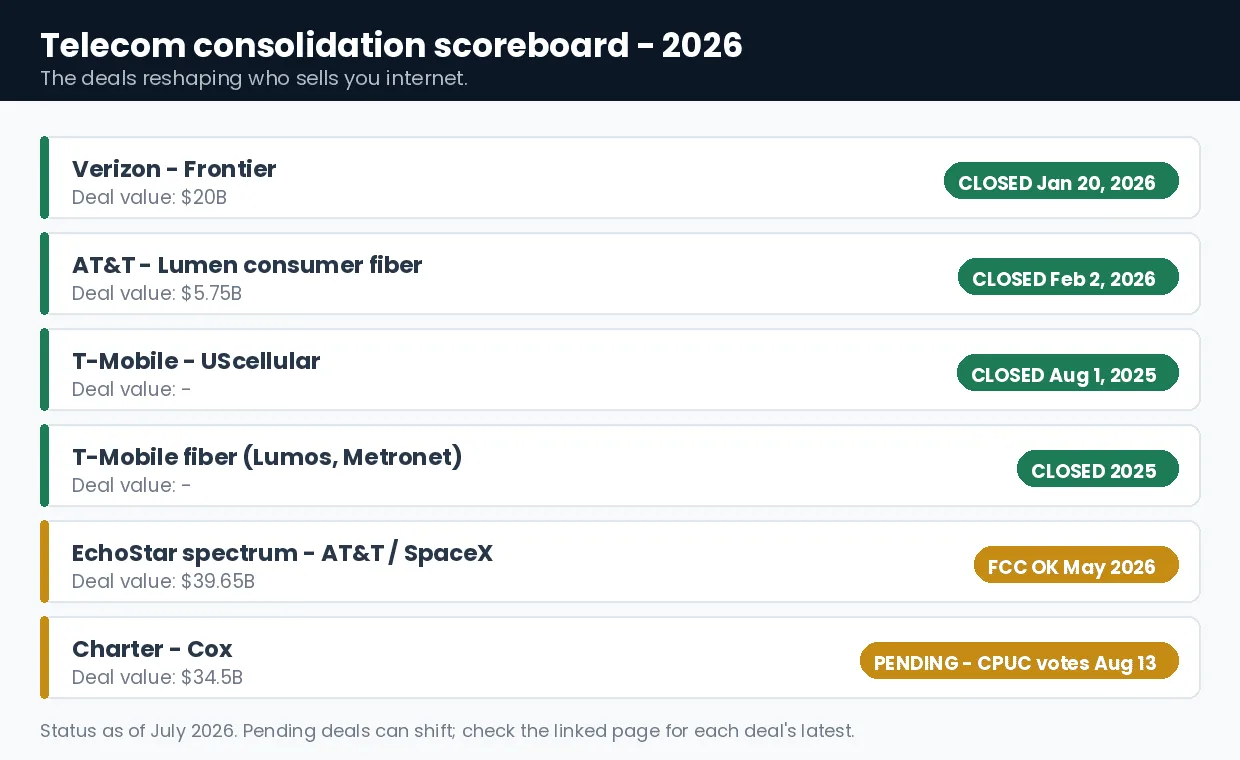
Here is the current state of telecom consolidation affecting U.S. residential customers, newest status first.
| Deal | Value | Status | What it means for you |
|---|---|---|---|
| Verizon – Frontier | $20B | Closed Jan 20, 2026 | Frontier is now a Verizon company; $15/mo mobile + home discount available |
| AT&T – Lumen consumer fiber | $5.75B | Closed Feb 2, 2026 | Quantum Fiber became AT&T; copper DSL stayed with Lumen |
| T-Mobile – UScellular | — | Closed Aug 1, 2025 | 4M+ wireless customers moved to T-Mobile |
| T-Mobile fiber (Lumos, Metronet) | Joint ventures | Closed 2025 | ~810K fiber customers under T-Mobile’s fiber arm |
| EchoStar spectrum – AT&T & SpaceX | $22.65B + $17B | FCC approved May 2026 | Boost continues via an AT&T MVNO; more direct-to-cell capacity |
| Stonepeak/Alphabet – GFiber + Astound | Undisclosed | Announced Mar 11, 2026 — expected Q4 2026 | Creates a ~7.1M-location independent provider; nothing changes yet |
| Charter – Cox | $34.5B enterprise value (~$21.9B equity) | Closed Aug 20, 2026 | Cox is now Spectrum; Spectrum pricing, packaging and branding launch in former Cox markets mid-September 2026. No data caps, no contracts, modem included. |
| Cable One – Mega Broadband (Vyve) | ~$475–495M for remaining 55% | Announced 2026 — expected Oct 1, 2026 | Full ownership of a rural broadband platform |
| BCE (Bell Canada) – Ziply Fiber | US$3.65B | Closed Aug 1, 2025 | Ziply runs as a separate unit; Bell enters the U.S. fiber market |
| Clearwave (Clearwave Fiber + Point Broadband) – Visionary Broadband | Undisclosed | Announced Sep 8, 2026 — pending close | Independent fiber platform across 17 states and ~700K homes and businesses; adds Wyoming, Colorado, Montana, New Mexico and Washington to Clearwave’s Southeast and Midwest footprint. No plan or price changes until closing. |
Why is telecom consolidation happening now?
Because fiber is expensive to build and comparatively cheap to buy. Trenching a new neighborhood costs thousands of dollars per home and takes years to earn back. Buying a company that already trenched those neighborhoods converts that timeline into a single transaction.
Three forces are compounding it. First, wireless carriers need fixed-line revenue as phone growth flattens, which is why Verizon, AT&T, and T-Mobile are all buying wireline assets. Second, mid-size regional providers built fiber with private capital that now wants an exit. Third, bundling economics reward scale — a company that sells you both wireless and home internet can discount one to keep the other, which is exactly the lever Verizon and AT&T pulled immediately after closing.
The result is that telecom consolidation is not a series of unrelated deals. It is one strategy executed by four companies at the same time.
What actually changes for customers after a merger?
Across every deal we have tracked, the sequence is remarkably consistent — and it is slower than people expect:
- Close. Ownership changes on a single day. Nothing about your service changes.
- Bundle offers appear. The buyer’s first move is cross-selling — wireless discounts, usually within weeks.
- Billing migrates. This is the one that matters. Your account moves to the buyer’s platform and pricing book.
- Portals and apps switch. Logins, support numbers, and email domains change over.
- The brand retires. Signage last, often a year or more after close.
If you take one thing from this page: watch step three, not step five. The logo change is cosmetic. The billing migration is when promotional rates, equipment fees, and renewal pricing get re-papered under the new owner’s terms. That is where telecom consolidation reaches your wallet.
Does telecom consolidation mean higher prices?
Not automatically, and it is worth being precise here rather than cynical. Scale genuinely can lower costs, and the bundle discounts that followed the Verizon and AT&T deals are real money for households that wanted wireless anyway.
The concern is structural rather than conspiratorial: consolidation removes the mid-size competitors who priced aggressively to win share. When Frontier, Cox, Metronet, and Quantum Fiber were independent, they had reason to undercut the nationals. Folded in, they do not. Meanwhile, according to the FCC’s national broadband map, most U.S. addresses still have only two or three wired providers — so consolidation is subtracting from an already short list.
Separately, 2026 has seen broad price increases that are not merger-driven at all. We break those out in our guide to why internet prices are rising in 2026, because conflating the two leads people to blame the wrong thing.
What should you do about it?
- Find your renewal date. It matters more than the merger date. Set a reminder 30 days ahead.
- Take the bundle if you were already buying the other service. Do not add a line just to chase a discount.
- Keep legacy pricing. Grandfathered and price-for-life rates are usually honored — do not trade one away for a short promo.
- Check for early termination fees. Several of these providers have none, which makes switching low-risk.
- Re-check your address annually. Buildouts and fixed wireless change what is available faster than most people assume.
Not sure who serves your address anymore?
After this much consolidation, the provider list at your home may look nothing like it did two years ago. Enter your ZIP or address to see fiber, cable, and 5G plans side by side on price and speed.
Compare providers at my address →Who reviews these deals before they close?
No amount of telecom consolidation happens by private agreement alone. Every deal on the scoreboard above passed through, or is still sitting inside, three layers of review.
- Federal antitrust. The Department of Justice Antitrust Division assesses whether a transaction meaningfully reduces competition. Clearance often carries a deadline — Charter and Cox are working against a September 15 expiry right now.
- The FCC. Licenses and authorizations cannot simply transfer; the commission must find the transfer serves the public interest, and it regularly attaches conditions. It required AT&T to accelerate a 600 MHz deployment and required EchoStar to fund a $2.4 billion escrow.
- State commissions. This is where deals actually stall. A single state — California, in the Charter–Cox case — can hold up a $34.5 billion transaction for months after every federal body has signed off.
Those conditions are the main channel through which telecom consolidation produces consumer benefits rather than only consumer costs. They are worth reading when a deal near you closes, because they are enforceable in a way that press-release promises are not.
How many providers do you actually have?
The answer depends less on how many companies exist than on which ones share your street. We mapped every provider footprint against every other one. The pattern that comes out is not what “consolidation” usually implies.
| Provider | Meets | Shared ZIP codes | Share of the smaller footprint |
|---|---|---|---|
| Spectrum | Verizon (Fios + Frontier) | 11,953 | 73% of Spectrum |
| Xfinity | Verizon (Fios + Frontier) | 5,242 | 83% of Xfinity |
| AT&T | Verizon (Fios + Frontier) | 4,454 | 74% of AT&T |
| AT&T | Spectrum | 3,774 | 63% of AT&T |
| Spectrum | Xfinity | 2,389 | 15% of Spectrum |
| AT&T | Xfinity | 1,554 | 26% of AT&T |
| Cox | Verizon (Fios + Frontier) | 963 | 89% of Cox |
| Astound | Verizon (Fios + Frontier) | 933 | 92% of Astound |
| Optimum | Verizon (Fios + Frontier) | 813 | 71% of Optimum |
Verizon is nearly everyone’s opponent. After absorbing Frontier it covers 21,553 ZIP codes — and it is the company on the other side of the street for 92% of Astound’s footprint, 89% of Cox’s, 83% of Xfinity’s, 74% of AT&T’s and 73% of Spectrum’s. For most households with two wired options, one of them is Verizon.
The cable companies barely meet each other. Spectrum and Xfinity — the two largest cable brands in the country — share just 2,389 ZIP codes, only 15% of Spectrum’s footprint. That is not an accident of consolidation; it is the legacy of franchise areas that were carved up decades ago and never really overlapped. Cable does not compete with cable. Cable competes with the phone company.
Which is why merger news matters more than it looks. When the phone-company side consolidates, it is consolidating the only alternative most cable customers have.
This is the number that determines whether telecom consolidation costs you anything, and most people guess it wrong in both directions. Marketing implies abundant choice; cynicism assumes a monopoly. The truth is usually two or three wired options plus a growing set of wireless ones.
The FCC’s National Broadband Map publishes provider-reported availability down to the individual address. It is the closest thing to an authoritative answer, though it is worth knowing that it reflects what providers claim they can serve, which sometimes runs ahead of what they will actually install on a given street.
Two developments push against the consolidation trend. Fixed wireless from the national carriers has become a legitimate third option in many markets, and satellite service continues to improve for rural addresses with no wired path. Neither replaces fiber for a heavy household, but both add pricing pressure that did not exist five years ago — which is why checking your address annually matters more than tracking which logo owns which network.
FAQ
What is telecom consolidation?
Telecom consolidation is the wave of mergers and acquisitions in which large national carriers buy regional internet and wireless providers. Since 2025 it has included Verizon–Frontier, AT&T–Lumen’s consumer fiber, T-Mobile’s fiber joint ventures and UScellular, and the completed Charter–Cox deal.
Has the Charter–Cox merger closed?
Yes. Charter completed its acquisition of Cox Communications on August 20, 2026, after FCC approval on February 27, 2026 and sign-off from the DOJ, several states, and finally the California Public Utilities Commission. The combined company operates as Spectrum across a 45-state footprint reaching more than 70 million homes. Spectrum pricing, packaging and branding launch in former Cox markets in mid-September 2026.
Will my internet bill go up because of a merger?
Not usually right away. Plans are typically honored at close, and increases tend to appear when your account migrates to the buyer’s billing platform and pricing book, which can take months. Separate industry-wide price increases in 2026 are not merger-driven.
Do I need to do anything when my provider is acquired?
No. You do not need to re-sign, re-verify identity, or accept new terms to keep service running. Treat any urgent message demanding account action because of a merger as a likely phishing attempt.
Does telecom consolidation reduce my choices?
It reduces the number of brands, though usually not the number of wires reaching your home in the short term. The longer-term concern is fewer independent mid-size competitors pricing aggressively against the national carriers.
By the Utility Search Marketplace Team · Last updated September 10, 2026. Deal statuses verified against company announcements and FCC filings. Sources: Charter Communications, Verizon, AT&T, T-Mobile, FCC, and Fierce Network M&A tracking.
Keep going
- Charter–Cox merger: when Cox becomes Spectrum
- Frontier–Verizon merger: what changed for Frontier customers
- AT&T buys Quantum Fiber: what changes for Quantum and CenturyLink customers
- T-Mobile’s acquisitions and its new fiber arm
- Dish Network bankruptcy: what it means for subscribers
- Why internet prices are rising in 2026
- GFiber + Astound: Alphabet sells majority stake to Stonepeak
- EchoStar sells $40B in spectrum to AT&T and SpaceX
- Ziply Fiber under Bell: what the BCE acquisition changed
- Cable One buys all of Vyve Broadband
- Telecom layoffs by company — the SEC-filed headcount numbers behind the industry’s shrinking workforce