
Blog
San Antonio Electricity Rates: Can You Choose a Provider? (2026)

In San Antonio, you can’t choose your electricity provider — CPS Energy, the city-owned municipal utility, serves the whole area. San Antonio electricity rates average about 12.5¢/kWh in 2026, below the Texas statewide average of 17.0¢/kWh (EIA, April 2026). CPS Energy is the largest municipally-owned utility in the U.S., and San Antonio was carved out of Texas deregulation — so there’s no retail plan to shop, but there are real ways to lower your bill. This guide breaks down exactly what makes up your CPS Energy bill and how to trim it.
TL;DR
- No provider choice: CPS Energy is the sole municipal electricity provider — you can’t switch.
- Average rate: ~12.5¢/kWh in 2026, below the 17¢ Texas average.
- Rebates & assistance are how you cut the bill, not shopping.
- You CAN shop internet in San Antonio — that market is deregulated.
Can you choose your electricity provider in San Antonio?
No. San Antonio is served by CPS Energy, a municipal utility owned by the City of San Antonio — and the largest city-owned electric and gas utility in the country. When Texas deregulated in 2002, municipally-owned utilities were allowed to opt out, and CPS Energy did. There’s no Power to Choose marketplace and no retail providers competing for your address; every San Antonio home buys power from CPS Energy at rates the utility and City Council set. It’s the opposite of a deregulated metro like Houston or Dallas, where 100+ providers compete for your business.
How much are San Antonio electricity rates in 2026?
San Antonio electricity rates average roughly 12.5¢/kWh in 2026 — below the Texas statewide blend of 17.0¢/kWh. CPS Energy uses a tiered residential rate with a fixed customer charge plus a fuel adjustment that moves with energy costs. Because the per-kWh price rises with usage, summer cooling drives the biggest bills — making efficiency the most effective way to save. Unlike a deregulated city, you can’t lower San Antonio electricity rates by switching plans; you lower them by using less at the right times.
What’s actually in your CPS Energy bill?
Your CPS Energy bill isn’t a single rate — it’s stacked from several components. Here’s a worked example for a typical 1,000 kWh summer month:
| Line item | What it is | ~Monthly cost (1,000 kWh) |
|---|---|---|
| Customer charge | Fixed monthly service fee — same regardless of usage | ~$9 |
| Tiered energy charge | Per-kWh rate that steps up as you use more | ~$70 |
| Fuel adjustment | Pass-through for fuel & purchased-power costs | ~$30 |
| City & regulatory charges | Riders and municipal service-area fees | ~$16 |
| Total | All-in electricity bill | ~$125 (~12.5¢/kWh) |
The takeaway: the tiered energy charge and the fuel adjustment together drive most of your bill, and both scale with how much you use. That’s different from a deregulated Texas market, where a regulated wires charge is fixed and you shop the energy rate. In San Antonio there’s nothing to shop — so every kWh you avoid, especially in the top tier, comes straight off the total. This is why the most reliable way to influence your San Antonio electricity rates is on the usage side, not the shopping side.
How to lower your CPS Energy bill
You can’t switch providers, but you can shrink the bill in four proven ways. Because San Antonio electricity rates are tiered, every one of these works by keeping your usage — and your tier — lower:
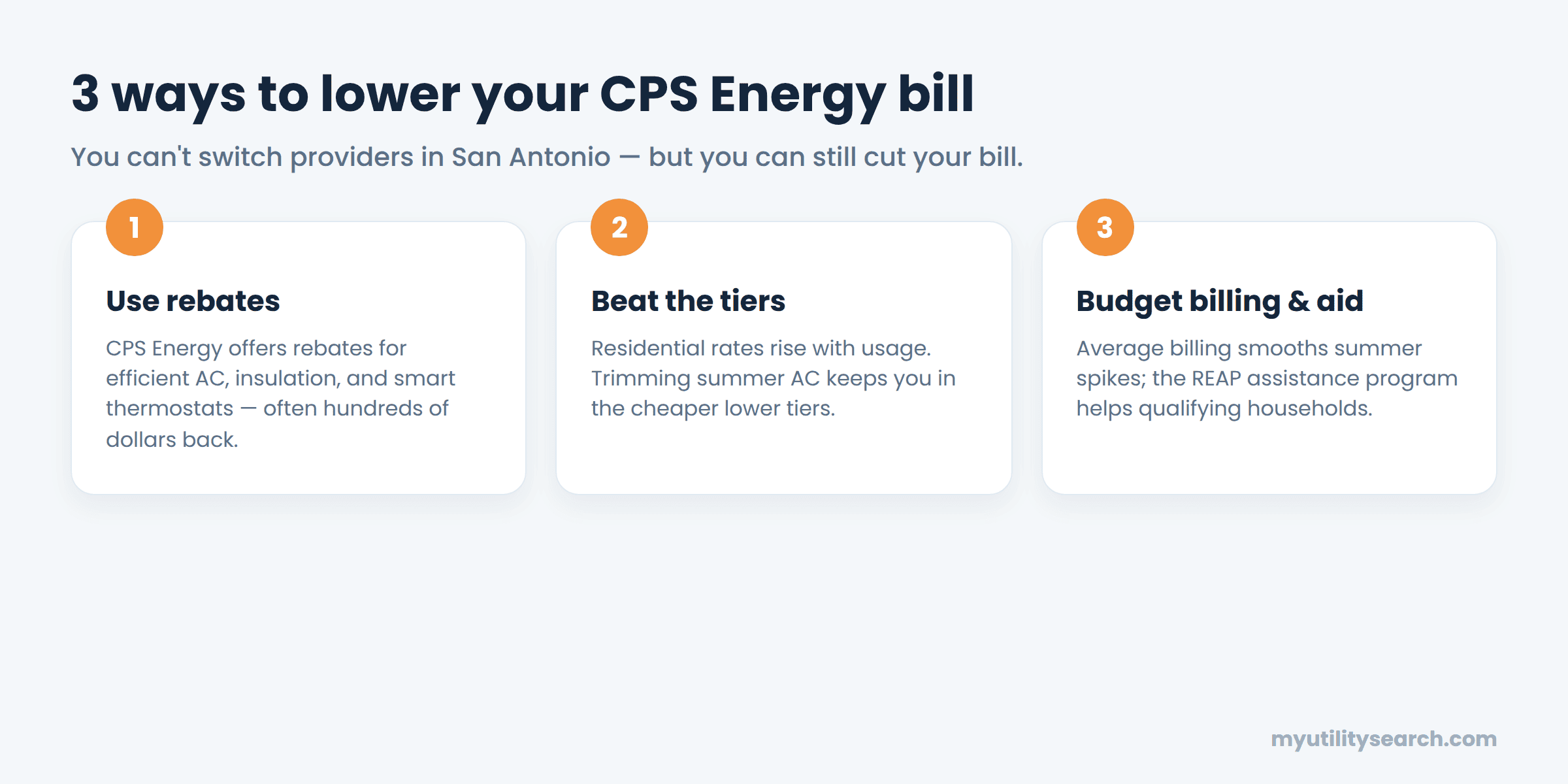
- Claim rebates. CPS Energy offers rebates for efficient AC, insulation, and smart thermostats through its Save for Tomorrow Energy Plan (STEP) — often worth hundreds of dollars, and they cut usage every month afterward.
- Beat the tiers. Rates rise with usage, so trimming peak summer AC keeps more of your kWh in the cheaper tiers. Raising your thermostat a couple of degrees and running major appliances off-peak both help.
- Use budget billing and assistance. Average monthly billing smooths summer spikes, and the Residential Energy Assistance Partnership (REAP) helps qualifying households with bill payment.
- Consider rooftop solar. CPS Energy’s solar rebates and net billing credit the energy your panels produce.
Moving to San Antonio? Setting up electricity
New San Antonio residents set up power directly with CPS Energy — there’s no provider to choose and no plan to compare. Open an account online or by phone with your service address and a start date, ideally a few days before move-in so the power is live when you arrive. A deposit may apply depending on your credit or service history. Because you can’t shop electricity, the smart move on move-in day is to compare the utilities you can shop — internet and home security — both of which are competitive at most San Antonio addresses.
Common misconceptions about San Antonio electricity rates
Two myths cost San Antonio residents time. First, that a “Power to Choose” plan can beat CPS Energy — it can’t, because those retail plans simply don’t serve San Antonio’s municipal territory; sites that show them are pulling deregulated-market listings that don’t apply to your address. Second, that rooftop solar eliminates the bill entirely — the customer charge and fuel adjustment still apply, and solar is credited through net billing rather than one-for-one net metering. Knowing what actually moves San Antonio electricity rates keeps your expectations (and your budget) accurate.
Shop internet in San Antonio
You can’t switch electricity, but you can compare internet providers at your address in minutes.
San Antonio electricity rates: FAQ
Can I switch electricity providers in San Antonio?
No. CPS Energy is a city-owned municipal utility and the only electricity provider in San Antonio. Texas deregulation doesn’t apply here, so there are no retail providers or plans to shop.
Who provides electricity in San Antonio?
CPS Energy, the municipal utility owned by the City of San Antonio and the largest city-owned utility in the U.S., provides both electricity and natural gas to the area.
What is the average electricity rate in San Antonio?
San Antonio electricity rates average about 12.5¢/kWh in 2026, below the Texas statewide average of 17.0¢/kWh (EIA, April 2026). Your bill depends on usage because CPS Energy prices in tiers.
Why is my CPS Energy bill higher in summer?
Because the rate is tiered. Heavy summer AC use pushes more of your kWh into the higher-priced tiers, and the fuel adjustment can rise with energy costs, so the same home pays a higher effective rate in July than in April.
Is San Antonio part of Texas electricity deregulation?
No. San Antonio opted out when Texas deregulated in 2002. Deregulated cities like Houston, Dallas, and Fort Worth let you choose a provider; San Antonio does not — which is why San Antonio electricity rates are set by the city utility rather than shopped on the open market.
How do I lower my CPS Energy bill?
Claim STEP efficiency rebates, cut peak summer usage to stay in lower rate tiers, sign up for average billing, and check the REAP assistance program if you qualify. Rooftop solar can help through CPS Energy’s solar rebates and net billing.
Does CPS Energy offer bill assistance?
Yes. The Residential Energy Assistance Partnership (REAP) helps qualifying households with bill payment, and average monthly billing spreads seasonal spikes evenly across the year.
What can I actually shop for in San Antonio?
Internet and home security are competitive in San Antonio even though electricity isn’t. Comparing internet providers at your address is usually the fastest way to cut a monthly utility bill here.
Keep going
- Texas electricity rates: where you CAN choose a provider
- Austin electricity rates (also municipal — Austin Energy)
- Deregulated energy: which states and cities let you choose
- Houston · Dallas · Fort Worth electricity rates
- Cheapest electricity in Texas: how to find it
- How to switch electricity providers in Texas
Reviewed by the Utility Search Marketplace team. Methodology: rate figures reflect CPS Energy’s published residential tiered rates plus the fuel adjustment; the sample bill is illustrative of typical 1,000 kWh usage. Sources: CPS Energy residential rates and the U.S. Energy Information Administration. Last updated July 2026.