






Blog
Dallas Electricity Rates: Compare Plans, Providers & Switch (2026)


Updated on September 5, 2026
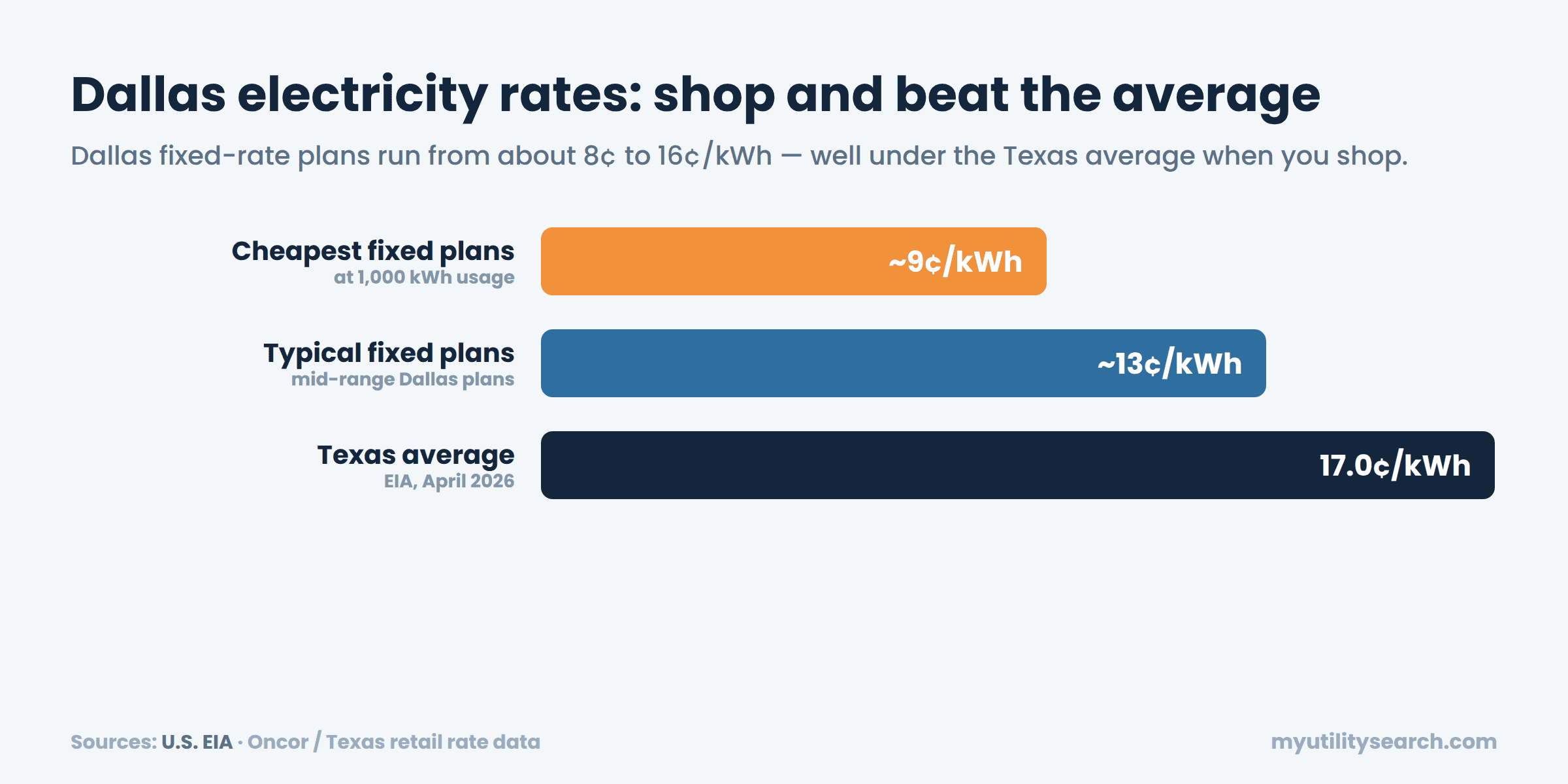
Dallas electricity rates in 2026 generally run from about 8¢ to 16¢/kWh on fixed-rate plans, and the cheapest land near 9¢/kWh at typical usage — well under the Texas statewide average of 17.0¢/kWh (EIA, April 2026). Because Dallas is a deregulated market, you choose your retail electricity provider (REP), while Oncor delivers the power and maintains the lines no matter who you pick. That means the only thing you’re really shopping is the energy rate. This guide breaks down what you actually pay, who the best providers are, and how to lock a low rate.
TL;DR
- Rate range: ~8–16¢/kWh in Dallas; cheapest fixed plans near 9¢/kWh at 1,000 kWh.
- Who delivers it: Oncor — the wires company — regardless of your provider.
- Delivery is over half your bill: Oncor charges $4.06/mo + 6.1196¢/kWh on top of your energy rate.
- How to save: compare 12-month fixed plans by the price at your usage, then switch online in about 10 minutes.
How much are Dallas electricity rates in 2026?
Dallas electricity rates aren’t one number — fixed-rate plans generally price between 8¢ and 16¢/kWh, and what you pay depends heavily on your usage because plans are priced at set tiers. The cheapest fixed plans land around 9¢/kWh at 1,000 kWh a month. That’s why the single most important figure when you shop is the price on the plan’s Electricity Facts Label (EFL) at the usage closest to yours — not the big headline teaser rate.
Even a mid-range Dallas plan sits below the Texas statewide average of 17.0¢/kWh (EIA, April 2026), which has climbed from 15.5¢ in 2025 and 14.9¢ in 2024 — roughly a 14% jump in two years. North Texas rates rise fastest in summer, when heat pushes ERCOT demand to record peaks, so locking a fixed plan before June is the simplest protection against the next spike.
What’s actually in your Dallas electricity bill?
Your bill has two parts, and understanding the split is the key to reading Dallas electricity rates correctly. Here’s a worked example for a typical 1,000 kWh month on a competitive ~11¢/kWh all-in plan:
| Line item | What it is | ~Monthly cost (1,000 kWh) |
|---|---|---|
| Energy charge | Set by your Retail Electric Provider — the part you shop | ~$45 |
| Oncor delivery | $4.06 base + 6.1196¢/kWh — regulated, same for everyone | ~$65 |
| Total | All-in electricity bill | ~$110 (11¢/kWh) |
The takeaway: at typical usage, Oncor’s delivery charge is more than half your bill — and it’s the same no matter which provider you choose. Oncor’s per-kWh delivery is actually higher than Houston’s CenterPoint, so it makes up an even bigger share of a Dallas bill. That means the only lever you control is the energy rate, and comparing plans purely on the advertised energy rate understates your true cost by about 6¢/kWh.
Who delivers electricity in Dallas?
Oncor is Dallas’s Transmission and Distribution Utility (TDU) — the regulated wires company that owns the poles and lines, restores outages, and reads your meter. You cannot shop for a different TDU, and Oncor charges every home the same delivery cost: a $4.06 monthly base charge plus 6.1196¢/kWh (effective June 2026). When the power goes out, you call Oncor, not your retailer. What you do shop for is the energy portion — the rate your Retail Electric Provider sets.
Best electricity providers in Dallas
More than 100 PUCT-licensed retail providers compete for Dallas customers on the Oncor grid — one of the most competitive electricity markets in the country. That competition is good for Dallas electricity rates, but it also makes shopping noisy. Here’s how the most established names line up; tap any provider for our full review.
| Provider | Plan style | Typical contract | Best for |
|---|---|---|---|
| TXU Energy | Fixed-rate + free nights/weekends options | 12–36 mo | Big-name reliability, bill-credit plans |
| Reliant | Fixed with flexible add-ons | 12–24 mo | Bundles and satisfaction guarantees |
| Gexa Energy | Low-cost fixed, 100% green options | 12–24 mo | Value-focused fixed rates |
| Rhythm Energy | 100% renewable fixed plans | 12–24 mo | Green energy without a premium |
| Green Mountain | 100% renewable | 12–36 mo | Texas’s longest-running green provider |
| 4Change Energy | Low fixed rates + charitable giving | 12–24 mo | Budget-minded households |
| Champion Energy | Straightforward fixed rates | 12–24 mo | Top-rated customer service |
| Frontier Utilities | Competitive fixed rates | 12–36 mo | Lowest advertised rates |
How to switch electricity providers in Dallas
Switching takes about 10 minutes and there’s no fee to leave once your contract is up (watch for early-termination fees if you switch mid-contract). The process is entirely paperwork — nothing changes physically at your home.
- Grab a recent bill. Note your monthly kWh usage — it’s the number that decides which plan is actually cheapest for you.
- Compare by the EFL price at your usage. Look at the price per kWh at 1,000 or 2,000 kWh, whichever matches your home, on Power to Choose or here.
- Pick a fixed-rate plan and enroll online. A 12-month fixed rate protects you from summer spikes; many plans need no deposit if you qualify.
- Let your new provider handle the switch. Oncor keeps delivering power on the same lines — no interruption, no technician, no rewiring. See our full Texas switching guide for details.
When is the best time to lock Dallas electricity rates?
Timing matters. Wholesale power prices in ERCOT climb through late spring and peak in summer, and retail fixed-rate offers tend to follow. The cheapest Dallas electricity rates usually appear in the fall and winter shoulder months, when demand is low. If your contract ends in summer, it’s often worth locking a new 12-month fixed plan a few weeks early rather than rolling onto a month-to-month variable rate during peak season — variable rates can jump sharply with no cap. A calendar reminder 30 days before your contract expires is the simplest way to avoid an expensive default rate.
Moving to Dallas? Setting up electricity
New Dallas residents set up power by choosing a Retail Electric Provider and giving them the service address and a start date — there’s no separate step with Oncor. Order service a few days before move-in so it’s live when you arrive. If you’re establishing credit or want to skip an upfront deposit, a prepaid or no-deposit plan can start same-day. Because internet is deregulated everywhere, it’s worth comparing internet providers at the same time you set up power.
Common mistakes when shopping Dallas electricity rates
Three traps cost Dallas shoppers the most. First, comparing the teaser rate instead of the EFL price at your usage — a plan that’s cheap at 2,000 kWh can be expensive at 800. Second, bill-credit plans: a $100 credit that only applies at exactly 1,000 kWh isn’t a deal if you use 700. Third, rolling onto a variable rate when a contract ends — those rates can climb with no ceiling. Reading the EFL and locking a fixed term sidesteps all three.
Compare Dallas electricity plans
Enter your ZIP to see live Dallas rates and lock a low 12-month fixed plan in minutes.
Dallas electricity rates: FAQ
Is Dallas electricity deregulated?
Yes. Dallas is part of the ERCOT deregulated market, so you choose your retail electricity provider and plan. Oncor still delivers the power on regulated lines — deregulation only affects who sells you the energy, not who maintains the grid.
What is the average electricity rate in Dallas?
Dallas fixed-rate plans generally run from about 8¢ to 16¢/kWh in 2026, with the cheapest near 9¢/kWh at 1,000 kWh — below the Texas statewide average of 17.0¢/kWh (EIA, April 2026). Shopping keeps your Dallas electricity rates at the low end.
Who has the cheapest electricity in Dallas?
There’s no single cheapest provider — the lowest rate depends on your usage. Retailers like Frontier, Gexa, and 4Change often post the lowest fixed rates, but the genuinely cheapest plan for you is the one with the lowest EFL price at your usage level.
Who delivers electricity in Dallas?
Oncor is the Transmission and Distribution Utility for Dallas. It owns the poles and wires, restores outages, and reads your meter regardless of which retail provider you sign up with.
How much is the Oncor delivery charge?
Oncor charges a $4.06 monthly base charge plus 6.1196¢/kWh for delivery. At 1,000 kWh that’s about $65 — more than half a typical Dallas electricity bill — and it’s the same no matter which retail provider you choose.
How do I switch electricity providers in Dallas?
Compare plans by the price at your usage level, pick a fixed-rate plan, and enroll online. Your new provider notifies Oncor and schedules the switch, usually on your next meter read. See our step-by-step Texas switching guide.
Will my power be shut off when I switch?
No. Switching retail providers is a paperwork change on the same Oncor grid. Your electricity keeps flowing with no interruption, no new equipment, and no visit from a technician.
When are Dallas electricity rates cheapest?
Usually in the fall and winter shoulder months, when demand and wholesale prices are lowest. Locking a 12-month fixed plan then, rather than during the summer peak, tends to secure the best Dallas electricity rates.
Keep going
- Texas electricity rates: compare by city & provider
- Cheapest electricity in Texas: how to find it
- Houston · Fort Worth · Austin electricity rates
- No-deposit electricity in Texas: best light companies
- How to switch electricity providers in Texas
- Deregulated energy: which states let you choose
- Provider reviews: Gexa · Rhythm · TXU · Reliant
Reviewed by the Utility Search Marketplace team. Methodology: rate figures reflect typical shopped 12-month fixed plans on the Oncor grid; delivery charges are Oncor’s published TDU rates. Sources: U.S. Energy Information Administration and the PUCT’s Power to Choose marketplace. Last updated July 2026.










One thought on “Dallas Electricity Rates: Compare Plans, Providers & Switch (2026)”