Blog
Texas Electricity Demand Is Set to Nearly Double by 2032 — Why We’d Lock a Rate Now


Updated on September 5, 2026
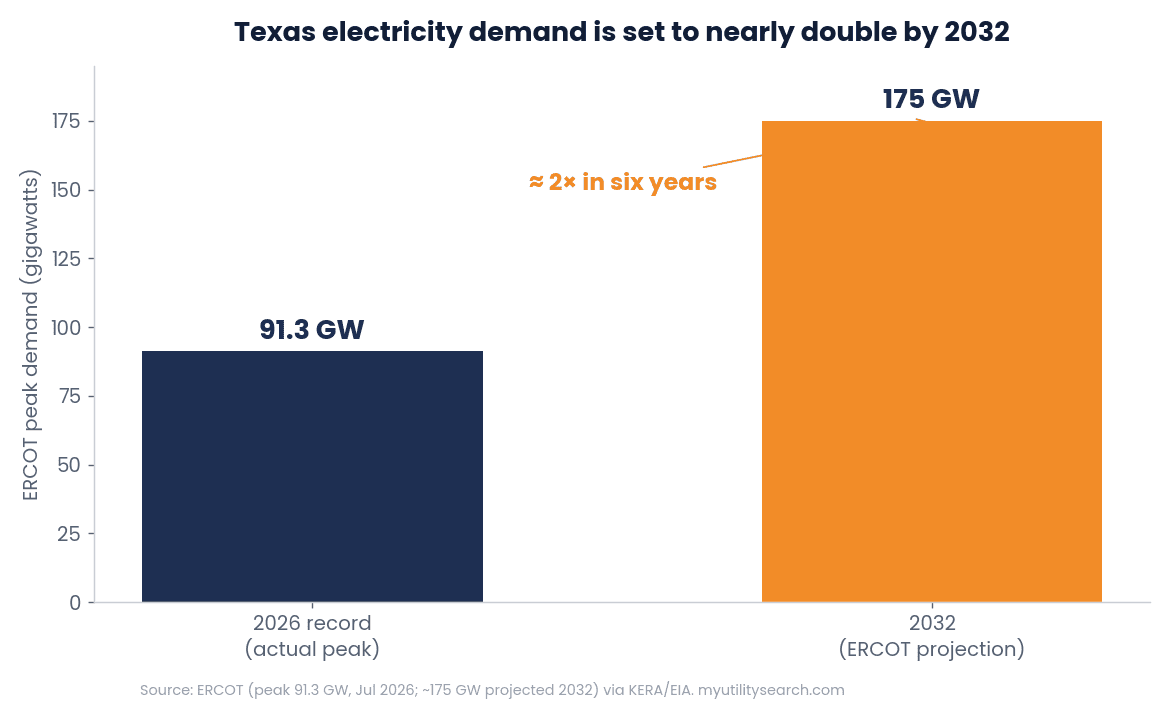
Texas electricity demand is on track to nearly double by 2032, and that is the single most important number for anyone paying a power bill in the state. ERCOT’s grid set a record 91.3 gigawatts in July 2026 and is projected to hit roughly 175 gigawatts by 2032 — driven by a surge of data centers layered on top of the fastest population growth in the country. Our position: if you live in deregulated Texas, this is the time to lock a fixed-rate plan, before demand-driven price pressure builds.
How we make money: MyUtilitySearch is a utility marketplace and may earn a commission when a Texan shops electricity through us. We only benefit if you find a better plan — so these figures come straight from ERCOT, the EIA, and Texas demographers.
Our take on Texas electricity demand
- The trend: ERCOT peak demand near-doubling by 2032 (91 → ~175 GW), led by data centers and population growth.
- The consequence: building for that demand means rising bills for ratepayers.
- Our recommendation: in deregulated Texas, lock a fixed-rate plan now; in municipal cities, focus on efficiency.
How fast Texas is really growing
Texas passed 31.7 million residents in 2025 and is climbing past 32 million in 2026, having added more than 390,000 people in a single year — more than double the national growth rate and the largest gain of any state. Demographers at Texas 2036 project the state could reach 36 to 44 million by 2060. Crucially for the grid, roughly 87% of Texans live in the Dallas–Fort Worth, Austin, San Antonio, and Houston triangle, so nearly all of that growth lands on a handful of metro grids at once.
That growth is powered mainly by domestic migration from the Midwest and Northeast, meaningful international migration in border metros, and a rising natural increase — the 65-and-older group alone is projected to grow more than 88% by 2050. Each of those newcomers and households adds steady residential electricity load on top of the industrial surge, which is why Texas electricity demand keeps setting records.
Why Texas electricity demand is about to double
Population is only half the story. The bigger accelerant is the wave of data centers and AI/crypto facilities racing to plug into ERCOT, alongside broader industrial expansion and brutal summer peaks. Put together, the EIA expects Texas electricity demand to grow 7% in 2025 and 14% in 2026, and ERCOT’s own forecast has peak demand nearly doubling within six years. There is no version of that curve that leaves prices untouched.
What doubling demand does to your bill
Meeting Texas electricity demand of ~175 GW means building an enormous amount of new generation, storage, and transmission — and utilities recover those costs from customers. Researchers at Texas A&M’s Private Enterprise Research Center describe the new era plainly as larger loads and rising bills. Add the summer scarcity spikes that ERCOT’s market is built around, and the direction of travel for Texas power prices is up. The question isn’t whether costs rise; it’s whether you’re locked in when they do.
The Texas advantage: most of you can actually shop
Here is the good news, and it is genuinely a Texas advantage. Most of the state sits in the deregulated ERCOT retail market — the most competitive in the nation — which means you can choose your supplier and lock a fixed rate instead of riding the market. That is a lever Texans have that customers in most states simply don’t. The exceptions are municipal-utility cities: Austin (Austin Energy), San Antonio (CPS Energy), and El Paso (El Paso Electric), plus some co-ops, where you can’t switch and efficiency is the only lever.
| If you live in… | Can you shop? | Your move as demand rises |
|---|---|---|
| Deregulated Texas (Houston, Dallas–Fort Worth, most metros) | Yes | Lock a competitive fixed-rate plan now |
| Municipal cities (Austin, San Antonio, El Paso) | No | Focus on efficiency, rebates, and usage timing |
Our take: lock a fixed rate before the next demand spike
Our position on Texas electricity demand is straightforward for the deregulated majority: lock a fixed-rate plan now. It converts an unpredictable, rising cost into a fixed line in your budget and takes summer-peak volatility off the table. Here is the short version of how to do it:
- Check your address. Confirm you’re in a deregulated area (most of Texas is; Austin, San Antonio, and El Paso are not).
- Compare fixed-rate plans for your actual monthly usage — not just the teaser rate at 1,000 kWh.
- Lock a term that carries you through at least the next couple of summers, and set a renewal reminder.
Where the growth is concentrated
Because 87% of the population sits in four metros, that is where rising Texas electricity demand shows up first — and where competitive shopping matters most. If you’re in one of the big deregulated markets, start with your city’s rate landscape: Houston, Dallas, and Fort Worth are all fully shoppable, while Austin and San Antonio are municipal.
Texas electricity demand FAQ
Why is Texas electricity demand rising so fast?
Three forces at once: explosive population growth (Texas added more than 390,000 people in 2025, over twice the U.S. rate), a massive influx of data centers, and a booming, electrifying economy — all straining the ERCOT grid. The EIA expects ERCOT demand to grow 7% in 2025 and 14% in 2026.
Will Texas electricity demand really double by 2032?
ERCOT projects peak demand could reach roughly 175,000 megawatts by 2032, up from a record 91,308 MW set in July 2026 — a near-doubling in about six years. Data centers are the single biggest driver, on top of population growth.
Does higher Texas electricity demand mean higher bills?
Generally yes. Meeting doubling demand requires enormous investment in new generation and transmission, and those costs are recovered from ratepayers. Analysts at Texas A&M’s PERC have framed the new phase bluntly as larger loads and rising bills.
Can I shop for a cheaper electricity plan in Texas?
In most of Texas, yes — the state runs the most competitive retail electricity market in the country, so you can choose your supplier and lock a fixed rate. The exceptions are municipal-utility cities like Austin, San Antonio, and El Paso, where you cannot switch.
Should I lock a fixed-rate electricity plan in Texas now?
In our view, most Texans in deregulated areas should. Locking a fixed rate protects you from the price pressure that doubling demand and summer peaks create, and it makes your budget predictable. Compare offers for your usage before signing.
Which Texas cities cannot switch electricity providers?
Austin (Austin Energy), San Antonio (CPS Energy), and El Paso (El Paso Electric), plus various co-op territories, are municipal or regulated and are not part of the deregulated market. There, the lever is efficiency, not switching.
Where in Texas is demand growing the fastest?
The Dallas–Fort Worth, Austin, San Antonio, and Houston metros — the triangle that holds about 87% of the state’s population and most of its new data-center and industrial load.
Do data centers or people drive Texas electricity demand more?
Both matter, but ERCOT and the EIA point to large data centers and crypto/AI facilities as the biggest single accelerant of near-term Texas electricity demand, layered on top of steady population growth and extreme-weather peaks.
The bottom line
Texas electricity demand is set to nearly double by 2032 as data centers and a booming population pile onto the grid, and that pressure points bills in one direction. The deregulated majority of Texans have a real advantage — the ability to lock a fixed rate — and now is the time to use it. Compare plans for your address before the next demand spike does it for you.
Sources & further reading
- U.S. EIA — rapid electricity demand growth in Texas (7% 2025, 14% 2026)
- KERA News — ERCOT demand could double by 2032 (91.3 → ~175 GW)
- Texas 2036 — understanding Texas population growth
- Texas A&M PERC — larger loads, rising bills