Blog
We Got Hit With 38 Spam Backlinks in 14 Days: A Toxic Backlinks Small Website Teardown

By the My Utility Search Team
If you run a toxic backlinks small website cleanup for the first time, the experience is unsettling — links you never asked for, appearing overnight, from domains you’ve never heard of. That’s exactly what happened to My Utility Search in May 2026, and rather than panic, we treated it as a case study. Here is the full forensic breakdown of what landed on the site, how we read the data, and the boring, correct response that any small-site owner can copy.
The short version: a flood of toxic backlinks looks alarming and almost never is. But knowing how to read it — and when to act — is the difference between wasted worry and a five-minute fix.
What actually landed on the site
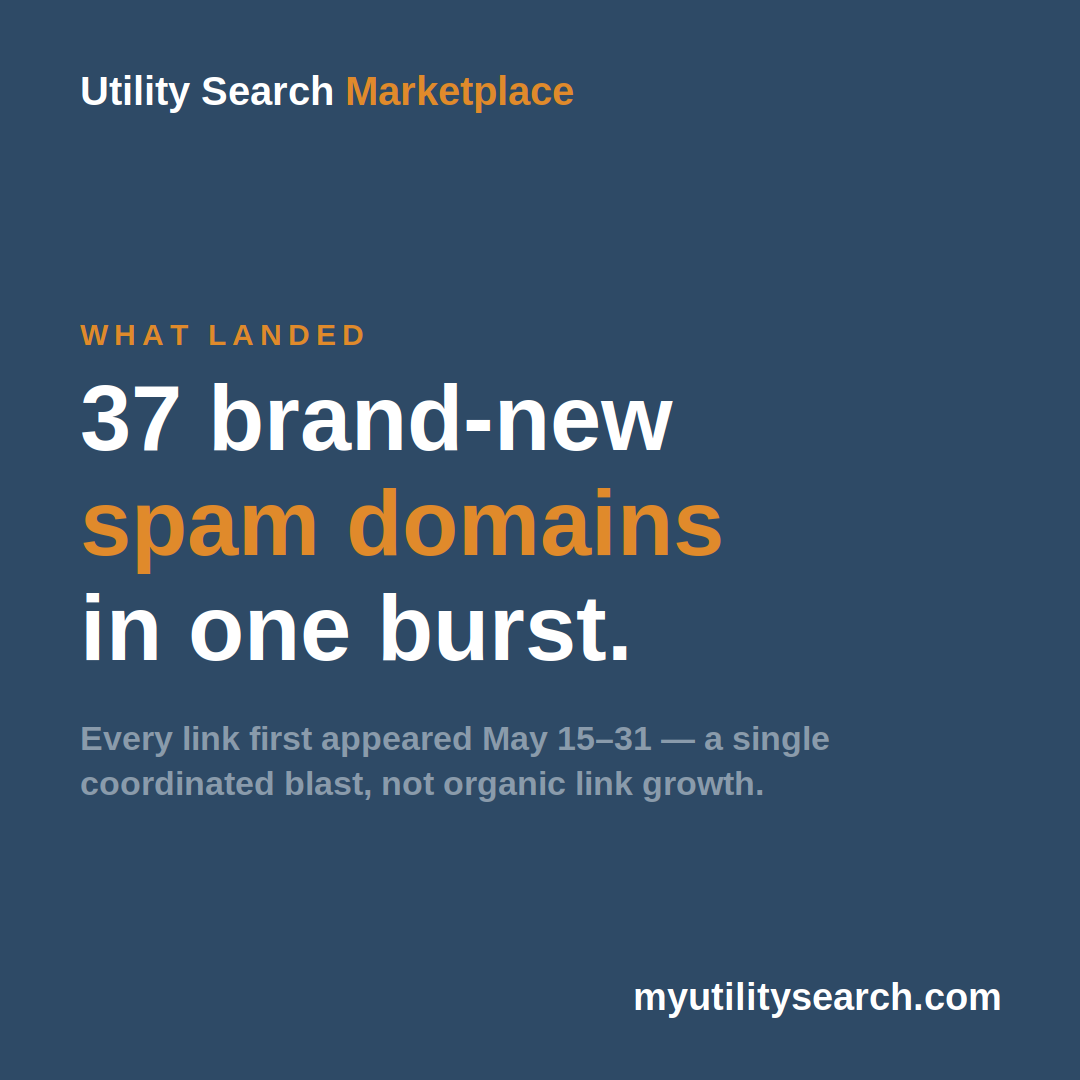
Our toxic backlinks small website incident began quietly. Over a two-week window in May, My Utility Search picked up 38 backlinks from 37 brand-new referring domains. None came from energy publications, local directories, or anything resembling a real publisher. They came from link farms with names that advertise exactly what they are: buyseobacklinks.shop, pbnseolinks.shop, authoritybacklinks.shop, and a cluster of eight near-identical domains all beginning with itxoft- that appeared within days of one another.
The timing was the first tell. Legitimate links accumulate slowly, from unrelated sources, over months. These all carried a first-seen date between May 15 and May 31 — a single coordinated burst, not organic link growth.
How we read the Ahrefs data
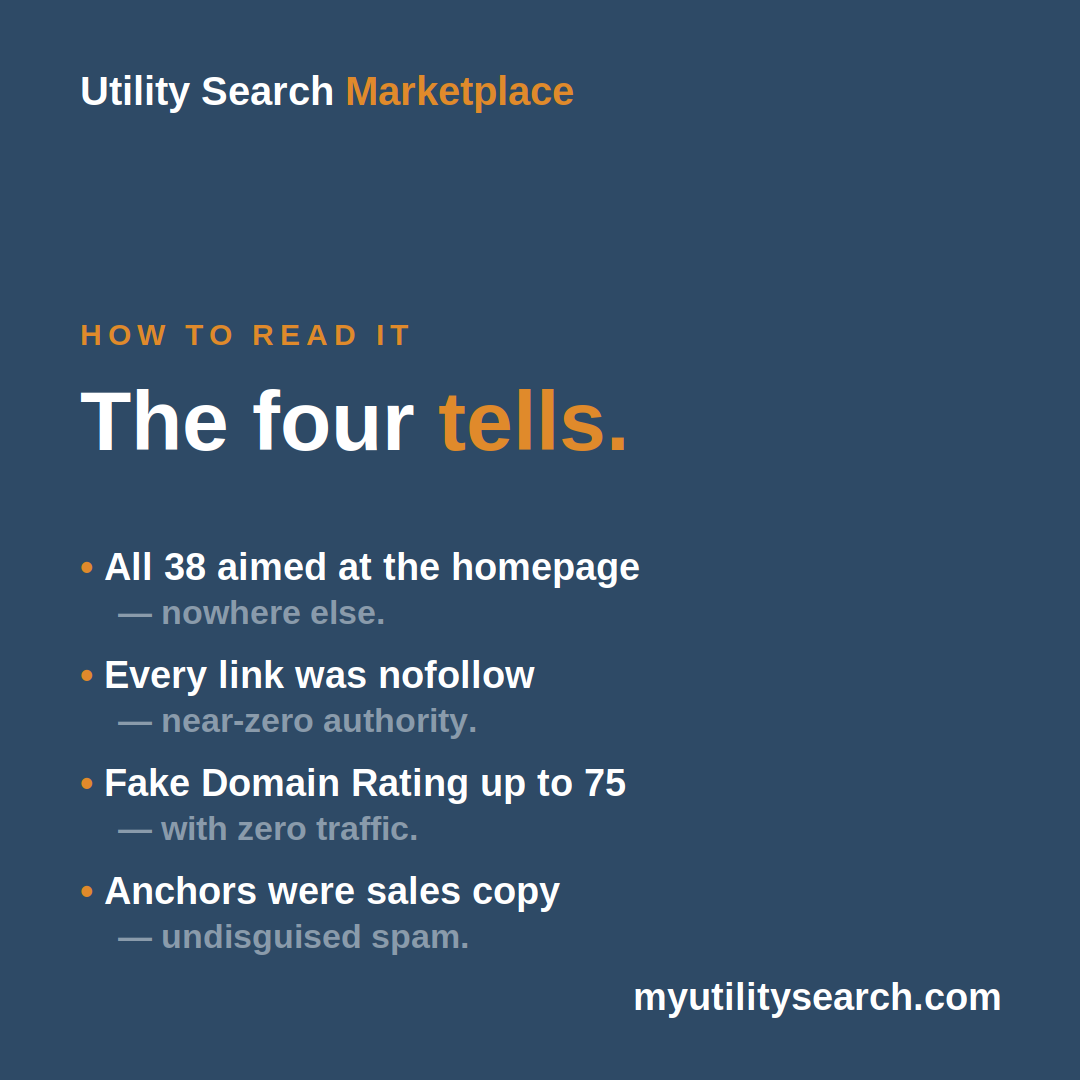
We pulled the referring-domains and page-level backlink reports in Ahrefs and the pattern was unmistakable across four signals.
| Signal | What we found | Why it matters |
|---|---|---|
| Link target | All 38 pointed at the homepage, nowhere else | Real links land on many pages; a single target is an automated tell |
| Follow status | Every link was nofollow | Nofollow links pass little to no ranking authority |
| Domain Rating vs traffic | Source domains showed DR as high as 75 with zero organic traffic and zero keywords | Inflated DR with no traffic is the signature of a private link network cross-linking itself |
| Anchor text | Links advertised the service in the anchor itself | These weren’t disguised — a sign of low-effort spray, not a targeted attack |
That last signal is worth dwelling on. The anchor text wasn’t hidden or made to look natural. It read like sales copy — “Premium SEO Authority Links to Rank Higher” — and in several cases the link farms used our own domain as a fake testimonial on their sales pages, with anchors like “How myutilitysearch.com Maxed Out SeoDaro.com Benefits.”
Attack, or cheap gig?
There are two plausible explanations for a toxic backlinks small website event like this, and the anchor text helped us rule between them.
The first is a deliberate negative-SEO attack by a competitor. Those tend to be sophisticated: hidden anchors, links pointed at deep pages, anchor text engineered to look like over-optimization Google would punish. We saw none of that.
The second — and far more likely here — is a low-effort link-farm spray, the kind generated by a cheap “rank my site fast” gig or by farms scraping domain names to manufacture fake social proof. The undisguised sales-copy anchors and the single homepage target both point squarely at this. The clincher: the entire itxoft cluster self-destructed on its own, with all eight links showing a lost date by May 31 — roughly two weeks after they appeared. Classic churn-and-burn.
The boring, correct response
Here is the part worth copying. Our response to the toxic backlinks small website problem was deliberately unglamorous, and that is exactly why it works.
First, document the baseline. Export the referring-domains report so you have a dated snapshot to compare against.
Second, build a domain-level disavow file. For clear-cut spam, disavow at the domain level — one line per domain, formatted as domain:example.shop — rather than listing individual URLs. This tells Google to ignore every link from that source, following Google’s own spam policies.
Third, submit it in Google Search Console under the correct property, then add the new blog URL to Search Console so the page itself gets indexed and tracked.
Fourth, re-pull the report weekly for a month. If the spam tapers off, it was a one-time burst and you can largely forget it. If it keeps growing, you have an active campaign and the disavow file becomes a living document.
Why you usually shouldn’t panic
The most important thing to understand about a toxic backlinks small website scare is that Google has been discounting obvious spam automatically for over a decade. Its systems were built to ignore manipulative links far more often than to penalize the sites they point at. Google’s own guidance now states that most sites never need a disavow file at all, because the algorithm simply doesn’t count the junk.
So why did we disavow this toxic backlinks small website spike anyway? Because My Utility Search is a young site whose entire backlink profile was, at that moment, spam — there were essentially zero legitimate referring domains to dilute it. On a site like that, a clean disavow removes any ambiguity and costs nothing. On an established site with a healthy link profile, you could reasonably do nothing at all.
What this means for you
If toxic links show up pointing at your small site, don’t panic and don’t reach for your wallet. The same link-selling economy that sprays spam at sites like ours is also happy to sell you a “cleanup” you almost certainly don’t need.
Do three things instead. Check who is actually linking to you a few times a year, using any backlink tool. Keep a disavow file ready for the genuinely clear-cut cases, disavowed at the domain level. And spend the real energy on offense — earning a handful of legitimate links from real publications and local sources — because a healthy link profile — the kind that powers a real comparison site like My Utility Search — makes the occasional spam blast irrelevant. The junk tends to clean up after itself; the legitimate links are the only ones that ever mattered.
FAQ
What are toxic backlinks on a small website?
Toxic backlinks are links from spam domains, link farms, or private blog networks that exist only to manipulate rankings. On a small website they stand out because they often arrive in a sudden burst from brand-new domains with inflated Domain Ratings but no real traffic, frequently all pointing at the homepage.
Do toxic backlinks hurt a small website’s Google rankings?
Usually not. Google has discounted obvious spam links automatically for over a decade and ignores them far more often than it penalizes the target site. The main exceptions are sophisticated, sustained negative-SEO campaigns, which look very different from cheap automated sprays.
Should I disavow toxic backlinks?
For most established sites, no — Google ignores the junk on its own. Disavowing makes sense when the spam is clear-cut and your site is young with few legitimate links, where a domain-level disavow file removes any ambiguity at no cost. Never alter facts or pay for a cleanup service you don’t need.
How do I disavow spam backlinks in Google Search Console?
Build a plain-text disavow file with one line per spam domain in the format domain:example.shop, then submit it through the disavow tool in Google Search Console under the correct property. Keep the file as a living document and re-check your backlink profile periodically.
How often should a small website check its backlink profile?
A few times a year is enough for most small sites, and it is the simplest way to catch a toxic backlinks small website problem early. Pull a referring-domains report, scan for sudden bursts of unfamiliar domains, and keep a dated baseline so you can tell a one-time spam blast from an ongoing campaign.