Blog
Business Electricity: Best Commercial Rates & Costly Traps (2026)


Updated on September 17, 2026
Business electricity is commercial power service — and in a deregulated state, the supply portion is yours to shop. You cannot change who delivers the power, but you can choose the supplier who sets the rate, and for a business that runs a meaningful monthly load, comparing a fixed-rate commercial plan against the utility default is one of the easiest ways to cut a controllable cost. Rates hinge on your usage, your peak demand, and your location, so the right plan is the one matched to how your business actually uses power.
Updated September 17, 2026. Business electricity rates verified against EIA data the same day.
TL;DR — shopping business electricity
- In deregulated states you choose the supplier; the utility still delivers the power and handles outages.
- Commercial bills often include a demand charge based on your peak load, not just total usage.
- A fixed-rate plan protects your budget from seasonal price spikes.
- Compare business electricity on your real usage and contract terms, not just the headline rate.
Compare commercial electricity plans at your address
📞 Prefer to talk? Commercial energy specialist · 866-328-7973
What is business electricity?
Business electricity is the commercial rate class utilities and suppliers use for offices, shops, restaurants, warehouses, and other non-residential accounts. The power itself is identical to what a home receives, but the pricing structure is built for higher and more variable loads. In the 13 deregulated states plus Washington, D.C., business electricity is split into two parts: delivery, which the local utility handles and you cannot shop, and supply, which you can. That supply half is where a business can actually save, because you are free to buy it from a competitive retail supplier instead of taking the utility default.
For a small storefront the savings might be modest, but for a business with a large or steady load — refrigeration, manufacturing, server rooms, long operating hours — the supply rate is a real line item worth managing rather than ignoring.
Can you shop business electricity in your state?
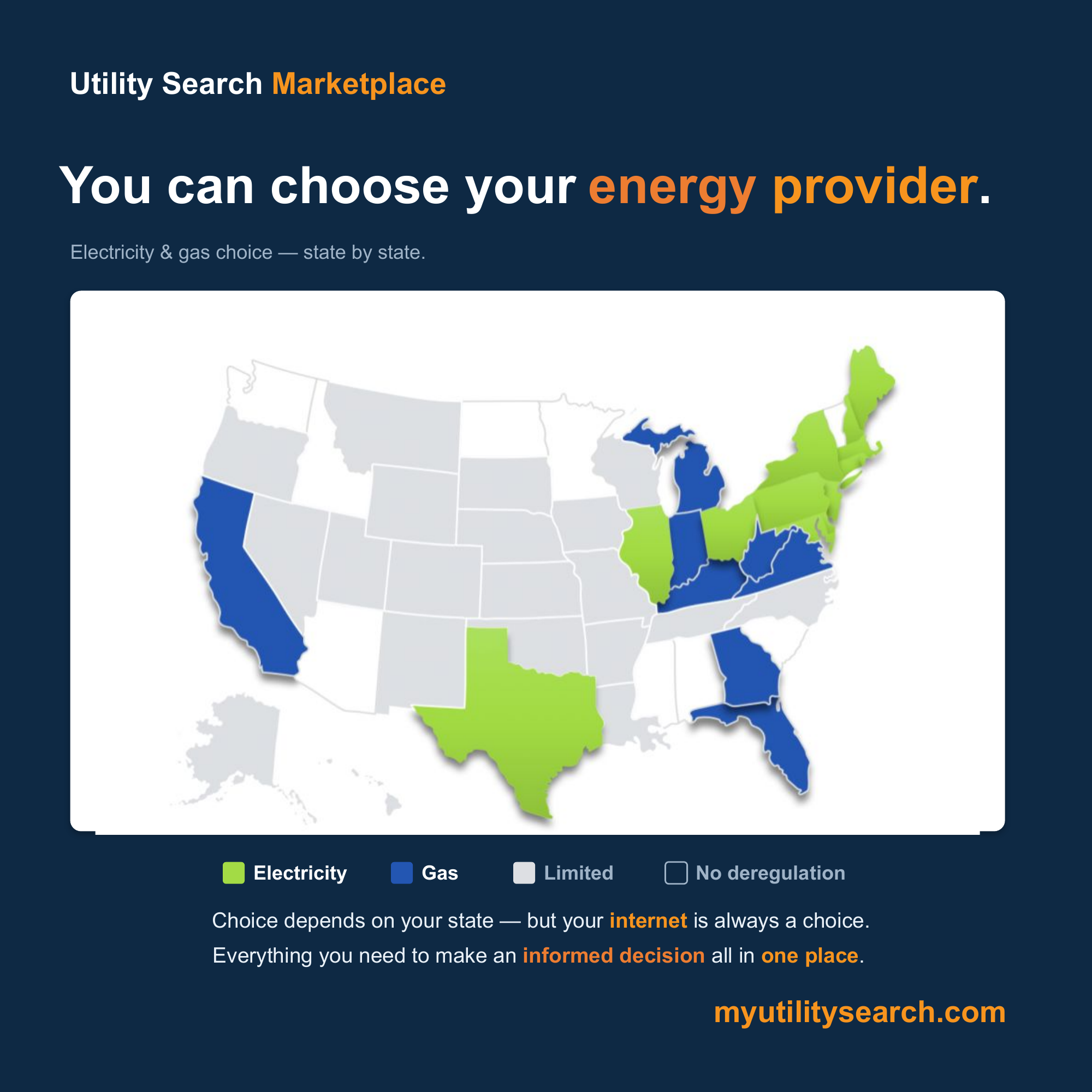
Only in a deregulated market. Thirteen states and Washington, D.C. let commercial customers choose their electricity supplier: Texas, Ohio, Pennsylvania, Illinois, New Jersey, New York, Massachusetts, Connecticut, Maryland, Maine, New Hampshire, Rhode Island, and Delaware. If your business sits in one of those, you can compare commercial suppliers and lock a rate. In a regulated state, the local utility is the only option and the rate is set by regulators — there is nothing to shop, though efficiency still lowers the bill.
Supply vs. delivery: Delivery (the poles, wires, and meter) always belongs to your local utility and appears on every bill. Supply (the actual electricity) is the part deregulation lets a business buy competitively. Shopping means changing the supply rate, not the wires.
How business electricity rates work
Commercial pricing has more moving parts than a home bill. Alongside the per-kilowatt-hour energy charge, many commercial plans add a demand charge based on your highest 15-minute spike of usage in the month, measured in kilowatts. Two businesses that use the same total energy can pay very different amounts if one has sharp peaks and the other runs steady. That is why the cheapest advertised rate is not always the cheapest bill — the plan has to fit your load shape, your contract length, and how predictable you need your costs to be.
Get a commercial electricity quote for your business
Have a recent bill handy. A commercial energy specialist will price your usage and contract options.
What does business electricity cost in 2026?
The national average commercial rate was 14.19 cents per kWh in June 2026, up 4.8% from 13.54 cents a year earlier, according to the U.S. Energy Information Administration. That average hides a huge spread in business electricity prices between states.
Here is what business electricity cost in the deregulated states we cover, using the EIA’s June 2026 figures for commercial customers. These are all-in averages, so they include delivery, not just the supply rate you can shop.
| State | June 2026 (¢/kWh) | June 2025 (¢/kWh) | Change |
|---|---|---|---|
| U.S. average | 14.19 | 13.54 | +4.8% |
| Texas | 8.66 | 8.42 | +2.9% |
| Pennsylvania | 13.33 | 12.37 | +7.8% |
| Ohio | 13.77 | 11.33 | +21.5% |
| Illinois | 14.53 | 12.85 | +13.1% |
| Maryland | 16.84 | 14.82 | +13.6% |
| New Jersey | 18.47 | 18.01 | +2.6% |
| Connecticut | 19.62 | 21.30 | −7.9% |
| New York | 23.56 | 22.00 | +7.1% |
| Massachusetts | 24.52 | 22.97 | +6.7% |
Source: EIA Electric Power Monthly, Table 5.6.A, average commercial price by state. Figures are averages across all commercial customers and will differ from any single quote.

Two things stand out. First, Texas business electricity is still cheap at 8.66 cents, well under the national average. Second, the fastest increases hit the PJM states, with Ohio up 21.5% and Maryland and Illinois both up more than 13% in a single year.

Those PJM increases are why capacity costs matter to a business electricity budget. When the region’s capacity auction clears high, suppliers build it into the next round of quotes. Our PJM capacity auction explainer covers what to expect.
If your business is in one of these states and has not repriced its supply contract since 2024, the market has moved against you. A fresh quote is the only way to know by how much.
What business owners really say: the good and the bad
J.D. Power interviewed 18,132 business customers of 80 U.S. electric utilities between February and October 2025. The results, released November 12, 2025, are the best window we have into how businesses feel about their power.
The bad: prices up, outages everywhere
The average price businesses paid per kWh rose 6.7%. Three in four business electricity customers (74%) had at least one outage during the year, and 25% said an outage cost them money. In the South, the average longest outage ran 22 hours.
That combination is what frustrates owners most. A higher bill is tolerable when service is flawless. A higher bill plus a day of lost sales is not.

The good: businesses are shopping, and it works
More than half of business customers (53%) chose a new rate plan in 2025, up from 43% the year before. Owners are no longer accepting the default. Of those who picked a plan, 39% chose a standard utility plan, 20% a specialty plan and 19% a real-time plan.
The study also found that communication changes everything. Businesses that got five or more updates during an outage rated safety and reliability at 699 on a 1,000-point scale, a 210-point advantage over businesses that heard nothing.
The lesson for anyone shopping business electricity: the supplier sets your rate, but the utility still handles outages. A cheaper supply contract never makes the wires more reliable, so judge the two separately.
How to lower your business electricity bill
There are two levers: the rate you pay and the power you use. On the rate side, compare commercial suppliers against your utility default and consider a fixed-rate term to protect against seasonal spikes; watch the contract length, early-termination terms, and whether the price includes or excludes delivery. On the usage side, flattening your peaks lowers demand charges — staggering equipment startups, upgrading to efficient lighting and HVAC, and shifting heavy loads off peak hours all help. Together, a better supply rate and a flatter demand curve are where most businesses find real savings.
Business electricity vs. residential electricity
The core difference is scale and structure. Residential plans are simple per-kWh rates; business electricity layers in demand charges, higher usage tiers, and contract terms built for commercial loads. A very small business might look a lot like a home account, but as the load grows the demand component and the supply choice become the two numbers worth managing.
Matching a plan to your load profile
The best plan follows how your business actually draws power. A restaurant or grocery runs steady refrigeration around the clock with sharp cooking-hour spikes, so both the supply rate and demand charges matter. An office has a predictable weekday load and benefits most from a fixed rate that steadies the budget. A warehouse or light-manufacturing site with heavy equipment sees large demand charges, so flattening startup peaks can save as much as the rate itself. Retail sits in between, driven mostly by lighting and HVAC hours.
Once you know your load shape, the choice gets simpler: steady, predictable loads reward a longer fixed-rate term, while spiky loads reward active demand management on top of a competitive rate. The point of comparing commercial suppliers is to find the plan that fits that shape rather than the one with the lowest headline number, since the headline rate rarely tells the whole story on a commercial account.
Broker or direct: how businesses actually buy electricity
Most small businesses buy business electricity one of three ways, and each has a catch worth knowing before you sign.
Direct from a supplier
You call or click through to a retail supplier and take their published commercial rate. It is fast, and for a small account with a simple load it is often fine. The catch is that you see one company’s price, and small-business web rates are rarely a supplier’s sharpest offer.
Through a broker
An energy broker collects your usage history, sends it to several suppliers and brings back competing bids. Brokers are paid by the supplier, usually through a small adder built into your rate. That is normal, but you should ask what the adder is, in cents or mils per kWh, and get it in writing. A good broker discloses it without being asked.
Brokers earn their fee on accounts with real load, roughly a few thousand dollars a month in supply and up, where a few tenths of a cent matter. On a tiny account the broker channel adds little because there is little to compete over.
Through a comparison marketplace
Our own model: compare commercial plans at your address on this page, or call the commercial energy line at 866-328-7973 to have an account reviewed. Either way, the goal is the same as a good broker’s, several suppliers competing for your load, without you making six phone calls.
What brokers are telling clients right now
In its August 2026 webinar, Broker Online Exchange, one of the larger U.S. energy broker networks, said it is bullish on locking in longer-term contracts. Its reasoning: growing LNG exports, rising gas burn from data centers, steep production decline rates on existing wells, and forward curves for 2027 through 2032 that it believes are underpriced.
That is one firm’s view of the business electricity market, not a guarantee, and a business with an uncertain lease should not sign five years of anything. But it explains why the quotes you see this fall may favor longer terms, and why a 24- or 36-month offer is worth pricing next to a 12-month one before you dismiss it.
The same webinar pushed a hardware add-on, harmonic filters that a vendor claims cut electricity use 8–12%. We have not verified those savings and do not recommend buying equipment on a webinar claim. Ask for measured before-and-after data from a business like yours.
Whichever route you take, one rule holds. Never sign a business electricity contract without seeing at least two other offers for the same term and the same start month. Rates move weekly, and a quote is only good against other quotes from the same week.
Business electricity contract red flags that cost real money
Commercial supply contracts carry terms that residential plans do not. These five business electricity terms cause most of the expensive surprises we hear about.
- The silent rollover. Many contracts roll to a month-to-month variable rate when the term ends. Pennsylvania’s PUC requires suppliers to send an initial notice 45 to 60 days before expiration and an options notice at least 30 days out, and it warns that customers who do nothing can be left on a variable-rate product that changes monthly. Put the end date on your calendar, not the supplier’s.
- Bandwidth or swing clauses. The fixed rate applies only while your usage stays within a band, often plus or minus 10% to 25% of your historical load. Use more or less, and the excess is billed at market. A business that expands, adds a shift or closes for a season can blow through the band.
- Pass-through language. A “fixed” rate may exclude capacity, transmission or regulatory charges, which the supplier passes through at cost. In PJM states that is where much of the 2025–2026 increase landed. Ask which components are fixed and which float.
- Early termination fees. Some contracts charge a flat fee; others charge liquidated damages equal to the remaining term at market difference. If you might sell, move or close, negotiate the exit terms before you sign.
- Auto-renewal at a new fixed rate. Better than a variable rollover, but the renewal rate is set by the supplier, not by competition. Treat every renewal notice as a new shopping event.
None of these are illegal or even unusual. They are simply the terms that separate a business electricity contract that saves money from one that quietly gives the savings back.
Frequently asked questions
What is business electricity?
It is commercial power service for non-residential accounts. In deregulated states, the supply portion is yours to shop while the utility handles delivery.
Can I choose my business electricity supplier?
Yes, in the 13 deregulated states plus Washington, D.C. Elsewhere the local utility is the only option.
What is a demand charge?
A fee based on your highest short spike of usage in the month, measured in kilowatts. It is why two businesses with the same total usage can pay different bills.
How can a business lower its electricity bill?
Shop a competitive supply rate, consider a fixed-rate term, and flatten your peak demand through efficiency and off-peak scheduling.
Is fixed or variable better?
Fixed protects your budget from seasonal spikes and is often the safer choice; variable can win in a falling market but carries risk.
Does business electricity have a deposit?
Some suppliers require one depending on the business and its credit; many offer no-deposit commercial plans.
Which states have commercial electricity choice?
Texas, Ohio, Pennsylvania, Illinois, New Jersey, New York, Massachusetts, Connecticut, Maryland, Maine, New Hampshire, Rhode Island, Delaware, and Washington, D.C.
Is it cheaper than residential power?
Not necessarily — the structure differs. Businesses can save by shopping the supply rate and managing demand, but demand charges can raise the effective cost.
What happens when my business electricity contract ends?
It depends on the contract. Many roll to a month-to-month variable rate, which can rise sharply in summer or winter. Regulators such as Pennsylvania’s PUC require advance notices, typically 45 to 60 days and then 30 days before expiration, but the responsibility to act is yours. Shop 60 to 90 days before the end date.
Should a small business use an energy broker?
It can help once your supply spend is large enough for competing bids to matter, typically a few thousand dollars a month or more. Ask the broker to disclose their fee per kWh in writing and to show you every bid, not just the winner. For a very small account, comparing plans directly is usually enough.
What is a bandwidth or swing clause in a business electricity contract?
It is the usage range within which your fixed rate applies, commonly plus or minus 10% to 25% of your historical load. Usage outside that band is billed at the market rate. If you plan to expand, add equipment or reduce hours, ask for a wider band or a contract without one.
How long a term should a business lock in?
Twelve to 36 months is common. Longer terms buy certainty and often a better rate when the market is low, but they carry early termination risk if your plans change. Match the term to how confident you are in your location and load for that period, and price two or three terms side by side before choosing.
Get a commercial electricity quote for your business
Have a recent bill handy. A commercial energy specialist will price your usage and contract options.
Keep going
- Commercial electricity rates by state — all 50 states ranked with the latest EIA data
- How to compare energy plans and save money
- Average electric bill by state and home size
- Columbus electricity rates & price to compare
- No-deposit electricity in Texas
- Green energy plans explained
Commercial electricity price data: U.S. Energy Information Administration.
Sources
- U.S. Energy Information Administration, Electric Power Monthly, Table 5.6.A, average price of electricity to commercial customers by state, June 2026 — eia.gov
- J.D. Power, 2025 Electric Utility Business Customer Satisfaction Study, November 12, 2025 — jdpower.com
- Pennsylvania Public Utility Commission, end-of-contract notice guidance, April 26, 2023 — puc.pa.gov
- Broker Online Exchange, August 2026 webinar “The hidden energy loss and how to fix it” — youtube.com