Blog
Sewage to Tap: Is Drinking Recycled Water Safe? (2026)

Updated on September 9, 2026
8 min read
Sewage to tap — advanced water recycling once nicknamed “toilet to tap” — purifies treated wastewater until it meets or exceeds federal drinking-water standards. Engineered sewage-to-tap water is rigorously safe. The real 2026 water risk isn’t recycled drinking water at all: it’s contaminated irrigation and tap water carrying chlorine-resistant parasites onto your food and into your glass.
TL;DR — sewage to tap in 2026
- “Sewage to tap” (also known as “toilet to tap”) is engineered potable reuse: multi-barrier treatment that produces water meeting or beating drinking-water standards.
- It is not the cause of 2026’s parasite outbreaks. Those trace to contaminated irrigation and surface water and failing septic systems — not recycled drinking water.
- Cyclospora, a chlorine-resistant parasite, has sickened about 7,000 people across 34 states this year.
- What you actually control is your own tap: a cyst-rated filter physically removes the parasites that chlorine can’t.
What is sewage to tap (also known as toilet to tap)?
Sewage to tap is the practice of purifying municipal wastewater into safe drinking water, a process engineers call potable reuse. The “toilet to tap” nickname stuck decades ago, but the water passes through far more treatment than conventional tap water ever does. There are two forms: indirect potable reuse, where purified water is banked in an aquifer or reservoir before re-entering the supply, and direct potable reuse, where it goes straight into the drinking-water system. Both are what people mean when they say sewage to tap.
How does sewage to tap work?
Sewage to tap works by pushing already-treated wastewater through several independent purification barriers, each one removing what the last barrier missed. No single step is trusted on its own — the safety comes from stacking them.
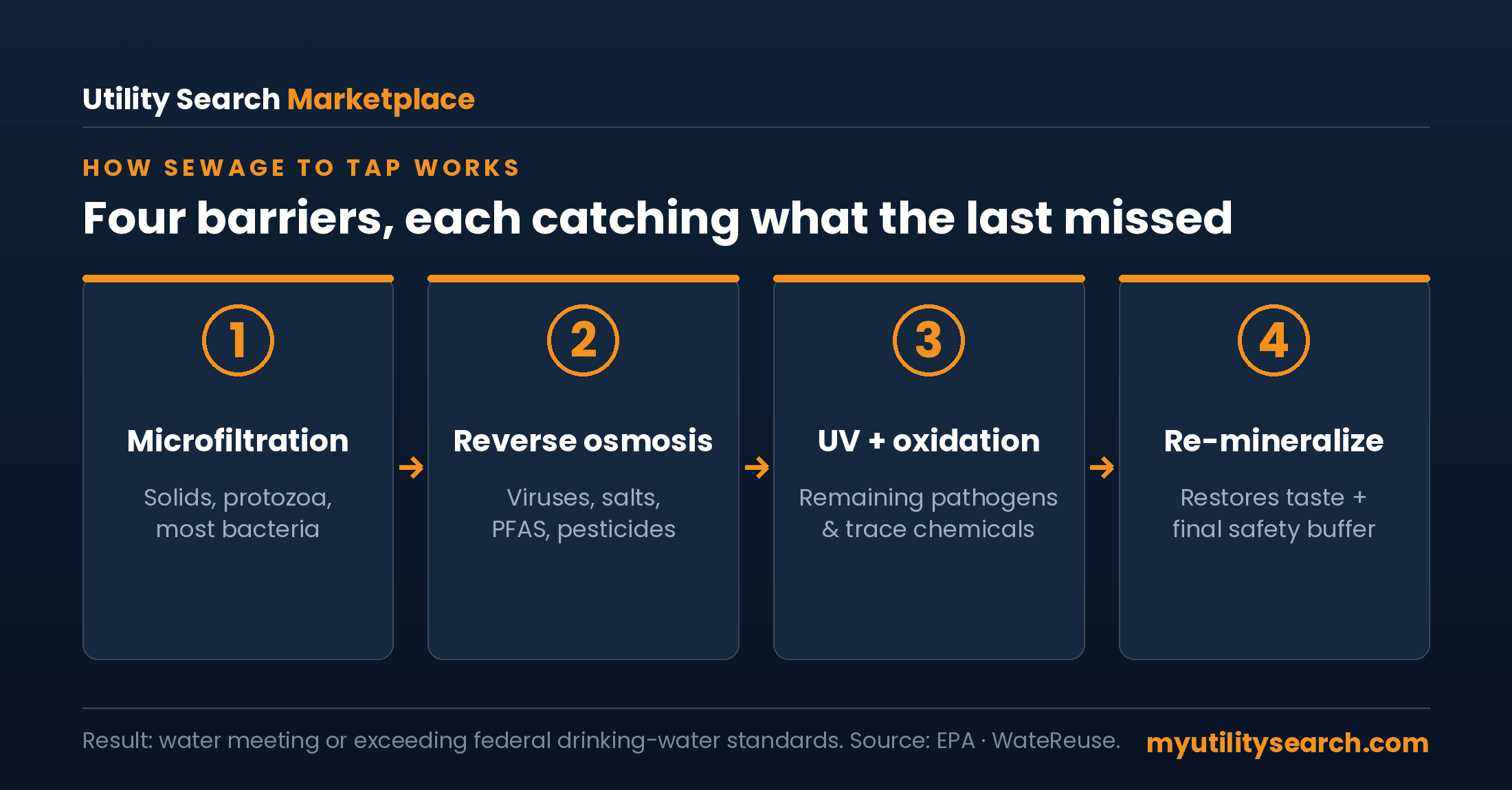
| Barrier | What it does | What it removes |
|---|---|---|
| Microfiltration | Membranes with pores about 1/300 the width of a human hair | Suspended solids, protozoa, most bacteria |
| Reverse osmosis | Water forced through a semipermeable membrane | Viruses, dissolved salts, pesticides, PFAS, pharmaceuticals |
| UV + advanced oxidation | Ultraviolet light plus an oxidant such as hydrogen peroxide | Remaining pathogens and trace organic chemicals |
| Re-mineralization + buffer | Minerals added back; water stored in an aquifer or reservoir | Restores taste; adds a final natural safety barrier |
The reason utilities stack four barriers instead of trusting one is simple: each removes a different class of contaminant, and overlapping them means anything that slips past microfiltration is caught by reverse osmosis, and anything that survives that is destroyed by UV. It is the same defense-in-depth thinking that keeps aircraft and hospitals safe — no single point of failure.
Definition — potable reuse: purifying treated wastewater to drinking-water quality through multiple engineered barriers. It is the technical name for “sewage to tap,” and the finished water is tested continuously against state and federal standards before anyone drinks it.
Is sewage to tap safe to drink?
Yes — sewage to tap water is among the most heavily tested water you can drink. Orange County, California runs the world’s largest water-recycling plant, the Groundwater Replenishment System, which after its final expansion produces up to about 130 million gallons a day — enough for roughly a million residents. In December 2023, California adopted direct potable reuse regulations (effective in 2024) that require pathogen removal far beyond what conventional drinking-water treatment must hit. The federal framework for these projects is coordinated through the EPA’s water reuse program. In short, sewage to tap is engineered to be safer than much of the tap water already flowing to U.S. homes.
Redundancy is what makes it trustworthy. Because no single barrier is relied on alone, a failure in one stage is caught by the next, and online sensors track water quality minute by minute rather than in occasional spot checks. The full journey from wastewater intake to purified water typically takes only a couple of hours, and in indirect systems the water then sits underground in an aquifer for months before anyone taps it — a final buffer that conventional supplies simply don’t have.
If sewage to tap is safe, what’s behind the 2026 parasite outbreak?
The 2026 parasite surge isn’t coming from sewage-to-tap systems — it’s coming from contaminated irrigation and surface water. A chlorine-resistant parasite called Cyclospora has sickened roughly 7,000 people across 34 states this year. About 45% of U.S. agricultural irrigation draws on surface water, which is easily fouled by leaking septic systems and human waste, and reporting on the outbreak points at that water — not recycled drinking water — as the likely path onto produce. The distinction is the whole point: sewage to tap is a closed, continuously monitored, multi-barrier system, while the irrigation water that touches your food often gets little or no treatment at all.
Definition — Cyclospora: a microscopic parasite spread through human waste that causes prolonged diarrheal illness. It resists chlorine, so standard disinfection doesn’t kill it — but because its oocysts are relatively large, a filter certified for cyst removal can physically strain it out.
Compare internet, energy & home security at your address
Shop InternetShop Energy RatesShop Home SecurityWhat you can control at your own tap
Here’s the part of the sewage-to-tap story you can act on today. You can’t re-engineer a treatment plant, but you can control the last few feet of pipe. A point-of-use filter rated for cyst removal (look for the NSF/ANSI 53 certification) physically strains out parasites like Cyclospora and Cryptosporidium that chlorine leaves alive, and a reverse-osmosis system adds another barrier against dissolved contaminants. If you’re not sure what’s in your water, start by checking your local report — our guide to whether your tap water is safe to drink walks through it, and our water filter system guide covers which filter removes what.
Water is one piece of the bigger picture. While you’re auditing the systems that run your home, it’s the natural moment to re-shop the recurring bills you actually can lower — internet, electricity, and home security — all shoppable at your address.
How tap water affects your plants, too
The same tap water quality that matters for your glass matters for your garden. Tap water is fine for most plants in moderation, but months of it can quietly stress sensitive or slow-growing species — because the chlorine, chloramine, fluoride, and minerals that treatment adds don’t simply vanish once they hit the soil.
What’s in tap water that affects plants:
- Chlorine and chloramine: disinfectants that can scorch sensitive foliage such as ferns, orchids, and seedlings, and knock back the beneficial soil microbes plants rely on. Chlorine off-gasses if water sits out; chloramine is more stable and lingers.
- Fluoride: added for dental health, it can build up in the leaf tips of sensitive plants like spider plants and dracaena, causing that classic brown, burnt-tip look.
- Hardness minerals (calcium and magnesium): helpful in small amounts, but in excess they raise soil pH and leave scale that can lock up iron and other nutrients.
- Total dissolved solids (TDS): typically 100–400 ppm in U.S. tap water; over time these salts accumulate in pots with slow drainage and stress the roots.
Signs tap water is stressing a plant: browning or yellowing leaf tips, stunted or slow growth, wilting even when the soil is moist, weak flowering or fruiting, and poor root development.
Easy fixes: let water sit in an open container for 24 hours to release chlorine (this won’t remove chloramine); run it through a carbon or reverse-osmosis filter, which strips chlorine, chloramine, and excess minerals at once; switch sensitive plants to rainwater or distilled water; and flush pots periodically to leach out built-up salts. If you’re unsure what your water carries, our guide to whether your tap water is safe to drink shows how to read your local report.
Does sewage to tap show up on your electric bill?
Indirectly, yes. Purifying water to drinking standards — the reverse-osmosis stage especially — is energy-intensive, so every new sewage-to-tap or desalination plant adds steady load to the same electric grid that powers your home. In deregulated states like Texas, that rising demand is one more reason to make sure you are not overpaying for power. You can’t control what a treatment plant spends on electricity, but you can see where rates are headed and switch to a better plan — the same logic as your water filter: fix the part of the system that is actually in your hands.
Where sewage to tap is expanding
Sewage to tap is spreading fastest across the drought-prone West and South, with major projects in California, Texas, Arizona, Colorado, and Virginia, and more on the way as reservoirs run low. Not everyone is sold: in 2026 the city council in Palm Coast, Florida began weighing a local ban, even though state law permits potable reuse — a reminder that the technology’s biggest hurdle is public trust, not engineering. The same pressure is playing out in South Texas, where the Corpus Christi water crisis has pushed the region toward desalination and reuse of its own.
Compare internet, energy & home security at your address
Shop InternetShop Energy RatesShop Home SecuritySewage to tap FAQ
Keep going
- Is your tap water safe to drink? How to check PFAS & contaminants
- Water filter system guide: which filter removes what
- Reverse osmosis system cost in 2026: is it worth it?
- Whole house water filter cost in 2026
- Corpus Christi water crisis 2026: what it means for you
- Are electricity prices going up? What 45 years of data shows