
Blog
Corpus Christi Water Crisis 2026: What It Means for You

Updated on October 1, 2026
12 min read
The Corpus Christi water crisis is the region’s multi-year struggle to keep water flowing as its reservoirs run low and heavy industrial demand keeps climbing. As of August 2026, the city has eased to Stage 2 restrictions after summer floodwater refilled its lakes — but the long-term shortage, and a roughly $1 billion push into desalination, is far from over.
TL;DR — the Corpus Christi water crisis right now
- Reservoirs have recovered to about 36.9% combined; the city moved from Stage 3 to Stage 2 restrictions on August 4, 2026.
- Summer floodwater pushed the projected Level 1 water emergency back a full year, to September 2028.
- The city council approved a $175 million brackish-water desalination plant; a separate ~$1 billion seawater plant faced a decision around September 1, 2026.
- Residents and businesses paid more than $100 million subsidizing discounted industrial water rates, per the city’s own rate models.
- Valero, Citgo and LyondellBasell are seeking roughly $80 million back after the city doubled industrial rates; a state hearing was held in July 2026 and the Public Utility Commission of Texas has not yet ruled.
- Industry uses more than half of the region’s water.
- The same cost-shift question is being decided on the ERCOT electric grid right now over data centers.
- You can’t control the drought — but in deregulated Corpus Christi you can shop your electricity, internet, and home-security bills.
What is the Corpus Christi water crisis?
The Corpus Christi water crisis describes a coastal Texas region whose two main reservoirs — Lake Corpus Christi and Choke Canyon — spent years falling toward record lows while one of the country’s largest petrochemical and oil-export hubs kept drawing enormous volumes of water. The result was years of tight outdoor-watering limits, an urgent search for new supply, and national headlines about a city rationing water in the middle of an industrial boom.
Stat: Industrial customers account for more than 50% of water use across the Corpus Christi region, against average daily demand of roughly 95 million gallons. (Source: Texas Tribune, July 2026.)
That mix — a shrinking natural supply plus outsized industrial demand — is what turned a routine drought into a genuine crisis. It also explains why the city is spending about $1 billion to manufacture drought-proof water instead of simply waiting for rain.
Is Corpus Christi running out of water?
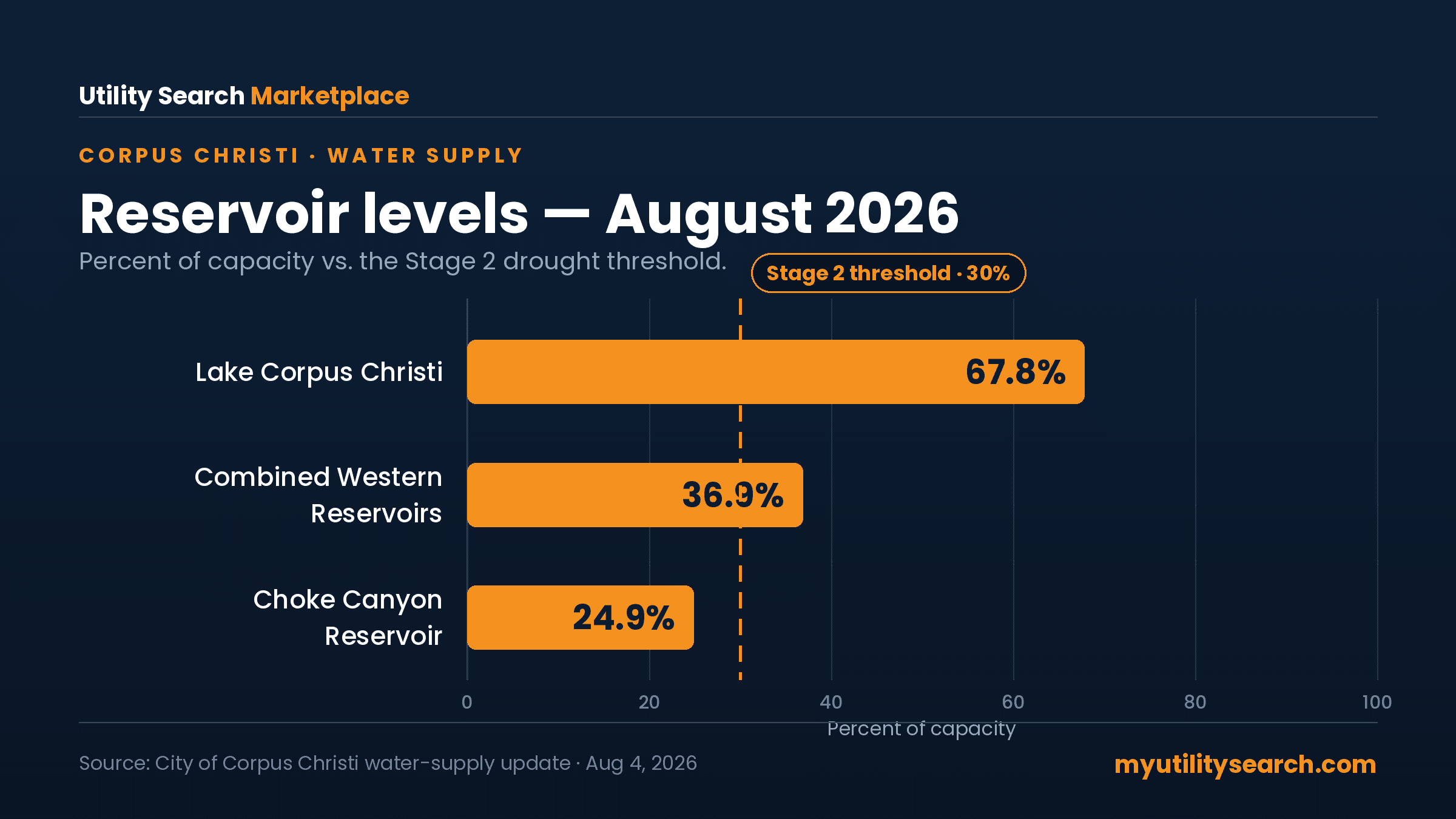
Not immediately. The near-term picture actually improved in mid-2026. Intense upstream storms sent floodwater into the reservoirs, lifting the combined western reservoir level to about 36.9% — Lake Corpus Christi rose to roughly 67.8% and Choke Canyon to about 24.9%. On August 4, 2026 the city relaxed its rules from Stage 3 (no outdoor irrigation) to Stage 2 (limited lawn watering once every two weeks).
Stat: The floodwater recharge pushed the city’s projected Level 1 water emergency back a full year — from 2027 to September 2028. (Source: Texas Tribune, July 2026.)
So the emergency has been delayed, not cancelled. The reprieve buys time to bring new supply online, which is exactly why desalination sits at the center of the Corpus Christi water crisis. It also means the story is far from settled: another dry stretch could pull the timeline forward again, and the reservoirs remain well below full.
Who pays for Corpus Christi’s water?
Residents and small businesses have been paying more than large industry has. For at least a decade, Corpus Christi sold water to a handful of refineries and petrochemical plants at a steeply discounted rate, and city rate models show residents and businesses covered more than $100 million to make up the difference. The city doubled industrial rates three years ago to correct it. The companies protested, and the case is still pending — which makes this the most consequential unresolved part of the Corpus Christi water crisis.
Stat: Corpus Christi residents and businesses paid more than $100 million subsidizing discounted water for large industrial customers, according to the city’s own cost-of-service rate models. (Source: Inside Climate News / The Texas Newsroom, July 2026.)
In late 2023, internal cost-of-service modeling showed how lopsided the system had become, and the city council voted to double the industrial water rate. Valero, Citgo and LyondellBasell — which buy water directly from the city utility to run plants just outside the city limits — responded by forming a coalition called Affordable Water for Corpus Christi and filing a protest with the Public Utility Commission of Texas.
Their demand: roughly $80 million refunded, covering the three years of higher rates they had already paid. The coalition’s filings argue the city’s rate methodology was flawed and that industrial users should not be charged for distribution infrastructure they neither own nor use the way retail customers do. At one point the companies offered to settle for $4 million. The city turned it down.
City Manager Peter Zanoni has defended the increase bluntly, saying “the large industry is not paying their fair share” for water.
Definition — cost-of-service study: the analysis a utility uses to work out what it actually costs to serve each class of customer (residential, commercial, industrial), and therefore what each class should pay. When one class pays less than its cost of service, the shortfall does not disappear — it gets recovered from everyone else. That is the mechanism at the center of the Corpus Christi water crisis rate fight.
Where the case stands now
A three-day public hearing opened July 13, 2026 at the State Office of Administrative Hearings in Austin — a trial-style proceeding with lawyers for the city and for the refineries arguing in front of a state administrative law judge. The judge issues a recommendation. The final decision rests with the Public Utility Commission of Texas, whose commissioners are appointed by the governor. As of August 2026 that decision has not been issued.
| Issue | City of Corpus Christi | Affordable Water for Corpus Christi |
|---|---|---|
| Position | The 2023 increase corrects a decade of underpayment by industry | The city’s rate methodology was flawed and legally non-compliant |
| Core argument | Households and small businesses should not subsidize multibillion-dollar corporations | Industrial users should not pay for distribution infrastructure they do not use |
| What they want | Keep the doubled industrial rate in place | Roughly $80 million refunded for three years of increases |
| Decided by | Administrative law judge recommends, then the Public Utility Commission of Texas rules | Same |
If the coalition prevails, the city could be ordered to refund tens of millions of dollars at the same moment it is trying to finance roughly $1 billion in new water supply — and raising rates on everyone else. That is the scenario that makes the rate case, not the reservoir level, the sharpest edge of the Corpus Christi water crisis.
The Corpus Christi water crisis desalination plan explained
The city is pursuing two very different desalination approaches. The one already approved is comparatively small, fast, and inland; the larger one is a coastal seawater plant that has drawn years of debate. Here is how they compare.
| Feature | Brackish plant (approved) | Seawater plant (pending) |
|---|---|---|
| Water source | Brackish groundwater (western well field) | Gulf / bay seawater |
| Status | Approved by city council (FCC Aqualia) | Decision pending ~Sept 1, 2026 |
| Cost | ~$175 million | ~$1 billion |
| Capacity | 21.3 million gallons/day by year two | Much larger, “drought-proof” supply |
| Main concern | Well-field drawdown | Cost and environmental / neighborhood opposition |
Definition — brackish desalination: treating water that is saltier than fresh water but far less salty than the ocean (typically from underground aquifers). Because it starts less salty than seawater, it needs less energy and less money per gallon to purify — which is why Corpus Christi could approve a brackish plant for a fraction of the seawater plant’s cost.
The approved brackish facility will be built at the O.N. Stevens Water Treatment Plant and begin delivering treated water within about 11 months, scaling to full capacity in year two. Brackish groundwater wells in Nueces County are already producing roughly 13 million gallons per day. Whether the far larger seawater plant gets built is the biggest open question hanging over the Corpus Christi water crisis.
The same cost-shift fight is happening on the Texas power grid
Water is where Texas is having this argument first, but it is not where the argument ends. The same regulator hearing the Corpus Christi rate case — the Public Utility Commission of Texas — is simultaneously rewriting how the costs of serving very large electricity customers get divided up on the ERCOT grid. The question is identical: when one enormous customer arrives, who pays for the infrastructure to serve it?
We call this the large-load subsidy gap: the difference between what an outsized industrial or data-center customer pays and what it actually costs to serve them, made up by everyone else on the system.
In electricity, the gap has a specific mechanism. Texas socializes approved transmission costs across the whole ERCOT system through a method called four coincident peak, or 4CP — meaning a household’s delivery charge helps fund transmission built largely for someone else’s load. ERCOT’s own Independent Market Monitor has reported that large flexible loads curtail strategically around those four peak windows, lowering their own transmission bill and shifting a disproportionate share onto other ratepayers.
Stat: The Public Utility Commission of Texas identified roughly $5.447 billion in annual ERCOT transmission cost of service in its June 2025 transmission order — recovered through the delivery charges paid by homes and businesses. (Source: Public Utility Commission of Texas.)
Stat: ERCOT is evaluating approximately 474 gigawatts of interconnection requests — more than five times its record peak demand — and data centers account for roughly 90% of that new demand. (Source: Office of the Governor of Texas, August 2026.)
Texas has started closing the gap. Senate Bill 6, signed in June 2025, requires loads of 75 MW or more to contribute to their own interconnection costs, allows ERCOT to curtail them during grid emergencies, and directs regulators to reexamine how transmission costs are assigned between customer classes. In July 2026 the commission told the governor it is actively revising transmission cost allocation so the cost of serving new data center development does not land on residential and small-business ratepayers. On August 3, 2026 the governor directed a pause on new data center interconnections pending a statewide audit.
And the two utilities are converging, not just rhyming: data centers consume water for cooling.
Stat: A May 2026 University of Texas at Austin analysis projected data centers could account for 3% to 9% of total Texas water use by 2040, up from less than 1% today. (Source: University of Texas at Austin.)
That is why the Corpus Christi water crisis reads as a preview rather than a local story. Corpus Christi spent a decade discovering what happens when very large customers are charged less than it costs to serve them, and it is now spending millions in legal fees trying to unwind it. Texas is deciding the same question on the electric grid right now — before the bills arrive rather than after. You have no vote in either proceeding, but in deregulated Texas you do choose your retail electricity provider, and locking a fixed rate is the one move that insulates your budget from cost-shift decisions made in Austin.
Compare internet, energy & home security at your address
Shop InternetShop Energy RatesShop Home SecurityWhat the Corpus Christi water crisis means for your utility bills
Here’s the part of the Corpus Christi water crisis you can actually do something about. You can’t refill a reservoir, but you can control the three monthly bills that the Corpus Christi water crisis touches most — and Corpus Christi sits in a deregulated market where each one is shoppable.
Electricity: desalination is energy-hungry, and you can switch plans
Desalination is one of the most electricity-intensive ways to make water, so every new plant adds load to the same ERCOT grid your home runs on — right as industry competes for both water and power. You can’t set the grid’s price, but Corpus Christi is in deregulated Texas, which means you choose your retail electricity provider on the state’s Power to Choose marketplace. Locking a fixed rate is the single biggest lever most households control. If you want the local playbook, see our guides to the cheapest electricity in Texas and how Texas electricity delivery charges work, plus rate breakdowns for nearby McAllen and Harlingen.
Internet: reassess your provider while you’re at it
Anytime you’re auditing household costs — or moving because of the Corpus Christi water crisis — it’s worth re-shopping internet, where introductory pricing and new fiber builds can cut your bill without cutting speed. Corpus Christi has real provider competition; comparing at your address is the fastest way to see who actually serves your block. Our Laredo internet providers guide shows how the South Texas comparison works.
Home security: leak detection is the water-crisis-relevant piece
Most monitored security systems support water leak and freeze sensors, and that is the part of a security package that actually connects to the Corpus Christi water crisis. Under Stage 2 restrictions a running toilet or a slab leak is both a bill problem and a compliance problem, and a low-cost sensor under the water heater catches it before it becomes either. If you are already comparing monitoring plans, ask which leak and flow sensors the system supports rather than only comparing camera counts.
Frequently Asked Questions
What caused the Corpus Christi water crisis?
A multi-year drought drained Lake Corpus Christi and Choke Canyon Reservoir while heavy industrial demand — petrochemical and oil-export operations that use more than half the region’s water — kept drawing on the same shrinking supply. Together those forces created the Corpus Christi water crisis.
Is Corpus Christi still under water restrictions in 2026?
Yes. As of August 4, 2026 the city is under Stage 2 restrictions, eased down from Stage 3 after reservoirs recovered to about 36.9% combined. Stage 2 allows limited lawn watering once every two weeks on assigned days.
When will Corpus Christi run out of water?
There is no fixed date, but the projected Level 1 water emergency is currently forecast for September 2028 — pushed back a year after summer 2026 floodwater recharged the reservoirs. New desalination supply is meant to arrive before then.
Did Corpus Christi sell its water to Exxon?
No. The city did not sell its municipal water supply. It does sell water to large industrial customers, including an ExxonMobil–SABIC joint venture, and industry accounts for over half of regional use — but the utility remains city-owned. The real tension is industrial demand competing with residents, not a sale.
How does the water crisis affect my electricity or internet bill?
Not directly on the meter — but desalination adds electricity demand to the ERCOT grid, and any household reassessing costs during the Corpus Christi water crisis can lower controllable bills. Because Corpus Christi is deregulated, you can switch your electricity provider and re-shop internet at your address to offset rising living costs.
Who is fighting Corpus Christi over water rates?
A coalition called Affordable Water for Corpus Christi — made up of Valero, Citgo and LyondellBasell — protested the city’s 2023 decision to double industrial water rates. The group is seeking roughly $80 million in refunds. A State Office of Administrative Hearings judge heard the case in July 2026; the Public Utility Commission of Texas issues the final ruling.
Are residents subsidizing industrial water in Corpus Christi?
Yes, historically. The city’s own cost-of-service rate models show residents and businesses paid more than $100 million over roughly a decade to make up for discounted industrial water rates. The 2023 rate increase was intended to correct that imbalance, and the industrial customers are contesting it.
Does the Corpus Christi water crisis have anything to do with data centers?
Indirectly, and increasingly. The Corpus Christi water crisis is driven by drought and refinery demand, not data centers. But the same regulator — the Public Utility Commission of Texas — is currently deciding how the cost of serving large data center loads gets allocated on the ERCOT grid, which is the same cost-shift question. A May 2026 University of Texas at Austin analysis projected data centers could reach 3% to 9% of Texas water use by 2040.
Compare internet, energy & home security at your address
Shop InternetShop Energy RatesShop Home SecurityKeep going
- Cheapest Electricity in Texas 2026: Best Ways to Save
- Texas Electricity Delivery Charges: 2026 Guide
- McAllen Electricity Rates 2026: Compare & Switch
- Harlingen Electricity Rates 2026: Compare & Switch
- What Uses the Most Electricity in Your Home?
Last updated August 12, 2026. Sources: City of Corpus Christi and the Texas Tribune. Figures reflect the latest available city and news reporting and may change as conditions evolve.