






Blog
Cable One Buys All of Vyve Broadband: What It Means for Customers


Updated on September 15, 2026
Cable One is buying the rest of Vyve Broadband — but as of September 2026 the finish line has moved. In January the company agreed to acquire the roughly 55% of Mega Broadband Investments Holdings (MBI) it does not already own, at a price it put at $475–495 million, with a target close of October 1, 2026. Since then Cable One has taken a $262.3 million write-down on its MBI stake, seen a debt-exchange offer draw only a third of lenders, and told investors on August 6 that it is still “evaluating the appropriate next steps.” The cable one vyve acquisition is still on the books; whether it closes on schedule is the open question.
Here is what the public filings say, what it means for Vyve customers, which brands are actually in the deal, and how Vyve’s prices compare with Sparklight’s today.
Updated September 5, 2026. Everything below is drawn from Cable One’s SEC filings and earnings releases, the companies’ own press pages, and trade coverage; the sources are linked at the end.
TL;DR — the cable one vyve acquisition
- Cable One already owned 45% of Mega Broadband Investments (MBI), the parent of Vyve.
- It is buying the remaining 55% from GTCR affiliates and MBI management.
- Price: roughly $475–495 million, per Cable One’s own estimate.
- Target close: October 1, 2026 — but on August 6 Cable One said it was still “evaluating the appropriate next steps” and declined to discuss financing.
- The deal was forced, not chosen: GTCR exercised a put option on January 2, 2026 that obligates Cable One to buy.
- Vyve, Northland and Eagle are in the deal. Point Broadband is not — it merged with Clearwave Fiber on May 4, 2026 under GTCR and Berkshire Partners.
- Cable One’s consumer brand is Sparklight, which is where Vyve may eventually land if the deal closes.
What exactly is the cable one vyve acquisition?
The cable one vyve acquisition is a buyout of a partner rather than the purchase of a stranger. Cable One has held a 45% stake in Mega Broadband Investments Holdings for several years; affiliates of the private equity firm GTCR and MBI’s own management held the balance. This transaction moves Cable One from minority partner to sole owner.
MBI operates as Vyve Broadband, serving smaller and rural communities — the kind of markets national carriers have historically skipped because the economics of building there are difficult. Cable One serves a similar profile under its Sparklight brand. That overlap in strategy, not in geography, is the logic behind the cable one vyve acquisition.
What has changed since January — and why October 1 is no longer a sure thing
The January announcement read like a formality. The filings since then read like a company working out how to pay for it. The dated record, from Cable One’s own disclosures:
- January 2, 2026 — GTCR pulls the trigger. Affiliates of GTCR exercised a put option written into the 2020 partnership, requiring Cable One to purchase the 55% it did not own. This was their decision, not Cable One’s.
- January 5 — Cable One announces the deal. Price $475–495 million; MBI net debt of $845–895 million (term loans maturing November 2027) comes with it; target close October 1, 2026; financing from cash plus the company’s $1.25 billion revolver.
- May 4 — Point Broadband and Clearwave Fiber close their merger. This is the transaction people confuse with the Vyve deal. Cable One’s fiber joint venture, Clearwave, combined with GTCR- and Berkshire-backed Point Broadband; Cable One exchanged its Clearwave interest for a minority equity stake in the combined company (carried at about $135 million).
- June 22 — the debt exchange offer. Cable One offered MBI’s lenders the chance to swap their term loans into new Cable One first-lien loans (up to $1.4 billion first-out at SOFR + 2.25%, second-out at SOFR + 3.00%) alongside a new $1.0 billion revolver. Participation came in at 33.4%.
- July 10 — preliminary Q2 numbers. Cable One flagged a residential broadband loss of 16,000–18,000 subscribers and said it was considering withdrawing the exchange offer. KeyBanc’s Brandon Nispel wrote that higher-rate debt hitting free cash flow “appears to be a high probability event.”
- August 6 — Q2 results. Revenue $348.9 million, down 8.4%; residential data customers 870,000, down 62,000 year over year; a $262.3 million after-tax impairment of the MBI equity stake and a $333.0 million after-tax loss on the put option; net loss $1.164 billion; gross debt $3.06 billion against $166.2 million of cash. On MBI, CFO Todd Koetje said only: “We continue to evaluate the appropriate next steps and do not have any additional updates to announce today.”
None of that cancels the cable one vyve acquisition. A put option is a contractual obligation, and Cable One has not said it will not close. What it has said, repeatedly, is that it is working on the financing — and the August 6 language is not the language of a company three weeks from wiring $475 million. Treat October 1 as the date in the agreement, not as a promise.
What changes for Vyve Broadband customers?
Nothing yet. The cable one vyve acquisition has not closed, and the October 1 date is a target that Cable One itself has stopped reaffirming. Until it closes, Vyve continues operating exactly as it does now, with the same plans, billing, and support — and Cable One has been a 45% owner since 2020, so the strategic direction does not change either way.
This deal is also gentler than most on the consolidation list for one specific reason: Cable One was already a substantial owner. The company has had influence over MBI’s direction for years, so the cable one vyve acquisition is less a change of strategy than a simplification of the cap table. Customers are unlikely to experience the abrupt platform migration that follows a genuine change of control.
What to watch after close, based on the pattern across every deal we track:
- Billing platform consolidation. This is where pricing and fees typically get re-papered, and it usually arrives months after close rather than on day one.
- Brand consolidation. Cable One sells under Sparklight. Whether Vyve keeps its name is an open question and one of the clearer signals of intent.
- Data caps and equipment fees. These are the line items most likely to be harmonized across two operations.
- Buildout commitments. Full ownership makes capital allocation simpler, which could accelerate upgrades in markets that have waited a long time.
Why rural broadband is consolidating
Deals like the cable one vyve acquisition happen because rural systems are expensive to run and hard to grow. Fewer homes per mile of cable means every upgrade costs more per customer than the same work in a dense suburb, and there is rarely a second wired provider to force competitive pricing. Scale is one of the few levers that improves those economics.
The honest tension is that scale helps the operator more reliably than it helps the customer. Combining two rural platforms lowers per-subscriber overhead and strengthens negotiating power on programming and equipment. Whether any of that reaches the bill depends on whether a competitor exists to make it necessary — and in most Vyve markets, one does not.
That is changing at the edges. Fixed wireless from the national carriers and low-earth-orbit satellite service now reach many rural addresses that had one option a few years ago. If you want to see what is actually available where you live rather than relying on any provider’s marketing, the FCC’s National Broadband Map reports provider-claimed service by address.
How this fits the wider 2026 picture
The cable one vyve acquisition is small next to the year’s headline deals — Verizon absorbing Frontier at $20 billion, Charter pursuing Cox at $34.5 billion — but it is the same pattern at a different scale. Infrastructure is cheaper to buy than to build, and owners are simplifying structures to fund the next round of upgrades.
It also completes a trend worth naming: the independent mid-size operator is disappearing from American broadband. Between the national carriers buying regional fiber, private equity assembling platforms, and deals like this one tidying up joint ventures, the number of genuinely independent providers keeps shrinking. Our telecom consolidation tracker follows every major transaction and its current status.
Antitrust review is the counterweight. The Department of Justice Antitrust Division examines whether a transaction reduces competition, and deals like this typically clear because the parties were not competing head to head — which is also why they do not expand anyone’s choices.
Which brands are actually in the deal — Vyve, Northland, Eagle, and not Point Broadband
This is where most coverage goes wrong, so it is worth being precise. Mega Broadband Investments is the holding company; Vyve Broadband is the brand. Two older names live inside it: Northland Communications (acquired 2018) and Eagle Broadband (acquired 2019) were both rebranded as Vyve in spring 2020, and Northland Cable Properties is still a named borrower on the MBI loans in Cable One’s June 2026 exchange documents. If your bill once said Northland or Eagle, you are a Vyve customer and you are in this deal.
Point Broadband is not. Point is a fiber operator that shares GTCR as a backer, which is why it gets lumped in. On May 4, 2026 it completed a merger with Clearwave Fiber — the fiber joint venture Cable One launched in 2022 — to form one of the larger independent fiber companies in the country: more than 500,000 passings across 12 states on day one, a stated goal of one million, CEO David Armistead, headquartered in Opelika, Alabama and Savannah, Georgia. Berkshire Partners and GTCR control it. Cable One is a minority shareholder, not the buyer. A Point Broadband customer is not becoming a Sparklight customer.
So the map after both transactions, if the Vyve deal closes: Cable One owns Sparklight and Vyve outright (cable-first, rural, 16 states for Vyve), and holds a passive stake in Point-Clearwave (fiber-first, GTCR/Berkshire-run). Two companies, two strategies, one investor in common.
Who is Vyve Broadband, and where does it operate?
Vyve Broadband is a cable operator built around smaller communities rather than metros — the towns where a single provider often serves the whole footprint and where national carriers have historically declined to build. It offers internet, TV and phone service over cable infrastructure, with fiber in parts of its network. Headquartered in Durant, Oklahoma, it was founded in 2012 as BCI Broadband and took the Vyve name in 2014; GTCR’s Mega Broadband Investments bought it in November 2019 and Cable One paid roughly $574 million for its 45% stake in September 2020.
Per Cable One’s January filing, MBI passes about 675,000 homes and businesses, serves roughly 210,000 residential and business data customers, and generated about $310 million of revenue in the twelve months to September 30, 2025. Its published service-area list covers sixteen states: Alabama, Arkansas, California, Colorado, Georgia, Idaho, Kansas, Louisiana, Nebraska, North Carolina, Oklahoma, South Carolina, Tennessee, Texas, Washington and Wyoming — heaviest in Oklahoma (Durant, Shawnee, McAlester, Pryor Creek), Kansas (Salina, Hays, Ottawa) and Texas (Corsicana, Stephenville, Marble Falls, Mineral Wells, Decatur). Vyve’s own address checker is the authority on any individual town.
That profile is precisely why the cable one vyve acquisition makes strategic sense. Cable One’s Sparklight brand serves a near-identical type of market. Two companies chasing the same customer profile with separate back offices, separate vendor contracts and separate capital plans is inefficient; one company doing it is not.
For subscribers, the relevant question is not who owns the company but whether anyone else can reach your address. In much of Vyve’s territory the honest answer has been no — which is what makes the ownership change feel consequential even when the service does not change.
Vyve vs. Sparklight: what each brand actually sells today
Cable One’s own retail brand is Sparklight, and it sells about 30 miles south of Vyve’s Durant, Oklahoma headquarters in Denison and Sherman, Texas (and in-state in Ada, Ardmore, Duncan and Lawton). That makes the two brands the closest thing to a controlled experiment for what the cable one vyve acquisition could mean at the bill: same rural North Texas and Southern Oklahoma customer, two different pricing playbooks. On September 5, 2026 we pulled a live Vyve quote for a Durant address and a live Sparklight quote for a Jacksonville, Alabama address (Sparklight’s Anniston market), and checked Vyve’s numbers against its April 2026 FCC broadband labels.
What Vyve quoted a Durant, OK address before the cable one vyve acquisition closes
| Plan | Online price | Speed (down / up) | Price lock | What is included |
|---|---|---|---|---|
| Vyve 300 | $40/mo | 300 / 30 Mbps | 1 year | No installation or activation fee, no contract. Modem is extra ($15.99/mo on the label) unless you bring your own. |
| Vyve Gig Value WiFi | $50/mo | Gig / 50 Mbps | 2 years | Modem, eero Pro 6 mesh router, unlimited data and the service protection plan all included; no installation or activation fee, no contract. |
The $10 gap between those two cards is the whole story at this address. For an extra $10 a month, the Gig Value card includes equipment that costs $15.99 a month on the 300 plan, removes the data cap, and locks the price for two years instead of one. Vyve’s site also advertises a 2 Gig Value WiFi tier (up to 2,000 Mbps, two eero units, a 3-year price lock) in markets where its network supports it; it was not offered online at this address.
Vyve’s published rate card: the FCC labels
Vyve publishes machine-readable FCC broadband labels, and the April 2026 file — the last one before the cable one vyve acquisition — shows something the marketing page does not: the same plan carries different standard prices by region, and typical speeds that in several cases beat the advertised number.
| Tier | Standard label price | Regional variants | Typical download / upload | Data allowance |
|---|---|---|---|---|
| Vyve 300 | $35 | $40–$45 | 351 / 35 Mbps (82 up on 105-upload systems) | 1,500 GB |
| Vyve 600 | $45 | $50–$55 | 691 / 47 Mbps (700 / 110 on 105-upload systems) | 2,000 GB |
| Vyve Gig | $65 | $70–$90 | 943 / 56 Mbps (955 / 108 on 105-upload systems) | 4,000 GB |
| Vyve 2 Gig | $75 | $85–$95 | 1,716–2,200 / 60–201 Mbps | 4,000 GB |
| Vyve 600 Fiber Plus WiFi | $39.99 | — | 758 / 733 Mbps (symmetrical fiber) | Unlimited |
| Vyve Gig Fiber Plus WiFi | $59.99 | — | 943 / 923 Mbps (symmetrical fiber) | Unlimited |
| Vyve 2 Gig Fiber Plus WiFi | $79.99 | — | 2,000 / 2,000 Mbps (symmetrical fiber) | Unlimited |
| Vyve Connect Essentials | $67.49 | — | 227 / 29 Mbps | Unlimited |
Two things stand out. First, where Vyve has built fiber, the Fiber Plus WiFi tiers are cheaper than the equivalent cable tier and symmetrical: 600 Mbps for $39.99 versus $45 on cable, with 733 Mbps typical upload instead of 47. If your Vyve address is fiber-served, that is the plan to ask about. Second, the regional variants matter: the same Vyve Gig plan is $65 on the standard label but $70, $80 or $90 in three regional price zones, which is why two neighbors in different Vyve towns can be quoted different prices for the same speed.
What Sparklight quoted a Jacksonville, AL address (September 5, 2026)
| Plan | Online price | Then | Regular rate | What is included |
|---|---|---|---|---|
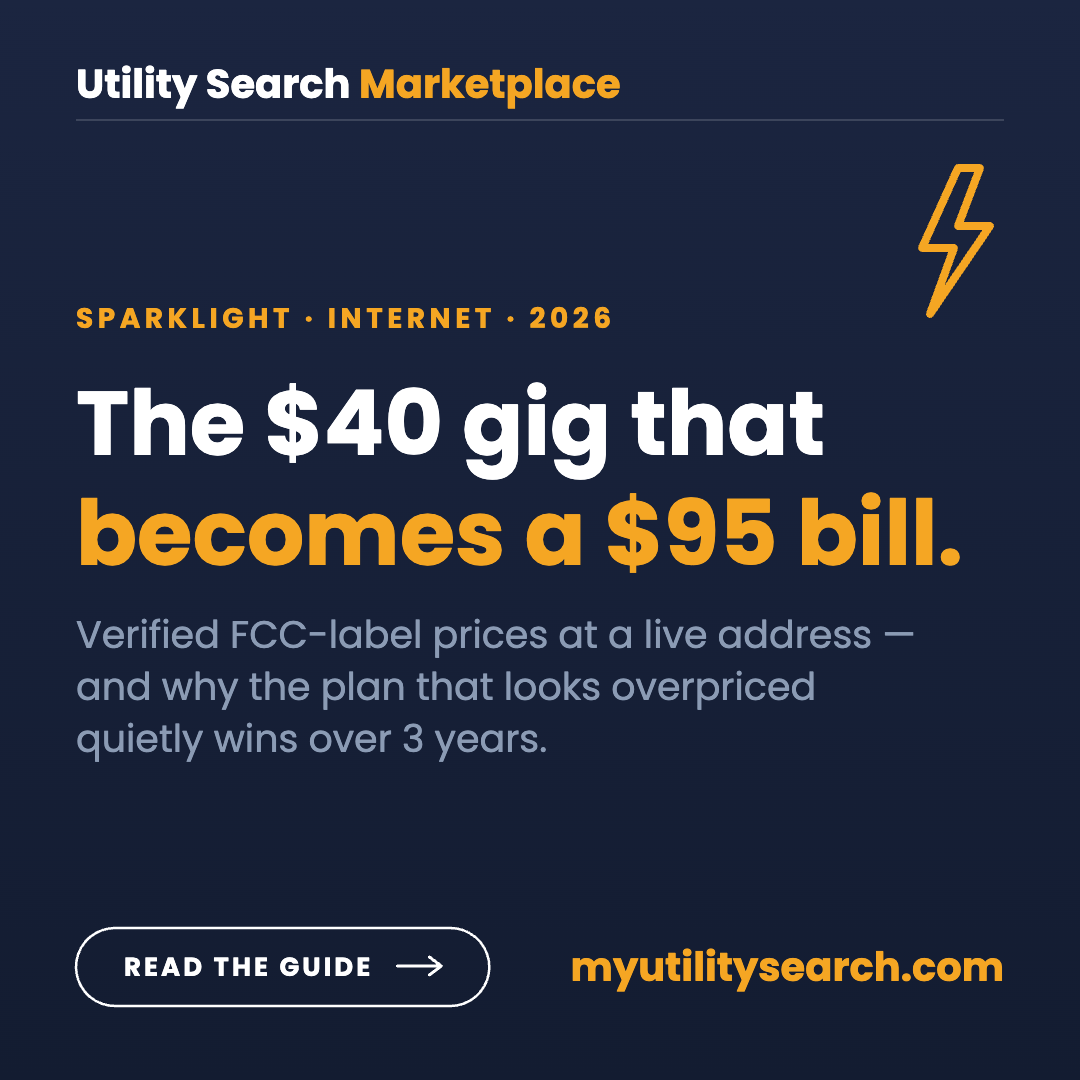
| Sparklight 1 Gig | $40/mo months 1–12 | $55/mo months 13–24, $75/mo months 25–36 | $95/mo | Modem + eero included, free installation, free Sparklight Mobile line for 12 months, unlimited data, no contract |
| Sparklight 600 Mbps | $65/mo | 36-month price lock | Address-quoted | Same: equipment included, free install, free mobile line, no contract |
| Sparklight 300 Mbps | $45/mo | 36-month price lock | Address-quoted | Same: equipment included, free install, free mobile line, no contract |
This is the detail Sparklight’s marketing page does not show. Its published offer describes the Gig plan’s step-ups, but at a real address the 300 and 600 tiers are sold as flat, three-year locks with equipment included — a longer lock than anything Vyve quoted. The Gig plan is the outlier: $40 for a year, then two step-ups on the way to a $95 regular rate that is more than double the promotional price.
Vyve vs. Sparklight, tier by tier: the cable one vyve acquisition baseline
| Speed tier | Vyve (Durant, OK) | Sparklight (Jacksonville, AL) | Who wins |
|---|---|---|---|
| 300 Mbps | $40/mo, 1-year lock, modem extra | $45/mo, 3-year lock, equipment included | Sparklight once you add a modem: $40 + $15.99 on Vyve vs $45 all-in, locked three times as long |
| 600 Mbps | Not offered online at this address (label $45–$55, modem extra) | $65/mo, 3-year lock, equipment included | Vyve on price if it is available to you; Sparklight on certainty |
| Gig | $50/mo, 2-year lock, modem + eero + unlimited data included | $40 → $55 → $75, regular $95, equipment included | Sparklight in years 1–2 by $60 total; Vyve by year three |
The Gig plan over three years
| Vyve Gig Value WiFi (Durant) | Sparklight 1 Gig (Jacksonville) | |
|---|---|---|
| Year 1 | $50 × 12 = $600 | $40 × 12 = $480 |
| Year 2 | $50 × 12 = $600 | $55 × 12 = $660 |
| Two-year total | $1,200 | $1,140 |
| Year 3 | Renewal pricing (lock expires) | $75 × 12 = $900 |
| Regular rate after promotions | Not published | $95/mo |
Over two years Sparklight’s Gig plan is $60 cheaper, and it throws in a mobile line. That is the cable one vyve acquisition in miniature: same owner, two price ladders. From month 25 it costs $75, and its regular rate is $95 — nearly double what Vyve quoted. Vyve’s $50 is the better number for anyone who plans to stay put, provided the renewal offer at month 25 is reasonable.
The pattern to notice is that the two brands lock different things: Vyve locks its Gig plan, Sparklight locks its 300 and 600 plans and lets Gig float. If the cable one vyve acquisition closes and Cable One harmonizes the two lineups, Vyve customers should hope it exports the three-year locks rather than the Gig step-up ladder.
Neither lineup is the ceiling for a rural address. Fixed wireless from T-Mobile and Verizon, and satellite from Starlink, now reach many Vyve and Sparklight towns at $50–$120 with no step-ups, so the cheapest way to hold either company to its best offer is to know what else can reach your door.
What rural customers should actually do
- Re-check your address annually. Fixed wireless and satellite coverage have expanded quickly. An address with one option two years ago may have three now, and that is the only thing that creates real pricing pressure.
- Note your promotional end date. Post-close is when acquired accounts get migrated and renewal pricing changes. Knowing when your rate resets is worth more than tracking the deal.
- Document your speeds. If service degrades after an ownership change, a record of what you were sold and what you actually receive is the strongest thing you can bring to a support call.
- Watch for equipment fee changes. When two operations merge, fee schedules tend to converge upward rather than downward.
None of that requires acting on the cable one vyve acquisition itself. The deal has not closed, and there is nothing to sign, verify or accept.
On Vyve Or Sparklight? See What Else Reaches You
Rural coverage changes faster than most people check — fixed wireless and satellite now reach addresses that had one option a few years ago. Compare every provider at your address on price and speed.
Compare internet plans at my address →FAQ
Is Vyve Broadband being sold?
Yes, in effect. Cable One has agreed to acquire the roughly 55% of Mega Broadband Investments Holdings, Vyve’s parent, that it did not already own, moving to full ownership. The agreement targets an October 1, 2026 close, but as of Cable One’s August 6, 2026 earnings call the company said it was still evaluating next steps and would not discuss financing.
Is the Cable One Vyve deal still closing on October 1, 2026?
October 1 is the target date in the January agreement. Cable One has not withdrawn it, but it also has not reaffirmed it: on August 6 it took a $262.3 million write-down on the MBI stake, reported that its lender exchange offer drew 33.4% participation, and said it continues to evaluate next steps. Watch Cable One’s investor-news page for a closing announcement or an amended agreement.
Is Point Broadband part of the Cable One Vyve acquisition?
No. Point Broadband merged with Clearwave Fiber on May 4, 2026 into a company controlled by Berkshire Partners and GTCR, with more than 500,000 fiber passings in 12 states. Cable One holds a minority equity stake in that company but does not run it. Point Broadband customers are not affected by the Vyve transaction.
Are Northland Communications and Eagle Broadband customers included?
Yes. Both brands were rebranded as Vyve Broadband in spring 2020 and are part of Mega Broadband Investments, so they are covered by the acquisition.
How much is the cable one vyve acquisition worth?
Cable One has indicated it expects the purchase price for the remaining stake to fall between approximately $475 million and $495 million.
Did Cable One already own part of Vyve?
Yes. Cable One held a 45% stake in Mega Broadband Investments, with affiliates of GTCR and MBI management holding the remainder. This deal takes Cable One to full ownership.
Will my Vyve plan or price change?
Not right now. The deal has not closed. After close, changes typically arrive with billing platform consolidation months later rather than immediately.
Will Vyve become Sparklight?
That has not been announced. Sparklight is Cable One’s consumer brand, so a future brand consolidation is plausible, but no timeline has been confirmed.
Do I need to do anything because of the acquisition?
No. You do not need to re-sign, re-verify your identity, or accept new terms to keep service running. Treat any urgent message demanding account action because of a merger as a likely phishing attempt.
Is Vyve cheaper than Sparklight?
It depends on the tier. On Gig, a Durant, OK address was quoted Vyve at $50 a month locked for two years with equipment included ($1,200 over two years), while a Jacksonville, AL address was quoted Sparklight at $40 for 12 months, then $55, then $75, with a $95 regular rate ($1,140 over two years, $2,040 over three). Sparklight is cheaper for two years; Vyve is cheaper from year three. On 300 Mbps, Sparklight quoted $45 with equipment included and a three-year lock versus Vyve at $40 with a one-year lock and the modem extra, so Sparklight is the better all-in price there.
Sources
Every figure above can be checked against the primary document:
- Cable One, “Cable One to Acquire Full Ownership of Mega Broadband,” January 5, 2026 (SEC Exhibit 99.1) — put option, price, MBI debt, passings, customers, revenue, October 1 target.
- Cable One, MBI term-loan exchange offer notice, June 22, 2026 (SEC Exhibit 99.1) — exchange terms, new facilities, Northland Cable Properties as borrower.
- Cable One, “Cable One Reports Second Quarter 2026 Results,” August 6, 2026 — revenue, subscribers, impairment, put-option loss, debt and cash.
- Light Reading, “Cable One flags bigger broadband losses, Vyve financing doubts,” July 10, 2026 — preliminary Q2, exchange-offer withdrawal consideration, analyst commentary.
- Point Broadband, “Point Broadband and Clearwave Fiber Close Merger,” May 4, 2026 — combined company scale, owners, leadership.
- Vyve Broadband, “Eagle Broadband and Northland Communications to Rebrand Under Vyve,” March 10, 2020
- Vyve Broadband service areas (current town-by-town list)
- Cable One investor news — where a closing or amendment announcement will appear first.
- Vyve Broadband — FCC Broadband Labels (April 2026 machine-readable file)
- Sparklight — online order flow and Broadband Facts for 512 Mountain St NE, Jacksonville, AL 36265 (checked September 5, 2026)
Keep going
- Bluepeak internet — the fiber overbuilder competing with Sparklight across Oklahoma and Wyoming
- TDS internet plans and prices — the fiber rival at Sparklight and Vyve addresses
- Telecom consolidation tracker: every major 2026 merger
- GFiber + Astound: Alphabet sells majority stake to Stonepeak
- AT&T buys Quantum Fiber: what changes for customers
- Best internet options for rural addresses
- Starlink for rural areas: is it worth it?
- Why internet prices are rising in 2026
- Sparklight internet: the $40 gig that becomes a $95 bill




2 thoughts on “Cable One Buys All of Vyve Broadband: What It Means for Customers”