Blog
Sparklight’s $40 Gig Becomes a $95 Bill in Month 13 — and the Plan That Looks Overpriced Quietly Wins

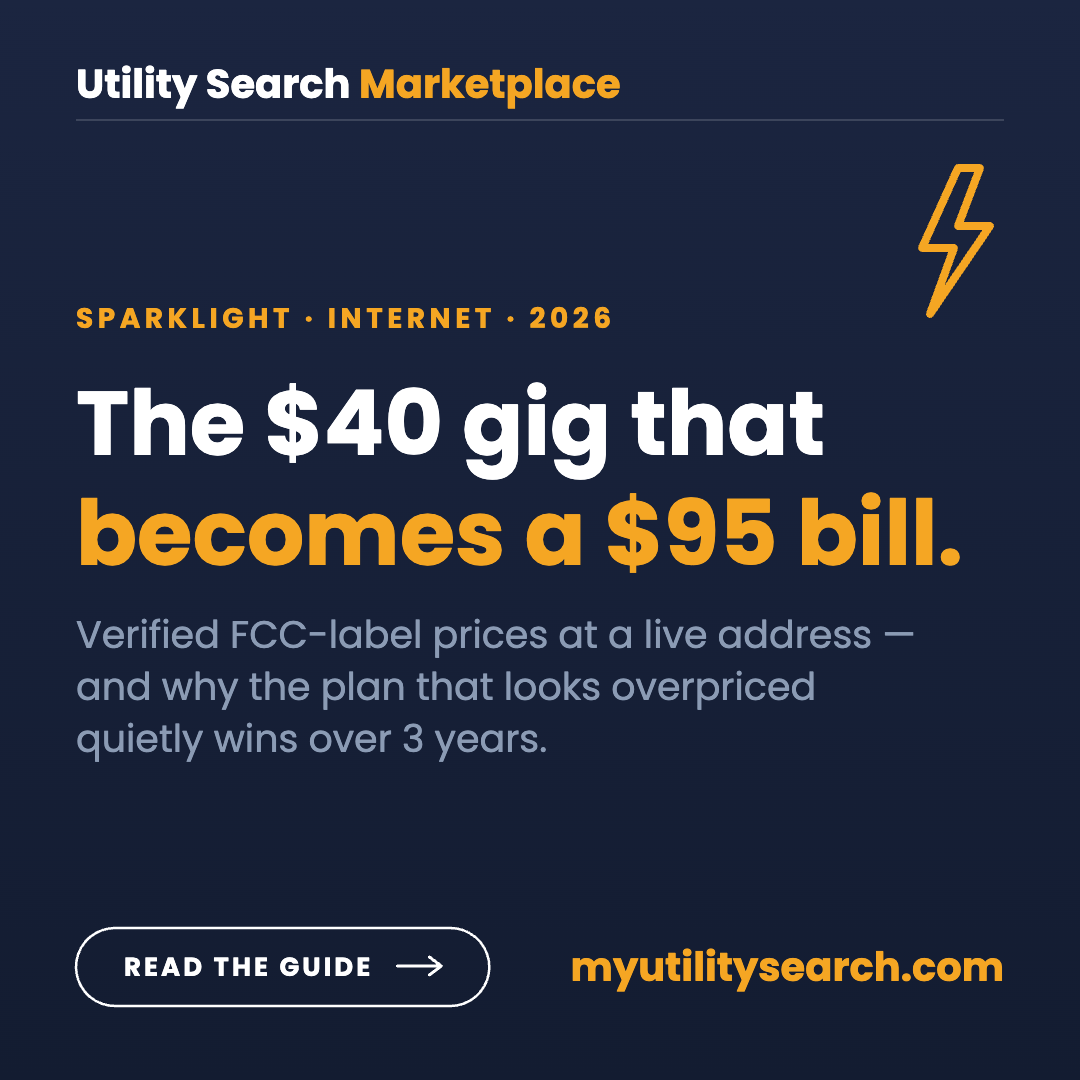
Sparklight internet costs $40 a month for 1 Gig at a verified Alabama address, but the FCC label on that same plan lists a regular price of $95. The promotional rate holds for 12 months. In month 13 the bill climbs $55. There is no early termination fee, so you can leave the day it happens.
The short version
- Sparklight internet prices its gigabit tier below both slower tiers for the first year — $40 versus $45 and $65.
- The gig is a 12-month promotion. The 300 Mbps and 600 Mbps plans carry 36-month price locks.
- Over three years the gig costs $2,760 and the 600 Mbps plan costs $2,340. The cheap plan becomes the expensive one.
- Every plan includes unlimited data, a $0 modem lease, and a $0 early termination fee.
What does Sparklight internet cost in 2026?
Sparklight internet sells three residential tiers, and the prices below came from a live availability check at 512 Mountain St NE, Jacksonville, Alabama 36265 on September 13, 2026. The regular prices are not estimates — they are pulled from each plan’s FCC Broadband Facts label, the standardized disclosure every provider must publish.
| Plan | Promo price | Promo term | Regular price | Increase |
|---|---|---|---|---|
| 1 Gig | $40/mo | 12 months | $95.00/mo | +$55 (138%) |
| 600 Mbps | $65/mo | 36 months | $80.00/mo | +$15 (23%) |
| 300 Mbps | $45/mo | 36 months | $65.00/mo | +$20 (44%) |
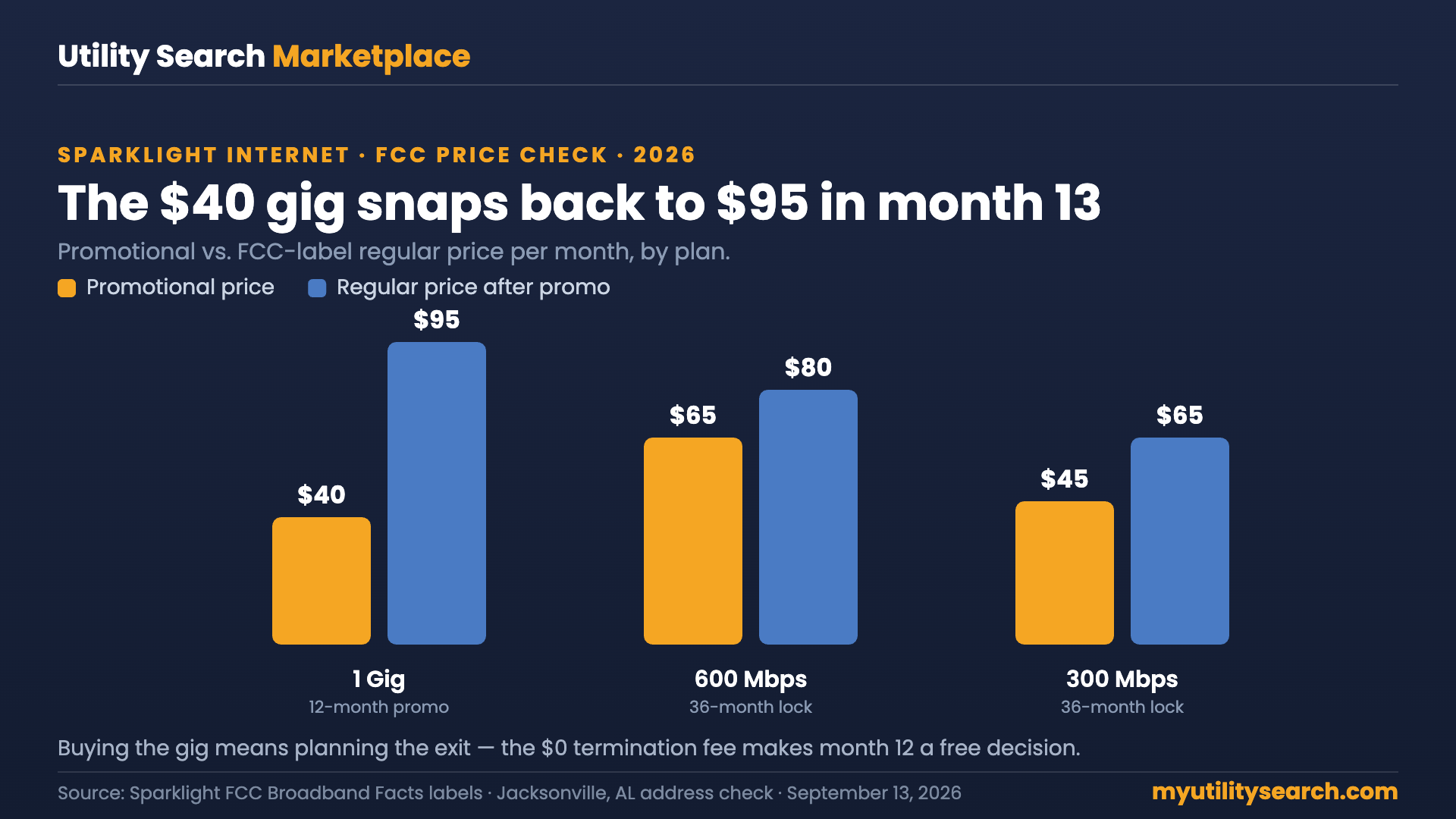
Read that table twice. Sparklight internet charges $25 more per month for 600 Mbps than it charges for a full gigabit. It charges $5 more for 300 Mbps than for a gigabit. The faster the plan, the less you pay — for one year.
Reverse ladder: a pricing structure where the higher-speed tier costs less than the lower-speed tiers, because the top tier is sold on a short promotional rate while the slower tiers are sold on long-term locks. Sparklight internet is currently the clearest example in U.S. cable.
Why is Sparklight internet cheaper at 1 Gig than at 300 Mbps?
Because the two plans are selling different things. The $40 gig is a customer-acquisition offer with a 12-month clock on it. The $45 and $65 tiers are 36-month price locks, and the lock is the product being sold, not the speed.
This is why comparing Sparklight internet plans on monthly price alone produces the wrong answer. A shopper looking at the shelf sees a gigabit for less than a 300 Mbps connection and reasonably concludes the gig is the deal. It is, briefly. The structure rewards anyone willing to leave in a year and punishes anyone who forgets.
Sparklight, formerly Cable One, serves smaller and rural markets across 21 states where it often faces little competition. Promotional aggression at the top of the lineup pulls in subscribers; the back-end rate is where the margin lives.
What happens to Sparklight internet pricing in month 13?
The 1 Gig plan reprices from $40 to $95. That is the single most important number in this article, and it appears nowhere on the plan card — only inside the Broadband Facts label, behind a link most shoppers never click.
The label is explicit about it: the $95.00 monthly price “is not an introductory rate” and “does not require a contract.” Sparklight internet is not hiding the figure. It simply is not putting it where you would look.
The 600 Mbps and 300 Mbps plans have a much gentler landing because their locks run 36 months. When those expire, 600 Mbps goes from $65 to $80 and 300 Mbps goes from $45 to $65.
Which Sparklight internet plan is actually cheapest over three years?
Run each plan to 36 months at its own published rates and the ranking inverts completely.
| Plan | Year 1 | Years 2–3 | 36-month total |
|---|---|---|---|
| 1 Gig | $480 | $2,280 | $2,760 |
| 600 Mbps | $780 | $1,560 | $2,340 |
| 300 Mbps | $540 | $1,080 | $1,620 |
The gigabit plan that looked like the bargain finishes $420 more expensive than the 600 Mbps plan that looked overpriced, and $1,140 more expensive than the 300 Mbps plan. The Sparklight internet lineup makes its cheapest-looking plan its costliest commitment.
None of that is an argument against the gig. It is an argument for knowing which game you are playing. If you will genuinely re-shop in month 12, the gig at $40 is the strongest Sparklight internet value on the shelf and the $0 early termination fee makes leaving free.
Compare internet, energy & home security at your address
What fees does Sparklight internet add on top of the advertised price?
Fewer than most cable operators, which is the genuinely good news in this lineup. Every Sparklight internet tier at this address showed the same fee structure on its FCC label.
- Modem lease: $0.00. Equipment is included. Most cable providers charge $10 to $15 here.
- Network access fee: $0.00.
- Activation fee: $0.00.
- Early termination fee: $0.00. No contract on any tier.
- Carrier cost recovery fee: $2.87/mo. Charged on every plan.
- Paper statement fee: $3.00/mo. Avoidable — paperless billing is required for the promo rate anyway.
- Installation: $0 to $99.99, and deposit: $0 to $50, both varying by address and credit.
A realistic monthly Sparklight internet bill is therefore the advertised rate plus $2.87, before government taxes. The $0 modem lease is a real differentiator: over 36 months, a competitor charging $14/mo for equipment adds $504 that Sparklight internet does not.
How fast is Sparklight internet in practice?
The FCC labels publish typical observed speeds rather than marketing maximums, and Sparklight internet over-delivers on download at every tier.
| Plan | Typical download | Typical upload | Typical latency |
|---|---|---|---|
| 1 Gig | 1,078.1 Mbps | 52.7 Mbps | 29 ms |
| 600 Mbps | 708.4 Mbps | 31.6 Mbps | 29 ms |
| 300 Mbps | 352.3 Mbps | 21.1 Mbps | 29 ms |
Upload is where the cable architecture shows. Sparklight internet delivers 52.7 Mbps up on its gigabit tier, while fiber providers at similar prices deliver symmetrical gigabit. For streaming, gaming, and video calls the 29 ms latency is fine. For uploading large video files or running a home server, it is the constraint.
Who should buy Sparklight internet, and who should not?
Buy the 1 Gig at $40 if you will put a calendar reminder at month 11 and genuinely re-shop. With no early termination fee, the downside is a phone call.
Buy the 300 Mbps at $45 if you want to stop thinking about it. At $1,620 over three years it is the lowest total cost in the Sparklight internet lineup, and 352 Mbps handles a normal household.
Skip the 600 Mbps at $65. It costs more per month than the gigabit, delivers two-thirds the speed, and its lock sits only $15 below its own regular rate. It is the weakest position on the shelf.
Look elsewhere entirely if fiber is available at your address. Symmetrical upload at comparable pricing beats any cable ladder, reverse or otherwise.
How does this compare with other small-market cable providers?
The promo-to-regular cliff is not unique to this brand. It is the standard cable playbook in markets where one wired provider dominates, and the pattern repeats across the operators serving similar towns.
What varies is the size of the drop and how honestly it is disclosed. Mediacom runs one of the steeper cliffs in the category, with promotional rates landing well under standard rates that more than double at the top tiers. Midco took the opposite approach in January 2026 and built its lineup around a three-year price lock, closer in spirit to the 300 Mbps and 600 Mbps tiers here.
Three things make this lineup better than the category average regardless of the cliff. Equipment is genuinely free rather than bundled into a rental line item. There is no contract and no termination fee, so the repricing moment is a decision rather than a trap. And the published typical speeds beat the advertised tier at every level, which is not true everywhere.
What makes it worse than average is the shape. Most providers price more speed at more money, so the shopper’s instinct — buy the tier you can afford — produces a sane result. A reverse ladder breaks that instinct. The shopper who economizes lands on the plan that costs the most per megabit, and the shopper who splurges lands on the best first-year value and the worst three-year one.
The practical takeaway for anyone comparing Sparklight internet against a neighboring cable or fiber operator: compare the FCC label regular prices, not the promotional cards. Promotional pricing tells you what the provider wants this quarter. The label tells you what you will actually pay for most of the time you are a customer.
Frequently asked questions about Sparklight internet
Does Sparklight internet have a data cap?
No. Every Sparklight internet plan checked in September 2026 lists unlimited data on its FCC label, with no charges for additional usage.
Does Sparklight internet require a contract?
No. All three tiers show a $0 early termination fee and the FCC labels state the monthly price does not require a contract. The 36-month “price lock” on the 300 and 600 Mbps plans protects your rate without obligating you to stay.
Why does Sparklight internet cost more for slower speeds?
Because the gigabit tier is sold on a 12-month promotional rate while the slower tiers are sold on 36-month price locks. This reverse ladder makes the gig cheapest in year one and most expensive across three years.
How much does Sparklight internet cost after the promotion ends?
The 1 Gig plan goes from $40 to $95 per month after 12 months. The 600 Mbps plan goes from $65 to $80 and the 300 Mbps plan goes from $45 to $65, both after 36 months.
Is equipment included with Sparklight internet?
Yes. The modem lease fee is $0.00 on every tier, which is unusual for cable and worth roughly $500 over three years compared with providers charging a monthly equipment rental.
Compare internet, energy & home security at your address
Sources
- Sparklight live availability check and cart, 512 Mountain St NE, Jacksonville, AL 36265, September 13, 2026.
- Sparklight FCC Broadband Facts labels, plan identifiers F0003474327SPHSHN3E95B0000 (1 Gig), F0003474327SPHSHN2E80B0000 (600 Mbps), F0003474327SPHSHN1E65B0000 (300 Mbps).
- FCC Broadband Consumer Labels — the disclosure standard behind the regular-price figures above.
Keep going
- Cable One and Vyve: what the deal means for Sparklight markets
- The cheapest internet plans in America right now
- Which providers still enforce data caps and overage fees
- Mediacom internet: promo rates versus the standard rate cliff
- Midco internet plans and its 3-year price lock
- Prepaid home internet with no contract or credit check
- Best internet options for rural addresses