Blog
Verizon Fios Locks Your Price for Five Years — but Its Worst Tier Charges $65 for Half the Speed


Updated on September 16, 2026
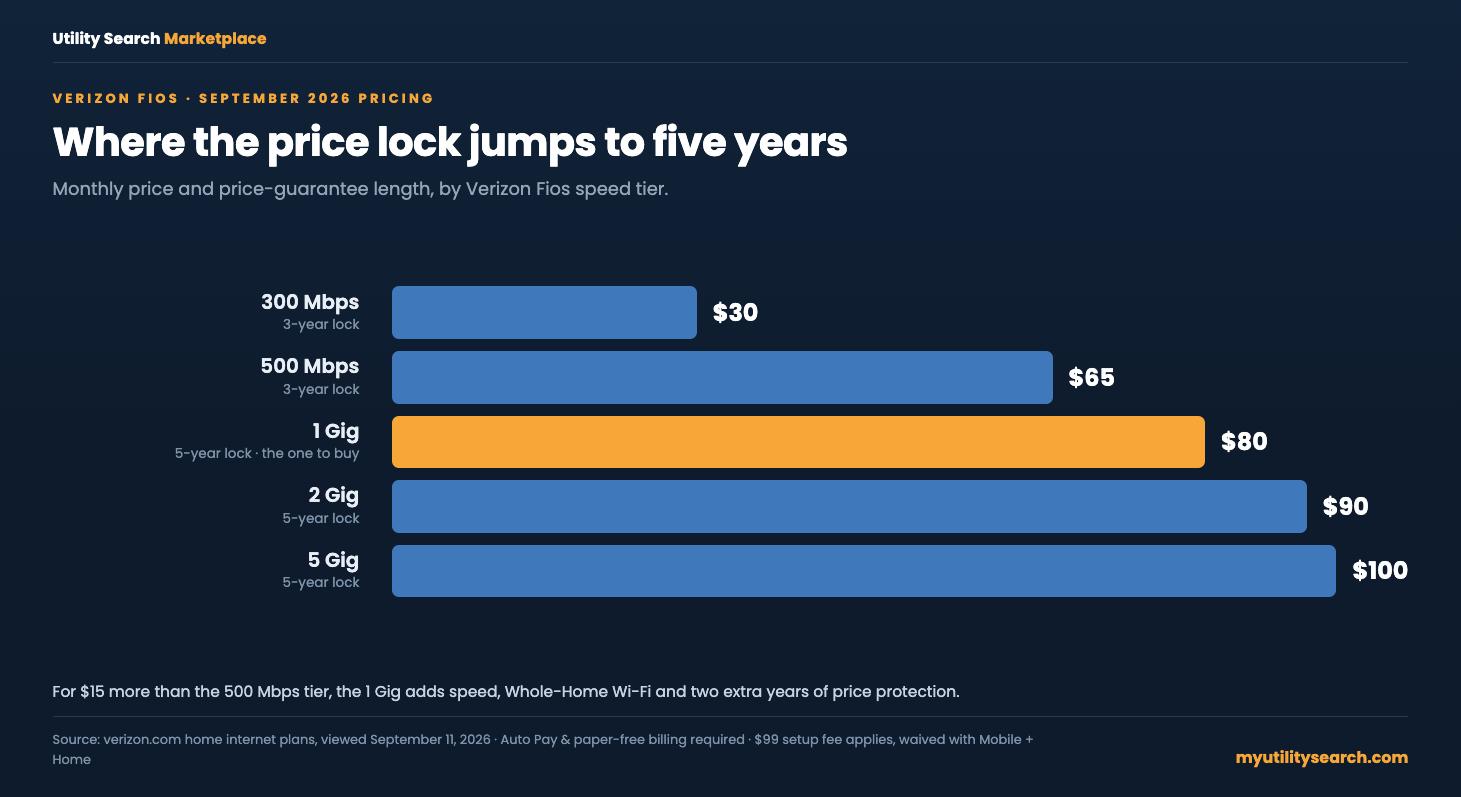
Verizon Fios speed tiers come in five levels: 300 Mbps, 500 Mbps, 1 Gig, 2 Gig and 5 Gig, priced at $30, $65, $80, $90 and $100 a month with Auto Pay and paper-free billing. Unlike almost every cable and fiber competitor, those are not promotional rates that expire in twelve months — each one carries a multi-year price guarantee. And there is a break point in the lineup that Verizon does not advertise: the guarantee jumps from three years to five years the moment you reach the 1 Gig tier.
By Christopher Burg · Last updated September 11, 2026. Verify pricing at your address — availability varies.
Key takeaways
- Five Verizon Fios speed tiers, all symmetrical, no data caps, no annual contract. 300 Mbps ($30), 500 Mbps ($65), 1 Gig ($80, down from $90), 2 Gig ($90) and 5 Gig ($100), all requiring Auto Pay and paper-free billing.
- The 500 Mbps tier is the one to skip. For $15 more, the 1 Gig nearly doubles your speed, adds Whole-Home Wi-Fi, and upgrades your price lock from three years to five.
- The guarantee break sits in the middle of the Verizon Fios speed tiers. The 300 and 500 carry a three-year price guarantee; the 1 Gig, 2 Gig and 5 Gig carry five years.
- 2 Gig is only $10 above 1 Gig for up to 2.3 Gbps instead of 940 Mbps — the best speed-per-dollar step in the lineup.
- Budget for the $99 setup fee, which Verizon waives for customers who enroll in Mobile + Home.
- The prices are the prices. No twelve-month promo cliff is the structural advantage here, and it is what makes Fios cheaper than AT&T Fiber over five years despite a higher year-one number.
What are the Verizon Fios speed tiers?
There are five, and they run further at the top end than most providers reach. The Verizon Fios speed tiers sold today are 300 Mbps, 500 Mbps, 1 Gig, 2 Gig and 5 Gig, all delivered over 100% fiber with matching upload and download speeds, no data caps and no annual contract. Every tier includes the router at no extra charge — a line item that costs $10 to $15 a month at most cable operators.
| Tier | Speed | Price / mo | Price guarantee | What’s included |
|---|---|---|---|---|
| 300 Mbps | Up to 300 Mbps | $30 | 3 years | Router |
| 500 Mbps | Up to 500 Mbps | $65 | 3 years | Router |
| 1 Gig | Up to 940 Mbps | $80 (was $90) | 5 years | Router + Whole-Home Wi-Fi |
| 2 Gig | Up to 2.3 Gbps | $90 | 5 years | Router + Whole-Home Wi-Fi + Digital Home Secure Plus |
| 5 Gig | Up to 5 Gbps | $100 | 5 years | Router + Whole-Home Wi-Fi + Digital Home Secure Plus |
Source: verizon.com/home/internet/, viewed September 11, 2026. All prices require Auto Pay and paper-free billing. A $99 setup fee applies and is waived for Mobile + Home customers. The price guarantee applies to the base monthly rate only, excluding setup, additional equipment, promotions, perks and third-party services. Availability varies by address.
Definition — price guarantee vs. promotional rate: A promotional rate is a discount that expires, usually after twelve months, after which you pay an “everyday” price that is often 50–80% higher. A price guarantee is a commitment that your base monthly rate will not rise for a stated term. The Verizon Fios speed tiers use the second model, which is why comparing Fios to a competitor’s twelve-month promo price flatters the competitor. Compare the three- or five-year total instead.
Which of the Verizon Fios speed tiers is the best value?
The 1 Gig at $80, and it is not close. Look at what the extra $15 over the 500 Mbps tier actually buys: roughly double the speed (940 Mbps against 500), Whole-Home Wi-Fi added to the included router, and a price guarantee that stretches from three years to five. The 500 Mbps tier loses on speed, on equipment and on lock length simultaneously. There is no household for which it is the correct choice, which makes it the decoy tier in this lineup — priced to make the 1 Gig look like a bargain, which it genuinely is.
The 300 Mbps at $30 is the other honest answer, and for most households it is the smart one. It is the cheapest serious fiber plan in the country from a major carrier, it is symmetrical, it includes the router, and 300 Mbps is more than a typical home consumes. If your household streams, browses, takes video calls and does not push large files upstream, take the 300 and bank the $50 a month.
Above the 1 Gig, the step to 2 Gig costs only $10 more for up to 2.3 Gbps and adds Digital Home Secure Plus. That is the best speed-per-dollar jump among the Verizon Fios speed tiers, though it is only meaningful if you have the home network to use it — multi-gig ethernet, a modern Wi-Fi 6E or 7 router setup, and devices that can actually saturate a gigabit. The 5 Gig at $100 exists for a small number of households with wired multi-gig infrastructure and, realistically, almost nobody else.
Stat block — the 500 Mbps tier is dominated on every axis: Against the 1 Gig at $80, the 500 Mbps tier at $65 gives up 440 Mbps of speed, the Whole-Home Wi-Fi equipment, and two years of price protection — to save $180 a year. Over the five years the 1 Gig is locked for, the 500 Mbps tier saves $900 on paper but only carries a guarantee for the first three of those years, so the last two are exposed to whatever Verizon charges then. It is the only tier in the lineup with no clear buyer.
How much speed do you actually need from the Verizon Fios speed tiers?
Far less than the top of the lineup. A 4K stream uses roughly 25 Mbps. Four of them at once, plus a video call and a large game download in the background, still fits inside the 300 Mbps entry tier. The number that separates real-world experience is not download at all — it is upload, and every one of the Verizon Fios speed tiers is symmetrical, so the 300 Mbps plan uploads at 300 Mbps.
That symmetry across the Verizon Fios speed tiers is the whole argument for fiber over cable. A gigabit cable plan typically uploads at 20–35 Mbps. Fios’s cheapest $30 plan uploads about ten times faster than that. If anyone in the house backs up to cloud storage, uploads video, runs a home server, or spends the day as the person on camera in meetings, the entry Fios tier outperforms a cable plan advertising three times the download number.
Sizing guide for the Verizon Fios speed tiers: one or two people streaming and working from home, the 300. A family of four with smart-home devices and multiple simultaneous video calls, the 300 still, or the 1 Gig if you want the five-year lock and the better Wi-Fi hardware. Regular large-file uploads, the 1 Gig. A wired multi-gig home network with a NAS, the 2 Gig. Everyone else, stop at 1 Gig.
Verizon Fios speed tiers vs. AT&T Fiber
The Verizon Fios speed tiers and AT&T’s are priced on opposite philosophies, and the comparison only makes sense over a multi-year horizon. AT&T sells twelve-month promotional rates that revert sharply; Verizon sells guaranteed rates that do not. At the gigabit level, AT&T’s 1 GIG promotes at $50 and reverts to $90, while Fios’s 1 Gig is $80 locked for five years.
| Gigabit plan, total cost of ownership | Year 1 | 3 years | 5 years |
|---|---|---|---|
| AT&T 1 GIG ($50 promo → $90, no setup fee) | $600 | $2,760 | $4,920 |
| Verizon Fios 1 Gig ($80 locked 5 yrs + $99 setup) | $1,059 | $2,979 | $4,899 |
Calculated by myutilitysearch.com from each provider’s published pricing, viewed September 11, 2026. Excludes taxes and fees. Assumes AT&T’s promotional rate runs twelve months and reverts to the everyday rate thereafter, and that Verizon’s guaranteed rate holds for five years. Setup fee waived for Verizon Mobile + Home customers, which would make Fios cheaper at every horizon.
The honest read: AT&T is meaningfully cheaper for one to three years, Verizon pulls level at five, and the two land within $21 of each other over the full five-year window. So price is not the deciding factor — predictability is. If you re-shop your internet every year and enjoy negotiating, AT&T’s promo model rewards you. If you want to set the bill and never think about it again, the Verizon Fios speed tiers are built for you. And if you are a Verizon mobile customer, the waived $99 setup plus the Mobile + Home perk credit tips it decisively to Fios.
What else affects your Fios bill?
The $99 setup fee is the one charge that sits outside the Verizon Fios speed tiers, and it is the single charge most people miss when comparing. Verizon waives it for customers who enroll in Mobile + Home, which also adds up to $10 a month toward a perk like Netflix, HBO Max, or the Disney+ bundle, plus Cellular Wi-Fi Backup and priority support. If you already have Verizon wireless, running the numbers without those credits understates Fios by several hundred dollars over a few years.
Beyond that: every price across the Verizon Fios speed tiers requires Auto Pay and paper-free billing, so turning either off costs you the rate. Taxes and fees are added on top. The price guarantee covers the base monthly rate only — it does not lock perks, promotions or additional equipment. There is no data cap on any tier and no annual contract, so you can leave without an early termination fee. And note the honest labelling on the 1 Gig: Verizon advertises it as “up to 940 Mbps,” not a round 1,000, which is the real-world ceiling of gigabit-class fiber hardware.
See which Fios tier is available at your address
Verizon Fios speed tiers FAQ
What are the Verizon Fios speed tiers in 2026?
Five: 300 Mbps ($30), 500 Mbps ($65), 1 Gig at up to 940 Mbps ($80), 2 Gig at up to 2.3 Gbps ($90) and 5 Gig ($100), all per month with Auto Pay and paper-free billing. Every tier is symmetrical fiber with no data cap, no annual contract and the router included.
Which of the Verizon Fios speed tiers should I get?
The 300 Mbps at $30 for most households, or the 1 Gig at $80 if you upload large files or want the longer lock. Skip the 500 Mbps: for $15 more the 1 Gig gives nearly double the speed, adds Whole-Home Wi-Fi, and extends the price guarantee from three years to five.
How long is the Verizon Fios price guarantee?
Three years on the 300 Mbps and 500 Mbps tiers, and five years on the 1 Gig, 2 Gig and 5 Gig. It applies to the base monthly rate only, excluding setup fees, additional equipment, discounts, promotions, perks and third-party services.
Are Fios upload and download speeds the same?
Yes. All Verizon Fios speed tiers are 100% fiber with symmetrical speeds, so the 300 Mbps plan uploads at 300 Mbps. By comparison, a gigabit cable plan typically uploads at 20–35 Mbps, which is why the cheapest Fios tier outperforms much faster-sounding cable plans for anything you send upstream.
Is there a setup fee for Fios?
Yes, $99. Verizon waives it for customers who enroll in Mobile + Home, which also includes up to $10 a month toward a perk such as Netflix or HBO Max, Cellular Wi-Fi Backup and priority customer support.
Does Fios have a data cap or contract?
No to both. All Verizon Fios speed tiers are uncapped with no annual contract, so there is no overage charge and no early termination fee if you leave.
Is Fios cheaper than AT&T Fiber?
Over one to three years, no — AT&T’s twelve-month promotional pricing makes its 1 GIG cheaper, roughly $2,760 against $2,979 over three years. Over five years they are effectively tied, at about $4,920 for AT&T and $4,899 for Fios. Fios wins outright if your setup fee is waived through Mobile + Home.
Why is the 1 Gig plan listed as 940 Mbps?
Because that is the real-world ceiling of gigabit-class fiber equipment once protocol overhead is accounted for. Verizon labels it “up to 940 Mbps” rather than rounding to 1,000, which is more accurate than most gigabit marketing.
Sources
- Verizon — Home internet plans with myHome (viewed September 11, 2026; all five tiers, prices and price-guarantee terms)
- Verizon — Fios fiber-optic internet (viewed September 11, 2026; setup fee, Mobile + Home benefits)
- AT&T — Fiber internet plans and pricing (viewed September 11, 2026; used for the cost-of-ownership comparison)
Keep going
- AT&T Fiber speed tiers explained
- Xfinity internet speed tiers explained
- Verizon Fios review: availability, pricing and the full plan card
- The Frontier–Verizon merger and what it means for Fios customers
- Which providers still charge data cap overage fees
- The cheapest internet plans in America right now