Blog
The Last Big Internet Data Cap Is Living on Borrowed Time — Cox, Xfinity, AT&T and Who Still Charges Overages in 2026

Updated on September 15, 2026
By Christopher Burg · Last updated September 10, 2026
An internet data cap is the fee your bill never advertises. As of September 10, 2026, Cox is the last major cable provider still charging overage fees on a 1.25 TB cap, Xfinity’s 1.2 TB internet data cap now applies only to legacy plans, and AT&T caps its copper plans at 1.5 TB. Every big fiber network, Spectrum, Optimum and the 5G home carriers sell unlimited data. And Cox’s cap is living on borrowed time: Spectrum, which doesn’t cap anyone, closed its purchase of Cox on August 20 and says its full lineup launches in Cox markets in mid-September.
Key takeaways
- Cox still enforces a 1.25 TB (1,280 GB) internet data cap on every wired plan: $10 per 50 GB, capped at $100 a month, with the first overage credited. Its policy page was last updated February 24, 2026.
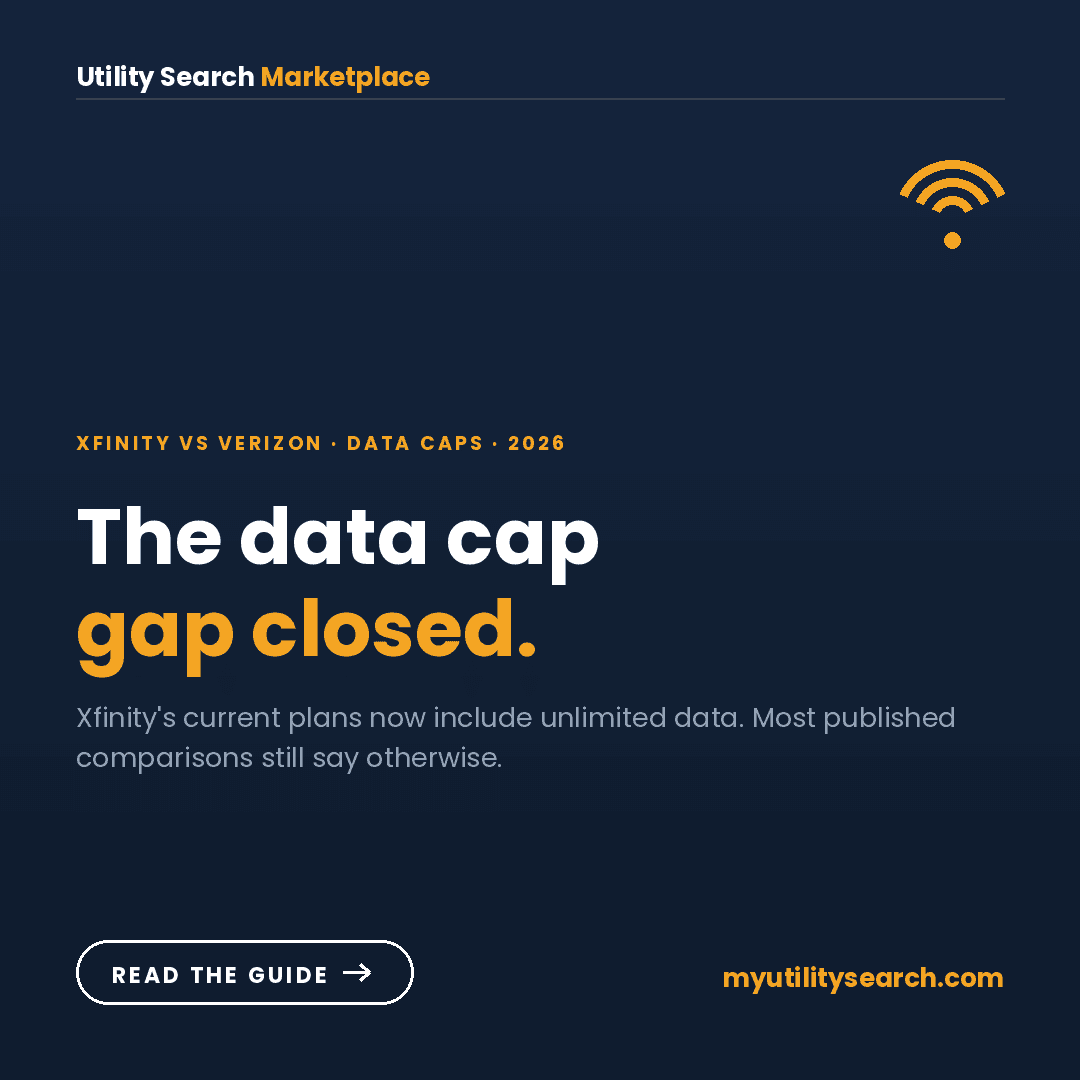
- Xfinity includes unlimited data on all new plans. The 1.2 TB internet data cap survives only on legacy plans, and it never existed in 13 Northeast states.
- AT&T caps its older copper “AT&T Internet” tiers at 1.5 TB and DSL at 150 GB; AT&T Fiber, AT&T Internet 100+ and Internet Air are unlimited.
- The average U.S. home used 711 GB a month in the second quarter of 2026, and 5.86% of homes now pass 2 TB, which means a capped plan is a real risk for a growing share of households, not just a few power users.
- No federal rule limits internet data caps. The FCC’s 2024 inquiry produced no regulation, and the agency’s public data-cap complaint page has since been taken down.
What is an internet data cap?
An internet data cap, sometimes called a data plan or data allowance, is a monthly limit on how much data your home plan includes, measured in gigabytes (GB) or terabytes (TB). Everything you stream, download, upload, back up or video-call counts toward it. Go over and one of three things happens depending on the provider: you’re billed for extra data in blocks, you’re pushed toward an unlimited add-on, or your speeds are slowed until the next billing cycle.
Cable networks tend to use hard caps with per-block overage charges. Satellite providers sell “priority data” buckets and slow you afterward. Fixed-wireless 5G plans have no hard cap at all but can deprioritize your traffic.
Definition — deprioritization: On fixed-wireless plans such as T-Mobile Home Internet and Verizon 5G Home, your traffic can be ranked below mobile-phone customers when a tower is congested, which temporarily slows your speed. Unlike a cap, it never stops service and never triggers a fee. It only affects speed at peak times.
Which providers still have an internet data cap in September 2026?
The short version: the internet data cap has retreated to three places — Cox’s cable footprint, Xfinity’s legacy plans, and AT&T’s copper network — plus satellite, where it takes the form of priority-data buckets. Here is the provider-by-provider status, verified against each company’s own policy pages where they publish one.
| Provider | Internet data cap (Sept 2026) | Overage | Unlimited option |
|---|---|---|---|
| Cox (all wired plans) | 1.25 TB (1,280 GB) up/down combined | $10 per 50 GB, $100/mo max; first overage credited | Unlimited add-on (listed at $49.99/mo by CableTV); wireless-served areas have no overage |
| Xfinity — new plans (300 Mbps+) | None | — | Included |
| Xfinity — legacy plans | 1.2 TB | $10 per 50 GB, $100/mo max; one courtesy month per 12 months | Unlimited Data or xFi Complete add-on, or switch plans |
| AT&T Internet (copper, 768K–75 Mbps) | 1.5 TB | $10 per 50 GB, $100/mo max | $30/mo |
| AT&T DSL | 150 GB | $10 per 50 GB, $200/mo max | $30/mo |
| AT&T Fiber, Internet 100+, Internet Air | None | — | Included |
| Spectrum | None | — | Included |
| Optimum | None | — | Included |
| Verizon Fios, Google Fiber, Frontier Fiber, Quantum Fiber | None | — | Included |
| Mediacom, Sparklight, Astound | None | — | Included |
| Starlink (Residential) | None | — | Included |
| T-Mobile / Verizon 5G Home | No hard cap; deprioritization during congestion | — | — |
| Hughesnet / Viasat (satellite) | Priority-data buckets by plan; slowed after | None (speed reduction instead) | Varies by plan |
Sources: Cox “Speeds and Data Plans” policy (updated Feb 24, 2026), Xfinity 1.2 TB data plan FAQ, AT&T data allowance support article, CableTV.com data cap guide (Apr 15, 2026) for the Cox unlimited price and the Mediacom/Sparklight/Astound rows.
Cox: the last big internet data cap, and why the Spectrum deal matters
Cox is the only large cable operator that still bills overages. Its policy page, updated February 24, 2026, lists the same 1.25 TB monthly data plan on every wired tier from Fast 300 Mbps to Go Beyond Fast 2 Gig, with overages at $10 per 50 GB block up to $100 a month ($30 for ConnectAssist customers). Cox credits the first overage in a customer’s history, sends usage alerts starting at 50%, and doesn’t count Cox phone service or most Contour video toward the cap. Two quiet exceptions: plans delivered over Cox’s wireless network and the prepaid StraightUp Internet product carry the same 1.25 TB allowance but “Not Applicable” overage charges.
What changed is the owner. Charter, which runs Spectrum, completed its acquisition of Cox on August 20, 2026, and Spectrum has never enforced a data cap. Charter’s closing announcement says Spectrum plans to launch its entire product suite to consumers in the former Cox markets in mid-September, while telling existing customers they will “not see any pricing or service changes at this time, unless initiated by you.” Read those two sentences together and the picture is this: a Cox customer who moves to a Spectrum plan when the lineup arrives leaves the cap behind; a customer who stays on a legacy Cox plan keeps it until Charter says otherwise. Neither company has announced a date for retiring the Cox cap outright. If you’re a Cox customer who regularly clears 1 TB, the mid-September plan launch is the moment to compare, and our Charter–Cox merger guide tracks what’s changing month by month.
Xfinity: unlimited on new plans, 1.2 TB on legacy plans, and the 13 states that never had a cap
Comcast’s own support page is unusually plain about it: “New Xfinity Internet plans include unlimited data and equipment at no extra cost. The 1.2 TB data limit only applies to older (legacy) internet plans.” If you’re still on a legacy plan, the first time you exceed 1.2 TB in a 12-month period is a courtesy month with no charge; after that it’s $10 per 50 GB up to $100. Alerts arrive at 75%, 90% and 100%, and again when overages hit $50 and $100. You can’t opt out of the legacy cap, but you can escape it three ways: switch to any new plan at 300 Mbps or above, add Unlimited Data, or add xFi Complete where it’s offered.
The exclusion list is worth knowing. The 1.2 TB cap never applied to Xfinity customers in Connecticut, Delaware, Massachusetts, Maryland, Maine, New Hampshire, New Jersey, New York, Pennsylvania, Virginia, Vermont, West Virginia and Washington, D.C., plus parts of North Carolina and Ohio — the old NBCUniversal/Northeast footprint. It also never applied to Internet Essentials, Prepaid, NOW Internet or Gigabit x10. Xfinity’s page notes most of its customers use about 498 GB a month. If you’re on a legacy plan, our Xfinity speed-tier guide shows what the current no-cap plans cost.
How much do overage fees actually cost?
On a capped cable plan, every overage is billed in 50 GB blocks at $10 each, up to a $100 monthly ceiling. That ceiling is the number to remember: a $60 plan can become a $160 plan in a heavy month, and AT&T DSL’s ceiling is $200. The unlimited add-ons that avoid the risk cost $30 a month at AT&T and Xfinity legacy plans, and about $50 at Cox, which means a capped customer paying for unlimited is often paying more than an uncapped fiber or 5G plan at the same address would cost outright.
Stat block — how much data homes use now: OpenVault’s Broadband Insights report for the second quarter of 2026 puts average monthly usage at 711 GB per subscriber, up 7.1% from 664.2 GB a year earlier. Median usage rose 11.8% to 482.3 GB. The share of homes using more than 2 TB a month reached 5.86%, a 16.1% increase year over year, and upstream usage grew 19.2% to 58.2 GB, more than three times the growth rate of downloads. Fiber customers upload the most, averaging 94.1 GB a month. (OpenVault OVBI 2Q26, July 22, 2026)
Those numbers explain why the cap became a retail problem for cable operators. An average home is now using more than half of a 1.2 TB allowance every month, and the 2 TB club is growing at double digits. Homes that work from home with cloud backups, run several 4K streams, or download games in the 100 GB range are the ones that hit overages, and they’re exactly the customers a provider least wants to lose to fiber.
How do I know if I’m hitting my internet data cap?
Every provider with a cap runs a usage meter. Cox shows it under Internet Tools in the Cox app; Xfinity shows it to primary or manager users in the Xfinity app; AT&T shows it in myAT&T. Check it twice in a billing cycle, at the midpoint and three days before the reset, and you’ll know whether your household is a 400 GB home or a 1.4 TB home. For a rough forecast, Netflix publishes that 4K streaming uses up to 7 GB an hour and HD about 3 GB an hour; three hours of 4K a night is roughly 630 GB a month on its own before anyone downloads a game, backs up a phone, or joins a video call.
How to avoid internet data caps and overage fees
The surest way to avoid a cap is to pick an uncapped plan in the first place, and in 2026 that’s most of the market. If you’re already on a capped plan, work through these in order:
- Check whether you’re on a legacy plan. Xfinity customers on a cap can move to any current plan at 300 Mbps or above and the cap disappears. Cox customers should watch the mid-September Spectrum lineup for the same reason.
- Compare uncapped providers at your address. If AT&T Fiber, Frontier, Fios, Google Fiber, Quantum, Spectrum, Optimum or a 5G home carrier serves you, the cap question is over. Our guide to fiber vs. cable vs. 5G home internet covers the tradeoffs.
- Price the unlimited add-on against a switch. Cox’s roughly $50 add-on and AT&T’s $30 add-on are, in most markets, more than the gap between your plan and a competitor’s uncapped one.
- Use the courtesy month deliberately. Xfinity legacy plans forgive one overage per 12 months; Cox credits your first ever. If a big move or a new console is coming, schedule the heavy month.
- Trim the invisible usage. Set streaming apps to “auto” or 1080p on TVs that aren’t 4K, turn off automatic cloud backup of video, and pause console auto-updates. Those three settings are the difference between 900 GB and 1.3 TB in a lot of homes.
Is anyone going to ban the internet data cap?
Not soon. The FCC opened a formal Notice of Inquiry into broadband data caps in October 2024 (WC Docket No. 23-199) to study how caps affect consumers and competition. Industry groups asked the agency to drop it, an inquiry gathers information rather than making rules, and the commission that opened it changed leadership in January 2025. As of September 2026 no rule has followed, and the FCC’s public “data caps” consumer page now returns a notice that access has been disabled. In practice, the data cap is being retired by competition, not regulation: fiber overbuilders and 5G home internet sell unlimited data as a headline feature, and the two cable companies that held out longest, Comcast and now Cox through Charter, are the ones giving way.
Compare uncapped internet, energy & home security at your address
Frequently asked questions
Which internet providers still have a data cap in 2026?
As of September 2026, Cox enforces a 1.25 TB internet data cap on all wired plans, Xfinity keeps a 1.2 TB cap on legacy plans only, and AT&T caps its copper AT&T Internet tiers at 1.5 TB and DSL at 150 GB. Satellite providers sell priority-data buckets and slow speeds afterward. Spectrum, Optimum, AT&T Fiber, Verizon Fios, Google Fiber, Frontier, Quantum Fiber, Mediacom, Sparklight, Astound, Starlink Residential and the T-Mobile and Verizon 5G home services have no data cap.
Does Xfinity still have a data cap in 2026?
Only on legacy plans. Xfinity’s support page states that new Xfinity Internet plans include unlimited data, and the 1.2 TB limit applies only to older plans. Legacy customers get one courtesy overage month per 12 months, then pay $10 per 50 GB up to $100. The cap never applied in 13 Northeast states and D.C.
Will Cox drop its data cap now that Spectrum owns it?
Not announced yet. Charter completed its purchase of Cox on August 20, 2026, Spectrum has no internet data cap, and Charter says Spectrum’s full product lineup launches in Cox markets in mid-September 2026. Customers who move to a Spectrum plan will not have a cap; Cox’s own policy page, last updated February 24, 2026, still lists the 1.25 TB plan for existing Cox plans.
How much are internet overage fees?
Cox, Xfinity legacy plans and AT&T all bill $10 for each 50 GB block over the cap. The monthly maximum is $100 at Cox and Xfinity and for AT&T Internet copper plans, and $200 for AT&T DSL. Unlimited add-ons cost $30 a month at AT&T and on Xfinity legacy plans, and about $49.99 at Cox.
How much data does the average home use per month?
OpenVault’s second-quarter 2026 report puts average U.S. household usage at 711 GB a month, with median usage of 482.3 GB. About 5.86% of homes use more than 2 TB a month, up 16.1% from a year earlier.
Do fiber internet plans have data caps?
No major fiber provider in the U.S. enforces a data cap. AT&T Fiber, Verizon Fios, Google Fiber, Frontier Fiber, Quantum Fiber, Ziply, Brightspeed Fiber, TDS Fiber and the regional fiber builders all include unlimited data.
Does 5G home internet have a data cap?
T-Mobile Home Internet, Verizon 5G Home and AT&T Internet Air have no hard data cap and no overage fees. During congestion your traffic may be deprioritized behind mobile customers, which slows speeds temporarily but never adds a charge.
Is the FCC going to ban internet data caps?
There is no rule and none is pending. The FCC opened a Notice of Inquiry on data caps in October 2024 (WC Docket 23-199), which collected comments but did not propose regulation, and the agency’s public data-caps page has since been taken offline. Data caps remain legal in every state.
Sources
- Cox — Speeds and Data Plans Information for Internet Services (updated February 24, 2026)
- Xfinity — Xfinity Internet 1.2 TB data plan FAQs
- AT&T — Home internet data allowances
- Charter — Charter and Cox Communications Complete Transaction (August 20, 2026)
- OpenVault — Broadband Insights Report (OVBI) 2Q26 (July 22, 2026)
- FCC — FCC Explores How Broadband Data Caps Impact Competition and Consumers (Notice of Inquiry, October 2024)
- CableTV.com — Internet Provider Data Caps Guide (April 15, 2026)