Blog
Business Utilities (2026): How to Set Up Electricity, Internet, Security, Gas and Water for a New Location — What You Can Shop and What It Costs

Updated on September 29, 2026
12 min read
Last updated September 28, 2026 · originally published September 28, 2026 · Benchmarks are EIA’s July 2026 commercial electricity release, the provider business pages read September 28, and the public small-commercial terms cited on our commercial pages. Every figure is dated in the text.
Business utilities for a new location are six accounts — electricity, natural gas, water and sewer, internet, phone, and security or fire monitoring — and as of September 28, 2026 only three of them can be shopped. Electricity is shoppable in the 14 retail-choice markets, where a business signs a supply contract with a retail provider while the utility keeps delivering; internet is shoppable everywhere two or more providers reach the address; security is shoppable everywhere.
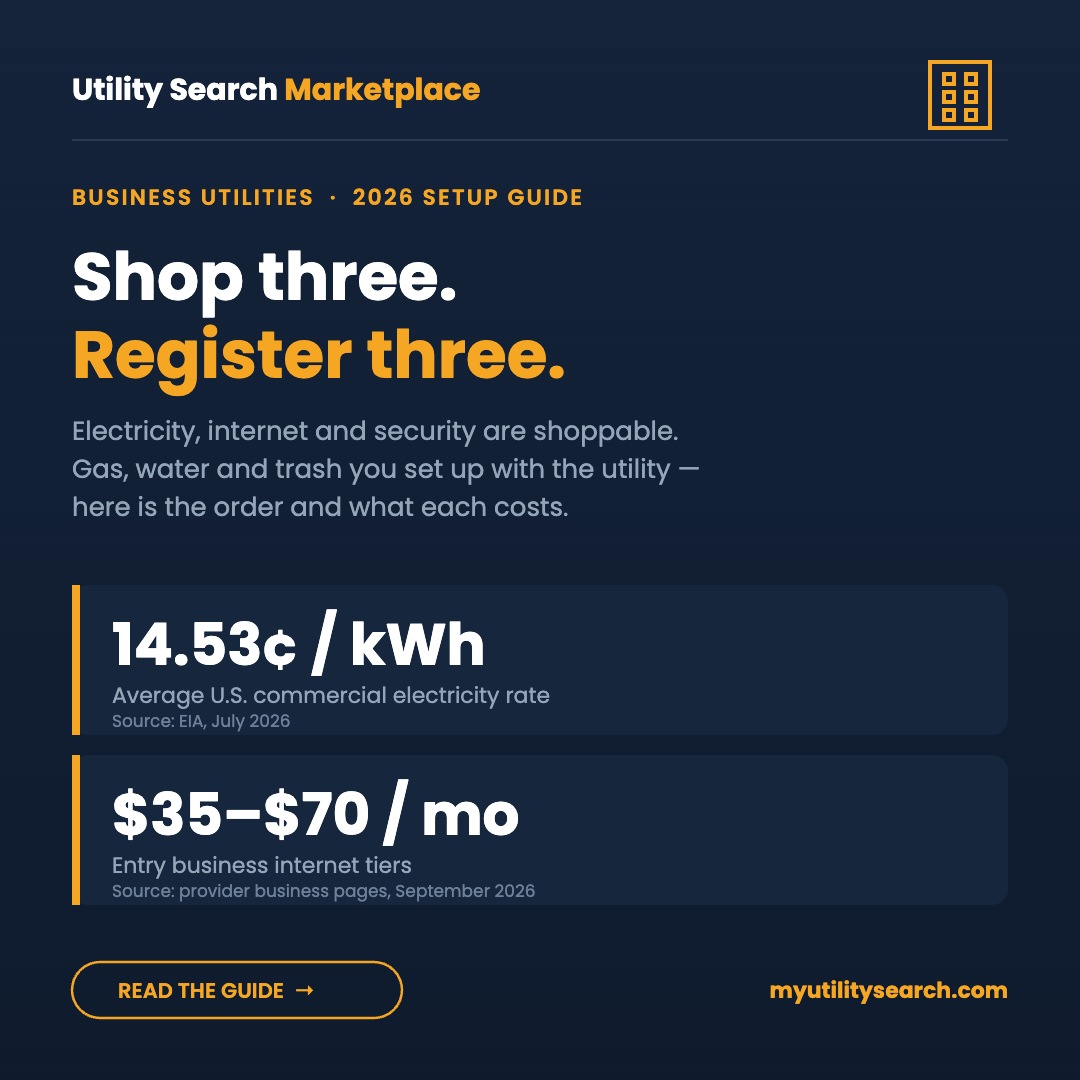
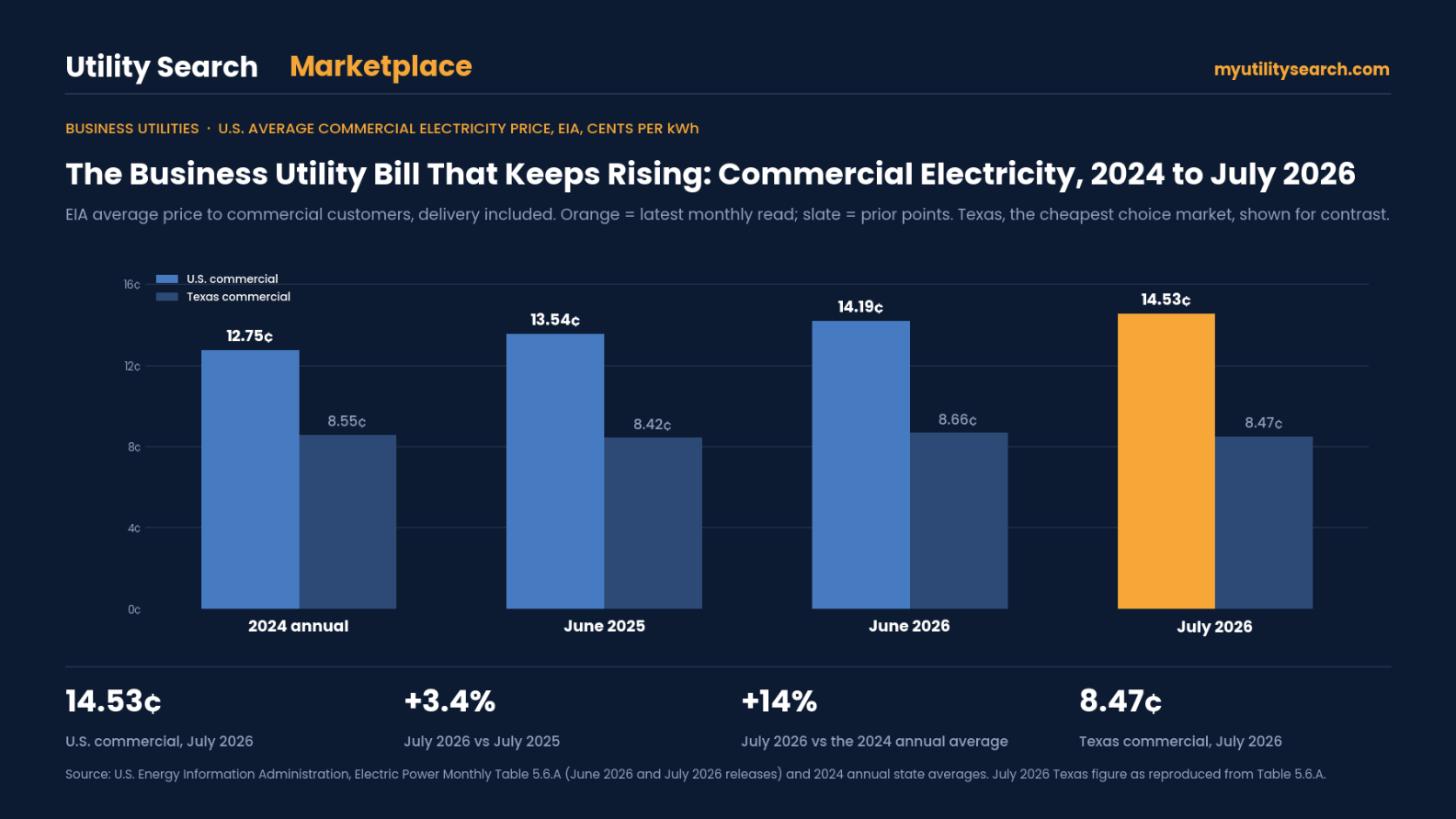
Gas is shoppable in about a dozen states, and water, sewer and trash never are. The U.S. commercial electricity average is 14.53¢ per kWh (EIA, July 2026), business internet entry tiers run $35 to $70 a month, and the rest of this page is the order to set them up in.
TL;DR — business utilities, September 2026
- Shop three, register three: electricity (choice markets), internet and security are competitive; gas is partly; water, sewer and trash are the incumbent’s at the incumbent’s rate.
- Electricity benchmark: U.S. commercial 14.53¢/kWh in July 2026, up 3.4% in a year and 14% on the 2024 average; Texas 8.47¢. Above 10 kW a demand charge, not the energy rate, decides most of the bill.
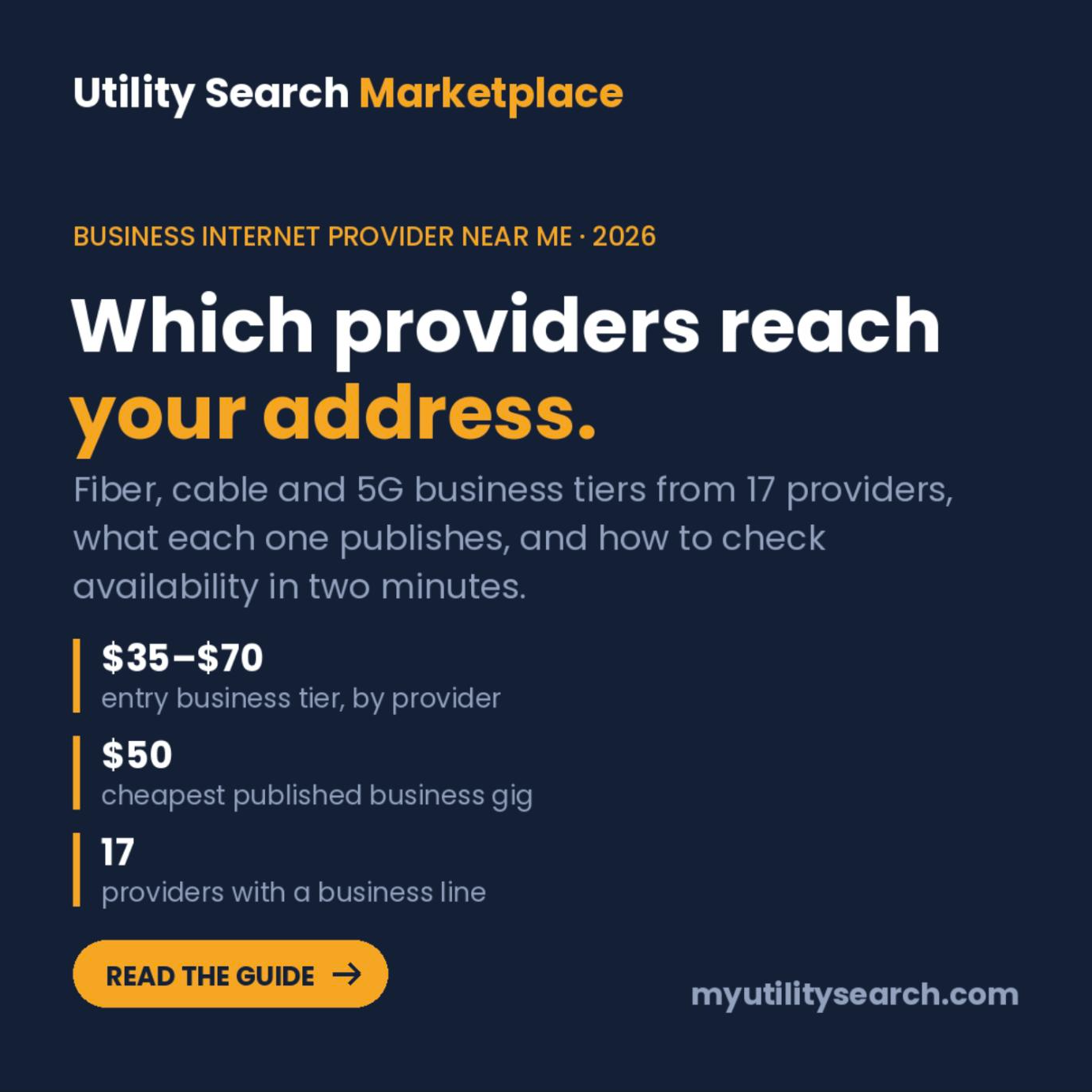
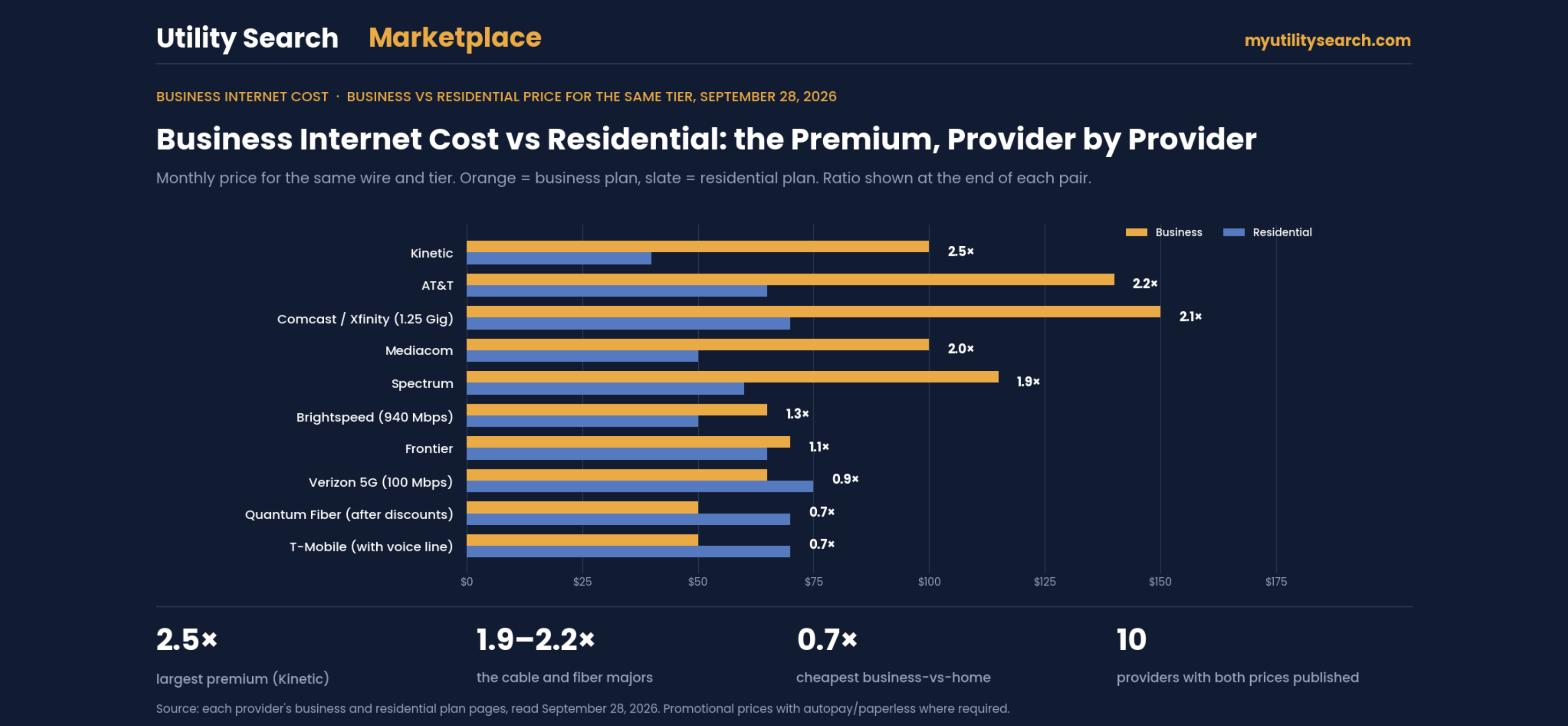
- Internet benchmark: entry business tiers $35–$70, published business gig $50 (Quantum) to $150 (Comcast); business tiers run about double residential on the same wire at the cable and incumbent-fiber brands.
- Lead times: electricity switches in one billing cycle; wired internet is 5 to 15 business days where the building is already served and weeks where a build-out is needed; 5G business internet ships in days.
- The order: address checks first, electricity and internet contracts second, then security, gas and the municipal accounts — the 30-day plan is at the bottom.
Business utilities checklist for a new location
| Utility | Who provides it | Can you shop it? | Typical lead time | Have ready |
|---|---|---|---|---|
| Electricity | Retail supplier (choice markets) or the utility | Yes in TX, OH, PA, IL, NJ, NY, MD, DC, MA, CT, DE, ME, NH, RI; no elsewhere | One billing cycle to switch; same-week start on an existing meter | 12 months of usage and billing kW if available; EIN; deposit or credit reference |
| Natural gas | Utility, or a retail supplier in choice states | Partly — business gas choice in IL, OH, PA, NJ, MD, DC, GA, VA, KY, MI, IN among others | One billing cycle | Meter number from the previous tenant’s bill |
| Internet | Cable, fiber or 5G provider | Yes, wherever two or more reach the address | 5–15 business days if the building is served; weeks for a build-out; days for 5G | Exact suite; landlord riser access; static-IP and SLA needs |
| Phone / VoIP | Bundled with internet or a VoIP vendor | Yes | Days; port the number before the old line closes | Existing numbers and account PIN for porting |
| Security and fire monitoring | National or local alarm company | Yes | 1–3 weeks incl. permit | Fire code requirements from the lease; camera count |
| Water, sewer, trash | Municipality or franchise hauler | No | Days; some cities require the lease and a deposit | Lease, EIN, deposit |
Business electricity: the utility you can actually negotiate
Electricity is the largest controllable line in business utilities and the only one priced to your meter. In the 14 retail-choice markets the utility still owns the wires and bills delivery, but the supply portion is a contract you sign with a retail provider, priced from your 12-month usage and load shape for a 12-, 24- or 36-month term. Below roughly 50 kW of peak demand a business can read published plans — in Texas, Champion’s small-commercial plan on Oncor carries a 9.7¢ energy charge and 17.0 to 18.7¢ all-in as of September 28, 2026 — and above that every price is a quote.
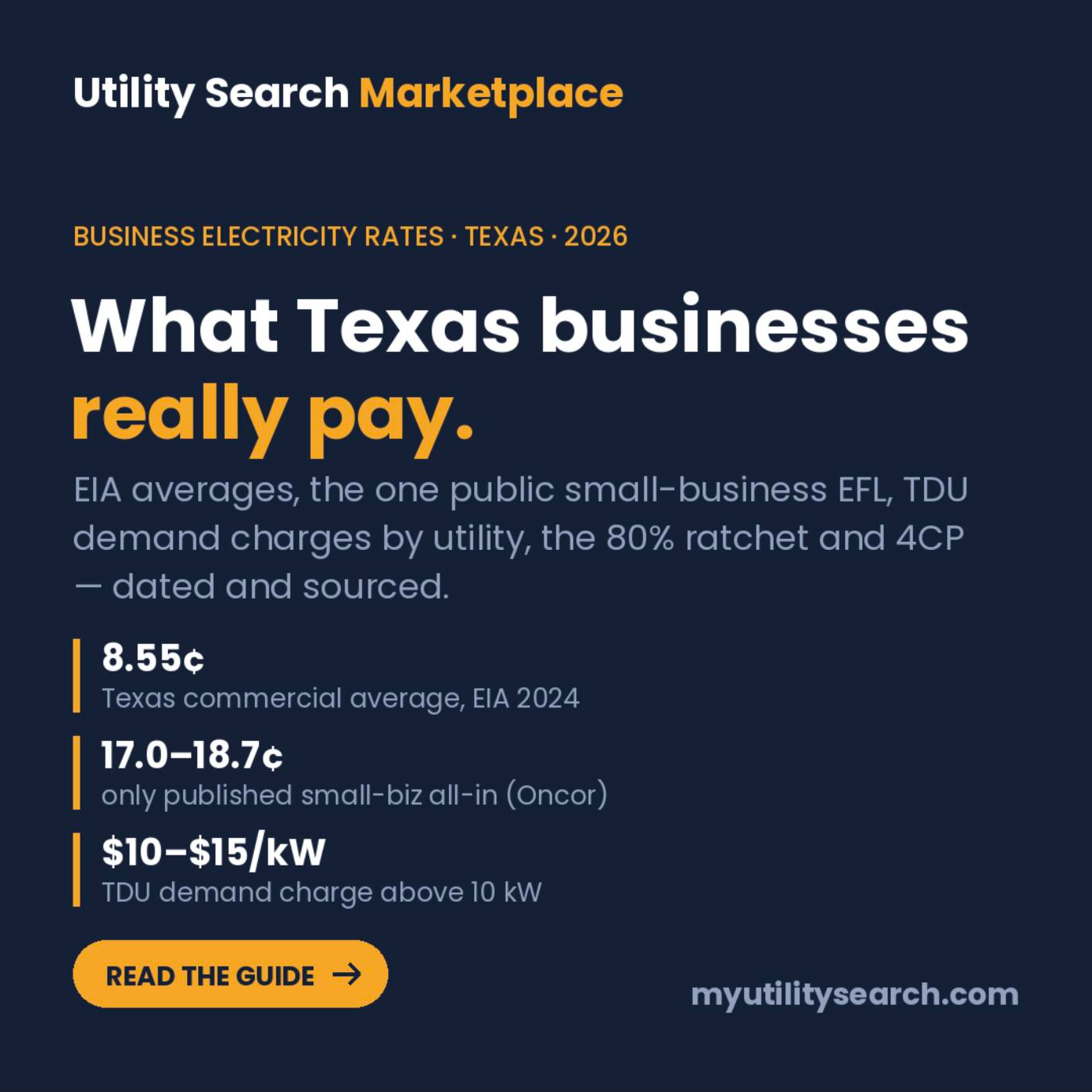
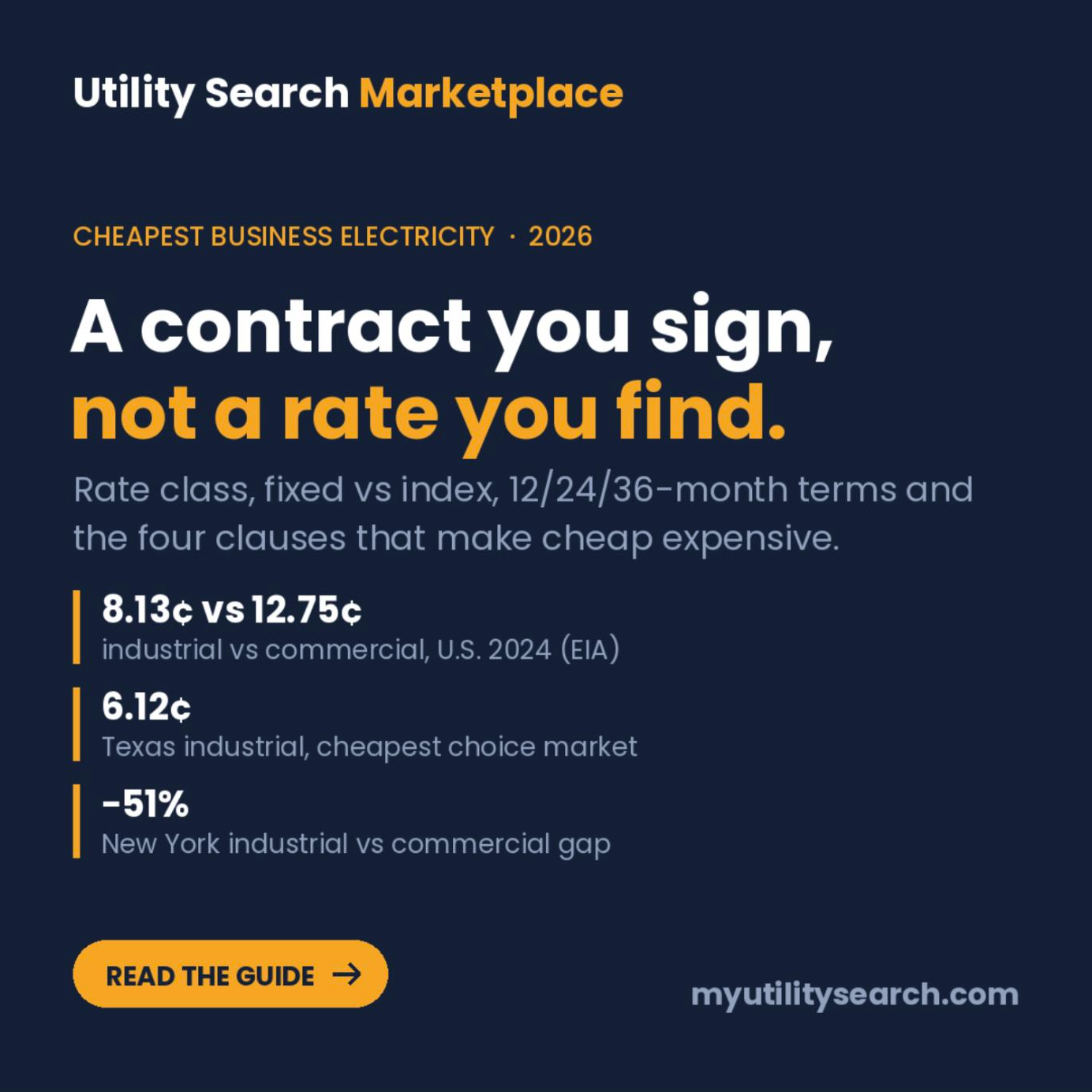
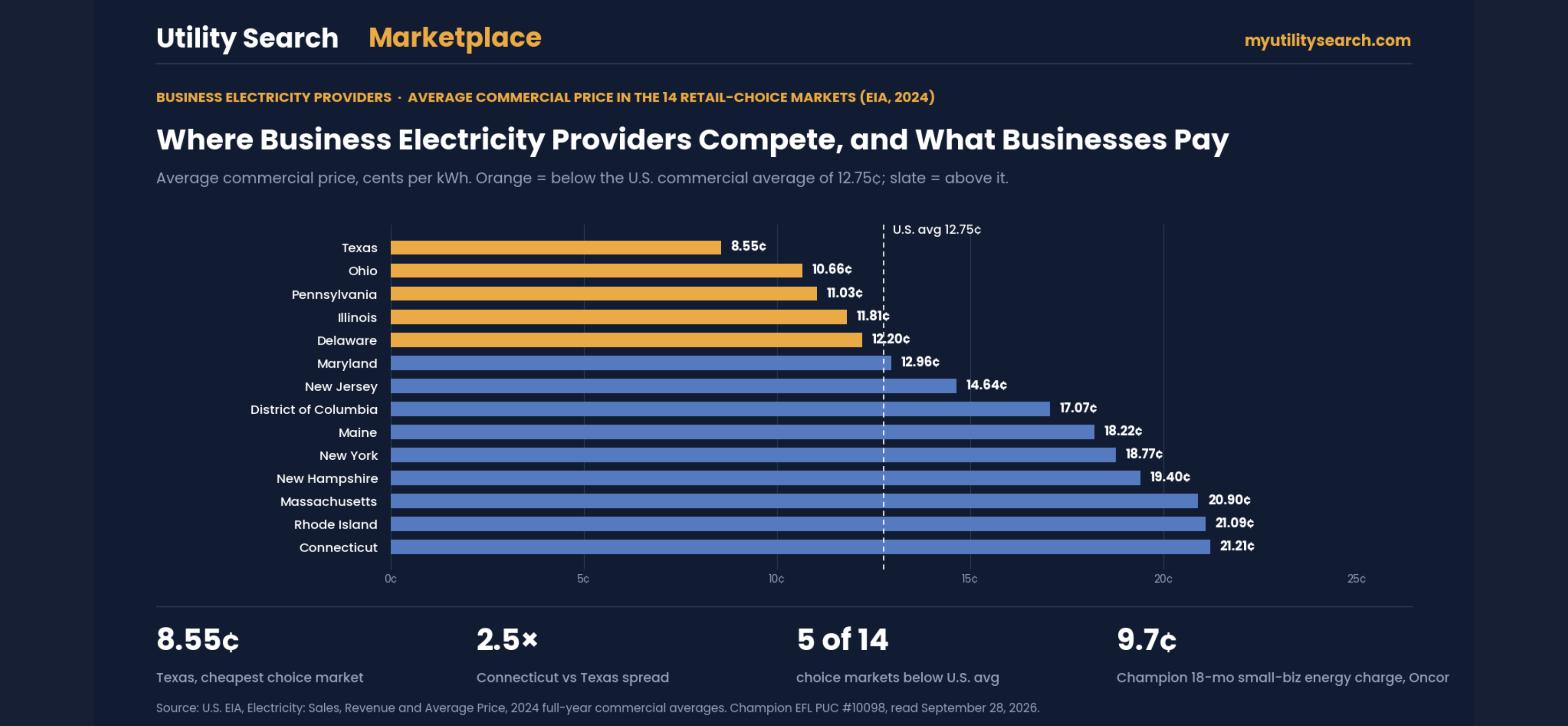
The benchmark to hold quotes against is EIA’s average price to commercial customers: 14.53¢ per kWh nationally in July 2026, up 3.4% from July 2025 and 14% on the 2024 annual average of 12.75¢. By choice market it runs from Texas at 8.55¢ (2024) to Connecticut at 21.21¢. The delivery half of the bill — the utility’s customer, distribution and demand charges — is the same under every supplier and, above 10 kW, is billed per kilowatt of your worst 15 minutes each month.
Where a business sits on the map matters more than any other business utilities decision: the chart below is the 2024 commercial average in each of the 14 retail-choice markets, the spread a supplier quote should be measured against.
The four commercial electricity pages on this site do the rest: business electricity explains the market, business electricity providers scores the suppliers, cheapest business electricity covers contract types and the all-in comparison, commercial electricity rates by state ranks the markets, and business electricity rates Texas works the demand-charge and 4CP math for the largest market.
Business internet: shoppable everywhere, decided by address
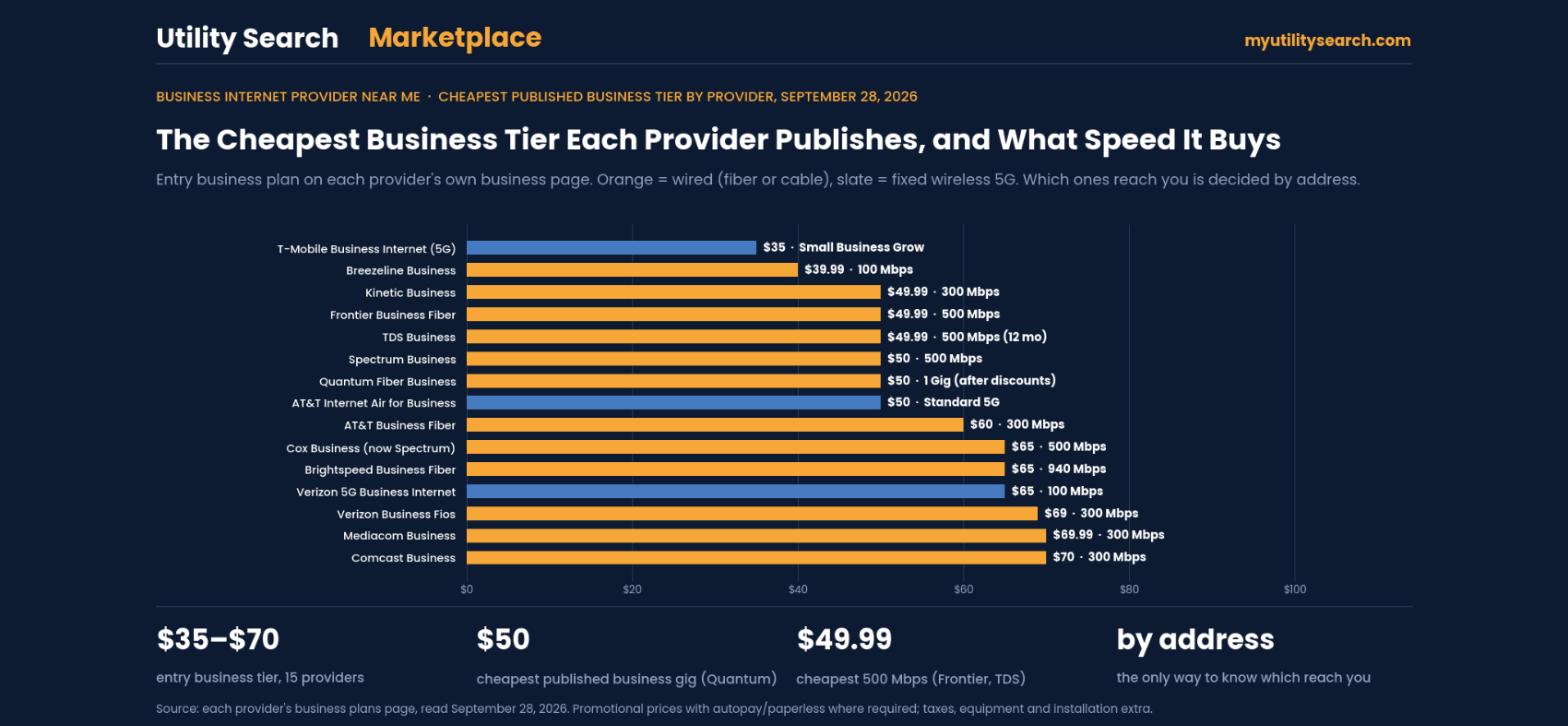
Internet is the business utility with the most sellers and the least transparency about who reaches you. Seventeen national providers publish a business line as of September 28, 2026 — fiber from AT&T, Verizon, Frontier, Quantum, Brightspeed, Kinetic and Google Fiber; cable from Spectrum, Comcast, Cox, Mediacom, Optimum, Sparklight, Breezeline and WOW!; 5G from T-Mobile, Verizon and AT&T Internet Air — and two or three will reach a given storefront. Entry business tiers run $35 (T-Mobile) to $70 (Comcast 300 Mbps); a published business gig runs $50 (Quantum, after discounts) to $150 (Comcast 1.25 Gig), with the four national majors at $115–$150.
The business utilities premium is real on internet: the same wire costs about double under a business account at the cable and incumbent-fiber brands, and less than the home plan at T-Mobile and Quantum.
Three rules from the internet pages. Check the exact address on the FCC National Broadband Map and each provider’s business checker, because fiber that passes the street may need a construction quote to enter the building. Take fiber where it exists, cable where it does not, and a 5G line as the backup for the card reader either way. And compare all-in: installation ($0 at AT&T, Frontier, Kinetic; $99–$199 at Cox), equipment ($0 to $15 a month), and what the promo steps to. The method is on business internet provider near me, the price ladder on business internet cost, and the provider comparison on business internet providers.
Business security and fire monitoring
Security is shoppable everywhere, but the lease usually decides the floor: most commercial leases require monitored fire and intrusion coverage, and the local fire code sets what the fire side must include. The practical split is simple. A home office stays on a residential system — the national brands’ consumer plans cover it and cost less. A storefront, clinic, warehouse or restaurant needs the brand’s business line, which adds commercial monitoring, fire and sprinkler supervision, access control and the certificate your insurer asks for.
Several of the brands on our security pages sell one; several do not, and say so on their business pages. Start with home security for the brand-by-brand picture, and treat the permit (most cities require an alarm permit for a business) as part of the lead time.
Set up business utilities at your address
Gas, water, sewer and trash: the business utilities you register, not shop
Natural gas splits by state. In the choice states — Illinois, Ohio, Pennsylvania, New Jersey, Maryland, D.C., Georgia, Virginia, Kentucky, Michigan and Indiana are where the largest commercial supplier sells business gas as of September 28, 2026 — a business can contract supply the same way it contracts electricity, with the utility delivering. Elsewhere the utility is the only seller.
Water and sewer are municipal or a regulated private utility everywhere, at a tariff you cannot negotiate; the account is opened with the lease, an EIN and often a deposit, and a business with meaningful water use should ask about a separate irrigation or process meter, which changes the sewer charge. Trash is a city contract or a franchise hauler; where haulers compete, the container size and pickup frequency are the only levers.
What business utilities cost: the benchmarks
| Utility | Benchmark | What moves it | Source, date |
|---|---|---|---|
| Electricity (U.S. commercial) | 14.53¢/kWh, July 2026; 12.75¢ 2024 annual | Market, load factor, demand charges, term | EIA Table 5.6.A, released September 24, 2026 |
| Electricity (Texas commercial) | 8.47¢/kWh July 2026; 8.55¢ 2024 | Demand charge $10.10–$14.98 per kW above 10 kW; 4CP above ~700 kW | EIA; TDU tariffs (April 30, 2026 reproduction) |
| Electricity (published small-commercial plan) | 9.7¢ energy; 17.0–18.7¢ all-in (Champion, Oncor) | Usage band; term | Champion EFL, September 28, 2026 |
| Internet, entry business tier | $35–$70/mo | Technology; promo conditions; install $0–$199 | Provider business pages, September 28, 2026 |
| Internet, 1 Gig business | $50–$150/mo; majors $115–$150 | Fiber vs cable; term; 24-month total $1,200–$3,600 | Provider business pages, September 28, 2026 |
| 5G business internet | $35–$85/mo | Bundled phone line; capacity at the address | T-Mobile, Verizon, AT&T, September 28, 2026 |
| Security, gas, water, trash | Quoted / tariffed | Lease and code requirements; municipal tariff | — |
Deposits, credit and the questions to ask before you sign
Two things trip up business utilities setups more than price: the deposit and the exit clause. Every shoppable business utility runs a credit check on the business, not the owner, and a new entity with no history should expect a deposit or a request for a personal guarantee; ask for the deposit policy and the refund trigger in writing.
For electricity, ask for the energy charge and every base or minimum charge, whether delivery is passed through at cost, the exact early-termination formula, and what happens at the end of the term if you do nothing — the published Texas terms are $4.95 per meter and $250 per remaining month, capped at 12, at NRG Business.
For internet, ask whether the price is for your exact address or a market rate, what installation includes, what the promo steps to, whether there is an agreement, and whether the gateway is included. A quote that cannot answer in writing is not a quote.
The 30-day plan for business utilities at a new location
- Day 1 — address checks. Run the exact address through the FCC National Broadband Map and each wired provider’s business checker; confirm the electricity utility and whether the state is a choice market; ask the landlord which providers are already in the riser.
- Days 1–5 — electricity. Pull 12 months of history from the previous tenant or the utility if you can; get three quotes at 12, 24 and 36 months; compare all-in at your usage; sign so the switch lands before the first bill.
- Days 1–10 — internet. Order the wired line first because it has the longest lead time; order a 5G business line the same week as the backup and the bridge if the wired install slips.
- Days 5–15 — security and fire. Read the lease’s coverage clause, quote the business line at two brands, file the alarm permit.
- Days 5–15 — gas, water, sewer, trash. Open the municipal accounts with the lease and EIN; contract gas supply if the state allows it.
- Day 30 — the diary. Record every contract’s end date and renewal terms; every business utility on this list rolls to a worse rate if nobody is watching.
Frequently asked questions about business utilities
What utilities does a business need to set up?
Six accounts: electricity, natural gas where the building uses it, water and sewer, internet, phone, and security or fire monitoring, plus trash service. As of September 28, 2026, electricity is shoppable in 14 retail-choice markets, gas in roughly a dozen states, and internet and security everywhere; water, sewer and trash are registered with the municipality or its franchise hauler.
Which business utilities can you shop?
Electricity supply in TX, OH, PA, IL, NJ, NY, MD, DC, MA, CT, DE, ME, NH and RI; natural gas supply in the gas-choice states (IL, OH, PA, NJ, MD, DC, GA, VA, KY, MI and IN among them); internet wherever two or more providers reach the address; and security everywhere. Delivery, water, sewer and trash stay with the incumbent at its tariff.
What is the average cost of business utilities?
Electricity averaged 14.53¢ per kWh for U.S. commercial customers in July 2026 (EIA), with Texas at 8.47¢; business internet entry tiers run $35 to $70 a month and a business gig $50 to $150; 5G business lines $35 to $85. Gas, water and security are tariffed or quoted by location, so no national average is meaningful.
How long does it take to set up business utilities?
Electricity switches within one billing cycle and can start the same week on an existing meter; wired business internet takes 5 to 15 business days where the building is already served and weeks where a build-out is required; 5G business internet ships in days; security and fire monitoring 1 to 3 weeks including the permit; municipal accounts a few days.
Do business utilities require a deposit?
Often, for a new entity. Retail electricity providers and internet providers run a business credit check and can require a deposit or a personal guarantee; municipal water accounts commonly require one with the lease. Ask each provider for the deposit amount and the condition that refunds it in writing before signing.
Is comparing business utilities here free?
Yes. Comparing business electricity, internet and security through MyUtilitySearch is free. You pay the rate on your contract and nothing else.
Bottom line on business utilities
Set up business utilities in the order of their lead times and their leverage: address checks on day one, electricity and internet contracts in the first week because they are the two you can negotiate, security and the municipal accounts in the second, and a diary of every end date at the close. The benchmarks on this page — 14.53¢ commercial electricity, $35–$70 entry business internet, roughly double residential for a business line on the same wire — are what a fair quote looks like in September 2026.
Set up business utilities at your address
Sources
- EIA — Electric Power Monthly, Table 5.6.A (July 2026 data, released September 24, 2026; June 2026; 2024 annual)
- FCC National Broadband Map — address-level provider availability
- Oncor — Delivery Charges 101 (demand billing above 10 kW; 15-minute interval; ratchet)
- Provider business plan pages read September 28, 2026 and the Champion Electricity Facts Label, NRG Business Texas terms and TDU tariff reproduction, each cited in full on business internet cost, business electricity providers and business electricity rates Texas
- Constellation — small-business electricity and natural gas markets (the gas-choice state list), read September 28, 2026
Keep going
- Business electricity — how the commercial market works
- Business electricity providers — the suppliers, scored on how they quote
- Cheapest business electricity — contract types and the all-in method
- Commercial electricity rates by state — the 14 choice markets ranked
- Business electricity rates Texas — demand charges, 4CP and the Texas benchmarks
- Business internet providers and business internet cost — the provider comparison and the price ladder
- Business internet provider near me — the two-minute address method