Blog
Cheapest Business Electricity: Contracts, Terms and What Each Business Type Pays (2026)

Updated on September 29, 2026
11 min read
Last updated September 28, 2026 · Prices are EIA 2024 full-year averages by state and sector, plus the one small-commercial Electricity Facts Label that is public without a quote (Champion Energy, read September 28, 2026). No rate on this page is estimated.
The cheapest business electricity in the United States is not a rate you find, it is a contract you sign. In 2024 industrial-class customers paid an average of 8.13¢ per kWh while commercial-class customers paid 12.75¢ (EIA), a 36% gap that comes almost entirely from load shape, delivery voltage and contract structure rather than from the supplier. In the 14 retail-choice markets the cheapest business electricity is a fixed-price supply contract of 12 to 24 months on a meter with a high load factor, compared against the utility’s default rate at your real usage, with the exit fee read before the rate. Texas is the cheapest market on both classes: 8.55¢ commercial and 6.12¢ industrial.
TL;DR — where the cheapest business electricity actually comes from
- Rate class beats supplier. Industrial 8.13¢ vs commercial 12.75¢ nationally; the gap is 29% in Texas and 51% in New York. A warehouse or plant on the wrong class is overpaying before any contract is signed.
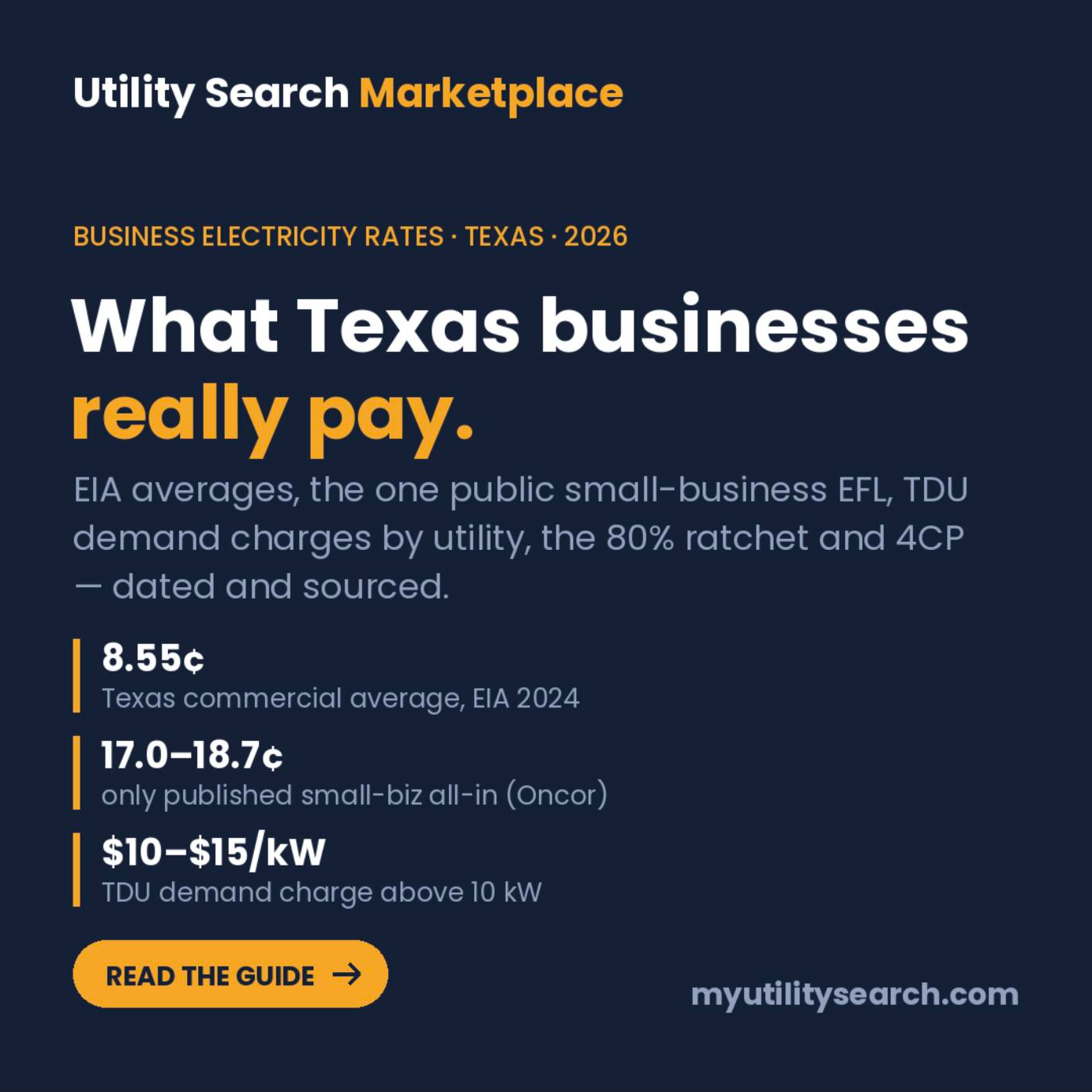
- Supply is the only part you can shop. On the one public small-business EFL, the 9.7¢ energy charge becomes 17.0–18.7¢ all-in once Oncor delivery is added. Delivery does not move.
- Fixed-price, 12–24 months, is the cheapest business electricity for most small accounts. Index and block-and-index win only when you can tolerate a variable bill.
- Cheapest by market: Texas 8.55¢ commercial, then Ohio 10.66¢, Pennsylvania 11.03¢, Illinois 11.81¢, Delaware 12.20¢. Connecticut is dearest at 21.21¢.
- Read four clauses before the rate: early-termination fee, usage bandwidth, capacity pass-through, and what happens at renewal.
Why the cheapest business electricity is a contract question, not a rate-card question
A business bill has two halves. Delivery — the wires, the meter and outage restoration — is billed by the utility at a tariff your state commission approves, and no supplier can change it. Supply — the energy itself, plus capacity and transmission in the PJM and ISO-NE markets — is the half you can shop in a retail-choice state. That is why almost no supplier publishes a business rate: the cheapest business electricity for your account depends on your meter’s usage history, load factor, delivery voltage and the forward market on the day you sign, and every supplier prices those individually.
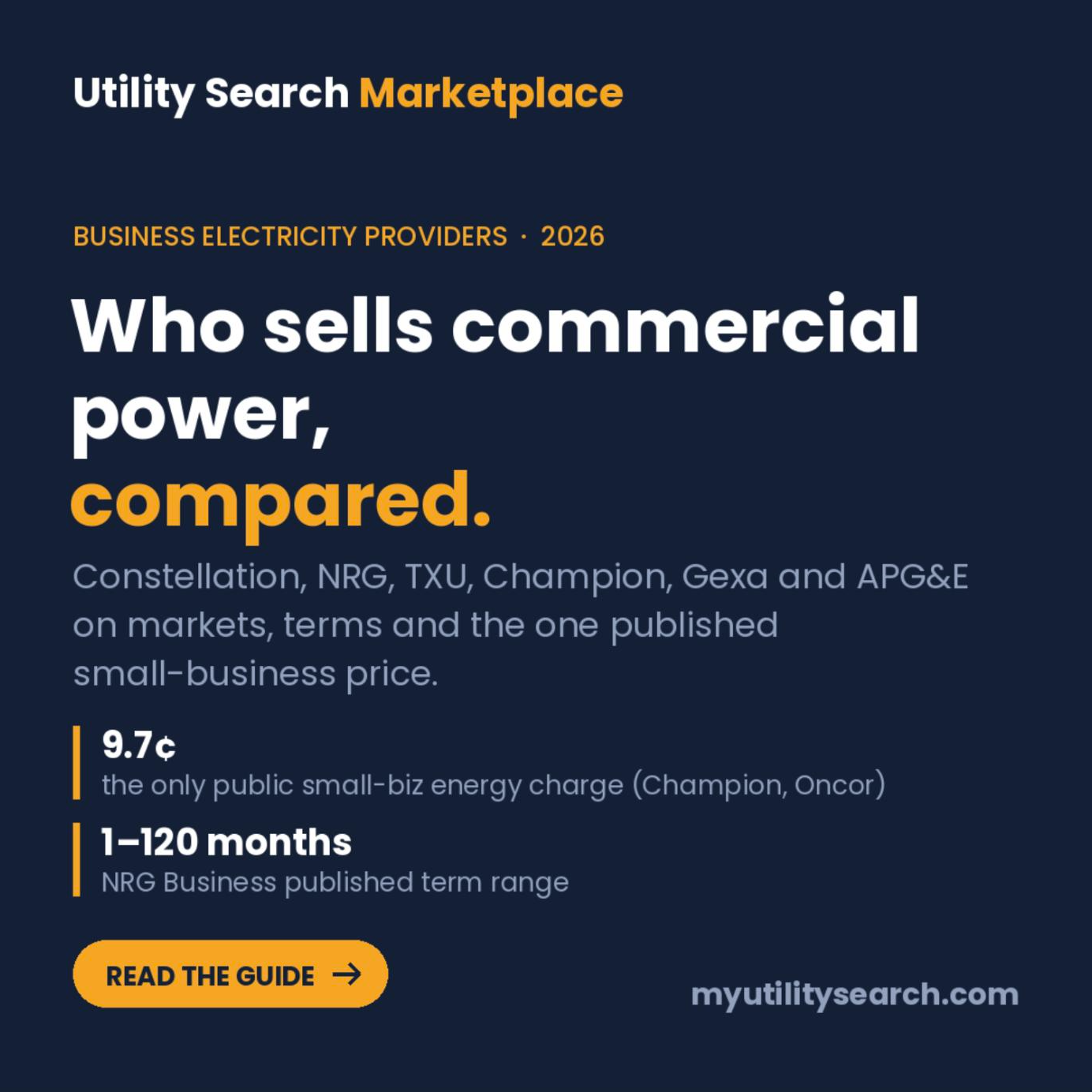
The one public small-commercial Electricity Facts Label in Texas shows the arithmetic. Champion Energy’s Business Savings Champ 18 (PUC #10098, read September 28, 2026) carries a fixed energy charge of 9.7¢ per kWh. Add Oncor’s delivery charges and the average all-in price is 18.7¢ at 1,500 kWh a month, 17.5¢ at 2,500 kWh and 17.0¢ at 3,500 kWh. The supply half is about 55% of the bill at 3,500 kWh; the rest is delivery. Shopping harder cannot touch the 45%.
What each type of business pays, and who gets the cheapest business electricity
The single biggest determinant of cheap business electricity is how flat your load is. Suppliers and utilities price a kilowatt-hour that is consumed evenly around the clock far lower than one consumed in a lunchtime or evening spike, because flat load is cheaper to hedge and cheaper to deliver. That is the whole story behind the industrial-versus-commercial gap.
| Business type | Typical load shape | Rate class | 2024 U.S. average | What makes it cheap or expensive |
|---|---|---|---|---|
| Office | Weekday 8–6, HVAC-driven summer peak | Commercial | 12.75¢ | Low load factor; pays for capacity it uses a few hundred hours a year |
| Retail shop | Seven days, lighting and HVAC, evening peak | Commercial | 12.75¢ | Peaks coincide with the grid peak, the most expensive hours to serve |
| Restaurant | High kW per square foot, refrigeration 24/7, cooking peaks | Commercial | 12.75¢ | Refrigeration flattens the load; cooking peaks and demand charges raise it |
| Warehouse | Lighting, forklifts, some refrigeration, long flat hours | Commercial or industrial, by utility | 8.13–12.75¢ | Flat load and primary-voltage delivery move it toward the industrial rate |
| Factory / plant | 24/7 or two-shift, process loads | Industrial | 8.13¢ | Highest load factor, largest volume, primary voltage; demand charges dominate the bill |
Two practical points follow. First, ask the utility which rate class your meter is on; a warehouse or light-manufacturing space that qualifies for an industrial or large-commercial tariff can save more by moving class than by switching supplier. Second, when you request quotes, ask for the price at your load factor, because a supplier quoting a flat 24/7 load at 9¢ will quote a 9-to-5 office at a different number for the same kWh.
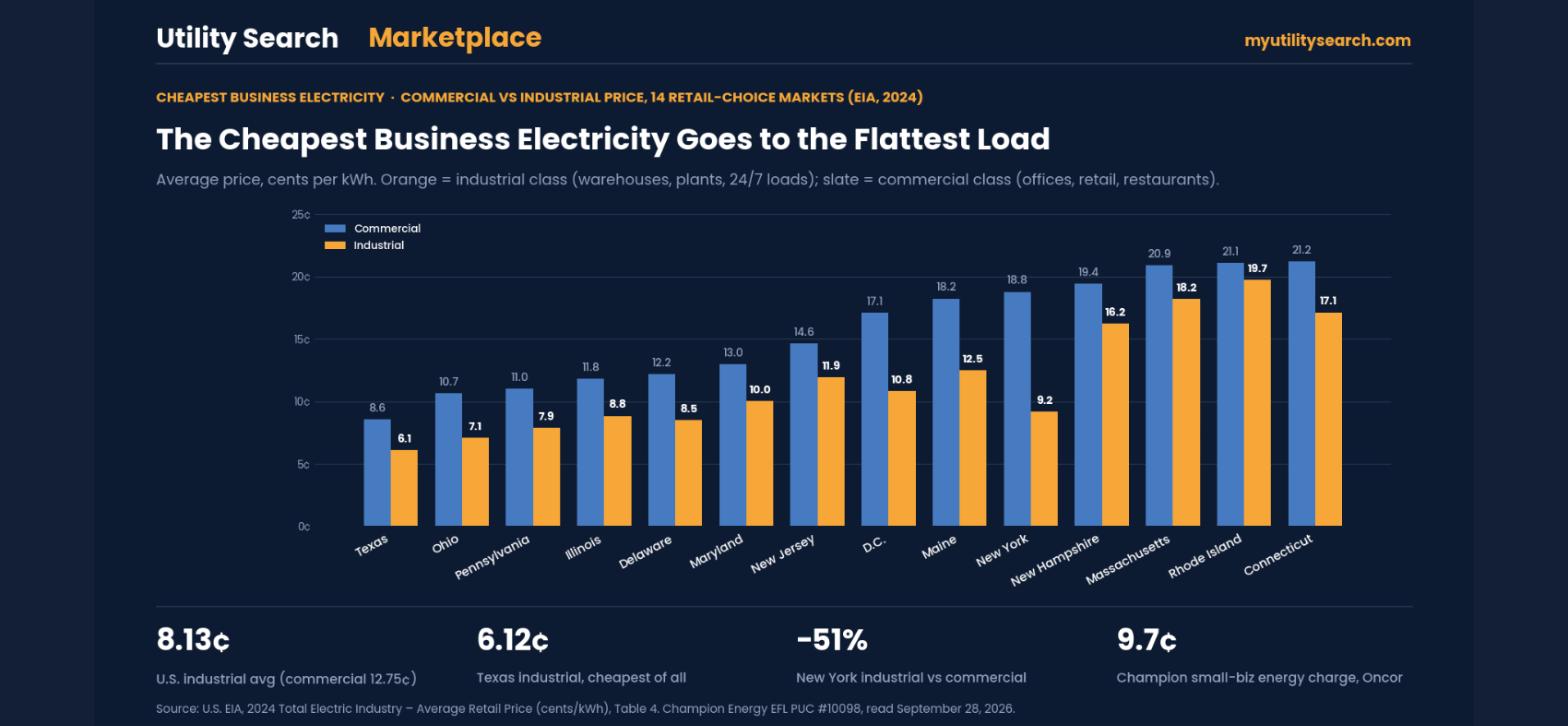
Cheapest business electricity by market: commercial vs industrial price in the 14 retail-choice states
EIA’s 2024 Table 4 gives every state’s average price by sector. Sorted by the commercial class, the choice markets look like this; the industrial column is what a flat 24/7 load in the same state pays.
| Choice market | Commercial ¢/kWh | Industrial ¢/kWh | Industrial discount |
|---|---|---|---|
| Texas | 8.55 | 6.12 | −28% |
| Ohio | 10.66 | 7.10 | −33% |
| Pennsylvania | 11.03 | 7.87 | −29% |
| Illinois | 11.81 | 8.83 | −25% |
| Delaware | 12.20 | 8.49 | −30% |
| Maryland | 12.96 | 10.01 | −23% |
| New Jersey | 14.64 | 11.93 | −19% |
| District of Columbia | 17.07 | 10.80 | −37% |
| Maine | 18.22 | 12.46 | −32% |
| New York | 18.77 | 9.17 | −51% |
| New Hampshire | 19.40 | 16.21 | −16% |
| Massachusetts | 20.90 | 18.19 | −13% |
| Rhode Island | 21.09 | 19.70 | −7% |
| Connecticut | 21.21 | 17.12 | −19% |
| U.S. average | 12.75 | 8.13 | −36% |
The cheapest business electricity in any choice market is Texas industrial at 6.12¢; the cheapest commercial-class price is also Texas at 8.55¢. The largest class gap is New York, where industrial customers pay 51% less than commercial ones, and the smallest is Rhode Island at 7%. For a full ranking of all 50 states on the commercial class, see commercial electricity rates by state.
Fixed, index or block-and-index: which one is the cheapest business electricity?
Fixed price locks the supply rate for the term. It is the cheapest business electricity in expectation for any account that cannot absorb a volatile bill, because it removes the risk premium you would otherwise pay in your own cash flow. Constellation calls its version a fully bundled fixed plan, with energy, capacity and transmission all inside one rate; Champion’s public EFL is a fixed 9.7¢ energy charge.
Index floats with the wholesale market plus an adder. It is cheaper than fixed on average over long periods, because the supplier is not charging you for the hedge, but a single hot month can cost more than a year of the fixed premium. It suits accounts with a budget cushion and someone watching the market.
Block-and-index fixes a base block of usage and floats the rest. Constellation’s capacity-adjust plans are a related structure: the energy rate is fixed but capacity costs move with the auction results. These are the right tools for a large, flat load with an energy manager; for a single small meter they add complexity without saving much.
Term length: which of 12, 24 or 36 months gives the cheapest business electricity?
Suppliers price a term off the forward market for those months, so the cheapest term changes with the shape of the curve. When far-forward prices sit above near-term prices, a 12-month contract is cheaper than a 36; when the curve is flat or falling, the longer term costs little more and buys three years of certainty. No supplier publishes the spread — NRG Business lists terms from 1 to 120 months and Champion’s public plan is 18 months — so the only reliable method is to request 12-, 24- and 36-month quotes on the same day, as all-in prices at your usage, and compare the annual cost of each. Anything quoted on different days is not comparable.
Compare business electricity at your address
Commercial contracts are priced off your meter and 12 months of usage, not a published rate card. Start with what your address can actually buy.
A worked example: the cheapest business electricity per kWh goes to the bigger meter
Take the one public EFL and run the arithmetic. At 1,500 kWh a month the average all-in price is 18.7¢, so the bill is about $280 a month or $3,366 a year. At 3,500 kWh it is 17.0¢, about $595 a month or $7,140 a year. The larger meter uses 2.3 times the energy but pays 2.1 times the money, because the fixed pieces of the bill — the base charge and the fixed portion of delivery — are spread over more kilowatt-hours. That is why the cheapest business electricity per kWh is almost always found on the bigger, flatter account, and why a small office should compare quotes at its own usage rather than at the headline rate.
The same arithmetic applies to the exit. On NRG Business’s published Texas formula, a 36-month contract cancelled in month 6 owes $250 × 12 = $3,000, roughly a year of the smaller meter’s whole bill. A supplier that is 0.5¢ cheaper on the energy charge saves that 1,500 kWh office $90 a year; it takes 33 years of that saving to cover one early exit. Cheapest business electricity means cheapest over the whole term, exit included.
Four contract clauses that turn the cheapest business electricity expensive
1. The early-termination fee
NRG Business publishes its Texas formula: $250 for every month remaining, capped at 12 months. Champion calculates the fee from your annual historic consumption and states it in the Terms of Service rather than on the EFL. Both are legal; only one can be priced before you sign. Ask for the fee as a dollar figure or a formula in writing.
2. Usage bandwidth
Many commercial contracts price a band around your historical usage, often plus or minus 10 to 25%, and charge market price or a penalty outside it. A business that grows, shrinks or adds a shift can find its cheapest business electricity contract repriced by its own success. Ask for the bandwidth and what happens outside it; the cheapest business electricity quote with a narrow band is not cheap for a growing business.
3. Capacity and transmission pass-through
In PJM (Ohio, Pennsylvania, Illinois, New Jersey, Maryland, Delaware, D.C.) and ISO-NE, capacity is a real cost that a fixed plan either bundles or passes through. A bundled rate is higher but final; a pass-through rate looks cheaper and moves when the capacity auction clears. Constellation names the difference explicitly (fully bundled vs capacity adjust). Know which one you are being quoted.
4. Renewal terms
The most common way cheap business electricity becomes expensive is doing nothing. Most contracts roll to a month-to-month or variable rate at expiry. Calendar the end date 90 days out, because that is when the next contract should be shopped.
How to get the cheapest business electricity contract: six steps
- Pull 12 months of bills and note the monthly kWh, the peak kW if it is shown, and the rate class. Every quote will be priced off these.
- Confirm the rate class with the utility. A flat, high-volume load on a commercial tariff may qualify for a cheaper class regardless of supplier.
- Get three quotes on the same day for the same term, as all-in prices per kWh at your usage, from business electricity providers that serve your utility.
- Compare each to the default rate for the same period: the utility’s Price to Compare in Ohio, Pennsylvania, Illinois and the Northeast, or the published EFLs in Texas.
- Read the four clauses above before the rate. A 0.3¢ cheaper energy charge does not survive a $3,000 termination fee or a 10% bandwidth.
- Check the license. Texas suppliers carry a PUCT REP certificate (Champion #10098, NRG Business #10011); other states license suppliers through the state commission.
Where the cheapest business electricity is, by state
Among the retail-choice markets, Texas, Ohio, Pennsylvania, Illinois and Delaware all price commercial power below the U.S. average, and Texas is the cheapest on every class. The Northeast markets are the most expensive but also have the most room for a supplier to beat the default, because the default itself is high. State-level detail: Texas, Ohio Apples to Apples, PA Power Switch, and the ComEd business rate increase in Illinois.
Frequently asked questions about the cheapest business electricity
What is the cheapest business electricity rate in the U.S.?
On EIA’s 2024 averages, Texas industrial customers paid 6.12¢ per kWh, the lowest of any retail-choice market and class; Texas commercial customers paid 8.55¢. The national averages were 8.13¢ industrial and 12.75¢ commercial.
Is a fixed-rate plan the cheapest business electricity?
For most small and mid-sized accounts, yes in practice: a 12- to 24-month fixed supply contract removes bill volatility for a small premium. Index and block-and-index plans can be cheaper on average but expose the business to monthly swings.
Why do warehouses and factories pay less than offices?
Because their load is flatter and larger and is often delivered at primary voltage, which puts them on an industrial or large-commercial rate class. Nationally that class paid 8.13¢ in 2024 against 12.75¢ for commercial; in New York the gap is 51%.
Do suppliers publish cheap business electricity rates?
Rarely. Of the major suppliers, only Champion Energy publishes a small-commercial Electricity Facts Label without a quote: 9.7¢ per kWh energy charge on an 18-month Oncor plan, 17.0–18.7¢ all-in. Everyone else prices each meter individually.
What contract length is cheapest?
It depends on the forward curve on the day you shop. Request 12-, 24- and 36-month quotes on the same day and compare the annual cost; the cheapest term is not always the shortest.
Is comparing business electricity here free?
Yes. Comparing and connecting through this site is free, and the contract price is the supplier’s own price.
Bottom line on the cheapest business electricity
Get the rate class right first, then shop the supply half on a fixed 12- to 24-month contract with three same-day quotes at your real usage, and read the termination, bandwidth, pass-through and renewal clauses before the rate. That sequence, not a rate card, is where the cheapest business electricity comes from in every one of the 14 choice markets.
Compare business electricity at your address
Commercial contracts are priced off your meter and 12 months of usage, not a published rate card. Start with what your address can actually buy.
Sources
- U.S. EIA — 2024 Total Electric Industry, Average Retail Price (cents/kWh), Table 4
- U.S. EIA — State Electricity Profiles 2024
- Champion Energy — Business Savings Champ 18 Electricity Facts Label (PUC #10098)
- NRG Business — Texas small commercial terms of service (REP #10011)
- Constellation — Electricity options for small businesses (plan structures)
Keep going
- Business electricity rates Texas — EIA averages, the one public small-business EFL, TDU demand charges by utility and 4CP
- Business electricity providers compared: who sells commercial power in 2026
- Business electricity: how commercial power is bought
- Commercial electricity rates by state, cheapest to most expensive
- Texas electricity: the deregulated-market hub
- Ohio Apples to Apples: Price to Compare by utility
- PA Power Switch: Pennsylvania Price to Compare by utility
- Business internet providers compared
- Business utilities: the full setup checklist for a new location