Blog
Electricity Bills 2026: Smart Ways to Beat Rising Costs

Two lines on your monthly budget are moving fast in 2026: the power bill and the connectivity bill. Electricity bills are climbing across most of the country, and the telecom map that decides your internet and phone options just got redrawn. Here’s the news driving both — and, because Utility Search Marketplace exists to help you pay less, exactly what you can do about your electricity bills today.
Key takeaways
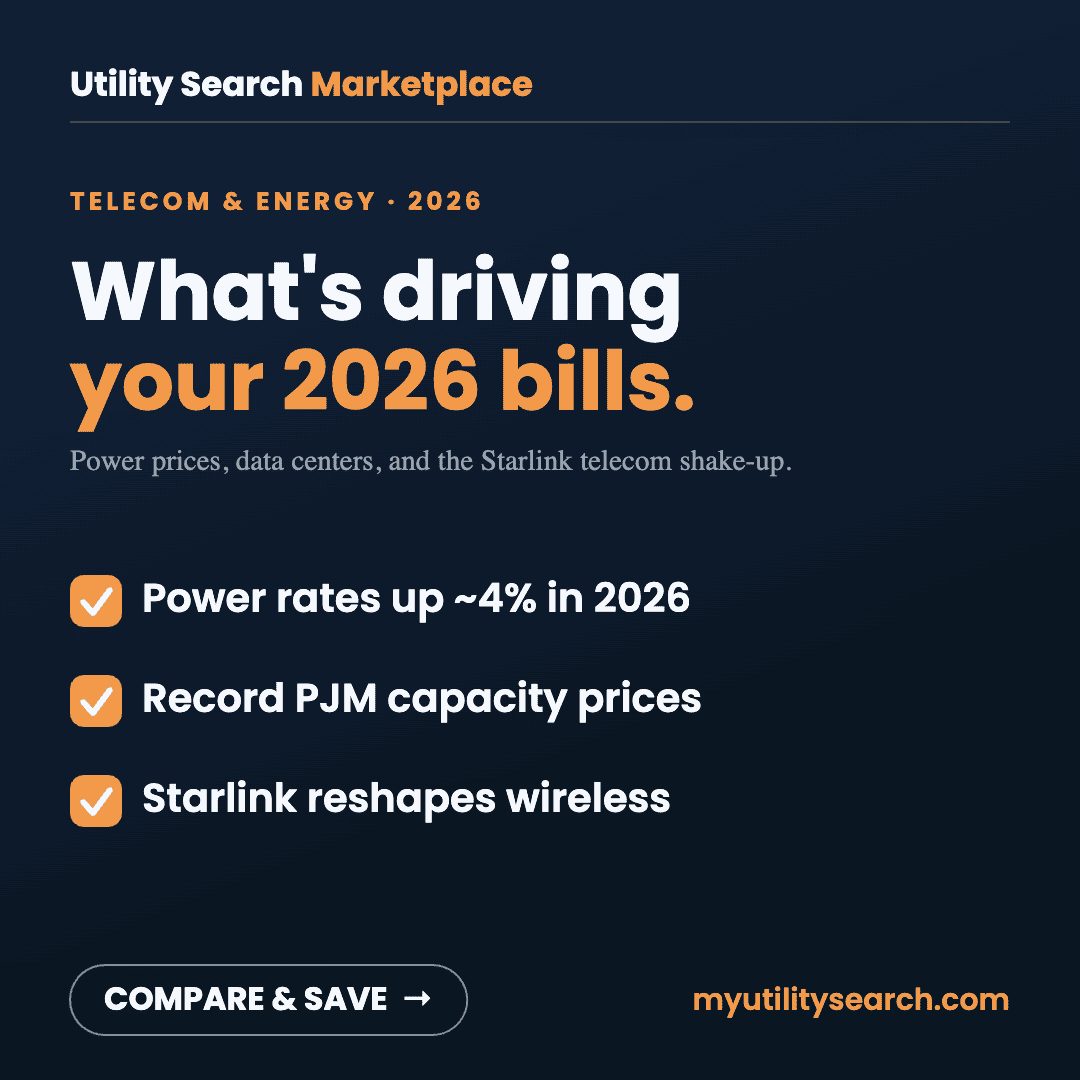
- The EIA projects the average U.S. residential rate at 18.02¢/kWh in 2026, up about 4.2% from 2025 — another year of rising electricity bills.
- Data-center demand in Texas (ERCOT) and the 13-state PJM grid is the single biggest force pushing electricity bills up.
- PJM’s latest capacity auction cleared at a record $333.44/MW-day for a $16.4 billion total — the third record in a row.
- The “fourth carrier” plan built on Boost Mobile collapsed in 2026: EchoStar exited wireless and its satellite arm filed for bankruptcy.
- SpaceX’s Starlink — now holding EchoStar’s old spectrum and in talks with Charter — is the disruptor to watch.
- In deregulated states you can shop suppliers and lock a fixed rate to blunt rising electricity bills.
Why your electricity bills are rising in 2026
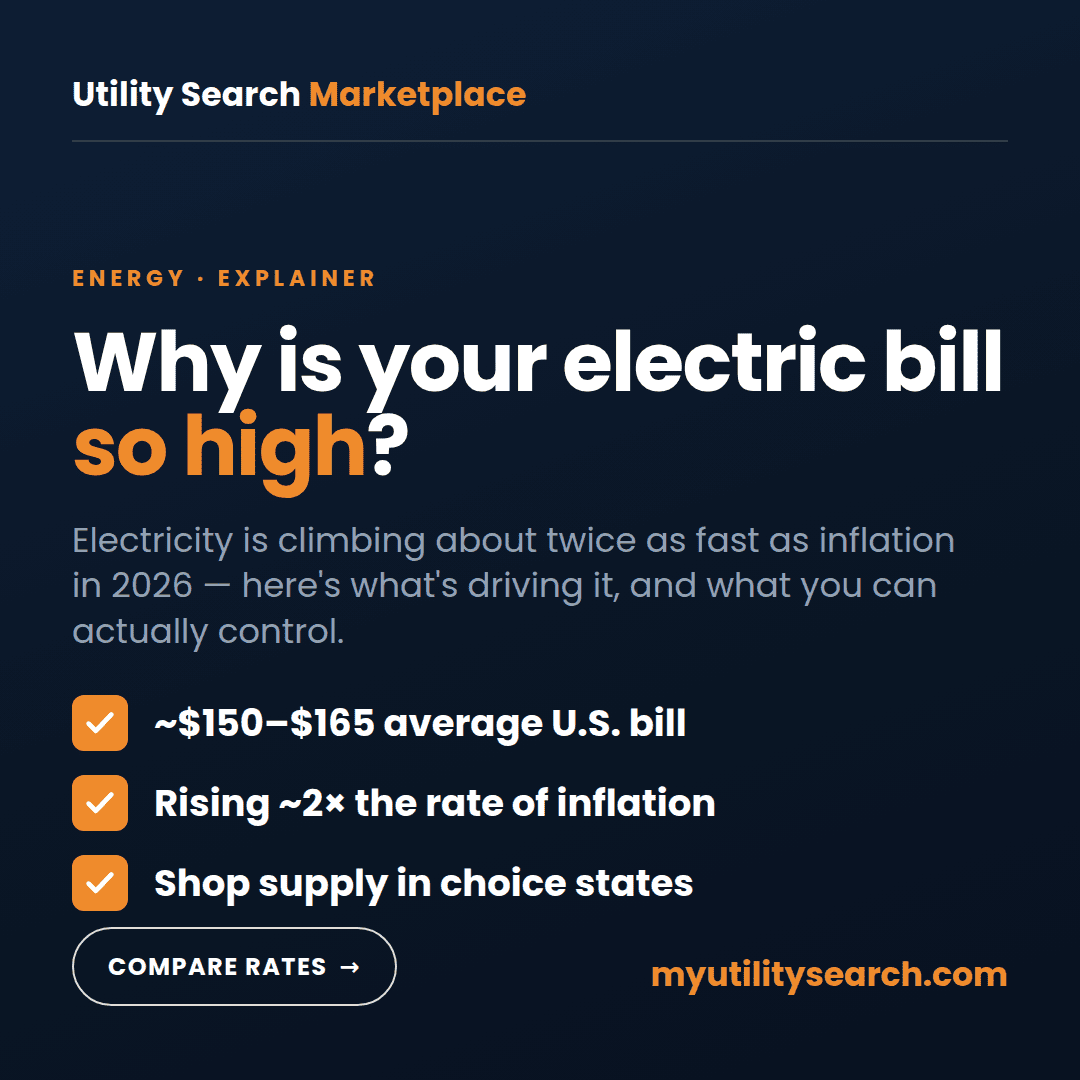
The U.S. Energy Information Administration’s latest Short-Term Energy Outlook puts the average residential price at 18.02 cents per kWh in 2026, up from 17.29 cents in 2025 — roughly a 4.2% jump. The pain is worse in some regions: New England is forecast near 30.01¢/kWh and the Pacific region near 24.88¢/kWh. If your electricity bills already sting, that is why.
Three forces are stacking on top of each other. Natural gas — still the fuel that sets the price in most hours — is forecast at $4.01/MMBtu (Henry Hub) in 2026 versus $3.56 the year before, and that flows straight into wholesale power. Surging demand, concentrated in data centers, is tightening supply in Texas and the Mid-Atlantic. And the fastest-growing piece of the bill isn’t generation at all: it’s the transmission and distribution spending utilities recover through grid-modernization riders. Together they explain why electricity bills keep drifting up even when your usage holds steady.

The PJM capacity crunch behind higher electricity bills
PJM Interconnection — the grid operator for 13 states plus Washington, D.C. — runs a yearly “capacity auction” that pays generators to be available on the highest-demand days. That cost lands on your bill. The most recent auction, for the 2027–2028 delivery year, cleared at a record $333.44 per MW-day, a $16.4 billion total and the third straight record. A 5,250-MW jump in PJM’s demand forecast — driven “almost entirely” by data centers — is a big reason why.
PJM says this particular auction should mean “little change” on any single bill because capacity is only one slice of the total. But three record auctions in a row is a trend, not a blip, and it is one more reason electricity bills across the PJM footprint keep grinding higher.
Data centers are the common thread
Whether you live in ERCOT (Texas) or the PJM Mid-Atlantic, the same story is playing out: AI and cloud data centers are adding load faster than new supply comes online. The EIA now expects commercial electricity use to surpass residential use by 2027 — a first — largely because of these facilities. More demand chasing tight supply is textbook upward pressure on electricity bills, and it’s why shopping your rate matters more this year than last.
The telecom shake-up: the fourth carrier that wasn’t
For five years, regulators counted on Boost Mobile to become a strong fourth carrier against AT&T, Verizon, and T-Mobile — a condition of the 2020 Sprint–T-Mobile merger. In 2026 that plan unraveled. EchoStar’s standalone 5G buildout fell short of expectations, FCC Chairman Brendan Carr opened an investigation, and the company abandoned its wireless ambitions, selling roughly $17 billion in spectrum to AT&T and SpaceX. EchoStar’s satellite business filed for bankruptcy in late June 2026. The fourth national carrier the government engineered simply didn’t materialize.
Starlink is the disruptor to watch
The real challenger came from orbit. SpaceX picked up EchoStar’s AWS-4 and H-block spectrum and is scaling Starlink direct-to-cell, which connects ordinary smartphones straight to satellites with no special hardware — live since February 2025 and already powering T-Mobile’s “T-Satellite” service. As of June 2026, SpaceX is also in talks with Charter Communications to launch a phone service through its Spectrum Mobile brand, and is teeing up a “Starlink Mobile” offering ahead of a planned IPO. A satellite layer that erases rural dead zones is exactly the kind of competition the Big Three haven’t faced before.
What this means for your internet and phone bill
More competition historically pressures prices downward, and satellite direct-to-cell finally puts coverage on the table for rural households that only ever had one option. It won’t rewrite your bill overnight — but it does mean it’s worth re-checking what’s available at your address, because the fastest lever on a connectivity bill is still bundling and shopping providers. You can compare high-speed internet plans the same way you’d compare power.
How to lower your electricity bills right now
You can’t control natural-gas markets or data-center demand, but in a deregulated state you can control who supplies your power. Shopping a competitive supplier and locking a fixed rate is the most reliable way to protect yourself from rising electricity bills:
- Check whether your state has choice. Thirteen states plus D.C. let you pick your electricity supplier while the utility still delivers the power.
- Lock a fixed rate. A 12–36 month fixed plan shields your electricity bills from summer price spikes and volatile gas markets.
- Avoid month-to-month variable rates, which reset upward fastest when demand surges.
- Bundle the rest of the stack. Comparing internet, home security, and energy in one pass usually beats shopping each alone.
Utility Search Marketplace does that comparison for you — compare electricity plans for your address and see whether a fixed rate beats what you’re paying now.
Ready to shop for lower energy rates?
You can’t control natural gas or data-center demand, but in a deregulated state you can lock a better electricity rate today. Compare suppliers for your address in minutes and see how much you could cut from your bill before the next increase hits.
Electricity bills & telecom news FAQ
Why are electricity bills going up in 2026?
Three things are stacking up: natural gas is forecast near $4.01/MMBtu, data-center demand is tightening supply in Texas and PJM, and utilities are recovering heavy grid-upgrade spending. The EIA projects the average residential rate at 18.02 cents per kWh in 2026, up about 4.2% from 2025.
Did the PJM capacity auction raise my electricity bills?
PJM’s latest auction cleared at a record $333.44 per MW-day for a $16.4 billion total. PJM says this single auction should mean little change on any one bill because capacity is only one component, but three record auctions in a row is a clear upward trend for electricity bills across its 13-state region.
Are data centers really making electricity bills higher?
Yes. AI and cloud data centers are adding load faster than new generation comes online, especially in ERCOT (Texas) and PJM. The EIA expects commercial electricity use to pass residential use by 2027, largely because of these facilities, which pushes prices up for everyone.
Is Boost Mobile still becoming the fourth carrier?
No. In 2026 EchoStar abandoned its wireless buildout after an FCC investigation, sold about $17 billion in spectrum to AT&T and SpaceX, and its satellite business filed for bankruptcy. The government-engineered fourth national carrier did not materialize.
What is Starlink direct-to-cell and will it lower my phone bill?
Starlink direct-to-cell connects a standard smartphone straight to satellites with no special hardware, live since February 2025 and powering T-Mobile’s T-Satellite. SpaceX is in talks with Charter to launch phone service too. More competition tends to pressure prices and closes rural coverage gaps, though it won’t change your bill overnight.
How can I lower my electricity bills?
In a deregulated state, shop a competitive supplier and lock a fixed 12–36 month rate so summer spikes and gas volatility can’t move your electricity bills. Avoid month-to-month variable plans, and bundle internet and security in the same comparison to save more overall.
Keep going
- Deregulated energy: compare electricity plans
- Business electricity rates and suppliers
- High-speed internet providers
- Best home security systems
- The Utility Search blog
Sources: U.S. Energy Information Administration Short-Term Energy Outlook; PJM Interconnection capacity auction results; FCC filings and public reporting on EchoStar, SpaceX, and Charter. This article is general information, not financial advice. Figures reflect the latest forecasts available at publication and may change.