Blog
Low-Income Internet in 2026: The Squeeze Behind the BEAD Clawback


Updated on September 5, 2026
Low-income internet in 2026 hasn’t disappeared. Households can still cut their bill through the federal Lifeline credit and provider plans like Xfinity Internet Essentials, Spectrum Internet Assist, and Access from AT&T. But the safety net got thinner this year: the ACP subsidy is gone, the BEAD rural build is shrinking, and an AT&T copper cutoff lands November 15, 2026. Here is what changed — and what low-income internet shoppers can actually do right now.
TL;DR — Three forces are squeezing the roughly 1.53 million households across Alabama, Florida, Georgia, and Mississippi that have no home broadband. The plan to build rural internet (BEAD) is shrinking and will not reach homes until 2027–28. The program that made service affordable (the ACP) has been dead since June 2024. And a hard federal deadline — November 15, 2026 — cuts copper service to tens of thousands more. The real barrier was always cost, and every lever that touched cost is moving the wrong way.
Developing story, last updated July 16, 2026. The BEAD satellite reduction described below broke on July 14 and is still unfolding — no final count of affected locations exists yet.
Why the BEAD clawback — and why now?
On July 14, 2026, the National Telecommunications and Information Administration (NTIA) began asking states to strip out a large share of the locations they had awarded to satellite internet providers under the $42.45 billion Broadband Equity, Access, and Deployment (BEAD) program — by some reports up to half. The trigger was the FCC’s updated “v9” National Broadband Map, which showed terrestrial service reaching areas previously counted as unserved, along with scrutiny that many satellite-awarded “locations” were non-residential structures or already had service.
Satellite had accounted for roughly 20% of the program’s ~3.9 million eligible locations and more than $1 billion in funding; SpaceX’s Starlink was slated for about $739 million nationally. How much is actually clawed back depends on state-by-state reviews now under way, so treat every figure as provisional.
Why now is the real story. Through 2025, BEAD was pushed toward a “tech-neutral, lowest-cost” posture that let satellite win a big slice of the map. The v9 map refresh and a fresh look at cost-per-location are now walking part of that back. The subsidized path to rural connectivity did not just slow down — it narrowed.

BEAD, defined. A $42.45 billion federal program to expand high-speed internet to unserved and underserved locations. It funds infrastructure on a reimbursement basis — it does not put a dollar toward a household’s monthly bill.
Why availability isn’t the real problem
Here is the part the headlines miss. BEAD is an availability program. But availability is not what keeps most of these 1.53 million households offline. The binding constraint is affordability and adoption. Pew Research puts home-broadband adoption at 92% for households earning over $100,000 a year and just 57% for those under $30,000. That gap does not close by running more fiber past the house. It closes when the monthly bill is payable.
For three years, one program did exactly that. The Affordable Connectivity Program (ACP) gave about 23 million households up to $30 a month off internet ($75 on Tribal lands). It ended on June 1, 2024. In Mississippi alone, an estimated 244,000 households lost it. Nationally, the Brattle Group estimates roughly 5 million households have since cut internet entirely, and a National Lifeline Association survey found nearly 40% of former ACP households cut back on food to keep their connection. As of 2026, Congress has considered several ACP reauthorization bills and passed none. There is no federal replacement.

The deadline nobody’s talking about: November 15, 2026
Then there is the event with an actual date on it. The FCC has approved AT&T’s request to discontinue service across more than 30% of its copper footprint — about 25% of its wire centers, covering roughly 90,000 customers in 18 states. The deadline is November 15, 2026, and all four states here are on the list: Alabama, Florida, Georgia, and Mississippi.
Affected customers are offered AT&T’s fixed-wireless landline replacement or a mobile line. But the point is simpler: tens of thousands of households — many older, many rural, many the same ones who lost the ACP — have about four months to land on a new provider, whether or not they were shopping for one. Three forces, one direction: the subsidized build recedes into 2027–28 and shrinks, the subsidy that made service affordable is gone, and a copper cutoff forces a switch.
What are the best low-income internet options right now?
The answer is not “wait for BEAD.” For households that need help today, low-income internet still exists through two stackable levers: the federal Lifeline credit and a provider’s own discounted tier.
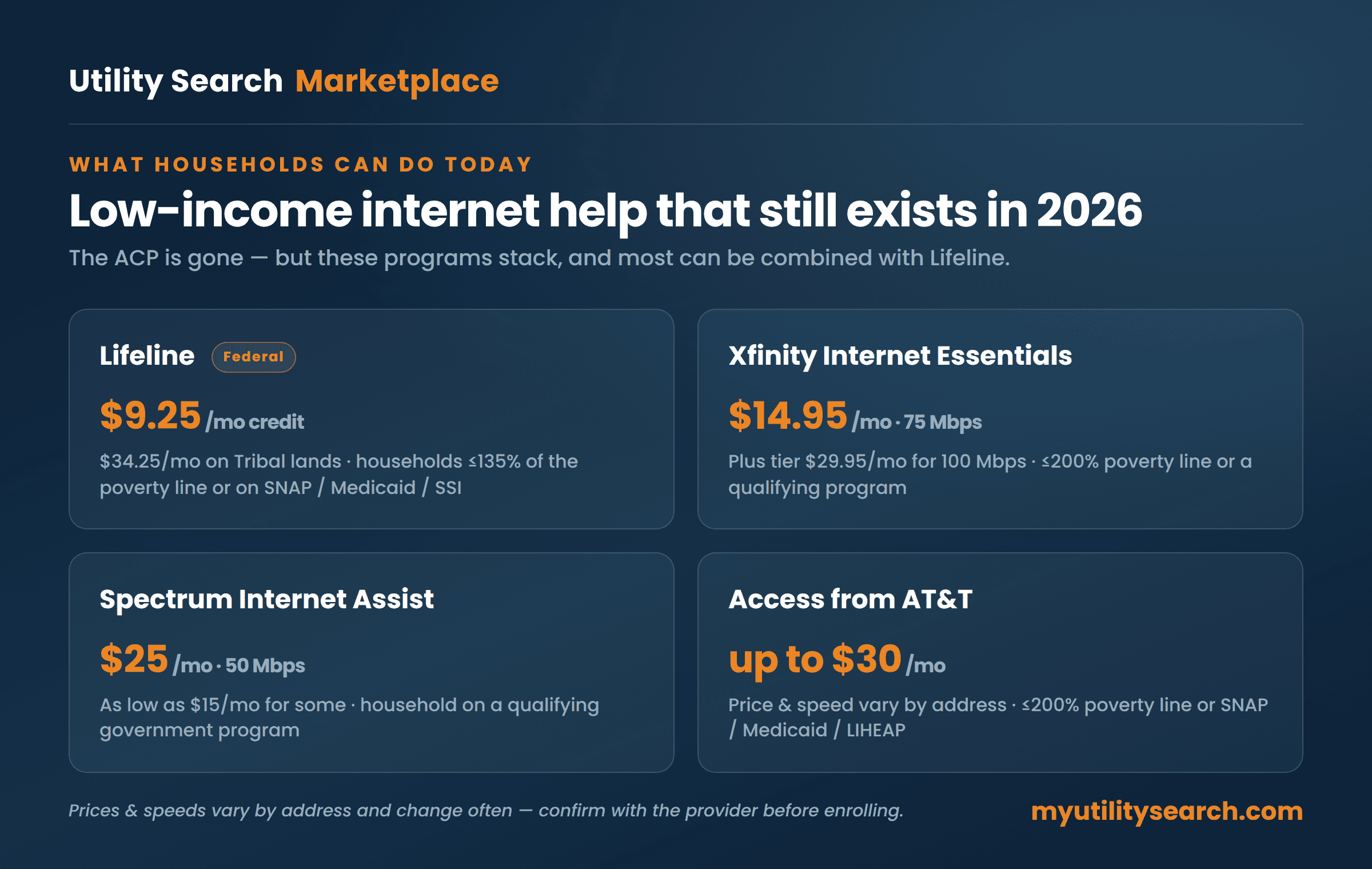
| Program | Price / speed (2026) | Who qualifies |
|---|---|---|
| Lifeline (federal) | $9.25/mo credit ($34.25 Tribal) | ≤135% poverty line, or SNAP / Medicaid / SSI |
| Xfinity Internet Essentials | $14.95/mo · up to 75 Mbps (Plus: $29.95 · 100 Mbps) | ≤200% poverty line or assistance program |
| Spectrum Internet Assist | $25/mo · 50 Mbps (as low as $15 for some) | Household on a qualifying government program |
| Access from AT&T | Up to ~$30/mo (varies by address) | ≤200% poverty line, or SNAP / Medicaid / LIHEAP |
For the genuinely unserved rural edge — a home miles from the nearest wire, the kind BEAD was supposed to reach in 2028 — low-earth-orbit satellite like Starlink remains the only service that can be switched on this month. It is not the cheapest option and the affordability programs above will not cover it, but for a home with no terrestrial choice and a copper line about to go dark, “available now” beats “funded for 2028.” See our honest take: is Starlink worth it in 2026?
Paying too much for internet?
The ACP is gone — but Lifeline discounts and low-cost plans still exist. Compare the cheapest internet available at your address, side by side.
Frequently asked questions
Did the ACP come back in 2026?
No. The Affordable Connectivity Program ended June 1, 2024, and as of 2026 Congress has not passed a replacement. The closest ongoing federal help for low-income internet is Lifeline, at up to $9.25 a month.
Will the BEAD clawback take internet away from anyone?
No. BEAD funds construction that has not happened yet. The reduction removes planned satellite-funded locations from state maps; it does not disconnect existing customers. Its effect is to shrink and delay the future subsidized build.
What happens to AT&T copper customers on November 15, 2026?
AT&T must offer a replacement — either its fixed-wireless landline service or a mobile line. Affected customers should confirm what is available at their address well before the deadline.
When will BEAD-funded internet actually reach homes?
Most construction is expected to deliver service in 2027–2028. BEAD reimburses providers as they build, so there is a multi-year lag between an award and a working connection.
What is the cheapest low-income internet in 2026?
Stacking Lifeline’s $9.25 credit with a provider tier such as Xfinity Internet Essentials ($14.95) or Spectrum Internet Assist (as low as $15) gets qualifying households closest to what the ACP used to cover.
Keep going
- Is Starlink worth it in 2026? An honest review
- Internet choice in deregulated energy states
- How internet data caps and overage fees work
- AT&T fiber expansion 2026: is it coming to your area?
- What the Frontier–Verizon merger means for you
- How to set up utilities when you move