Blog
Green Energy Plans 2026: How Renewable Electricity Works & What It Costs

Updated on August 19, 2026
Green energy plans let you power your home with renewable electricity — wind, solar, and hydro — without installing a single panel. When you sign up, your retail provider buys Renewable Energy Certificates (RECs) that match your usage to clean generation on the grid. In 2026, green energy plans typically cost only about 1–3¢/kWh more than standard plans, and because wind and solar are now so cheap, many green energy plans actually match or beat fossil-fuel rates. This guide explains how they work, what they cost, and how to pick a genuinely green one.
TL;DR
- What they are: retail electricity plans matched to renewable generation via RECs — no rooftop hardware needed.
- Cost: usually a 1–3¢/kWh premium, but many green energy plans now price at or below standard rates.
- Where: available anywhere you can choose a provider — deregulated states like Texas and beyond.
- Pick a real one: look for a stated renewable % and third-party (Green-e) certification, not vague “eco” labels.
What are green energy plans in 2026?
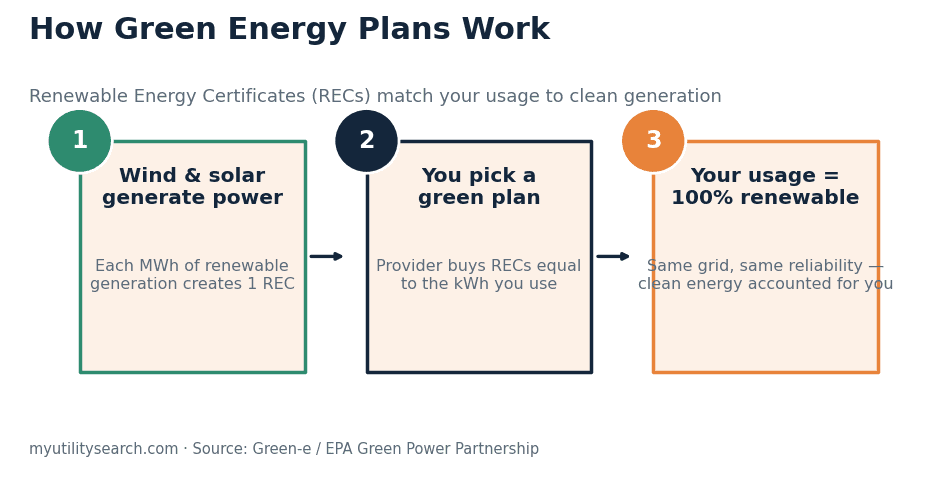
Green energy plans are retail electricity plans where the provider matches some or all of your consumption with renewable generation. A 100% renewable plan means the provider buys RECs equal to every kilowatt-hour you use, so your electricity is accounted for as wind or solar even though the physical electrons come from the same shared grid as everyone else’s. That’s the key idea: green energy plans change what’s put back onto the grid on your behalf, not the wires into your house. You get the same reliability as any other plan — the same utility still delivers the power and restores outages.
How do green energy plans work? (RECs explained)
The mechanism behind green energy plans is the Renewable Energy Certificate. Every time a wind farm or solar array generates one megawatt-hour of electricity, it creates two things: the physical power, and one REC representing the environmental attributes of that clean generation. When you buy a green plan, your provider retires RECs matching your usage — that’s what lets them (and you) claim the electricity as renewable.
- Unbundled RECs — the most common approach: the certificates are bought separately from generators nationwide. Cheaper, and still a legitimate way to fund renewables.
- Bundled RECs — the power and the certificate come together from a specific project. A stronger, more direct commitment, usually at a higher price.
Either way, the more demand there is for RECs, the more it supports building renewable capacity — which is the point of green energy plans.
Do green energy plans cost more?
Historically, green energy plans carried a small premium — about 1 to 3 cents per kWh over a comparable standard plan. That’s still a fair rule of thumb, but the gap has narrowed sharply: utility-scale wind and solar now generate power far cheaper than fossil fuels, so many green energy plans in 2026 match or even undercut conventional rates. The takeaway: don’t assume green costs more. Compare the all-in price on the Electricity Facts Label (EFL) at your usage level, exactly as you would for any plan — a 100% renewable fixed rate is often within pennies of, or cheaper than, the “brown” alternative.
Green energy plans vs regular electricity plans: what actually differs
The electricity itself is identical — what differs is the paperwork, the price spread, and what your money funds. A regular power plan buys generic grid electricity; a green plan buys the same electricity plus renewable energy certificates (RECs) that match your usage to wind or solar generation. Here’s the honest comparison shoppers ask for:
| Regular electricity plan | Green energy plan | |
|---|---|---|
| Power delivered to your home | Grid mix (same wires) | Grid mix (same wires) |
| What you pay for | Energy only | Energy + RECs matching your usage |
| Typical price difference | Baseline | Often within ~0–1¢/kWh of comparable fixed plans; occasionally cheaper when a supplier runs a green promo |
| Contracts & terms | Fixed, variable, or prepaid | Same structures — judge the rate and term, not the label |
| Reliability / outages | Identical | Identical — your utility still delivers and repairs |
| What changes in the world | Nothing extra | Demand signal + funding for renewable generation |
Bottom line: a green plan is worth it when its rate is within a hair of the best regular fixed rate — you get the renewable match nearly free. It’s not worth a large premium; compare both on the same term length before signing.
Best green energy providers
Several established retailers specialize in renewable electricity. In deregulated Texas and other choice markets, these are common names for green energy plans — tap any for our full review:
| Provider | Green offering | Best for |
|---|---|---|
| Green Mountain Energy | 100% renewable; pioneered retail green power | Longest-running green provider |
| Rhythm Energy | 100% renewable fixed-rate plans | Green without a premium |
| Gexa Energy | 100% green fixed plans at value rates | Value-focused renewable plans |
National green suppliers such as Constellation, Direct Energy, and IGS Energy also offer renewable options in other deregulated states. The best green energy plan for you is the one with a clear renewable percentage, a good EFL price at your usage, and a fixed term.
How to choose a genuine green energy plan
Not every “eco” label is equal. To avoid greenwashing and pick a real green plan:
- Confirm the renewable percentage. A true green plan states an exact figure (often 100%), not a vague “clean energy” claim.
- Look for Green-e certification. The independent Green-e program verifies renewable claims and guards against double-counting — the gold standard for legitimacy.
- Read the EFL. Check the all-in price per kWh at your usage level and the contract term, just like any plan.
- Choose a fixed rate. A 12-month fixed green plan protects you from summer price spikes the same way a standard fixed plan does.
Green plan vs rooftop solar: which is right for you?
People often weigh a green retail plan against installing solar panels. They solve different problems. Rooftop solar generates power on your roof, can lower your usage dramatically, and may earn export credits — but it’s a large upfront investment, requires a suitable roof, and isn’t an option for renters. A green retail plan takes effect the moment you enroll, costs little or nothing extra, works in an apartment, and requires no equipment. Many households do both: shop a renewable plan today, and consider panels later if they own a good roof. For most renters and anyone who wants clean energy without a project, a green plan is the fast, low-friction path.
Compare green energy plans
Enter your ZIP to see 100% renewable electricity plans at your address and lock a low fixed rate in minutes.

Green energy plans: FAQ
What are green energy plans?
Green energy plans are retail electricity plans where your provider matches your usage with renewable generation using Renewable Energy Certificates (RECs). A 100% renewable plan covers all of your kWh — no solar panels required.
Do green energy plans cost more?
Sometimes only slightly — historically about 1–3¢/kWh more, but many green energy plans now match or beat standard rates because wind and solar have become the cheapest generation. Always compare the EFL price at your usage.
How do green energy plans actually work?
Your provider buys and retires RECs equal to your electricity use. Each REC represents one megawatt-hour of renewable generation, so your consumption is accounted for as wind or solar even though the grid itself is shared.
Is my power different on a green plan?
No. The same utility delivers the same electricity over the same lines with the same reliability. A green plan changes the renewable accounting behind your usage, not the physical power or your outage response.
What is a REC?
A Renewable Energy Certificate represents the environmental attributes of one megawatt-hour of renewable generation. Retiring RECs matched to your usage is what makes an electricity plan “green.”
How do I know a green plan is legitimate?
Look for a stated renewable percentage and third-party Green-e certification, and read the Electricity Facts Label. Those confirm the plan is genuinely renewable rather than a vague marketing claim.
Can I get green energy plans in Texas?
Yes. Texas is deregulated, so you can choose a 100% renewable plan from providers like Green Mountain, Rhythm, or Gexa. Green energy plans are available anywhere you can pick your retail provider.
Are green energy plans worth it?
For most shoppers, yes — the premium is small or gone entirely, and you support renewable generation while getting the same reliability. Compare a 100% renewable fixed plan against standard rates before deciding.
Keep going
- Texas electricity rates: compare by city & provider
- Cheapest electricity in Texas: how to find it
- What is the average electric bill? By state & home size
- Green provider reviews: Green Mountain · Rhythm · Gexa
- How to switch electricity providers in Texas
- Deregulated energy: which states let you choose
- Business electricity buyers comparing green plans
Reviewed by the Utility Search Marketplace team. Methodology: REC mechanics and certification per the Green-e standard and the EPA Green Power Partnership; pricing reflects typical 2026 retail green plans. Compare the EFL at your usage before enrolling. Last updated July 2026.