Blog
Cox Homelife: What Happens to Your System After the Merger

Updated on August 24, 2026
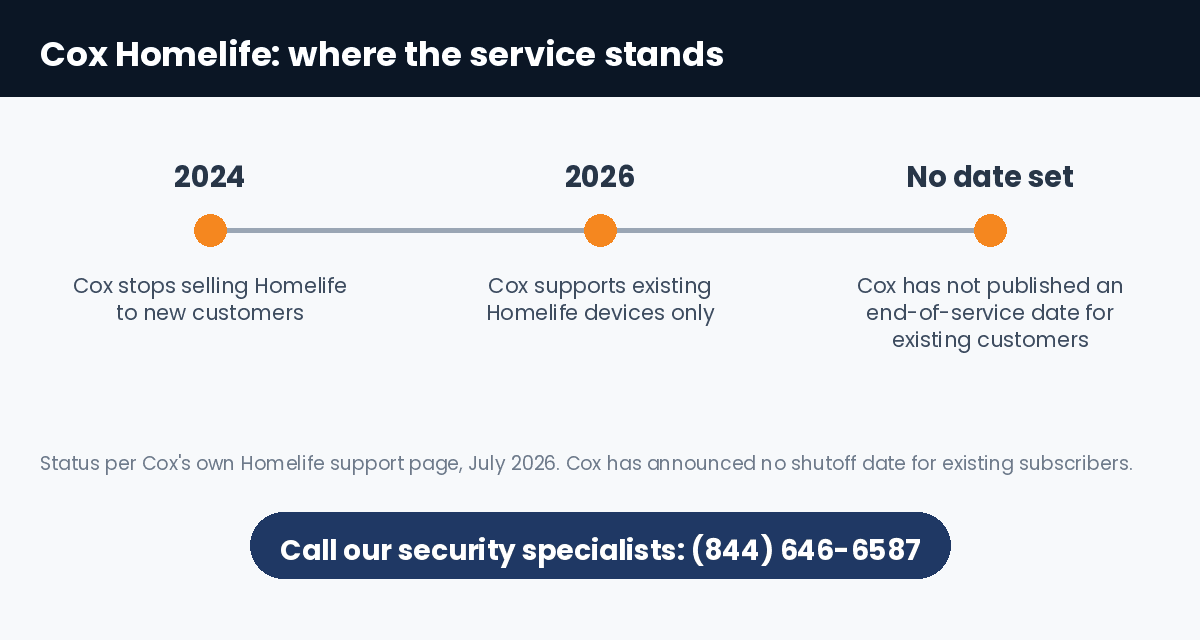
Cox Homelife is in maintenance mode. Cox stopped enrolling new Homelife customers in 2024, has retired the dedicated Homelife app, and states it is “only supporting existing Cox Homelife devices.” With the Charter–Cox merger closing in August 2026, Cox service becomes Spectrum service — and Spectrum has no equivalent home security product. No transition plan for Homelife customers has been published by either company. If you have Homelife today it still works, but you should price alternatives before your equipment fails rather than after.
Last updated: 24 August 2026
TL;DR — where Cox Homelife stands
- New signups stopped in 2024. The dedicated Homelife app has been retired.
- Cox’s own support page says it is “only supporting existing Cox Homelife devices.”
- Spectrum does not offer a comparable home security product. There is nothing to migrate you to.
- No transition plan has been published by Cox or Charter. Not “not yet announced” — not published at all.
- Your system works today. The risk is not sudden shutoff; it’s support drying up when a sensor fails or a panel needs replacing.
- Act on your own timeline, not on an outage.
Is Cox Homelife being discontinued?
Cox has not published a shutdown date, and that distinction is worth being precise about.
What Cox has done: stopped accepting new Homelife customers, retired the standalone app, and narrowed its published support language to existing devices only. That is the standard profile of a product being wound down rather than one being killed on a date.
Definition: what “maintenance mode” actually means for you
A product in maintenance mode keeps running for existing customers but stops receiving new features, new hardware and new customers. In home security specifically, the practical failure point is replacement parts and technician expertise. Your panel and sensors keep working until one doesn’t — and then the question becomes whether a replacement part exists and whether anyone is trained to install it.
Does the Charter Cox merger change anything for Cox Homelife?
It changes the context, not the product — and the context is the problem.
The Charter–Cox merger closed 19 August 2026, with Charter announcing completion on 20 August. Cox’s consumer brand becomes Spectrum across all markets, with the rebrand rolling out roughly a month after close and Spectrum’s full product suite, pricing and packaging landing in Cox markets in mid-September 2026.
Charter’s completion release and Cox’s transition page both list what carries over: internet, TV, mobile, equipment, billing, email, appointments. Home security is not on either list, because Spectrum does not sell a directly comparable product to migrate Homelife customers into.
Cox’s own transition language is worth reading with the hedges intact. “You can continue using your current equipment and apps. If changes are ever needed, we will guide you step-by-step.” That is a commitment to communicate, not a commitment to continue.
What should Cox Homelife customers do?
Four things, in order.
- Find out exactly what you have and what you’re paying. Log your panel model, sensor count and types, camera models, monthly monitoring fee, contract end date, and whether you own or lease the equipment. Lease versus own is the single most consequential line — leased equipment usually has to go back, owned equipment may be reusable.
- Find out whether your equipment is reusable. Many Homelife installations use hardware built on common security platforms. Whether a given panel or sensor can be adopted by another monitoring company depends on the specific model and how it was provisioned. Ask a prospective provider directly, with model numbers in hand, before you assume either answer.
- Price alternatives now, while your system still works. The worst time to shop for home security is the week a sensor dies. Get two or three quotes while you have no urgency and full leverage.
- Do not sign a long contract out of anxiety. Maintenance mode is not an emergency. Self-monitored and no-contract professionally monitored options both exist, and a three-year agreement signed in a hurry is a worse outcome than the problem you’re solving.
Compare internet, energy & home security at your address
What are the alternatives to Cox Homelife?
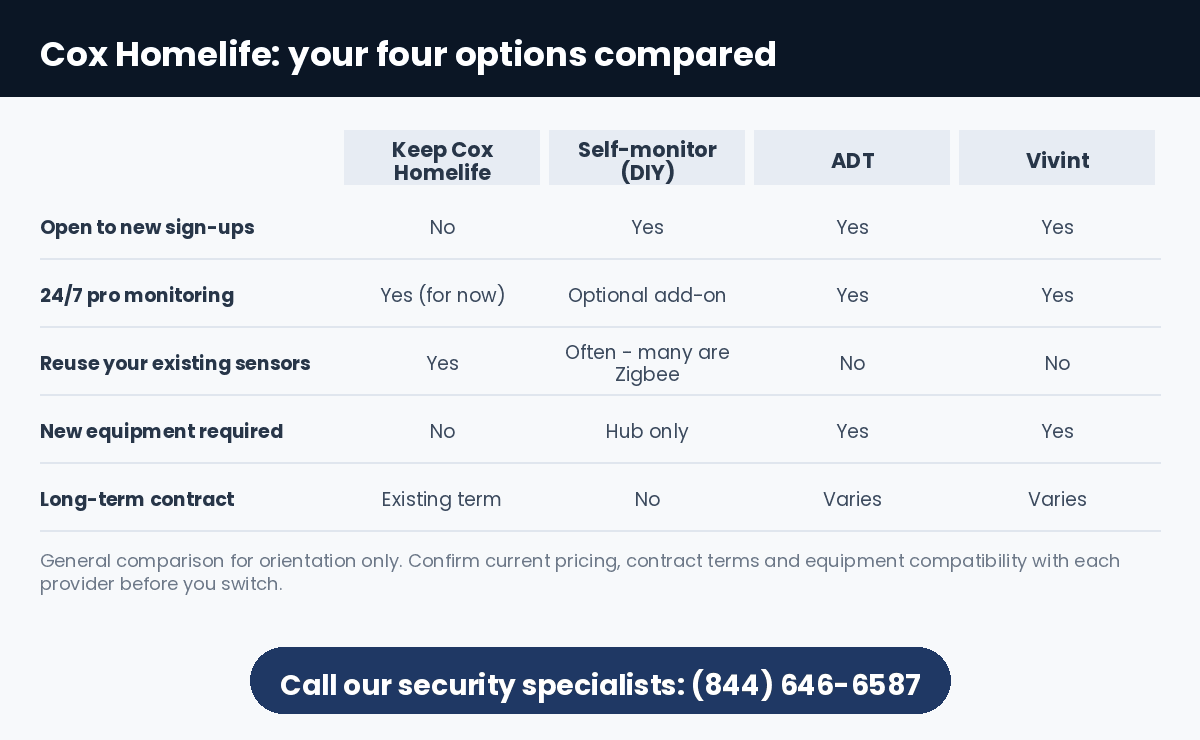
Here is how the main paths compare on the four factors that decide it for a Homelife customer. Monitoring prices move constantly, so we keep current pricing on the linked review pages rather than freezing a number here.
| Option | Monitoring | Contract | Cellular backup | Works with existing gear? |
|---|---|---|---|---|
| Vivint | Professional, 24/7 | Varies — financing terms apply to equipment | Yes | Ask with model numbers; some third-party gear supported |
| Brinks | Professional, 24/7 | Term contract typical | Yes | Known for adopting existing compatible systems — ask first |
| DIY / self-monitored | Self-monitored (pro optional) | Usually none | Varies by kit | Usually no — new hardware, lower cost |
The four columns that decide it, in order of how much they matter:
- Contract length. You have already been through one product wind-down. Do not buy into a long lock-in.
- Equipment reuse. If any of your existing sensors can be adopted, the switching cost drops sharply.
- Professional monitoring vs. self-monitoring. Homelife was professionally monitored. If that mattered to you — insurance discount, alarm permit requirements in your city — it still does.
- Cellular backup. Your Homelife system almost certainly had it. A cheaper WiFi-only replacement is not equivalent.
Cox’s support page states it is “only supporting existing Cox Homelife devices” — the dedicated Homelife app has been retired, and new customer enrollment ended in 2024.
Cox Homelife FAQ
Is Cox Homelife shutting down?
Cox has not published a shutdown date. It has stopped new signups, retired the dedicated app, and limited its published support to existing devices. That is a wind-down profile, not an announced end-of-life.
Will Spectrum take over my Cox Homelife service?
Spectrum does not offer a comparable home security product, and no transition plan for Homelife customers has been published by Cox or Charter. Home security does not appear on either company’s list of services carrying over through the merger.
Does my Cox Homelife system still work right now?
Yes. Nothing about the merger switched anything off. The risk is support and replacement parts over time, not sudden shutoff.
Can I keep my Cox Homelife equipment if I switch providers?
It depends on the specific hardware and whether you own or lease it. Get your panel and sensor model numbers, then ask a prospective provider directly — do not assume either answer.
What happens to my monitoring contract?
Cox states existing contract terms will be “honored according to your current agreement.” Check your own agreement for its end date and any early-termination terms before making a move.
Should I switch now or wait?
There is no forcing event, so there’s no need to rush — but shopping while your system works gives you better options and better pricing than shopping the week something fails. Price alternatives now; decide on your own timeline.
Cox Homelife still works today — the smart move is simply to price your next system while that’s true, not after a failure decides the timing for you.
Compare internet, energy & home security at your address
Keep going
- Charter Cox merger: what it means for customers — the full merger picture
- Best home security systems — the current comparison
- How much does home security cost? — monitoring, equipment and install pricing
- Vivint home security review — professionally monitored alternative
- Brinks home security review — professionally monitored alternative
- DIY home security systems — if you’d rather self-monitor