
Blog
Moving Truck vs Container: Real Cost to Move Cross-Country


8 min read
Last updated: November 12, 2026
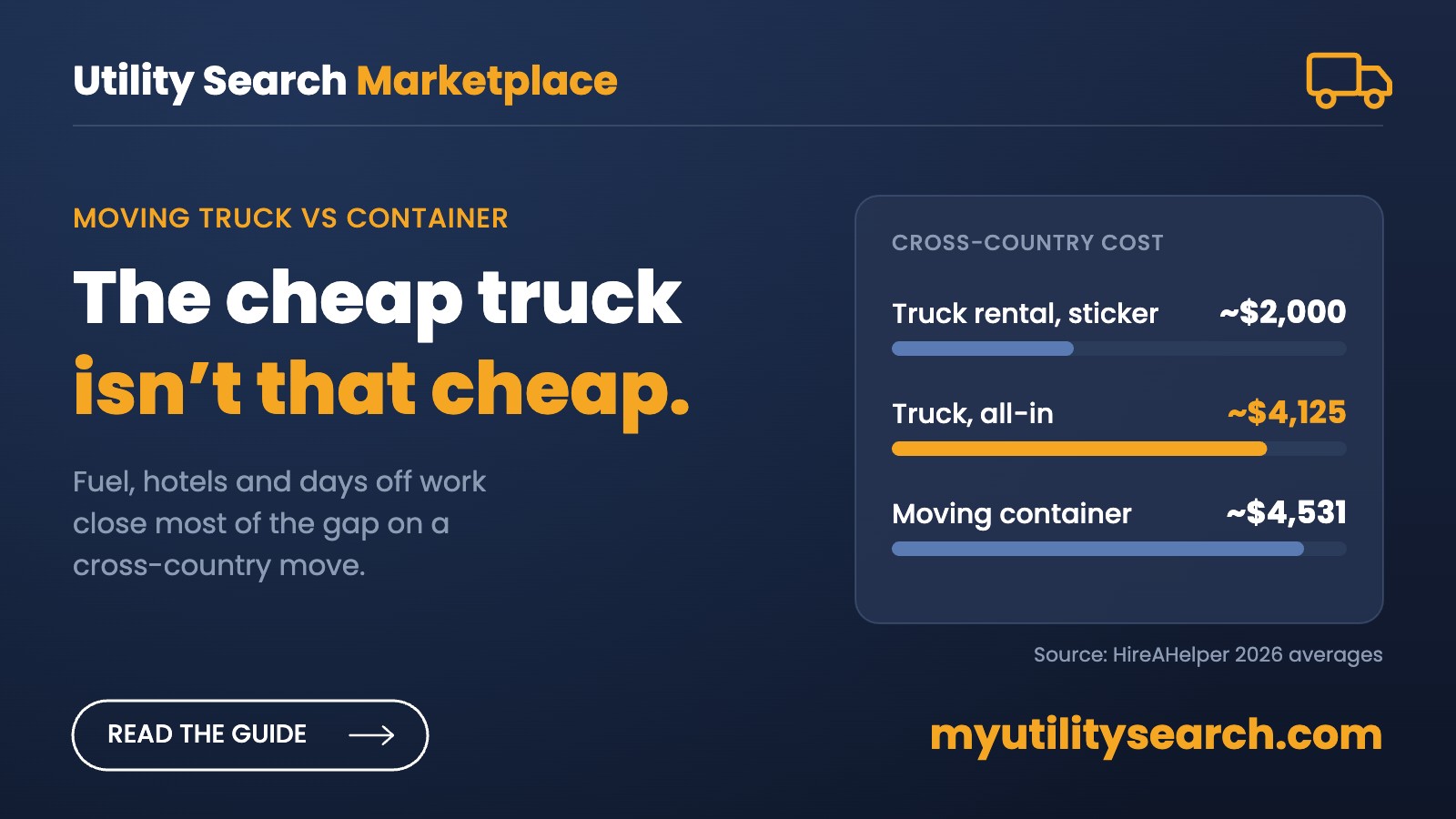
Moving truck vs container is the first real money decision of any move. A rental truck wins on sticker price, but barely on a long haul. A cross-country truck rental starts around $2,000, yet the all-in cost averages about $4,125 once you add fuel, mileage, lodging and days off work to drive. A comparable moving container averages about $4,531. On a cross-country move, the real gap is roughly 10%.
Key takeaways
- Local move: a rental truck is clearly cheaper, about $167 vs. about $589 for a container.
- Cross-country: the all-in costs nearly converge, about $4,125 (truck) vs. about $4,531 (container).
- A truck’s price is a meter: miles, fuel, a hard return deadline and your own days behind the wheel.
- A container is a flat window you load on your own schedule, usually with about a month of storage built in.
- Add a gap between homes and the truck’s hidden costs climb: a separate storage unit, plus loading everything twice.

How much does a moving truck vs a container actually cost?
In a moving truck vs container comparison, a truck is cheaper on paper and a container costs more up front, but the gap depends almost entirely on distance. Here are the current moving truck vs container averages:
| Move type | Rental truck | Moving container |
|---|---|---|
| Local (same metro) | ~$167 | ~$589 |
| Regional (next state over) | ~$200 | ~$665 |
| Cross-country (all-in) | ~$4,125 | ~$4,531 |
Moving truck vs container averages, HireAHelper 2026. Real quotes vary by route, size and season.
The truck’s base rental really is cheap: about $19.95 a day plus mileage for a small truck, and a one-way 26-footer cross-country runs around $2,000. Our moving truck rental guide comparing U-Haul, Penske and Budget breaks those rates down. The catch is everything stacked on top: fuel at 8 to 14 mpg, per-mile charges, two to four days of hotels and meals, time off work, insurance and one-way drop fees. Add it up and the all-in cross-country truck average lands near $4,125.
A moving container (PODS, U-Pack, 1-800-PACK-RAT) bundles transport and about a month of storage into one price. Cross-country containers run roughly $2,068 to $7,448 depending on size and route, averaging about $4,531. See our moving container companies comparison and the detailed PODS cost guide for the full ranges.
Moving truck vs container cost by route
Averages hide a lot, because price tracks distance and home size. These are container ranges for common long-distance routes:
| Route | Approx. distance | Moving container |
|---|---|---|
| Austin → Dallas | ~200 mi | $1,010–$1,516 |
| Tampa → Atlanta | ~460 mi | $1,790–$2,684 |
| New York → Los Angeles | ~2,800 mi | $3,138–$4,708 |
| Miami → San Francisco | ~3,000 mi | $5,016–$7,357 |
Container ranges from our PODS cost guide (Moving Calculator data). A rental truck on the same routes starts at a lower sticker price but adds fuel, lodging and days off work on top.
Notice the pattern: the shorter the move, the more a truck’s low rental wins. The longer the move, the more the truck’s hidden costs catch up to the container. That crossover is the whole moving truck vs container question in one line.
What “all-in” means: in any moving truck vs container comparison, a truck’s quoted price is the rental only. “All-in” is what the move actually costs: rental + fuel + mileage + lodging + meals + time off + insurance + any one-way or drop fees. On a long move, the extras can nearly double the sticker.
The truck has a meter running. The container is your schedule.
This is the real difference behind the moving truck vs container numbers. A rental truck is billed by the day and the mile, it burns fuel the whole way, and it comes with a hard return deadline. You are the driver, and you are racing a clock. If you hire loaders, they are billed by the hour on top.
A container flips that. The company delivers it to your door, you load it over days or even weeks at your own pace, and someone else does the driving. About 30 days of storage is usually included, so a gap between closings is not a crisis. You trade a lower sticker price for time, flexibility and not white-knuckling a 26-foot box truck across three states.
What a truck rental quote leaves out
The quote you see is almost never the price you pay. In a moving truck vs container decision, these are the truck-side costs that close the gap:
- Fuel and per-mile charges. A big truck gets 8 to 14 mpg, and one-way rentals add roughly $1 per extra mile.
- Hotels and meals on a multi-day drive.
- Days off work to pack, drive and unload.
- Insurance, late-return fees and one-way drop fees.
- A separate storage unit if there’s a gap between homes, which means unloading and reloading everything, doubling the labor and the risk of damage.
What a moving container includes
In the moving truck vs container trade-off, a container’s higher price buys back a lot of friction: delivery and pickup, no driving, about a month of storage, loading on your own schedule, and the choice to keep it in your driveway or at the company’s facility.
It isn’t perfect. Containers cost more on short local moves, need driveway space or a city permit, have delivery windows that aren’t exact, get scarce in peak summer, and charge for date changes or extra storage. Those are honest trade-offs, not deal-breakers.
Where full-service movers fit
Full-service movers are the third option: they pack, load, drive and unload, so you do almost nothing. That convenience costs the most. Our guide to how much movers cost breaks down hourly rates and long-distance prices by home size. A long-distance full-service move typically runs several thousand dollars more than a container or a truck you load yourself.
They earn their price when you’re short on time, physically can’t do the labor, or your employer is paying. For most hands-on households, though, the real money decision stays moving truck vs container, with full-service movers as the premium tier above both.
How to compare a moving truck vs container quote
The only way to settle a moving truck vs container decision is to price your exact move, not the average. Run both quotes like-for-like:
- Get a quote for your real route and dates from a truck company and a container company: same origin ZIP, same destination ZIP, same week.
- Add the truck’s hidden costs to its quote. Estimate fuel (miles ÷ 10 mpg × local gas price), plus lodging and meals for each night on the road, plus any days of pay you’ll lose driving.
- Check your storage gap. If your move-out and move-in dates don’t line up, add a storage unit to the truck side, or note that a container usually includes about a month.
- Factor the season and your driveway. Summer raises both prices and tightens container availability. No driveway may mean a city permit for the container.
Do that, and in many moving truck vs container matchups the option that’s cheaper on paper is often not the one that’s cheaper in your bank account.
Moving truck vs container: which should you pick?
Pick the one that matches your distance and your tolerance for driving. The moving truck vs container choice comes down to a few clear signals:
Choose a rental truck if it’s a local or regional move, your budget is tight, you can load and drive a box truck in a day or two, and there’s no gap between your old place and your new one.
Choose a moving container if it’s a long-distance or cross-country move, your timeline is flexible, you want to load over several days, you need storage between closings, or you simply don’t want to drive a heavy truck across the country with your family in the car.
Don’t forget the utilities at your new address
Whichever way your moving truck vs container decision goes, the move isn’t finished until the lights and the Wi-Fi are on. Set up electricity and internet before move-in so you’re not unpacking in the dark on day one. In deregulated states you can shop your electricity rate instead of taking the default, and comparing internet by address keeps you from overpaying for a plan you don’t need.
Our change-of-address checklist covers who else to notify, and our College HUNKS × Utility Search partnership can help with the move itself.
Also compare energy, home security and home warranty at your new address
Electricity plans in 14 deregulated states. Security and warranty nationwide.
Moving truck vs container FAQ
Is it cheaper to rent a truck or a moving container?
In a moving truck vs container comparison for a local move, a rental truck is clearly cheaper, about $167 vs. about $589 for a container. For a cross-country move the gap nearly disappears: about $4,125 all-in for a truck vs. about $4,531 for a container, because fuel, lodging and time off close the sticker-price gap.
How much does it cost to move cross-country?
A cross-country move averages about $4,125 all-in with a rental truck and about $4,531 with a moving container. Container pricing ranges roughly $2,068 to $7,448 depending on home size and route. A bare truck rental starts near $2,000 before fuel and lodging.
Is PODS cheaper than U-Haul?
On sticker price, U-Haul is cheaper; a one-way cross-country truck can start around $2,000. Once you add fuel, mileage, hotels and time off, PODS and other containers come out close on a long move. See our PODS cost guide and truck rental comparison for exact numbers.
Do moving containers work for a military PCS move?
Yes. Containers fit a personally procured move (PPM) well: you can get certified weight tickets, store goods between duty stations, and skip a long drive with family in the car. Start at move.mil and your installation transportation office to confirm your reimbursement.
What’s the cheapest way to move cross-country?
Driving a rental truck yourself is usually the lowest sticker price if you can load and drive it, but a container often wins once you value your time, fuel and lodging. Run both quotes for your exact route before deciding.
Sources
- HireAHelper: Moving Trucks vs. Moving Containers
- FMCSA: Protect Your Move (interstate moving rights)
- MyUtilitySearch: PODS Cost 2026
- MyUtilitySearch: Moving Truck Rental, U-Haul vs Penske vs Budget
Keep going
- Moving truck rental — U-Haul vs Penske vs Budget, cheapest picks
- Moving container companies compared — PODS vs U-Box vs U-Pack vs PACK-RAT
- PODS cost 2026 — prices by size and distance
- Change-of-address checklist — who to notify
- College HUNKS × Utility Search — utility setup for your move
- No-deposit electricity — skip the deposit at your new address