Blog
Rent Concessions Explained: Free Months, Net Effective Rent & How to Ask

Updated on November 10, 2026
12 min read
Rent concessions are the discounts landlords hand out to fill units — free weeks or months of rent, waived fees, gift cards, free parking, or bundled perks — and in 2026 they’re everywhere: 39.8% of U.S. rental listings offered one in July, and in Dallas and Austin it’s roughly two of every three listings (Zillow). Here’s how to win them, price them, and keep saving after move-in.
TL;DR — Key takeaways
- Rent concessions hit a near-record in July 2026: 39.8% of U.S. listings offered a deal, up from 35.9% a year earlier — and Sun Belt metros are far higher (Charlotte 68.1%, Denver 67.2%, Dallas 65.6%, Austin 65.1%).
- Always convert the offer to net effective rent: one free month on a 12-month lease is an 8.3% discount — but only if the face rent didn’t get marked up first.
- Cash-equivalent rent concessions (free months, reduced rent) usually beat perk concessions (gift cards, “free” WiFi) — perks are worth only what you’d actually pay for them.
- Watch the clawback clause: many leases make you repay rent concessions if you leave early, and renewals typically reset to full face rent.
- The compounding move: take the concession in rent and keep your own meters — then shop electricity and internet yourself for savings that repeat every month.
What Are Rent Concessions?
Rent concessions are incentives a landlord offers to close a lease without permanently lowering the advertised rent. The property keeps its “face rent” high on paper — which protects its building valuation and comps — while handing you a one-time discount to get you signed.
Definition box — the concession menu:
- Free rent: 2–8 weeks free, up front or spread across the lease. The gold standard — pure cash value.
- Reduced rent: a lower monthly rate for the full term. Rarer, and often better than a free month because renewals anchor to it.
- Waived fees: application, admin, amenity, or pet fees ($100–$500 in real money).
- Perk concessions: gift cards, free parking, storage, or “free WiFi.” Value these at what you’d truly pay — a $30/mo parking spot you don’t need is worth $0.
- Net effective rent: total lease cost after rent concessions, divided by the number of months. This is the only number that lets you compare two offers honestly.
Why 2026 Is the Best Renter’s Market for Rent Concessions in Years
The math behind the giveaway: a historic wave of new apartment construction hit Sun Belt metros just as rent growth stalled. Multifamily rents rose only 1.7% year-over-year nationally in July (versus 3.0% for single-family rentals), and operators with empty units compete on sweeteners rather than cutting face rent.
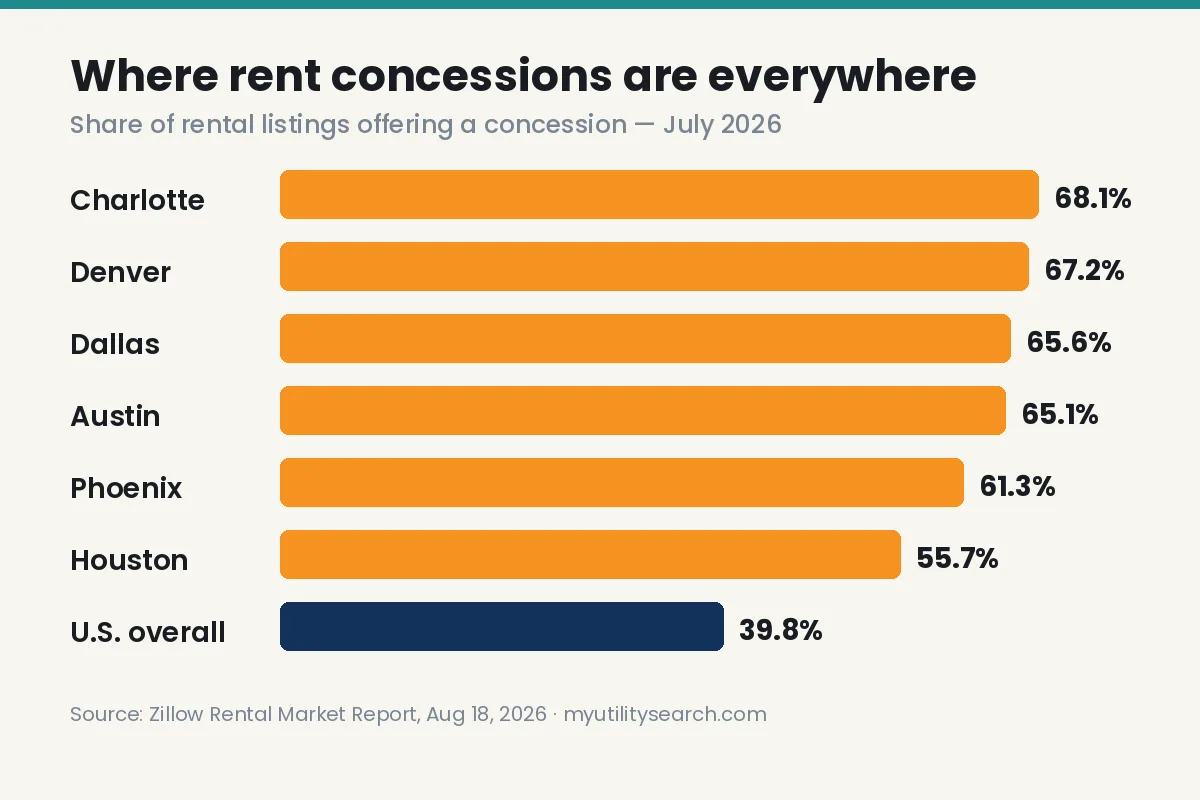
Stat block: In July 2026, 39.8% of U.S. rental listings on Zillow offered at least one concession — up from 35.9% a year earlier. In Charlotte (68.1%), Denver (67.2%), Dallas (65.6%), and Austin (65.1%), rent concessions appeared on roughly two of every three listings (Zillow, August 18, 2026).
Two forces cap how long this lasts: national rents are re-accelerating (+2.3% year-over-year, the fastest pace in over a year), and new construction deliveries are slowing. Translation: the leverage is real, and it’s strongest right now, in lease-up-heavy Texas and Sun Belt submarkets. Buyers have leverage this fall too: see our October market check on whether it’s a good time to buy a house.
How to Negotiate Rent Concessions (Scripts Included)
- Shop the comps first. Screenshot 3–4 comparable units in the same ZIP advertising deals. Your leverage is the vacancy across the street.
- Ask the open question: “What move-in specials are available on this unit right now?” Let them anchor first — in a 65% concession market, there is almost always something.
- Trade term for value: “If I sign a 13- or 14-month lease, can you extend that to six weeks free?” Longer terms help their occupancy math and often unlock bigger rent concessions.
- Convert perks to rent: “Instead of the gift card and free parking, would you take $75 off the monthly rent?” Recurring beats one-time, and it anchors your renewal lower.
- Get it in the lease. A verbal special doesn’t exist. The concession, its timing, and any repayment condition must appear in the lease or an addendum.
Net Effective Rent: Price Rent Concessions Like a Landlord Does
| Offer | Face rent | Concession | Net effective rent (12 mo) |
|---|---|---|---|
| Unit A | $1,650 | None | $1,650 |
| Unit B | $1,750 | 1 month free | $1,604 |
| Unit C | $1,700 | $500 gift card + waived $300 admin fee | $1,633 |
| Unit D | $1,595 | $55/mo off (reduced rent) | $1,540 |
Notice two things. Unit B’s splashy “free month” is real — but its marked-up face rent claws back half the value, and next year’s renewal starts from $1,750.
Unit D’s quiet reduced rent wins the year and the renewal conversation. That’s the whole game with rent concessions: the marketing is loud, the math is quiet.
The Fine Print: Where Rent Concessions Bite Back
- Clawback clauses. Break the lease early and many agreements require repaying the full concession. Know the number before you sign.
- Renewal reset. Rent concessions are a year-one price; renewals typically quote full face rent. Budget for the jump, or renegotiate with fresh comps — in a soft market, renewal concessions exist too.
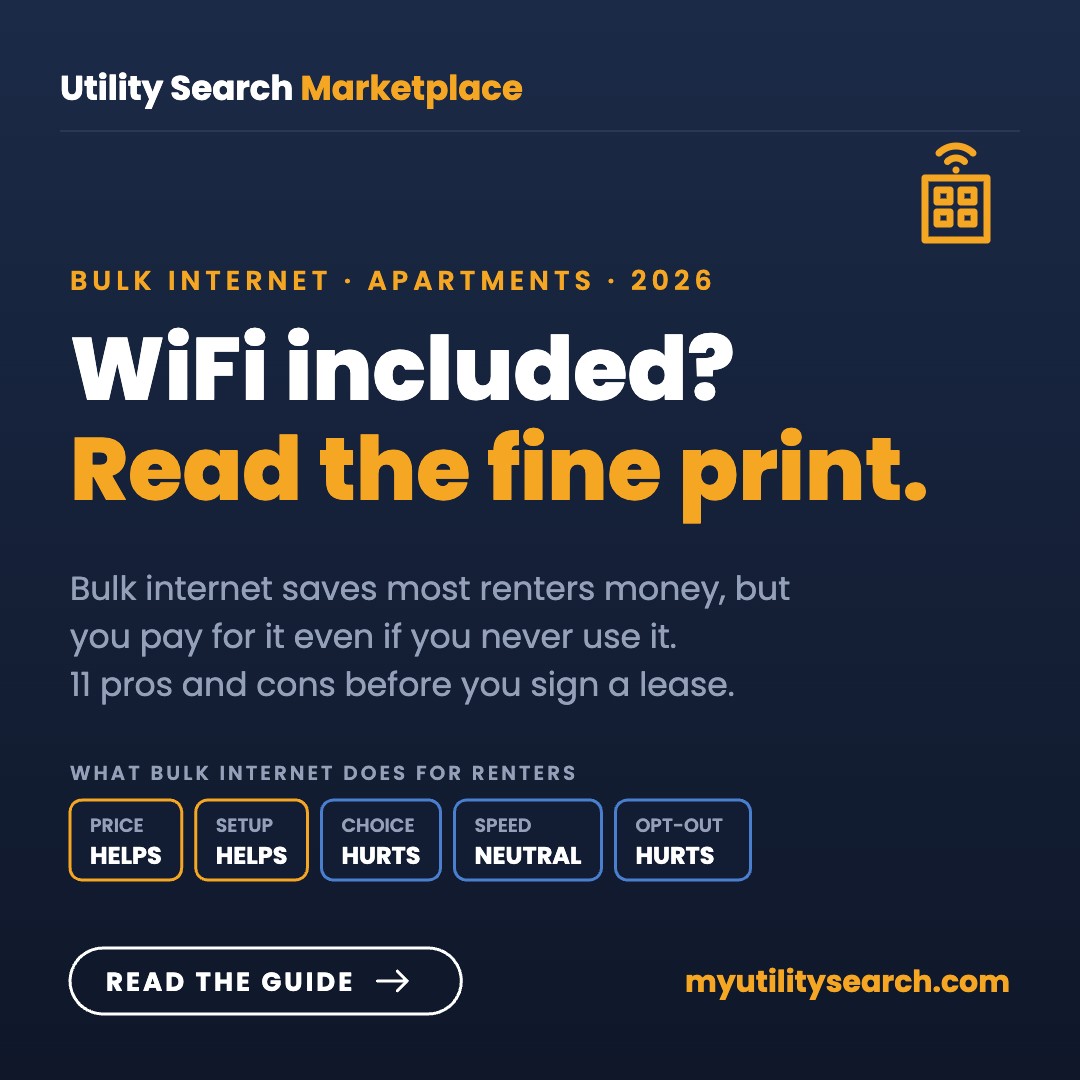
- “Free” bundles that remove choice. A concession of “free WiFi” or “utilities included” is the building choosing your providers for you. As we covered in our utilities included apartments guide, that trade can cost more than it saves — take the discount in rent and keep the bills you can shop.
- Concession-heavy buildings. If every unit is discounted, ask why. High turnover, construction noise, or management issues can be the real price.
Keep Winning After Move-In: Pair Rent Concessions With Utility Savings
A free month is a one-time win. The bills are forever — and that’s where renters leave money on the table. The renter who negotiated $1,654 rent in Houston (one free month ≈ $138/mo effective) but never shopped electricity or internet often gives the entire concession back within the year.
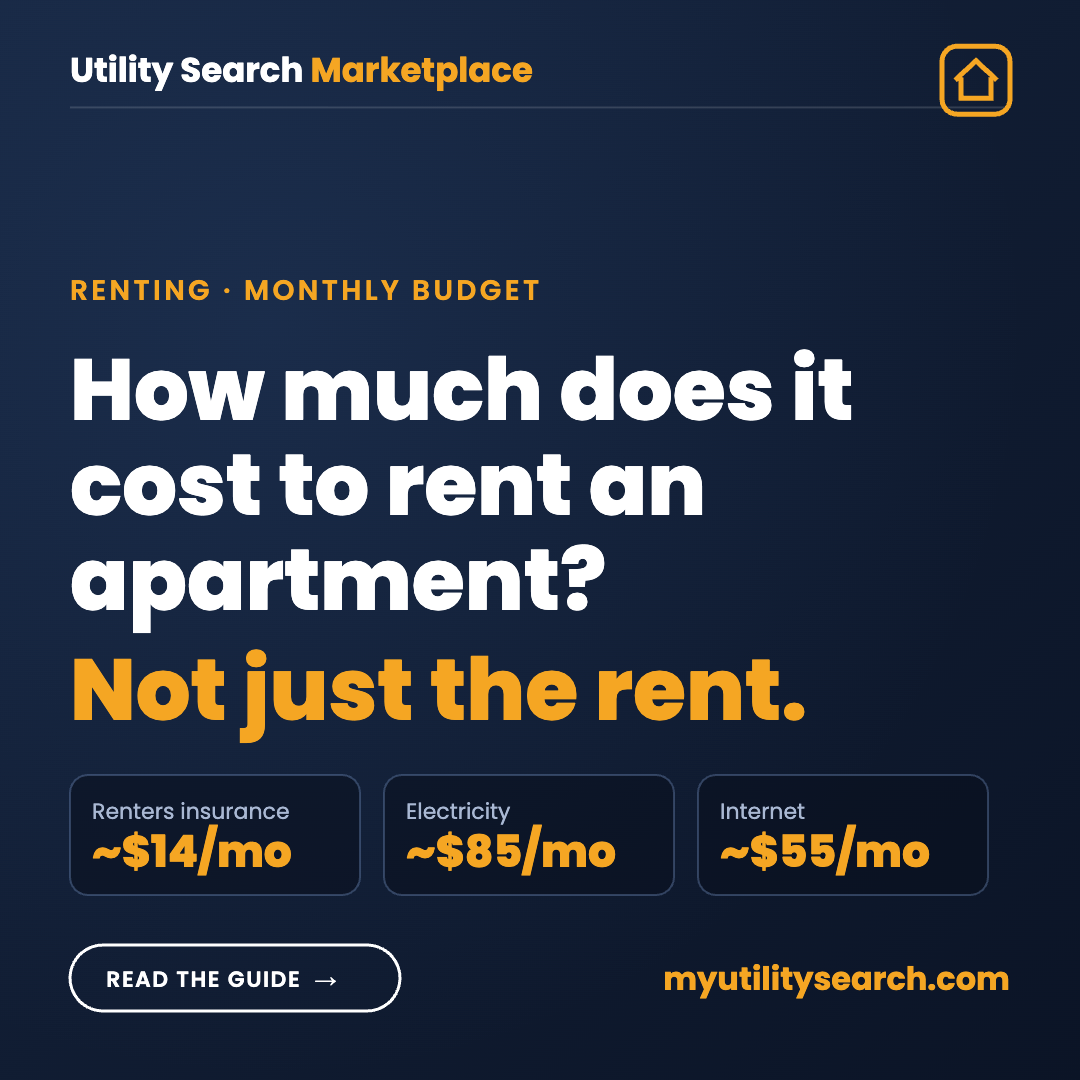
Stat block: A typical one-bedroom’s shoppable bills — electricity ($90–$135) plus internet ($40–$80) — run $130–$215 every month. Cutting $40/mo across both is $480 a year, recurring: more than many one-time rent concessions are worth.
The playbook: if your unit is individually metered in Texas or another deregulated state, compare electricity plans at your usage. If your building isn’t on a bulk internet agreement, price your own connection against the marketed one.
And if a deposit stands in your way, our no deposit electricity guide shows every $0-start path. Concession at signing, savings every month after — that’s the full stack.
When to Sign: Timing Your Lease for Maximum Concessions
Rent concessions follow the calendar. Demand peaks in late spring and summer — when the most renters move and units lease fastest — and softens from October through February, when operators stare down winter vacancies.
The same unit that offers two weeks free in June frequently offers six weeks free in November. If your move date is flexible, even by a month, aim for the shoulder season: apartments now sit on the market about 30 days on average before leasing (Apartment List), and every extra week of vacancy makes the leasing office more generous.
Timing also matters inside the month. Leasing teams chase monthly and quarterly occupancy targets; touring in the last week of the month, politely ready to sign “today if the numbers work,” is when discretionary approvals happen.
In lease-up buildings — brand-new properties racing from empty to stabilized — rent concessions are largest in the first months after opening, because the developer’s loan terms depend on filling floors fast. Those buildings are where 8-week-free offers live.
Renewal Season: The Second Concession Nobody Asks For
Most renters negotiate hard at signing and then sign whatever the renewal letter says a year later. That’s backwards in a market like this one. Your landlord’s alternative to renewing you is a vacant unit in a metro where two-thirds of competing listings are discounting — turnover costs them a make-ready, marketing, and typically a concession to the next tenant anyway.
Sixty days before your lease ends, pull the same comp screenshots you used at signing, note what your own building is advertising to new renters, and ask the direct question: “New residents are getting six weeks free — what can you do on my renewal?” A $50–$100 monthly reduction or a renewal concession is a routine ask in 2026, and even a “no” costs you nothing.
Pair the renewal conversation with a fresh look at your bills — renewal season is also the natural moment to re-shop your electricity plan and internet rate, which quietly drift upward on the same 12-month cycle your lease does.
Rent concessions: the questions people ask, answered
What renters type when they see “2 months free,” in their own words, answered as of October 25, 2026.
What is a rent concession, in plain terms?
A discount a landlord gives to get a lease signed or renewed without lowering the advertised rent: one or two months free, a reduced security deposit, waived application or amenity fees, free parking, or a gift card. The advertised (‘gross’) rent stays on paper; what you actually pay over the lease (‘net effective rent’) is lower. Landlords prefer concessions to rent cuts because the next tenant can be charged the full gross rent.
What does ‘one month free’ or ‘two months free’ actually mean, and do I still pay a deposit?
It means the total rent over the lease is reduced by one or two months’ worth; it does not mean you move in for nothing. Most leases either waive a specific month (often the first or the last) or spread the credit across every month. You still pay the security deposit, any application or admin fees, and the first month unless the lease says the free month is month one. If the ad says ‘two months free’ on a 12-month lease at $1,861, your net effective rent is about $1,551 a month: $1,861 times 10, divided by 12.
What is a monthly concession, and how is it different from free rent?
A monthly concession is the same discount spread evenly: instead of one $1,861 month free, you get $155 off every month for 12 months. Landlords prefer it because the gross rent stays intact for renewal, and tenants prefer it because the savings arrive every month rather than at the end. Either way the dollar value is identical; the difference is timing and what the rent will reset to at renewal.
What are examples of rent concessions besides free rent?
Reduced or waived security deposit; waived application, admin and amenity fees; free parking or storage for the term; a free month of a bulk internet or cable package; a gift card ($250 to $1,000 at large complexes); upgraded appliances or paint; a shorter lease at the 12-month rate; and, at renewal, a smaller increase in exchange for a longer term. In 2026 the common package in oversupplied Sun Belt markets is six to eight weeks free plus a waived admin fee on a 12- or 14-month lease.
What does a ‘$500 rent concession’ mean on my lease?
A one-time credit of $500 applied to your rent ledger, usually in the first month, or $500 spread over the term (about $42 a month on a 12-month lease). It is not a deposit and is not refundable; if you break the lease early, most agreements say the concession is ‘recaptured’ and added to what you owe. Look for the recapture clause before you sign.
Does a 12-week-free or 18-month-lease deal work the same way?
Yes; longer leases carry larger concessions because the landlord locks in occupancy. Twelve weeks free on an 18-month lease is roughly 2.8 months of rent spread over 18, or about 15 percent off. Compare offers on net effective rent per month, not on the number of free weeks: a 14-month lease with two months free (14 percent off) can beat an 18-month lease with 12 weeks free (15 percent off) if you do not want to be locked in for the extra four months.
Can my first month’s rent be free, and can I get a free month at the start and the end?
Both happen. ‘First month free’ is a common move-in special when the unit has sat vacant; ‘front and back’ (a free month at move-in and another at the end of the term) is used on longer leases to reward staying. Ask for the structure you want; the landlord’s cost is the same, and a free first month helps most renters’ cash flow more than a credit in month 12.
What is a renewal concession, and how do I get concessions again at renewal?
A discount offered to keep you from leaving when your lease ends: a smaller increase, a free month on a new 12-month term, or a fee waiver. You get it by asking, 60 to 90 days before the lease ends, with evidence: current new-tenant specials at your own complex and at two or three competitors nearby. Management companies would rather give a returning tenant a concession than pay turnover costs of $2,000 to $4,000 per unit, so a polite, documented ask works more often than not.
Are rent concessions common in 2026, and where?
Yes, the most common since 2009. Record apartment deliveries in 2024 and 2025 left large complexes in Austin, Dallas, Houston, Phoenix, Nashville, Atlanta, Charlotte, Denver, Orlando and Tampa offering one to two months free on most new leases, and roughly a third of all U.S. listings on the major rental sites carried a concession in 2026. Older Northeast and coastal California markets with little new supply offer far fewer. Utilities are the other lever: in deregulated states, choosing your own electricity plan at move-in can save as much as a small concession.
Also searched as: rent concessions, lease concessions, rent concession guide, free rent concession, what is a monthly concession and renewal concession. They all mean the discounts on this page.
FAQ
What are rent concessions?
Rent concessions are one-time incentives landlords offer to fill units without lowering advertised rent — most commonly free weeks or months of rent, waived application/admin/amenity fees, reduced monthly rent, gift cards, or free parking. They’re negotiated at signing and written into the lease.
How common are rent concessions in 2026?
Very. 39.8% of U.S. rental listings offered a concession in July 2026, per Zillow — and in supply-heavy metros like Charlotte (68.1%), Denver (67.2%), Dallas (65.6%), and Austin (65.1%), it’s about two in three listings.
How do I ask for a rent concession?
Ask directly — “What move-in specials are available on this unit?” — armed with screenshots of comparable discounted units nearby. Offering a longer lease term (13–14 months) frequently unlocks larger rent concessions, and converting perks into a monthly rent reduction beats one-time freebies.
What is net effective rent?
Net effective rent is your true monthly cost after concessions: total lease cost minus all discounts, divided by lease months. One free month on a 12-month, $1,750 lease is a net effective rent of about $1,604. Always compare units on this number, not face rent.
Do rent concessions have to be repaid?
Sometimes. Many leases include a clawback clause requiring repayment of the concession if you terminate early. Check the addendum before signing, and note that renewals usually reset to full face rent.
Also compare energy, home security and home warranty at your address
Electricity plans in 14 deregulated states. Security and warranty nationwide.
Keep going
More ways to stack the renter math in your favor:
- Moving soon? Start with our moving checklist — every step from 8 weeks out to your first month in
- Utilities Included Apartments: What’s Covered & What You Can Still Choose — when the “free utilities” concession is worth it, and when it isn’t.
- No Deposit Electricity: Every Way to Skip the Deposit — start service at $0 while your cash covers the move.
- Best Internet Providers for Renters — the shoppable half of your monthly stack.
- First Apartment Utilities Checklist — what to set up and when, once the lease is signed.
- Dallas Electricity Rates: Best Plans & Providers — shop the metro where 65.6% of listings are dealing.
- Austin Electricity Rates: Best Ways to Save — same play, Austin edition.
Sources: Zillow Rental Market Report, Aug 18, 2026 (concession shares, metro rents, rent growth); Apartment List National Rent Report, July 2026. Market figures change monthly — validate before major updates.