Blog
What Uses the Most Electricity at Home? Ranked by Appliance (2026)

Updated on November 14, 2026
13 min read
By Chris Burg, founder of MyUtilitySearch · Updated November 14, 2026 · Figures from the U.S. Energy Information Administration
What uses the most electricity at home? In a typical U.S. home, the appliances that use the most electricity are the air conditioner, the space heater or electric furnace, and the water heater. Together they account for roughly 43% of household electricity, according to the U.S. Energy Information Administration (EIA). The refrigerator, lighting and TVs come next. The appliances most people suspect, such as the microwave, phone chargers and the coffee maker, barely register.
Knowing what uses the most electricity tells you where a lower bill actually comes from. Below is the full ranking with what each one costs per year at today’s average rate, how to check your own appliances, and which fixes are worth your time.
- #1 Air conditioning: about 2,055 kWh a year, or $373, averaged across all U.S. homes.
- #2 Space heating: about 1,304 kWh, or $237, and far more in homes heated mainly by electricity.
- #3 Water heating: about 1,264 kWh, or $230, and it runs all year.
- Next: refrigerators ($152), lighting ($119), TVs and related devices ($111), and clothes dryers ($82).
- Your rate matters too: the same usage costs more than twice as much at California’s average rate as at Louisiana’s.
Usage from EIA’s 2020 Residential Energy Consumption Survey, divided across all 123.5 million U.S. homes. Costs use EIA’s August 2026 average residential price of 18.16¢ per kWh, calculated by myutilitysearch.com.
Which appliances use the most electricity? The full ranking
The EIA’s Residential Energy Consumption Survey is the most complete federal measure of what uses the most electricity at home. Its latest consumption estimates cover 2020 and more than 18,000 households. We divided each appliance’s national total by the number of U.S. homes, then priced it at the August 2026 national average residential rate.
| Rank | Appliance or end use | kWh per year (avg U.S. home) | Share of home use | Cost per year at 18.16¢ |
|---|---|---|---|---|
| 1 | Air conditioning | 2,055 | 19% | $373 |
| 2 | Space heating | 1,304 | 12% | $237 |
| 3 | Water heating | 1,264 | 12% | $230 |
| 4 | Refrigerators (all in the home) | 835 | 8% | $152 |
| 5 | Lighting | 654 | 6% | $119 |
| 6 | TVs and related devices | 613 | 6% | $111 |
| 7 | Furnace and AC blower fans (air handlers) | 498 | 5% | $90 |
| 8 | Clothes dryers | 453 | 4% | $82 |
| 9 | Separate freezers | 189 | 2% | $34 |
| 10 | Cooking (range, oven, cooktop) | 189 | 2% | $34 |
| 11 | Clothes washers (motor only) | 57 | <1% | $10 |
What uses the most electricity, ranked by average annual use. Source: EIA 2020 Residential Energy Consumption Survey, table CE5.1.ST (billion kWh by end use), divided by 123.53 million households; shares use EIA’s average of about 10,500 kWh per home per year. Costs at EIA’s August 2026 U.S. average residential price, 18.16¢/kWh. Calculated by myutilitysearch.com.
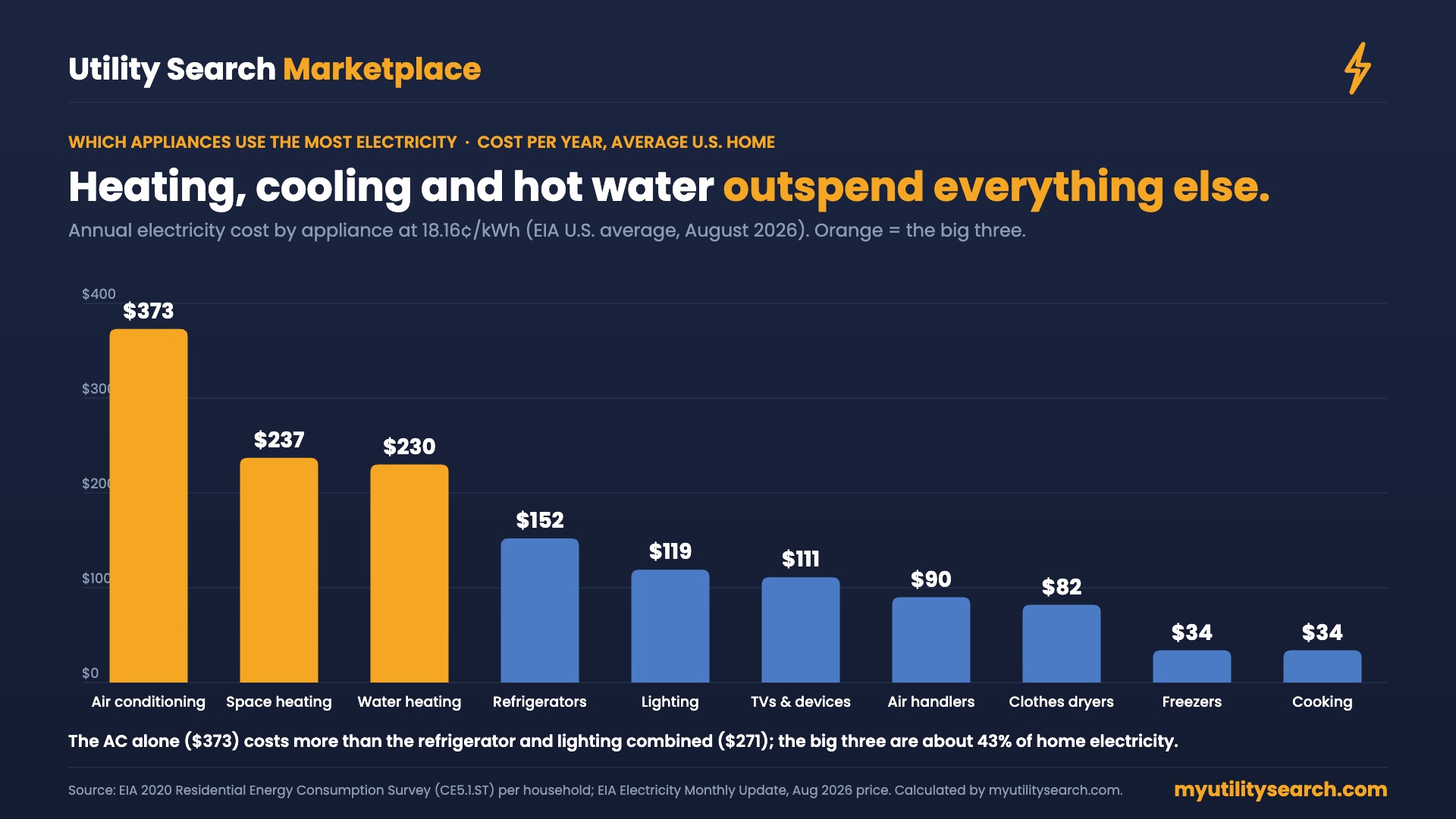
One thing to read carefully: these are averages across every home, including homes that heat with gas or have no dryer. If your home uses electricity for heat, or you run a dryer most days, your number for that appliance will be higher than the average shown.
What uses the most electricity in a home? The big three
Air conditioning, space heating and water heating are the appliances that use the most electricity because they move heat, and moving heat takes a lot of energy. EIA lists them as the three largest uses of home electricity, at 19%, 12% and 12% of the total in 2020.
1. Air conditioning
When it comes to what uses the most electricity, air conditioning is the single biggest user in most American homes. EIA counts 89% of homes using air conditioning in 2020, up from 57% in 1980, and 67% with central air. In hot states the share of the bill is far larger than the national average, because the system runs for months.
2. Space heating
Electric heat is spreading. In 2024, 42% of U.S. households said electricity was their main heating fuel, according to Census data reported by EIA. Electric resistance heat, such as baseboard heaters and portable space heaters, is the most expensive way to heat with electricity. A heat pump moves heat rather than making it and uses much less for the same warmth.
3. Water heating
The water heater is the quiet one among the appliances that use the most electricity. It runs every day of the year, and its use rises with the number of people in the home, because more people means more showers and laundry. An electric tank water heater set hotter than it needs to be wastes energy around the clock.
The always-on appliances: refrigerators, freezers, lighting and TVs
These are not the appliances that use the most electricity per hour, but they never stop running, so they add up.
- Refrigerators. Nearly every home has one, and 34% of homes had two or more in 2020. EIA estimates the main refrigerator cost about $87 a year to run in 2020 and a second refrigerator about $66, at 2020 prices.
- Separate freezers. About a third of homes have one, and EIA puts the average cost at $74 a year. A half-empty garage freezer is one of the easiest loads to cut.
- Lighting. LED bulbs have shrunk lighting’s share, but it is still the fifth-largest use of home electricity in the table above.
- TVs and related devices. TVs, cable boxes, streaming devices and game consoles together use about as much as lighting. Many keep drawing a little power in standby.
Compare internet, home warranty & home security at your address
How to figure out what your own appliances use
You do not have to guess what uses the most electricity in your home. The U.S. Department of Energy uses a simple formula:
Watts × hours used ÷ 1,000 = kWh. Then kWh × your price per kWh = cost.
To see what uses the most electricity in your own home, find the wattage on each appliance’s label, or in the EnergyGuide label for refrigerators, washers and water heaters. Your price per kWh is on your electric bill. Two worked examples at the 18.16¢ national average:
- A 1,500-watt space heater running 8 hours a day for 30 days uses 360 kWh, which is about $65 a month.
- An electric vehicle driven 12,000 miles a year at about 30 kWh per 100 miles uses roughly 3,600 kWh, about $654 a year if you charge at home. That is more than the average home spends on air conditioning.
For the most accurate answer on what uses the most electricity at your address, plug a small appliance into an inexpensive plug-in electricity usage meter for a few days, or check the hourly usage data in your utility’s app.
Appliances that use less electricity than people think
Some of the usual suspects are not on the list of appliances that use the most electricity.
- The washing machine itself uses very little, about 57 kWh a year on average. The real cost is the hot water, which shows up under water heating.
- Cooking (range, oven and cooktop together) averages about 189 kWh a year, roughly $34.
- Microwaves and dishwashers were each about 1% of home electricity in EIA’s 2015 survey.
- Phone chargers are nowhere near the appliances that use the most electricity; they use a trivial amount. Unplugging them will not change your bill in any way you would notice.
How to cut what uses the most electricity
Because what uses the most electricity is heating, cooling and hot water, the changes that matter are the ones aimed at those three.
- Use a programmable or smart thermostat. Setting the temperature back when you are asleep or away cuts the biggest load in the house.
- Turn the water heater down. Many are set hotter than needed. Check the setting and the manufacturer’s guidance.
- Retire the second fridge or garage freezer if it is mostly empty. EIA puts their average cost at $66 and $74 a year at 2020 prices.
- Swap resistance heat for a heat pump when the old system needs replacing.
- Finish the switch to LED bulbs and put entertainment centers on a power strip you switch off.
- Dry full loads and clean the lint filter so the dryer runs fewer, shorter cycles.
Your rate matters as much as what uses the most electricity
Even if you know exactly what uses the most electricity, your bill is usage times price. In August 2026, EIA’s average residential price ran from under 13¢ per kWh in states such as Nevada and Louisiana to 29.02¢ in California, more than double. The national average was 18.16¢, up 3.4% from a year earlier.
If you live in a deregulated state such as Texas, Ohio, Pennsylvania, Illinois, New York or New Jersey, you can choose the company that supplies your electricity. Locking a lower fixed rate lowers the cost of every appliance at once, including the AC and water heater you cannot do without. See which electric company serves your address, or start at our energy shopping page.
If your bill jumped and you are not sure why, our guide to why your electric bill is so high walks through every cause, and the average electric bill by state shows how yours compares.
What uses the most electricity: the questions people ask, answered
What people search when the bill arrives, answered with EIA figures as of November 12, 2026.
What uses the most electricity at home?
Air conditioning, space heating and water heating. The EIA lists them as the three largest uses of home electricity, at 19%, 12% and 12% of the total in 2020, or about 43% combined. Refrigerators, lighting and TVs come next. In a home with gas heat and a gas water heater, the air conditioner is usually the largest electric load by far, especially in summer.
Which household appliance uses the most electricity: the air conditioner or the water heater?
Nationally, the air conditioner: about 2,055 kWh a year averaged across all U.S. homes, or $373 at 18.16¢ per kWh, compared with about 1,264 kWh ($230) for water heating. The water heater runs all year, so in a mild climate with little AC use it can come out ahead. In Texas, Florida or Arizona the air conditioner wins easily. In homes heated mainly by electricity, winter heating can top both.
What are the biggest electricity users in a house, ranked?
Averaged across U.S. homes at 2026 rates: 1. Air conditioning ($373 a year). 2. Space heating ($237). 3. Water heating ($230). 4. Refrigerators ($152). 5. Lighting ($119). 6. TVs and related devices ($111). 7. Furnace and air-handler fans ($90). 8. Clothes dryers ($82). 9. Freezers ($34). 10. Cooking ($34). 11. Clothes washers ($10). A pool pump or an EV charger, if you have one, can rank in the top three on its own.
What in my home is consuming the most electricity right now?
In summer, almost always the air conditioner. In winter with electric heat, the heating system. Year-round, the water heater, dryer and refrigerator. To check rather than guess, open your utility’s hourly usage chart if you have a smart meter: the steady overnight baseline is the refrigerator, standby devices and the water heater cycling, and the spikes are heating or cooling, the dryer and the oven. A plug-in watt meter measures single appliances, and some utilities and libraries lend them.
How much energy do heating, cooling, TVs and electronics use compared with each other?
Averaged over a year across U.S. homes, air conditioning uses about 2,055 kWh, space heating about 1,304 kWh, TVs and related devices about 613 kWh, and lighting about 654 kWh. Heating and cooling together use roughly five times as much as TVs and their connected devices. The thermostat setting and the water heater temperature are the two settings that move the bill most.
What does every person need electricity for every day, and how much does that cost?
The daily essentials are refrigeration, lighting, cooking, hot water, heating or cooling, and charging phones and computers. Internet equipment such as a modem and router draws about 10 to 20 watts around the clock, about $1 to $3 a month at 18.16¢ per kWh. The average U.S. home uses about 10,500 kWh a year, roughly 29 kWh a day, which is about $159 a month at the August 2026 average rate before fixed charges and taxes. In deregulated states, the rate you pay for those kilowatt-hours is a choice; compare plans at your address above.
What are the most common things that waste electricity in a home?
A thermostat set well below 78°F in summer or above 68°F in winter, the settings the Department of Energy suggests while you are home; a water heater set above 120°F; an old second refrigerator or freezer in the garage; incandescent or halogen bulbs; a pool pump running longer than it needs to; electric space heaters used to heat whole rooms; and standby power from set-top boxes, game consoles and chargers. A second refrigerator alone costs about $66 a year to run.
Also searched as: what uses the most electricity in a house, biggest electricity users in a home, what uses most electricity at home and which appliance uses the most electricity. They all mean this ranking.
What uses the most electricity: FAQ
Which appliances use the most electricity?
The appliances that use the most electricity are air conditioning, space heating and water heating. The EIA lists them as the three largest uses of home electricity, at 19%, 12% and 12% of the total in 2020. Refrigerators, lighting and TVs come next.
What appliance uses the most electricity in a home?
In most U.S. homes it is the air conditioner, at about 2,055 kWh a year averaged across all homes, or about $373 at the August 2026 national average rate. In a cold-climate home heated by electricity, the heating system usually uses even more.
Which household appliance uses the most energy year-round?
The water heater. Heating and cooling are seasonal, but the water heater runs every day, averaging about 1,264 kWh a year, and its use grows with the number of people in the home.
How much does it cost to run a refrigerator?
EIA estimates the most-used refrigerator in a home cost about $87 a year to run in 2020, a second refrigerator about $66, and a separate freezer about $74. All the refrigerators in a home average about 835 kWh a year, or about $152 at today’s average rate.
How do I calculate how much electricity an appliance uses?
Multiply the appliance’s watts by the hours you use it and divide by 1,000 to get kWh. Multiply kWh by your price per kWh to get the cost. A 1,500-watt space heater used 8 hours a day for a month uses 360 kWh, about $65 at 18.16¢ per kWh.
Do phone chargers and small electronics raise my electric bill?
Barely. Phone chargers use a trivial amount. TVs, cable boxes and game consoles together add up to about 6% of home electricity, so a switchable power strip on the entertainment center helps more than unplugging chargers.
How much electricity does an average home use?
About 10,500 kWh a year, according to EIA, or roughly 875 kWh a month. At the August 2026 national average of 18.16¢ per kWh, that is about $159 a month before fixed charges and taxes. Use varies widely by state, from 7,976 kWh a year in Hawaii to 14,779 kWh in Louisiana in 2020.
Is it cheaper to run appliances at night?
Only if you are on a time-of-use or free-nights plan, where electricity costs less at certain hours. On a standard fixed-rate plan, a kWh costs the same at any hour. Some plans in deregulated states offer free nights or weekends, which can make running the dryer and dishwasher at night worthwhile.
Does air conditioning use a lot of electricity?
Yes. Air conditioning is the single largest use of electricity in U.S. homes, about 19% of the total in 2020, and 89% of homes have it. It is the main reason bills spike in hot months.
How much electricity does an EV use?
An EV driven about 12,000 miles a year uses roughly 3,600 kWh to charge at home, about $654 a year at 18.16¢ per kWh. That is more than the average home’s air conditioning, so for EV owners charging is often what uses the most electricity.
Compare internet, home warranty & home security at your address
Sources
- U.S. Energy Information Administration, Electricity use in homes (end-use shares, refrigerator and freezer costs, air conditioning adoption)
- U.S. Energy Information Administration, 2020 RECS table CE5.1.ST, detailed household site electricity end-use consumption
- U.S. Energy Information Administration, Electricity Monthly Update, August 2026 (18.16¢ national residential average) and Electric Power Monthly table 5.6.A (state prices)
- U.S. Energy Information Administration, Electricity use is becoming more common for residential heating (42% of households, 2024)
- U.S. Energy Information Administration, 2015 RECS end-use estimates (microwaves, dishwashers, clothes dryers)
- U.S. Energy Information Administration, How much electricity does an American home use? (state comparisons)
- U.S. Department of Energy, Watt does it cost to use it? (kWh and cost formula)
Compare internet, home warranty and home security at your address
See the internet providers, warranty plans and security systems available where you live, side by side.
Keep going
- Why is my electric bill so high? Every cause, and how to find yours
- Average electric bill in 2026: by state and home size
- Are electricity prices going up? 45 years of data
- Data centers and electric bills: what AI is really adding
- Green energy vs. regular electricity plans
- What electric company serves my address?
- The cheapest electricity in Texas
- Texas electricity rates: compare by city and provider
- How to switch electricity providers in Texas
- Deregulated energy: which states let you choose